





— Blogs —
—Products—
 Consumer hotline +8618073152920
 WhatsApp:+8615367865107
Address:Room 102, District D, Houhu Industrial Park, Yuelu District, Changsha City, Hunan Province, China
Product knowledge
Time:2026-06-09 11:32:08 Popularity:1035
Quick Answer: Water plant instrumentation should be arranged by treatment stage and operating decision, not by putting every available water-quality channel into one cabinet. Raw-water changes, filter performance and finished-water disinfection require different measuring points and verification methods. A common PLC or SCADA can combine the records, but it does not make the instruments or sampling arrangements interchangeable.
Start with the plant flow diagram. Mark the point where an operator needs to recognize a change, then identify the action that follows. An inlet conductivity change may prompt a source-water investigation; an individual filter's turbidity trend can direct attention to that filter; a downstream chlorine observation concerns water that has passed through the relevant treatment and sampling path.
A single combined monitoring point can provide useful context but cannot locate every upstream problem. A blended outlet may conceal differences between filters, while a remote sample panel adds transport delay. Choose the point according to the question being answered, then select the instrument and sample route together.
| Plant location | Possible observations | Decision the arrangement supports |
|---|---|---|
| Raw-water inlet | Turbidity, pH, conductivity and flow as required | Recognize source changes and investigate implications for treatment |
| Clarification outlet | Turbidity with process operating information | Review clarification behavior before water reaches filtration |
| Individual filter outlet | Suitably specified low-level turbidity and filter state | Distinguish normal filtration from a filter-specific event |
| Disinfection monitoring point | Required disinfectant result, pH and appropriate process context | Interpret residual after the relevant treatment and sample delay |
| Finished-water delivery | Project-required quality, flow and pressure observations | Document the water leaving the defined plant boundary |
This is an instrumentation planning framework, not a mandatory parameter list. Determine the plant's required methods and operating rules independently. Do not add DO, ORP or another channel merely because an assembly has a spare port.
An online sensor can support operations without satisfying every formal reporting requirement. Before procurement, state the required range, allowable error, detection performance and approved method where one applies. Do not infer suitability for a low filtered-water threshold from an instrument's display resolution alone.
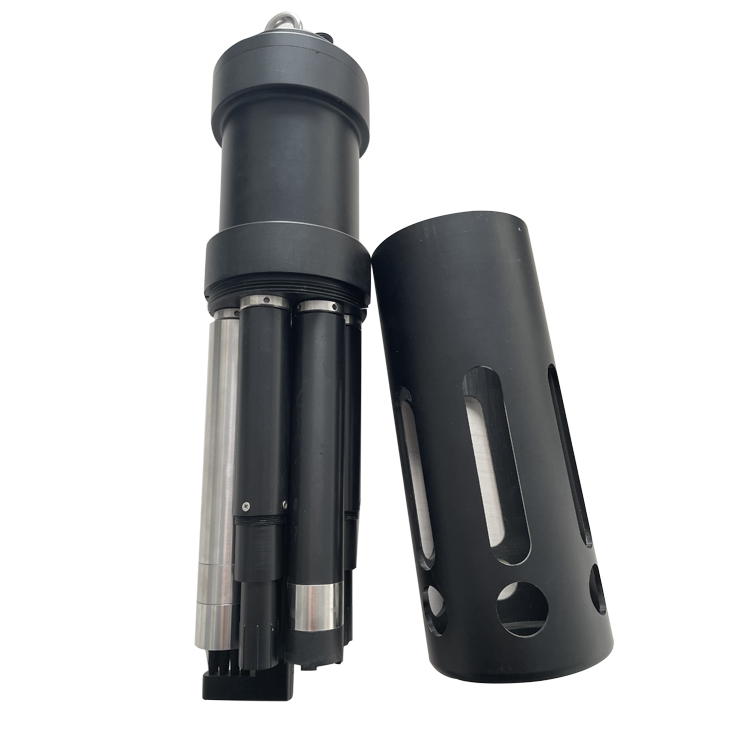
The multiparameter assembly at the start of this page is a configurable platform. Its turbidity options begin with 0-100 NTU and 0-1000 NTU ranges, with stated error expressions of +/-3% or +/-2 NTU and +/-5% or +/-3 NTU respectively. Those values require review against the intended duty; the combined housing does not by itself establish low-NTU filter-outlet performance.
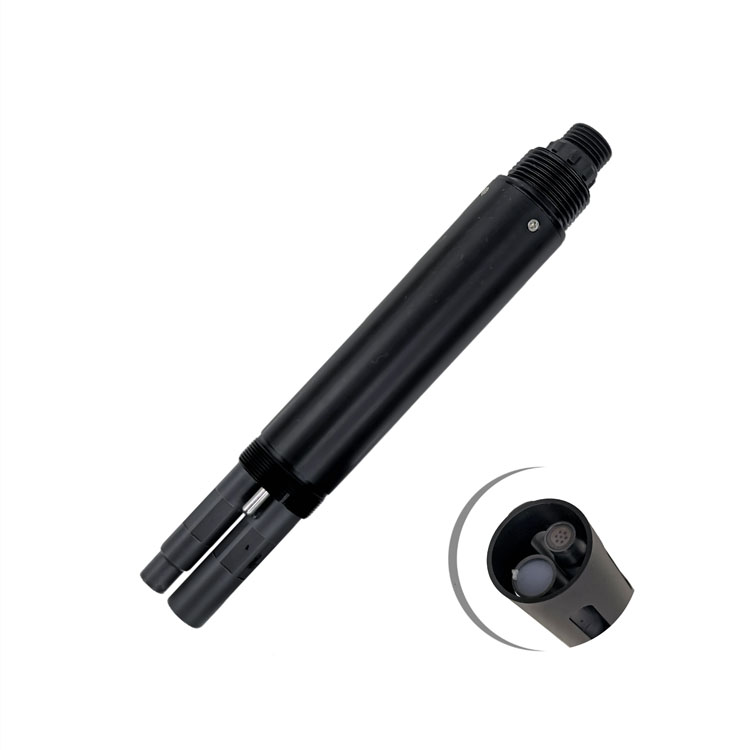
The separate probe below illustrates another sensing construction, not a complete sample panel. Identify the exact instrument selected for each location. If the installed channel cannot resolve the operating decision with the required confidence, change the instrument specification rather than disguising the gap with more decimal places.
A shared panel does not mean every instrument can share an unrestricted sample path. Consider cell pressure, flow regulation, bubbles, residence time and the materials in contact with the sample. Long lines can delay an event; deposits and dead legs can change what reaches the instrument.
A chlorine electrode needs the specified cell and stable flow. A turbidity instrument needs a sample that preserves the relevant particles and optical conditions. A pH probe needs representative contact and safe access for buffer checks. Arrange isolation so one service action does not unintentionally stop the water supply to all other analyzers.
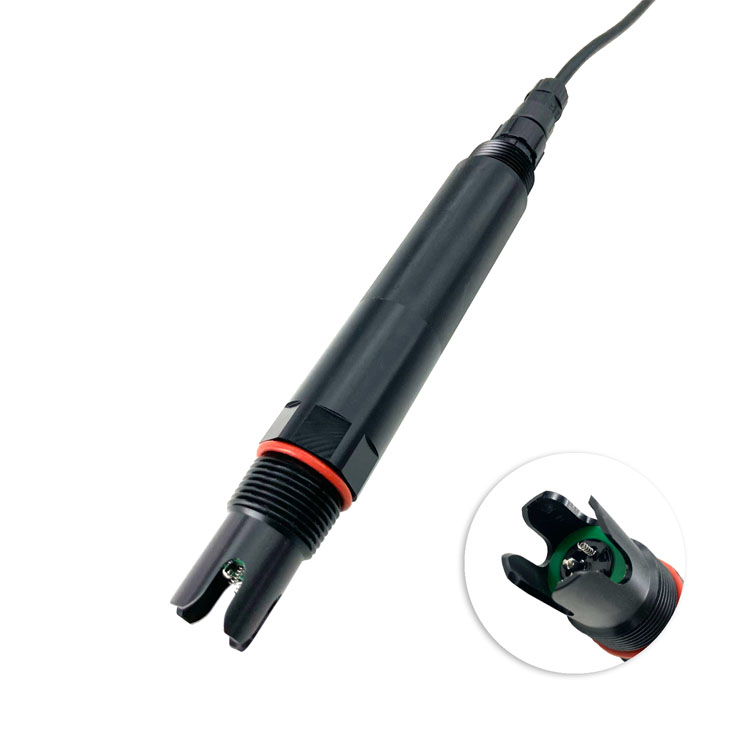
Take reference samples at a point representing the same water as the online observation. Label the sample port by stream and instrument, not just "test tap." The chlorine probe shown below is a separate measurement technology; installing it beside other instruments does not make their calibration procedures the same.
| Electrical or mechanical item | NiuBoL multiparameter platform example |
|---|---|
| Identified platform | NBL-WQ-MPS-5A; fitted channels selected for the project |
| Supply | 12 V DC +/-5% |
| Consumption | 5 W at 12 V; confirm complete peak/startup demand for the supplied assembly |
| Output | RS485 Modbus RTU |
| Cleaning | Automatic mechanical cleaning; inspection and channel-specific checks still needed |
| Cable | Standard 5 m; confirm jacket, extension and wet-joint requirements |
| Environmental and mounting limits | Confirm the complete assembly's pressure, protection rating, materials and holder for the actual measuring point |
The multiparameter platform must not be connected to 24 V simply because several standalone NiuBoL probes accept 12-24 V. Likewise, its 5 W consumption must not be replaced by a single probe's 0.2 W figure. Include the collector, communications and other loads separately when specifying the cabinet supply.
Map value, unit, acquisition time and available status for each actual instrument. A common Modbus RTU protocol does not establish identical register locations, data types or diagnostic functions. Verify the supplied register definitions rather than cloning one probe's block across every parameter.
Where the operating decision depends on flow, include appropriate sample-flow information. A responding analyzer can still be seeing old water after a valve closes. Conversely, a communication failure should not appear as a valid zero concentration. Keep maintenance state separate from both conditions.
SCADA can display trends and alarms; local control and protection need the architecture appropriate to the process. A remote platform outage should not silently remove a required local function. Decide this from the plant's operating requirements rather than assuming cloud access supplies every control function.
For commissioning, follow a representative observation from the physical sample port to its final tag. Check the sample route and time delay, compare the instrument under the agreed method, verify receiver scaling and confirm the alarm reaches the designated operator. Repeat for each distinct configuration, not only the first sensor on the bus.
Exercise maintenance and unavailable-input states under an approved test procedure. Verify what the operator sees when a sample valve is shut, an instrument is removed or communication is lost. Keep the original photographs and instrument identity in the installation record so future maintenance does not alter the measuring point unnoticed.
No. Use the channels and sample arrangement needed for that stage. Separate instruments may be preferable when ranges, verification methods or maintenance requirements differ.
Not reliably if the streams have already blended. Individual-filter observations answer a different question from the combined plant outlet.
Only if its demonstrated performance meets the actual decision threshold and applicable requirements. Review error and detection capability, not just the range or display increment.
Not without checking each supply specification. The MPS-5A example requires 12 V DC +/-5%, so provide the appropriate regulated supply arrangement.
Provide the process diagram with measuring points, required methods and limits, sample conditions, receiving interfaces and access requirements. Separate probe, sample-panel, cabinet and communications scope.
Water plant instrumentation becomes useful when each observation has a defined location and purpose. Match the method and sample path to that decision, size the actual hardware and verify the complete data route. NiuBoL configuration review should start with the plant's measuring points rather than an undifferentiated list of sensors.
Prev:Online Turbidity Sensor Control: Filter States and Valve Actions
Next:Fluorescence Dissolved Oxygen Sensor: Quenching, Cap and Compensation
Related recommendations
Sensors & Weather Stations Catalog
 Agriculture Sensors and Weather Stations Catalog-NiuBoL.pdf
Weather Stations Catalog-NiuBoL.pdf
Agriculture Sensors Catalog-NiuBoL.pdf
Water Quality Sensor Catalog-NiuBoL.pdf
Related products
 Combined air temperature and relative humidity sensor
 TDR Soil Moisture & Temperature Sensor for irrigation| RS485 |4-20mA| NBL-S-THR
 Soil pH sensor RS485 soil Testing instrument soil ph meter for agriculture |NBL-S-PH
 Wind Speed sensor Output Modbus/RS485/Analog/0-5V/4-20mA
 Tipping bucket rain gauge for weather monitoring auto rainfall sensor RS485/Outdoor/stainless steel
 Pyranometer Solar Radiation Sensor 4-20mA/RS485

Screenshot, WhatsApp to identify the QR code
WhatsApp number:+8615367865107
(Click on WhatsApp to copy and add friends)

