





— Blogs —
—Products—
 Consumer hotline +8618073152920
 WhatsApp:+8615367865107
Address:Room 102, District D, Houhu Industrial Park, Yuelu District, Changsha City, Hunan Province, China
Product knowledge
Time:2026-06-09 11:32:09 Popularity:395
Quick Answer: A fluorescence dissolved oxygen sensor detects how oxygen changes the light response of a sensing layer. The instrument converts that optical response into oxygen data using its calibration and compensation settings. It does not consume oxygen as an electrochemical measurement does, but it still needs representative water contact, an intact sensing cap and verified settings to produce useful readings.
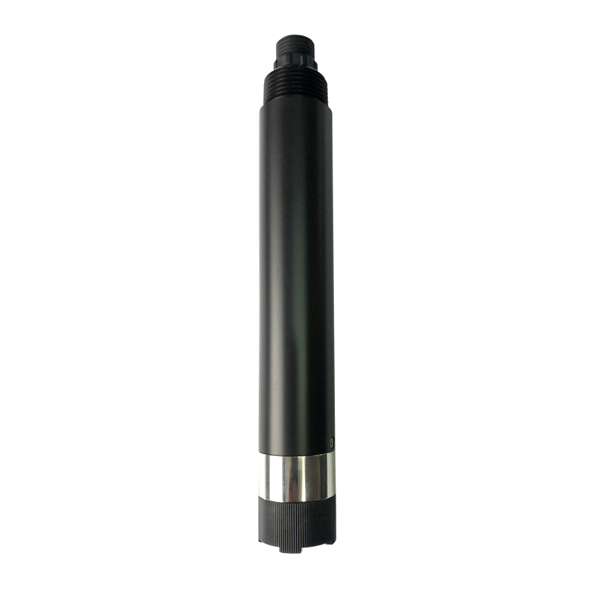
Light excites an oxygen-sensitive layer at the probe tip. Oxygen interacting with the excited material changes its luminescence behavior, including the decay time. A phase-based instrument relates the timing difference between excitation and returned light to that response. It does not photograph bubbles or directly count oxygen molecules in a sample.
The USGS dissolved-oxygen guidance covers the optical luminescence method alongside other DO methods. The underlying physical response must be converted by the particular sensor's calibration and temperature treatment; it is not a universal raw voltage that every controller can interpret identically.
For the NiuBoL DO-4 series, conversion occurs within the digital probe. The PLC reads the resulting data over RS485 Modbus RTU. A valid reply confirms data transfer, not the condition of the optical cap or the correctness of a salinity setting.
Optical sensing does not deplete oxygen at the tip in the way an oxygen-consuming electrochemical measurement can. That reduces one source of flow dependence. It does not mean a probe buried in sediment or coated with biofilm measures the bulk water correctly.
The sensor responds to conditions at its sensing layer. A poorly exchanged recess may have a different oxygen concentration from the surrounding tank. Deposits can slow exchange or create a local environment. Choose an observation zone that represents the intended water body and inspect the cap rather than treating the absence of electrolyte as freedom from maintenance.
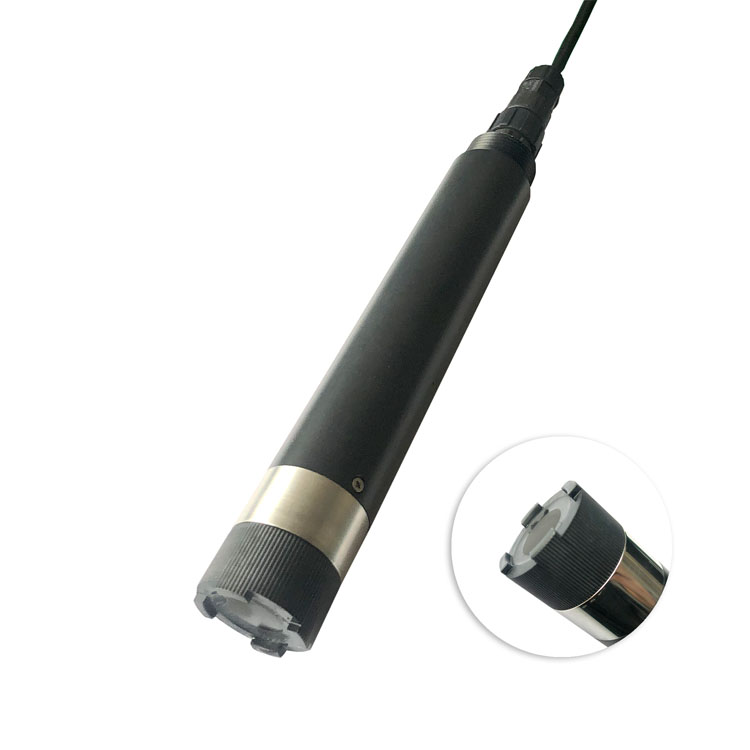
The probe below shows the sensing-end arrangement of an online DO instrument. Protect that region from impact and abrasion, and keep it away from bottom deposits and persistent trapped bubbles. A convenient mounting point is useful only if the water there answers the monitoring question.
Concentration in mg/L describes oxygen mass per water volume. Percent saturation expresses the condition relative to an equilibrium reference under defined temperature, pressure and salinity conditions. One cannot be converted to the other using one fixed mg/L number for every site.
Water temperature changes oxygen solubility. Salinity and atmospheric pressure also matter when establishing saturation and concentration relationships. Check how the delivered instrument handles these inputs or corrections; do not assume every required variable is automatically measured by the probe.
The DO-4 series supports a salinity setting, which is not a separate salinity analyzer. If the water becomes brackish or changes composition, review the setting against an appropriate measurement. A retained freshwater assumption can make an otherwise stable optical signal misleading.
| Item | NBL-WQ-DO-4A |
|---|---|
| Principle | Fluorescence quenching |
| Range | 0-20.00 mg/L; 0-200% saturation |
| Resolution / accuracy | 0.01 mg/L; +/-2% of reading; temperature +/-0.3 degrees C |
| Response / detection limit | T90 below 30 s; minimum detection limit 0.08 mg/L |
| Compensation | Pt1000 temperature compensation; salinity setting |
| Output | RS485 Modbus RTU; optional 4-20 mA |
| Supply / consumption | 12-24 V DC; 0.2 W at 12 V |
| Water conditions / protection | 0-50 degrees C; at or below 0.2 MPa; IP68 |
| Construction / cable | POM and ABS/PC configuration; confirm mounting, supplied cable length and jacket for the ordered assembly |
Use the DO-4A configuration when reviewing these values. A higher-range or metal-bodied variant requires its own identification. The 0.01 mg/L reporting increment is not the 0.08 mg/L detection limit, and neither replaces a defined application acceptance test.
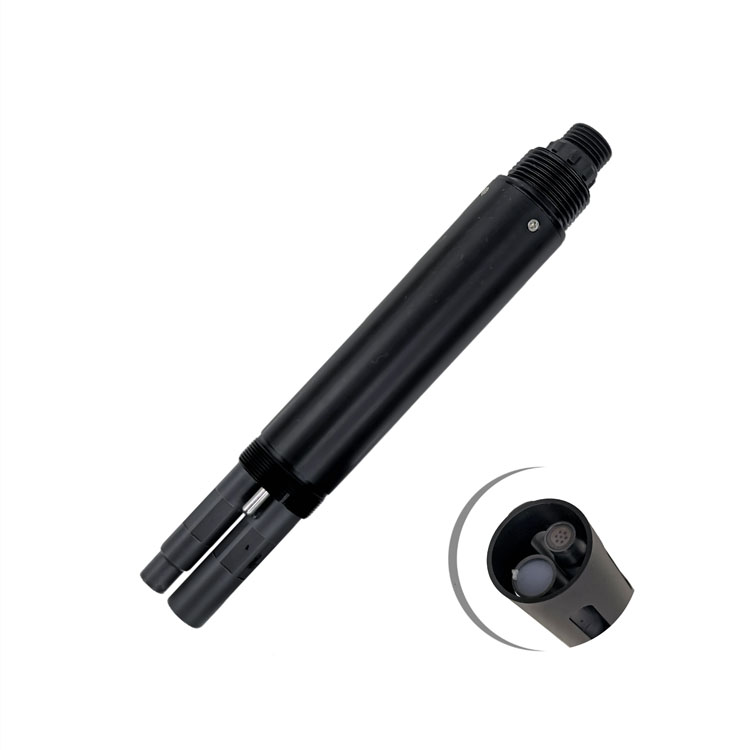
Other water-quality probe bodies can look similar, as illustrated below. A shared connector style does not establish a shared optical cap, calibration or wiring. Use the actual model and sensing assembly when requesting replacement parts.
An optical DO cap responds to oxygen at the sensing layer, including when exposed to air. A nonzero air reading therefore does not prove a sensor fault. A proper saturation check requires the supported method and the relevant environmental inputs; an oxygen-free check requires a suitable preparation, not an empty dry container.
Before adjustment, inspect the cap and establish its condition. Use the model-specific conditioning and calibration sequence after storage or replacement. Keep a record of the original check and any adjustment so a subsequent change is not automatically attributed to the water.
If an installed reading disagrees with a reference, compare at the same position and time without aerating or warming a grab sample during handling. A probe near a diffuser and a reference in a bucket may be measuring different conditions. Moving the reference carefully to the installed point can clarify that difference.
The optical layer is a service component, not a permanent, indestructible window. Inspect for deposits, damage and response changes. Replacement timing depends on the specified cap and actual exposure; avoid treating an advertised nominal interval as a guarantee for every wastewater or pond installation.
After cleaning or replacement, verify the restored measurement and its settings before relying on it for an aeration decision. More frequent Modbus polling cannot correct a fouled sensing surface or make sample exchange faster. Retain acquisition time and invalid-input handling at the logger.
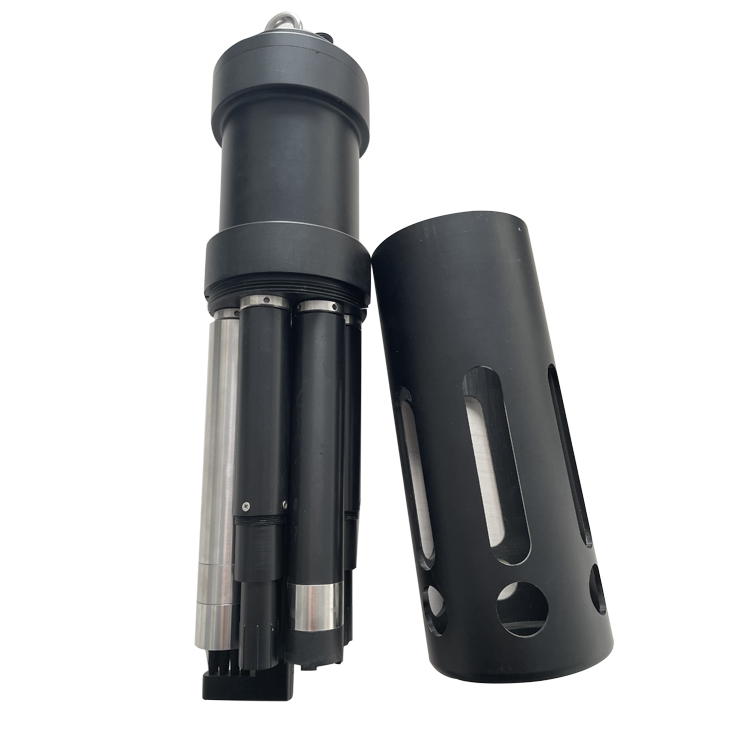
The multiparameter assembly below has a different channel configuration and performance specification. An optical DO channel in a combined instrument must not automatically inherit the standalone DO-4A accuracy or power consumption.
No. Optical sensing uses an oxygen-dependent light response rather than an oxygen-consuming electrochemical current. Both still need appropriate installation and verification.
It does not require flow to replace oxygen consumed by its measurement. However, the sensing layer must contact water representative of the intended observation zone, without burial or obstructive deposits.
Not merely because a setting exists. Confirm the instrument's implementation and enter or supply an appropriate value where required. Keep the setting consistent with the actual water.
Air contains oxygen, which affects the optical layer. Use the supported oxygen-free or saturation-check method rather than treating dry air as zero.
Confirm the compatible part, preparation, calibration and compensation settings, then compare the restored observation under suitable conditions. Also verify the final controller's units and fresh timestamp.
A fluorescence dissolved oxygen sensor converts an oxygen-dependent optical response into usable water data. Its advantages do not remove the need for representative placement, cap care or correct compensation. Select the actual NiuBoL configuration and verify the measurement before applying it to an aeration alarm or control loop.
Prev:Water Plant Instrumentation: Assign Measuring Points by Treatment Stage
Next:Pharmaceutical Wastewater Monitoring After Advanced Oxidation
Related recommendations
Sensors & Weather Stations Catalog
 Agriculture Sensors and Weather Stations Catalog-NiuBoL.pdf
Weather Stations Catalog-NiuBoL.pdf
Agriculture Sensors Catalog-NiuBoL.pdf
Water Quality Sensor Catalog-NiuBoL.pdf
Related products
 Combined air temperature and relative humidity sensor
 TDR Soil Moisture & Temperature Sensor for irrigation| RS485 |4-20mA| NBL-S-THR
 Soil pH sensor RS485 soil Testing instrument soil ph meter for agriculture |NBL-S-PH
 Wind Speed sensor Output Modbus/RS485/Analog/0-5V/4-20mA
 Tipping bucket rain gauge for weather monitoring auto rainfall sensor RS485/Outdoor/stainless steel
 Pyranometer Solar Radiation Sensor 4-20mA/RS485

Screenshot, WhatsApp to identify the QR code
WhatsApp number:+8615367865107
(Click on WhatsApp to copy and add friends)

