





— Blogs —
—Products—
 Consumer hotline +8618073152920
 WhatsApp:+8615367865107
Address:Room 102, District D, Houhu Industrial Park, Yuelu District, Changsha City, Hunan Province, China
Product knowledge
Time:2026-07-28 10:07:57 Popularity:265
A water quality probe maintenance schedule is part of the measurement system. Without it, good sensors slowly become unreliable data sources. Fouling, dried reference junctions, damaged cables, old calibration liquids and ignored alarm history create most long-term monitoring problems.
The right schedule depends on water type. Clean drinking water, aquaculture ponds, wastewater outlets, river stations and industrial process tanks need different inspection frequency. A single monthly checklist is rarely enough for every probe.
Daily checks are simple: confirm the station is powered, values are within a believable range, communication is normal and the probe is submerged or properly installed. Operators should not wait for a full calibration event to notice a dry probe or broken cable.
Weekly checks should include visual inspection, light cleaning where permitted, checking for bubbles or sediment around optical windows, and reviewing trend changes. A sudden flat line can be as suspicious as a sudden spike.
| Interval | Task | Reason |
|---|---|---|
| Daily | Review live value, power and communication status. | Find station faults early. |
| Weekly | Inspect probe surface, cable, bracket and water level. | Prevents fouling and mechanical failures. |
| After storm or process upset | Check debris, sediment and abnormal readings. | Explains data changes before they become disputes. |
| Before reporting period | Confirm calibration and cleaning record. | Supports data credibility. |
Monthly work should be more structured. Clean probes according to the selected model, check seals and connectors, verify readings with buffer, standard solution or reference method, and record the result. Do not use expired calibration liquids.
Quarterly work can include deeper inspection: holder condition, cable gland sealing, grounding, communication logs, spare-part inventory and comparison of online data with laboratory or handheld records.
The maintenance record should include date, operator, method, before-cleaning value, after-cleaning value, calibration result and any parts replaced. This record protects the project when readings are questioned later.
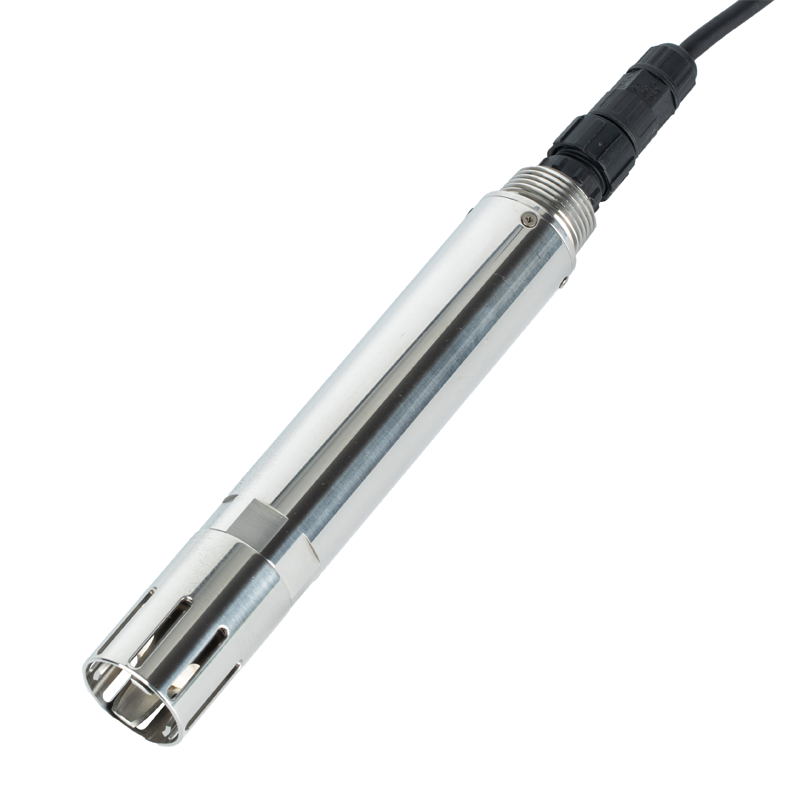
pH and ORP probes need attention to reference junction, glass bulb or electrode surface and storage condition. Optical DO, turbidity, chlorophyll and TSS probes need clean optical windows and protection from scratches. Conductivity probes need clean electrodes and correct temperature compensation.
Residual chlorine probes may need membrane, electrolyte and flow-cell maintenance depending on design. Multi-parameter probes reduce station wiring but still require parameter-by-parameter care.
| Probe type | Main maintenance risk | Buyer spare planning |
|---|---|---|
| pH or ORP | Drying, junction poisoning, coating and drift. | Buffer, storage solution and spare electrode. |
| Optical DO | Biofouling and optical cap aging. | Cleaning tools and cap replacement plan. |
| Turbidity or TSS | Dirty optical path and solids buildup. | Wiper or cleaning parts where needed. |
| Chlorine | Flow cell, membrane and calibration drift. | Membrane kit, electrolyte and comparison method. |
Maintenance is not only physical cleaning. Reviewing data trends can detect faults before the site visit. Examples include a pH value that stops moving, conductivity that jumps after cable work, DO that rises unrealistically after cleaning or turbidity spikes only during pump starts.
For RS485 Modbus RTU systems, check communication errors, address conflicts and missing timestamps. A sensor can be clean and still produce unusable data if the bus is unstable.
The operator should define who reviews the data. In many projects, data is collected but nobody owns the decision to clean, recalibrate or replace a probe.
Procurement documents should ask for the user manual, calibration method, cleaning method, consumable list, recommended spare parts, warranty terms, packaging details and expected lead time for replacements.
For distributed projects, ask for labeling by station number and parameter. This reduces mistakes when multiple pH, DO, turbidity and EC probes arrive together for several sites.
The first month after installation is the learning period. Operators should record fouling speed, calibration drift, communication errors, cable condition and whether the chosen location remains representative during rain, dosing, aeration or water-level change.
After that first month, the schedule can be tightened or relaxed by parameter. A pH electrode in difficult wastewater may need more attention than a conductivity sensor in clean water. A turbidity probe in an algae-rich river may need cleaning sooner than expected from a generic manual.
| First-month finding | Schedule adjustment | Procurement implication |
|---|---|---|
| Fast fouling after cleaning | Increase inspection frequency | Add spare cleaning parts or self-cleaning option |
| Stable clean-water readings | Keep routine verification interval | Stock calibration liquids and seals |
| Repeated communication loss | Inspect bus wiring and grounding | Request cable and wiring support |
The purchase order should not only list sensor models. It should include manuals, calibration accessories, spare consumables, packaging labels, warranty terms and expected lead time for replacement parts. This is especially important for distributors and contractors who support several end sites.
For NiuBoL multi-parameter stations, ask for a parameter-by-parameter maintenance note. pH, ORP, DO, chlorine, turbidity, conductivity and TSS do not fail in the same way. A useful maintenance package reflects those differences.
When the buyer provides water type and service interval expectation, the recommended spare list becomes more accurate. That prevents both overbuying unused parts and underbuying critical consumables.
Every long-term monitoring project needs a named record owner. It may be the plant operator, farm technician, distributor service team or contractor during the warranty period. If nobody owns the record, cleaning and calibration become informal and later data disputes are hard to resolve.
The record owner should keep sensor ID, station name, date, action, reference value, cleaning result, calibration result and next due date. This does not need complex software at the start; a controlled spreadsheet or maintenance log is enough if it is actually used.
For multi-parameter stations, each parameter should have its own maintenance line. A pH electrode replacement and a turbidity cleaning event are different actions and should not be hidden under one general service note.
A spare-part list reduces downtime and helps distributors support repeat orders. It should include parameter-specific consumables, cables, seals, holders and cleaning items. For remote stations, the spare list should be shipped with the first system rather than after the first failure.
When asking NiuBoL for a quotation, include the water type and expected service interval. The recommended spare list for drinking water will not be the same as wastewater, aquaculture or river monitoring.
For procurement teams, maintenance cost should be visible in the first purchase. Calibration liquid, storage solution, optical caps, membranes, cleaning tools and spare cables are small compared with the cost of sending a technician to a remote site without the right parts.
For integrators, the maintenance schedule should be handed over with the Modbus map and wiring diagram. The operator needs to know not only which value appears on the platform, but also what action keeps that value trustworthy.
A useful NiuBoL RFQ should describe water type, fouling risk, number of stations, maintenance access and expected service responsibility. This lets the quotation include realistic spare parts rather than a sensor-only list.
The maintenance plan should also state what happens when a probe fails. Keep a decision rule for cleaning again, recalibrating, replacing the sensor or checking the communication line. This prevents operators from repeating the same cleaning step when the fault is actually cable or controller related.
For distributors, this record becomes after-sales evidence. It helps separate warranty issues from normal consumable replacement and gives the end user a clearer reason to reorder correct spare parts.
A maintenance schedule also helps purchasing forecast repeat orders. When cleaning intervals, cap life, buffer use and cable failures are recorded, the next spare-part purchase is based on field evidence rather than emergency guessing.
For project handover, attach the maintenance schedule to the sensor list. The operator should see model, parameter, location, cleaning method and next service date in one place.
A water quality probe maintenance schedule is less useful when it is copied into a manual but not assigned to a person. The project should name the operator, distributor or contractor responsible for records, cleaning, calibration and replacement decisions.
A maintenance article is less suitable for a project if it only lists generic cleaning intervals and does not connect each action to pH, DO, turbidity, EC, ORP, chlorine or multi-parameter probe behavior.
Q1: How often should water quality probes be cleaned?
A: Cleaning frequency depends on fouling. Clean water may need light periodic cleaning, while wastewater, aquaculture ponds and algae-rich surface water may need weekly or more frequent inspection.
Q2: What should be checked every day?
A: Check power, communication, believable values, water level, probe immersion and visible alarms. Daily checks catch dry probes, cable faults and station power problems early. For repeat projects, keep this record by station and parameter so spare parts can be purchased before the next service visit.
Q3: Do pH probes need special storage?
A: Yes. pH probes should not be stored dry unless the selected model specifically allows it. Follow the model manual for storage solution and protective cap requirements.
Q4: How should optical DO probes be maintained?
A: Keep the optical window clean, inspect the cap, avoid scratching the sensing surface and verify readings according to the manual or project procedure. For repeat projects, keep this record by station and parameter so spare parts can be purchased before the next service visit.
Q5: What is the most practical way to handle turbidity and TSS fouling?
A: Install the probe in a representative location with cleaning access, clean optical surfaces on schedule and record before-and-after readings to judge fouling speed. For repeat projects, keep this record by station and parameter so spare parts can be purchased before the next service visit.
Q6: Can maintenance be managed remotely?
A: Remote data review can identify likely faults, but physical cleaning, calibration, cable inspection and part replacement still require field work. For repeat projects, keep this record by station and parameter so spare parts can be purchased before the next service visit.
Q7: What spare parts should be purchased with a sensor package?
A: Common spares include pH electrodes, calibration buffers, storage solution, optical caps, cleaning parts, cables, seals, flow-cell parts and parameter-specific consumables. For repeat projects, keep this record by station and parameter so spare parts can be purchased before the next service visit.
Q8: How does RS485 maintenance differ from analog systems?
A: RS485 systems need address, baud rate, register and bus-quality checks. Analog systems need scaling and signal-loop checks. Both need cable and grounding inspection. For repeat projects, keep this record by station and parameter so spare parts can be purchased before the next service visit.
Q9: What should a maintenance record include?
A: Record date, operator, sensor ID, cleaning method, calibration result, reference value, before-and-after readings, parts replaced and next action. For repeat projects, keep this record by station and parameter so spare parts can be purchased before the next service visit.
Q10: What information should be requested from NiuBoL?
A: Ask for the model manual, calibration steps, cleaning recommendations, consumable list, spare-part code, warranty terms and lead time for replacement probes. For repeat projects, keep this record by station and parameter so spare parts can be purchased before the next service visit.

A water quality probe maintenance schedule protects data credibility. Cleaning, calibration, data review and spare planning should be written into the project from the beginning.
For NiuBoL systems, provide the parameter list, water condition and maintenance interval expectation. The recommended package can then include the right probes, accessories and spare parts rather than only sensors.
Prev:Water Quality Monitoring Buoy: Sensor Package, Power and Telemetry Design
Next:pH Electrode Supplier Evaluation: Bulk Order Checks for Water Projects
Related recommendations
Sensors & Weather Stations Catalog
 Agriculture Sensors and Weather Stations Catalog-NiuBoL.pdf
Weather Stations Catalog-NiuBoL.pdf
Agriculture Sensors Catalog-NiuBoL.pdf
Water Quality Sensor Catalog-NiuBoL.pdf
Related products
 Combined air temperature and relative humidity sensor
 TDR Soil Moisture & Temperature Sensor for irrigation| RS485 |4-20mA| NBL-S-THR
 Soil pH sensor RS485 soil Testing instrument soil ph meter for agriculture |NBL-S-PH
 Wind Speed sensor Output Modbus/RS485/Analog/0-5V/4-20mA
 Tipping bucket rain gauge for weather monitoring auto rainfall sensor RS485/Outdoor/stainless steel
 Pyranometer Solar Radiation Sensor 4-20mA/RS485

Screenshot, WhatsApp to identify the QR code
WhatsApp number:+8615367865107
(Click on WhatsApp to copy and add friends)

