





— Blogs —
—Products—
 Consumer hotline +8618073152920
 WhatsApp:+8615367865107
Address:Room 102, District D, Houhu Industrial Park, Yuelu District, Changsha City, Hunan Province, China
Product knowledge
Time:2026-06-30 11:16:26 Popularity:214
A weather station equipment list should be built from the monitoring purpose. A station used for agriculture, road operation, airport support, environmental monitoring or laboratory testing does not need exactly the same parameter set. Buyers often ask for a four-parameter, five-parameter or six-parameter station, but the more useful starting point is: what decision will the station support, what accuracy is required, and where will the equipment be installed?
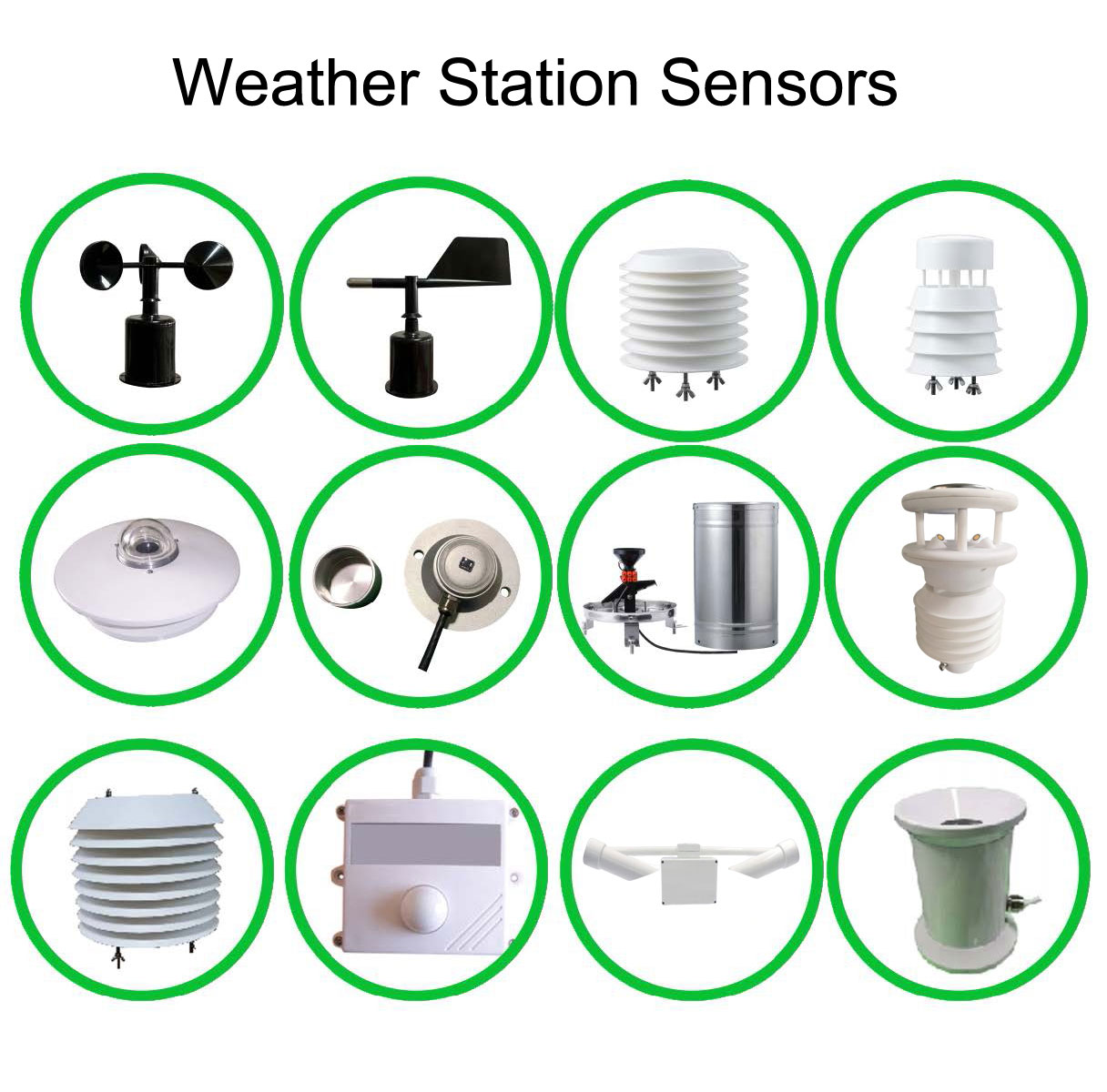
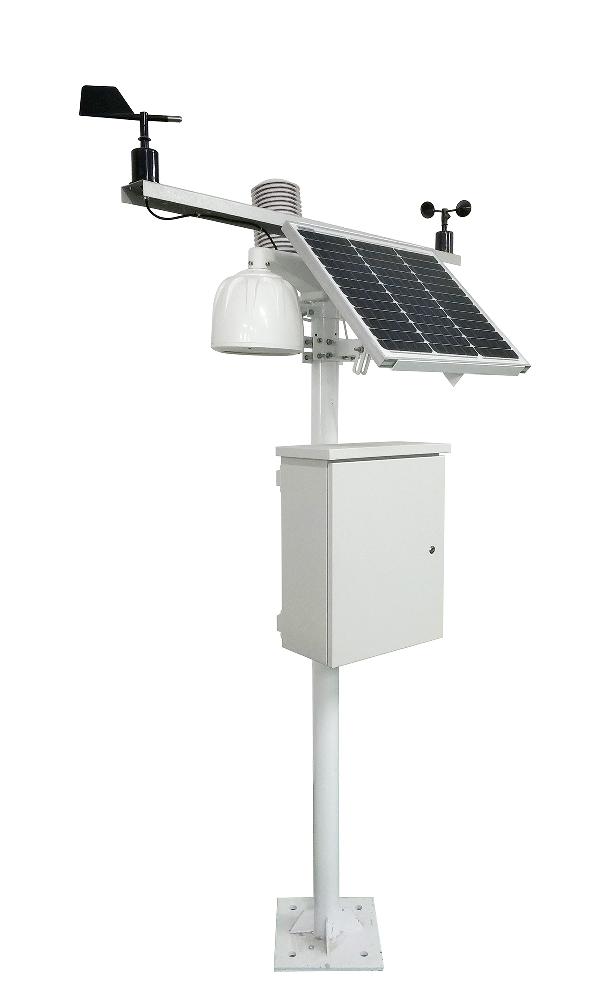
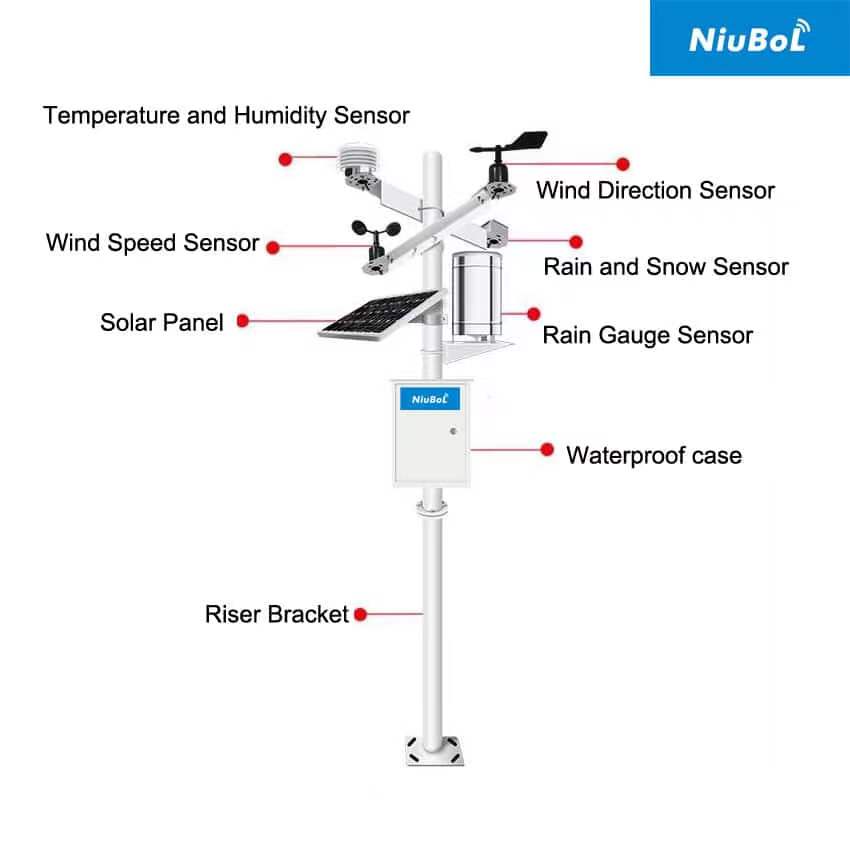
A complete automatic weather station includes field sensors, mounting hardware, a data collector, power supply, communication module, enclosure, grounding and software platform. The sensor group may be integrated or separated. Integrated ultrasonic sensors reduce wiring and moving parts. Separate sensors allow different installation heights and easier replacement of individual instruments.
Agricultural stations often include temperature, humidity, wind speed, wind direction, rainfall, radiation, soil moisture and soil temperature. Environmental stations may add PM, noise or gas variables. Road stations may prioritize wind, rainfall and local microclimate. This is why equipment selection should be tied to use case rather than a generic list.
| Model / Configuration | Measured Variables | Key Technical Reference |
|---|---|---|
| NBL-W-51MUWS 5-in-1 | Wind speed, wind direction, air temperature, humidity, pressure | DC 12 V, RS485, Modbus, 9600 baud, 0.3 W, ABS, IP65 |
| NBL-W-61MUWS 6-parameter | Wind speed, wind direction, temperature, humidity, pressure, rainfall or illuminance by configuration | DC 12 V, RS485 Modbus, 0.3 W, -40 to 80 C operation |
| NBL-W-71GUWS multi-parameter | Wind, temperature, humidity, pressure, optional PM, noise, radiation, rainfall | DC 12-24 V, RS485 Modbus, IP65, 0.4 W without dust sensor |
| Wind speed range | 0-40 m/s for 51/61 series; up to 0-60 m/s for 71GUWS type | Select according to local wind risk and application |
| Wind direction | 0-360 degrees or 0-359 degrees, ±3 degrees | Requires north alignment during installation |
| Temperature | -50 to 100 C or -40 to 80 C by model, ±0.5 C | Supports outdoor weather records |
| Humidity | 0-100% RH, ±5% RH | Supports climate and crop environment evaluation |
| Pressure | 500-1100 hPa or 10-1100 hPa, ±1.5 hPa | Supports weather trend monitoring |
| Rainfall | 0-8 mm/min, ±10%, 0.01 mm resolution | Useful for compact rain monitoring and warning projects |
| Cable | Standard 2.5 m for some models, customizable by project | Affects cabinet position and extension wiring |
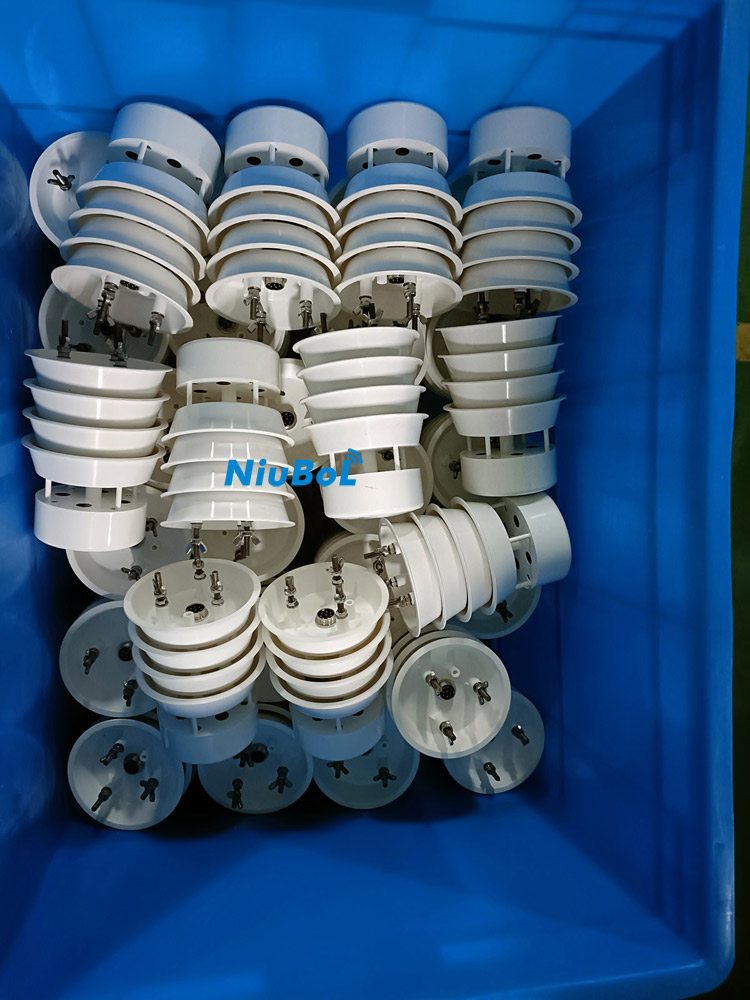
Integrated equipment is practical when the project needs fast installation, compact appearance and lower maintenance. It is common for smart agriculture, roadside monitoring, smart poles, environmental grids and remote IoT stations. Modular equipment is suitable when the project requires standard observation heights, separated radiation measurement, independent rain gauge siting or replacement of single sensors.
For procurement, integrated is not automatically cheaper once the whole system is counted, and modular is not automatically more accurate unless siting and calibration are done properly. The decision should be based on site space, maintenance access, required variables, expected life and platform integration.
Most NiuBoL compact weather sensors use RS485 output and standard Modbus protocol, which allows integration with data collectors, PLCs, RTUs and IoT gateways. The collector stores timestamped values and uploads them through 4G, Ethernet, Wi-Fi or other project communication methods. Solar power can be used when mains power is unavailable, but power consumption must be calculated with the selected sensors and upload interval.
A professional equipment list should specify supply voltage, cable length, connector type, register map, mounting bracket, enclosure, lightning protection, grounding and platform functions. Without these details, the buyer may receive sensors but not a complete station.
Ultrasonic sensors should be mounted on a vertical pipe and kept level. The north mark should be aligned with geographic north. The mounting site should avoid buildings, trees, poles, wires and roof edges that produce turbulent airflow. Radar and radio transmitters should not be installed on the same plane, and vibration sources should be avoided.
For open-area weather measurement, common guidance is to install wind instruments about 10 m above ground in an open area. If the instrument is installed on a building, height and surrounding obstruction must be reviewed. For project stations that cannot meet formal observation siting, the limitation should be documented in the acceptance report.
Field environment challenge: Farms need local weather data for irrigation, frost warning, disease risk and disaster prevention.
System integration scheme: Select temperature, humidity, wind, rainfall, radiation and soil sensors as needed, with 4G or solar power.
User value: Managers can compare field conditions with crop events and improve response timing.
Field environment challenge: Air quality interpretation requires weather context, especially wind direction and humidity.
System integration scheme: Combine weather station equipment with PM, gas or noise modules and upload data to an environmental platform.
User value: Operators can explain pollution events using local wind and weather records.
Field environment challenge: Road sections may experience local wind, rain or pressure changes that affect safety.
System integration scheme: Use compact ultrasonic sensors on masts or gantries with stable power and communication.
User value: Traffic managers receive near-site data for warnings and operation review.
Field environment challenge: Users need visible, exportable and easy-to-maintain weather records.
System integration scheme: Use an automatic station with clear sensor naming, platform dashboard and data export.
User value: The station supports teaching, experiment records and demonstration use.
Define monitoring purpose before selecting parameter count.
Confirm RS485 Modbus register map and platform compatibility.
Specify power method, cable length, mounting height and enclosure.
Check whether the project needs integrated or modular sensors.
Include installation photos, address table and data export in acceptance files.
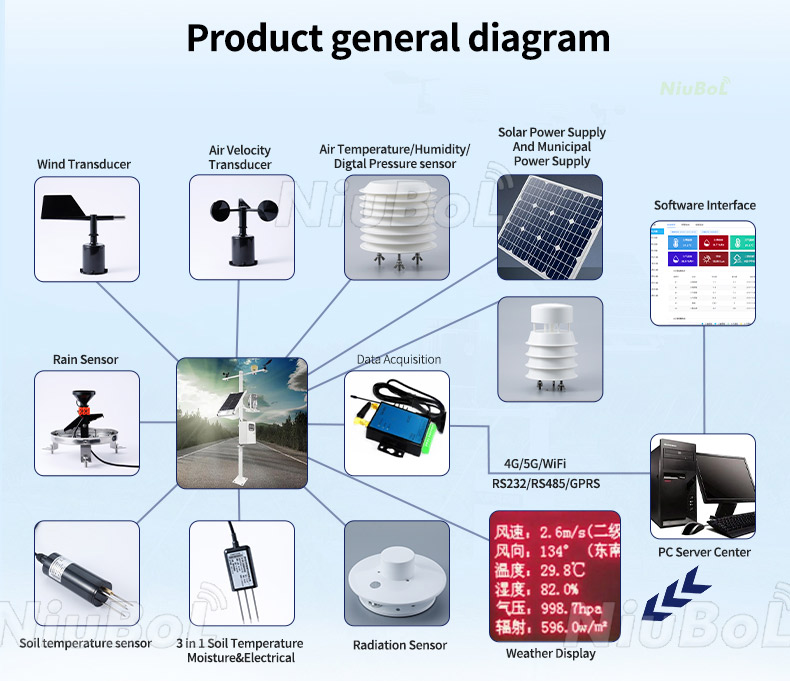
A weather station quotation should show whether the supplier is offering sensors only or a complete operating station. A complete station normally includes sensor set, mast, cross arm or mounting bracket, data logger, power supply, communication module, enclosure, grounding accessories, platform access and installation documents. If any of these items are missing, the buyer should know who will provide them.
The quotation should also identify which data are measured directly and which are optional modules. For example, PM2.5, PM10, noise, radiation and rainfall may be optional on some integrated sensors. If the buyer needs these values for a project requirement, they must be written into the order and checked during acceptance.
After installation, the buyer should receive a sensor list, device address table, platform login, data export sample, installation photos and maintenance instructions. These deliverables are useful for future service work because they reduce dependence on the original installation team.
Over-configuration happens when every optional sensor is added without a use case. Under-configuration happens when a low-cost station lacks the variable needed for the actual decision. A farm that wants evapotranspiration support may need radiation and wind data. A dust-monitoring site needs wind direction. A school demonstration station may need visible display and simple export more than a large parameter set.
A good selection table therefore links each sensor to a decision, report or alarm. If a variable has no operational use, it can be left for a later phase. If a variable is required for regulation or project acceptance, it should be included from the first quotation.
Weather station maintenance should be planned before purchase because maintenance access affects model selection. A station on a campus lawn can be inspected easily. A station on a remote mountain, bridge or industrial boundary needs fewer moving parts, stronger power planning and clearer remote diagnostics. Buyers should ask how to identify offline devices, sensor faults and abnormal values from the platform.
Spare parts also matter. For projects with many stations, keeping spare cables, connectors, power modules or selected sensors can reduce downtime. The supplier should explain which parts are field-replaceable and which require factory service.
A: It usually includes sensors, mounting mast, data collector, power system, communication module, enclosure, grounding accessories and software platform.
A: A 5-in-1 sensor usually covers wind speed, wind direction, temperature, humidity and pressure. A 6-in-1 configuration adds another variable such as rainfall or light depending on model.
A: RS485 Modbus supports industrial wiring, addressable devices and integration with loggers, PLCs, gateways and third-party platforms.
A: Yes if the selected parameters match both needs. Agriculture may require soil or radiation data, while environmental projects may require PM, gas or noise modules.
A: Use mains power where available. Use solar power for remote sites, but calculate battery and panel size based on sensor load and upload interval.
A: Siting, mounting height, north alignment, cable quality, power stability, maintenance and unit mapping all affect practical data quality.
A: Choose integrated sensors for compact deployment and lower maintenance. Choose separate sensors when standard heights or individual sensor placement are required.
A: Request datasheets, wiring diagrams, Modbus register maps, installation guide, platform instructions and acceptance checklist.
A: Yes, with a suitable data collector or gateway. The platform can show real-time values, history, alarms and export records.
A: Start with application, select variables, confirm installation site, choose communication and power, then request a complete equipment list.
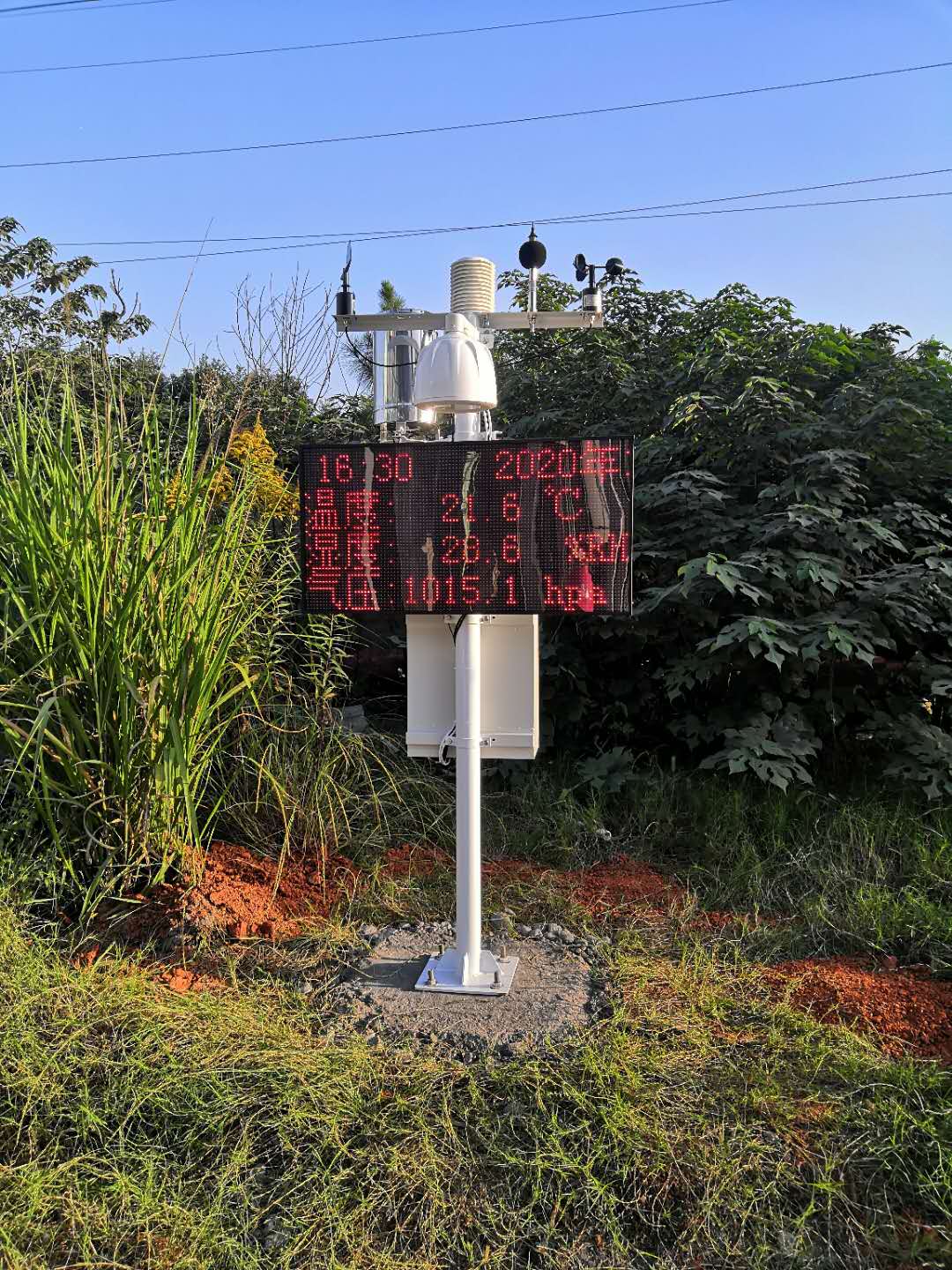
Weather station equipment should be selected as a system: sensors, power, communication, mounting, software and acceptance records. NiuBoL weather sensors support compact ultrasonic measurement, RS485 Modbus communication and project-level integration for agriculture, roads, environmental monitoring, campuses and research stations.
Prev:Aquaculture Greenhouse Construction and Environmental Monitoring Design Guide
Next:Greenhouse Steel Frame Selection Guide for Multi-Span Greenhouse Projects
Related recommendations
Sensors & Weather Stations Catalog
 Agriculture Sensors and Weather Stations Catalog-NiuBoL.pdf
Weather Stations Catalog-NiuBoL.pdf
Agriculture Sensors Catalog-NiuBoL.pdf
Water Quality Sensor Catalog-NiuBoL.pdf
Related products
 Combined air temperature and relative humidity sensor
 TDR Soil Moisture & Temperature Sensor for irrigation| RS485 |4-20mA| NBL-S-THR
 Soil pH sensor RS485 soil Testing instrument soil ph meter for agriculture |NBL-S-PH
 Wind Speed sensor Output Modbus/RS485/Analog/0-5V/4-20mA
 Tipping bucket rain gauge for weather monitoring auto rainfall sensor RS485/Outdoor/stainless steel
 Pyranometer Solar Radiation Sensor 4-20mA/RS485

Screenshot, WhatsApp to identify the QR code
WhatsApp number:+8615367865107
(Click on WhatsApp to copy and add friends)

