





— Blogs —
—Products—
 Consumer hotline +8618073152920
WhatsApp:+8615367865107
Address:Room 102, District D, Houhu Industrial Park, Yuelu District, Changsha City, Hunan Province, China
Product knowledge
Time:2021-12-25 16:04:32 Popularity:2543
Quick Answer: Arm licensing models describe rights to processor technology or compatible chip designs, not the operating capabilities of a finished IoT gateway. An equipment buyer normally evaluates the delivered device rather than entering an upstream processor IP agreement. Check the exact hardware revision, supported firmware and application interfaces. Shared instruction-set ancestry does not make two industrial IoT devices interchangeable.

A processor technology license can allow a semiconductor developer to integrate a specified core design. An architecture license concerns the right to develop a compatible implementation under its agreement. Both are upstream chip-development matters. The package photograph above is illustrative; it does not identify the processor inside a NiuBoL device.
Commercial access programs can combine technologies, tools and support in different ways. They should not be reduced to three permanent license categories or used to infer the specifications of a gateway. Arm's licensing overview describes current access programs; the applicable agreement determines the actual rights, fees and conditions.
| Concept | Meaning for a chip supplier | Meaning for an equipment buyer |
|---|---|---|
| Processor or core technology | A supplier integrates licensed core technology into a chip design. | Check the finished processor, interfaces and supported software. |
| Architecture rights | A supplier may design a compatible processor implementation under an architecture agreement. | Compatibility at instruction-set level does not guarantee identical peripherals or performance. |
| Implementation support | Physical-design and optimization resources may help target a manufacturing process. | This is upstream engineering information, not a substitute for device qualification. |
A shared instruction set does not establish the same operating system, application binary interface, drivers or peripheral map. One device may expose a configurable serial polling function, while another requires a separately supported application. A firmware image built for one board should not be installed on another merely because both are described as Arm-based.
For an acquisition project, ask whether the supplied software can read the required sensor registers, preserve timestamps and export the intended record. RS485 is an electrical interface; Modbus RTU polling and application mapping require supported software. Processor capability alone does not establish any of those functions.
Ask about product lifecycle, operating-system and security-update policy, boot protection, storage endurance, operating temperature and recovery from a failed update. Confirm that serial, Ethernet, cellular and other interfaces needed by the project are supported by the finished gateway, not merely by the processor family.
Software support matters over the device life. A powerful processor does not compensate for undocumented firmware, unavailable configuration backups or a short maintenance window.
When evaluating a NiuBoL data logger, distinguish the ordered acquisition configuration from any assumptions about its internal processor. Check channel count, supported sensor types and retained records on that configuration. The product photograph below shows an acquisition unit, not evidence of a particular CPU or upstream licensing arrangement.
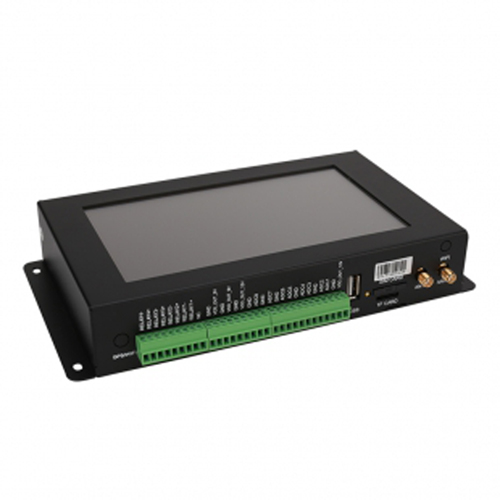
Record the exact hardware revision, firmware version, supported update method and expected supply period. Ask whether configuration can be exported and restored on replacement hardware. Industrial deployments often remain in service longer than consumer devices, so component availability and software maintenance can matter more than benchmark performance.
Also confirm third-party software dependencies and license obligations for the finished product. These are separate from ARM’s upstream licensing relationship with the chip supplier.
Suppose a replacement gateway retains the same external connectors but changes its board or software platform. Check that the exported configuration can be restored, sensor polling produces the same units and scale, stored data survive the required restart sequence and the remote endpoint still authenticates correctly. Connector similarity and an architecture label cannot establish these results.
Gateway firmware updates need a supported recovery route. Ask how an interrupted update is handled, who supplies corrective releases and whether application settings and credentials are retained. For device lifecycle planning, separate component availability from the equipment supplier's software-support period; one does not automatically establish the other.
A finished system may include a device runtime, development tools, operating-system components and a hosted service. Check the terms that apply to what will actually be installed or redistributed. Buying the hardware does not by itself establish rights to copy every software component or reuse a hosted service for another project. Product-specific rights need confirmation from the relevant supplier.
For a NiuBoL acquisition or communication inquiry, describe the sensor interfaces, required processing and expected replacement method. A 4G router can supply a network function, whereas a logger must also acquire and manage measurements. Choose by demonstrated functions and support, not a presumed processor identity. The interface drawing below concerns the finished equipment, not Arm licensing models.

Ordinary procurement of a finished device is different from developing a processor implementation. Check the product and software terms supplied with the equipment. A custom chip-development project requires its own licensing review with the relevant rights holder.
No. Processor IP rights concern the relevant technology agreement. Tools, operating systems, applications and services can have separate terms. Identify the components being used rather than assuming one agreement covers the entire system.
Not on that basis alone. Board design, boot chain, memory layout, drivers and supported software differ. Use only an image approved for the exact equipment and hardware revision.
No. The finished hardware must include suitable interfaces and radio equipment, and its firmware must support the intended functions. Verify acquisition and communication independently.
Confirm configuration recovery, field-protocol behavior, data formats, credentials and firmware support on the replacement. A successful power-on test alone does not establish that historical measurements and remote operations remain compatible.
Arm licensing models help explain how technology reaches chip developers. For industrial IoT devices, the practical decision concerns the qualified hardware, maintained software and interfaces the project will use. Evaluate NiuBoL acquisition and communication equipment by those functions without inferring its processor or licensing relationship from a product photograph.
Prev:ARM microprocessors of Application areas
Next:Edge computing promotes the development of IoT technology
Related recommendations
Sensors & Weather Stations Catalog
 Agriculture Sensors and Weather Stations Catalog-NiuBoL.pdf
Weather Stations Catalog-NiuBoL.pdf
Agriculture Sensors Catalog-NiuBoL.pdf
Water Quality Sensor Catalog-NiuBoL.pdf
Related products
 Combined air temperature and relative humidity sensor
 TDR Soil Moisture & Temperature Sensor for irrigation| RS485 |4-20mA| NBL-S-THR
 Soil pH sensor RS485 soil Testing instrument soil ph meter for agriculture |NBL-S-PH
 Wind Speed sensor Output Modbus/RS485/Analog/0-5V/4-20mA
 Tipping bucket rain gauge for weather monitoring auto rainfall sensor RS485/Outdoor/stainless steel
 Pyranometer Solar Radiation Sensor 4-20mA/RS485


Screenshot, WhatsApp to identify the QR code
WhatsApp number:+8615367865107
(Click on WhatsApp to copy and add friends)

