





— Blogs —
—Products—
 Consumer hotline +8618073152920
 WhatsApp:+8615367865107
Address:Room 102, District D, Houhu Industrial Park, Yuelu District, Changsha City, Hunan Province, China
Product knowledge
Time:2024-02-25 21:48:05 Popularity:3574
An automatic irrigation system using soil moisture sensors measures water conditions in the crop root zone and uses the data to help control irrigation. A typical system combines soil moisture sensors, a PLC or irrigation controller, solenoid valves or pumps, and optionally a data logger or IoT gateway for remote monitoring.
The basic control principle is simple: when soil moisture falls below a configured lower control point, irrigation can be started; when moisture reaches an upper control point, or another stop condition is reached, irrigation is stopped. However, there is no single moisture threshold suitable for every crop, soil or substrate. Control values should be determined according to crop type, root depth, soil texture, growing medium, irrigation method and field conditions.
For commercial farms, greenhouses and smart irrigation projects, soil moisture data can also be combined with rainfall, weather, flow and pressure measurements to create a more reliable irrigation control system.
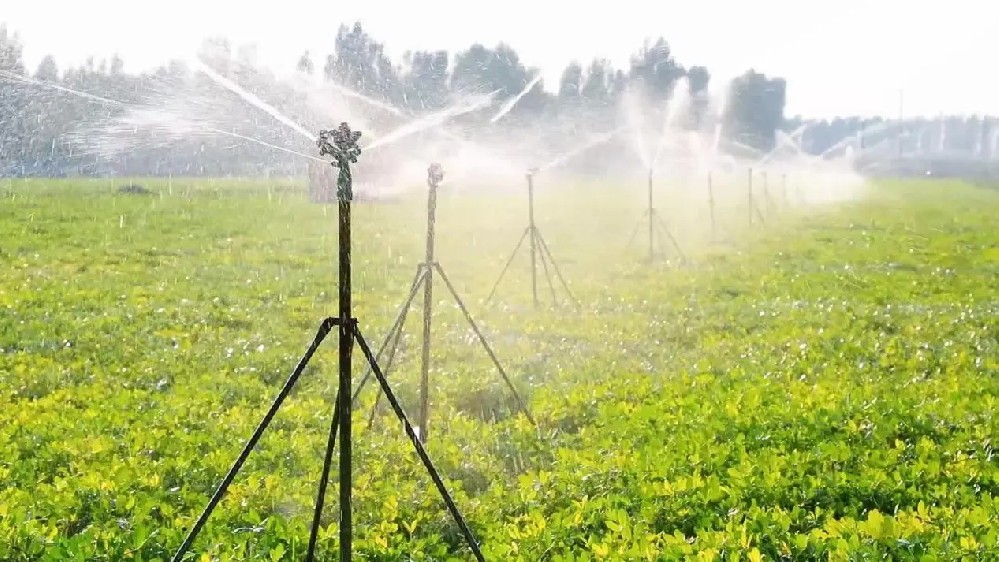
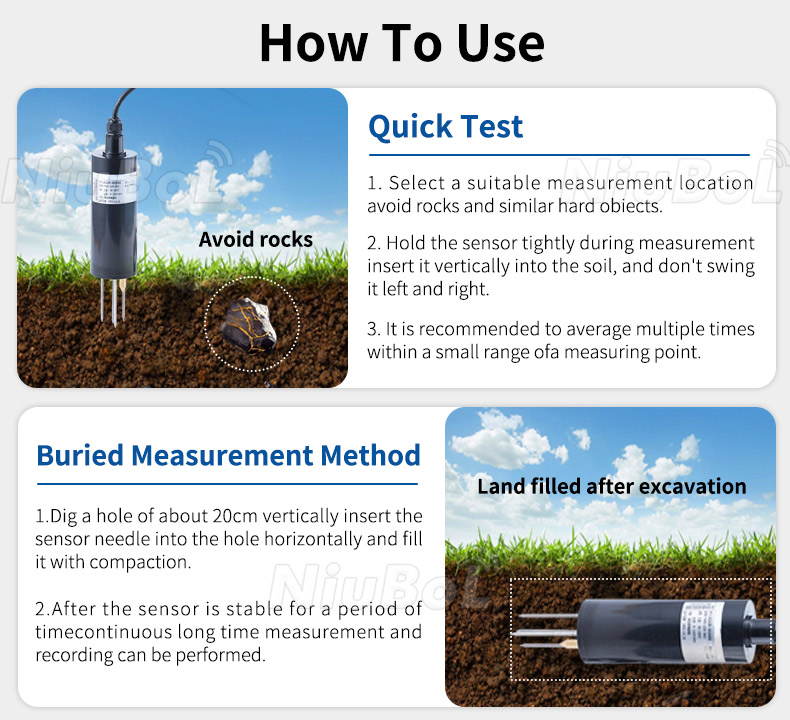
The soil moisture sensor is installed in a representative part of the crop root zone. It continuously measures changes in soil water content and sends the measurement to a controller, PLC, data logger or IoT gateway.
The controller compares the measured value with the irrigation control logic. Depending on the system design, it can open a solenoid valve, start a pump, issue an alarm or simply record the data for the operator.
A typical automatic irrigation process is:
The soil moisture sensor measures conditions in the root zone.
The controller or data logger reads the sensor value.
The value is compared with the configured irrigation conditions.
If irrigation is required, the controller opens the relevant valve or starts the pump.
The sensor continues monitoring while irrigation is operating.
Irrigation stops when the upper moisture condition, maximum irrigation time or another stop condition is reached.
The system records the event and continues monitoring for the next irrigation cycle.
Soil Moisture Sensor → RS485 / Analog / LoRaWAN → PLC or Controller → Relay → Solenoid Valve / Pump → Irrigation
Data Logger / IoT Gateway → 4G / Ethernet / Wi-Fi → MQTT / HTTP → Cloud Platform or Customer Server
The soil sensor normally provides measurement data rather than directly powering a pump or solenoid valve. Irrigation equipment should be controlled through a suitable PLC, irrigation controller, relay module or control cabinet.
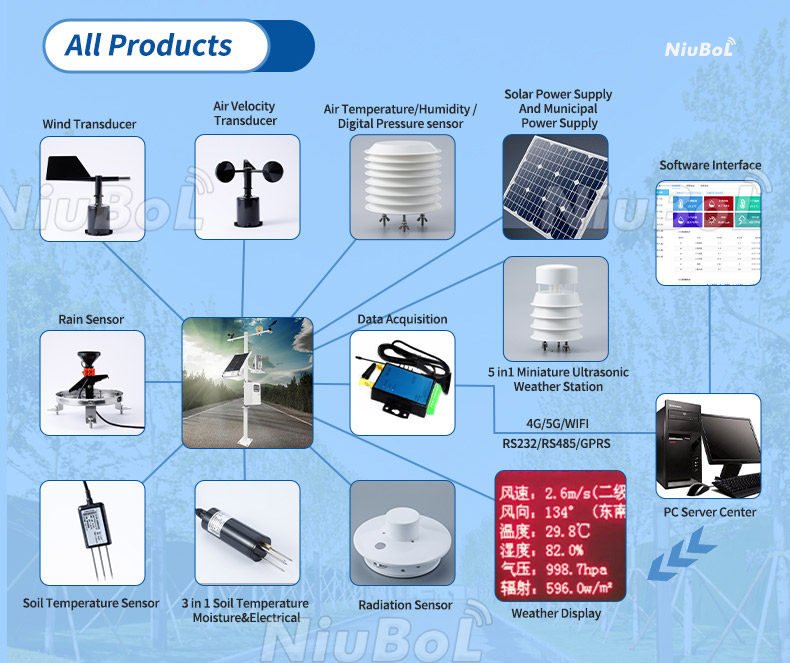
| Component | Function |
|---|---|
| Soil Moisture Sensor | Measures moisture conditions in the crop root zone. |
| PLC / Irrigation Controller | Processes sensor data and executes irrigation control logic. |
| Solenoid Valve | Controls irrigation water to individual zones. |
| Pump | Provides water flow and pressure where required. |
| Flow Sensor | Confirms actual irrigation flow and can help identify blocked pipes, leaks or valve problems. |
| Pressure Sensor | Monitors irrigation-line pressure and pump operating conditions. |
| Data Logger / Gateway | Collects sensor data and provides local or remote communication. |
| Weather Station | Provides rainfall, temperature, humidity, solar radiation, wind and other weather data for advanced irrigation decisions. |
Different soil moisture sensing technologies are available. The appropriate choice depends on required accuracy, budget, soil conditions, installation method and system interface.
| Type | Typical Characteristics | Suitable Use |
|---|---|---|
| TDR | Uses electromagnetic propagation characteristics to estimate volumetric water content. | Agriculture, irrigation, research and continuous soil monitoring. |
| FDR / Capacitive | Measures changes related to the dielectric properties of soil. | Agricultural monitoring and cost-sensitive multi-point projects. |
| Tensiometer | Measures soil water tension rather than volumetric water content. | Irrigation management where soil water potential is the preferred control parameter. |
For industrial and IoT irrigation projects, an RS485 soil moisture and temperature sensor is convenient because several sensors can be connected to the same Modbus network and integrated with PLCs, data loggers and gateways.
NiuBoL's NBL-S-THR soil moisture and temperature sensor supports long-term buried monitoring and is designed for agriculture, smart irrigation and environmental monitoring applications.
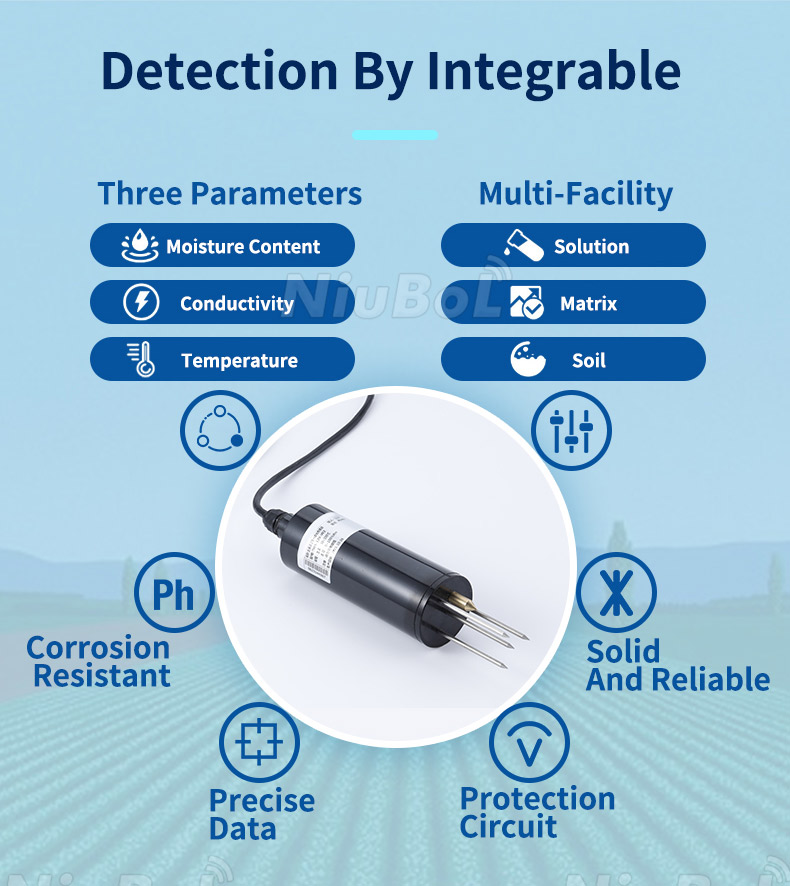
There is no universal soil moisture percentage that should start or stop irrigation for every project.
Suitable control values depend on:
Crop species and growth stage
Root depth
Soil texture and structure
Field capacity and water-holding characteristics
Growing medium, such as mineral soil, coco coir or peat
Irrigation method
Sensor installation depth and location
Local climate and evapotranspiration
A practical system usually uses two control points rather than one. A lower control point can request irrigation, while an upper control point stops irrigation. This difference creates hysteresis and prevents valves or pumps from switching on and off repeatedly when the measurement fluctuates around one value.
The thresholds should first be validated through field observation and adjusted according to actual crop response and irrigation performance.
Irrigation starts when root-zone moisture falls below the configured lower control point and stops when the upper condition is reached. This is simple and suitable for many small or medium irrigation projects.
The system has predefined irrigation time windows, but soil moisture is used as a permission condition. If the soil is already sufficiently moist, the scheduled irrigation can be skipped or shortened.
This approach is often more practical for commercial farms because it combines predictable irrigation operation with actual root-zone measurements.
More advanced systems can combine soil moisture measurements with rainfall, temperature, humidity, solar radiation and other weather information.
An automatic weather station can provide additional environmental data for irrigation planning. Weather data should normally complement rather than replace direct root-zone measurements.
Sensor location is one of the most important factors affecting the usefulness of an automatic irrigation system.
The sensor should represent the part of the soil from which the crop is actively taking up water. Suitable depth therefore depends on the crop and growth stage rather than using the same installation depth for every field.
Do not choose a location simply because it is easy to access. Avoid depressions, drainage channels, field edges or abnormal soil patches unless these areas are intentionally being monitored.
In drip irrigation systems, a sensor installed immediately beside an emitter may indicate wet soil much earlier than the rest of the crop root zone. Sensor distance from the emitter should therefore be selected according to the wetting pattern and monitoring objective.
For deep-rooted crops, orchards or research projects, sensors at several depths can show how irrigation water moves through the soil profile and whether excessive water is moving below the active root zone.
| Feature | RS485 Modbus | LoRaWAN |
|---|---|---|
| Connection | Wired | Wireless |
| Best suited for | PLCs, control cabinets and nearby monitoring points | Distributed plots and locations where cabling is difficult |
| Power | Usually centralized DC supply | Battery or solar options depend on the LoRaWAN node |
| Important considerations | Cable length, topology, power drop and unique Modbus addresses | Frequency region, gateway coverage, antenna position and battery life |
For RS485 systems, sensors are normally connected on a bus with unique Modbus addresses. A suitable DC power supply, twisted-pair communication cable and appropriate termination should be considered according to cable length and site conditions.
A data logger or IoT data collector can collect sensor measurements and upload them through 4G, Ethernet or other available communication methods.
Commercial farms and greenhouses are usually divided into irrigation zones rather than controlled as one large area.
Different zones may have different:
Crops or varieties
Soil textures
Root depths
Sun exposure
Irrigation requirements
Elevation
Dripper or sprinkler configurations
Each important irrigation zone should therefore have representative measurements. Using one soil moisture sensor to control a large field with very different soil conditions can produce misleading irrigation decisions.
Remote farmland without mains electricity can use solar panels and batteries to power soil sensors, data loggers and communication equipment.
Solar system sizing should be based on total daily energy consumption, communication frequency, controller and gateway load, required battery autonomy, local solar conditions and system losses. A fixed panel or battery size should not be applied to every project.
Depending on the project, PWM or MPPT charge controllers can be selected according to panel voltage, battery configuration, efficiency requirements and system size.
Divide the site according to crop, soil, irrigation method and hydraulic layout.
Choose representative root-zone locations and determine whether one or several depths are required.
Choose RS485, LoRaWAN or another architecture according to distance, wiring conditions, power availability and data-platform requirements.
Start with conservative control settings, observe actual field conditions and adjust lower and upper control points based on crop and soil response.
Where practical, use flow, pressure, valve feedback, maximum run time, alarms and manual override to prevent one sensor reading from becoming the only protection mechanism.
Using one universal moisture threshold for all crops and soils.
Installing the sensor directly beside a dripper without considering the wetting pattern.
Using only one sensor for a large field with strongly variable soil.
Ignoring sensor installation depth and crop root depth.
Allowing one sensor to control a pump without safety limits.
Not using hysteresis, causing valves to switch repeatedly around one threshold.
Ignoring flow and pressure verification in larger irrigation systems.
Not providing manual control when communication or sensors fail.
Choosing wireless communication without checking gateway coverage.
Failing to inspect probes, cables and connectors periodically.
Water management: Irrigation decisions can be based on measured root-zone conditions rather than only fixed schedules.
Reduced unnecessary irrigation: Irrigation can be skipped when the soil or substrate already contains sufficient water.
Better consistency: Automated control can help maintain more consistent growing conditions.
Remote monitoring: IoT systems allow operators to view soil moisture and irrigation status remotely.
Historical data: Recorded measurements can be used to evaluate irrigation performance over time.
Scalability: Multi-zone systems can monitor and control different plots independently.
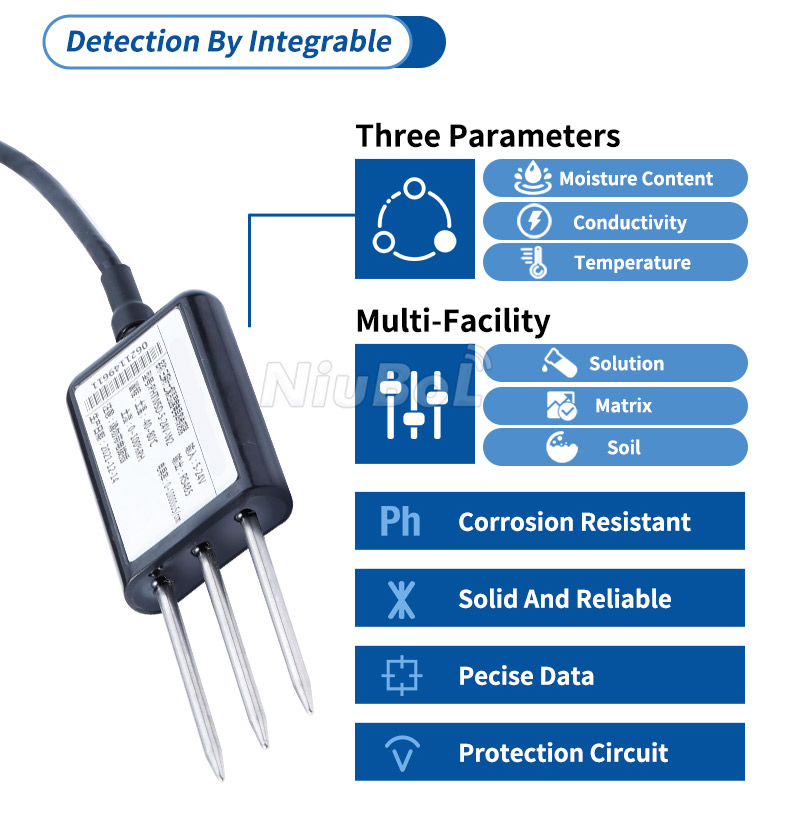
Normally, the sensor provides a measurement signal to a PLC, controller or relay system. The controller then operates the solenoid valve or pump. The sensor itself should not normally be used as the valve power source.
There is no universal percentage. The correct value depends on the crop, soil or substrate, root zone, irrigation method and how the sensor is calibrated and installed. Control values should be validated at the actual site.
The number depends on field variability and irrigation zones rather than area alone. Separate zones with different soils, crops or irrigation conditions should normally have representative measurements. Large or variable zones may require multiple sensors.
Yes. Multiple RS485 Modbus sensors can normally share one bus when each sensor has a unique address and the power supply, cable length, topology and termination are designed correctly.
Yes. An RS485 soil sensor can be connected to a compatible LoRaWAN acquisition node, or a sensor with integrated wireless communication can be used. The frequency band, gateway coverage and power system must match the deployment location.
Yes. A suitable gateway or data logger can collect sensor measurements and send data through 4G or Ethernet. Protocols such as MQTT, HTTP or TCP can be selected according to the gateway configuration and server requirements.
For many agricultural projects, yes. Soil moisture represents actual root-zone conditions, while weather data provides information about rainfall and atmospheric demand. Combining both can support more informed irrigation decisions.
For a practical project proposal, it is useful to provide:
Project location and total cultivation area
Crop type and growth method
Soil type or growing substrate
Approximate crop root depth
Number of irrigation zones
Drip, sprinkler or other irrigation method
Existing pump and valve configuration
Available AC or DC power
Distance between monitoring points
Required RS485, LoRaWAN, 4G or Ethernet communication
Whether a PLC or irrigation controller already exists
Whether data should be uploaded to a cloud platform or private server
Whether solar power is required
NiuBoL provides soil moisture sensors, soil moisture and temperature sensors, multi-depth soil sensors, data collectors and environmental monitoring equipment for agricultural irrigation projects.
Systems can be configured with RS485 Modbus, LoRaWAN, 4G and other communication methods depending on the project. Data can also be integrated with compatible PLCs, control systems, cloud platforms or customer servers.
For project selection, send us the cultivation area, crop, soil or substrate, number of irrigation zones, required monitoring depth, communication method and existing irrigation equipment. These details are more useful than simply specifying a moisture sensor model.
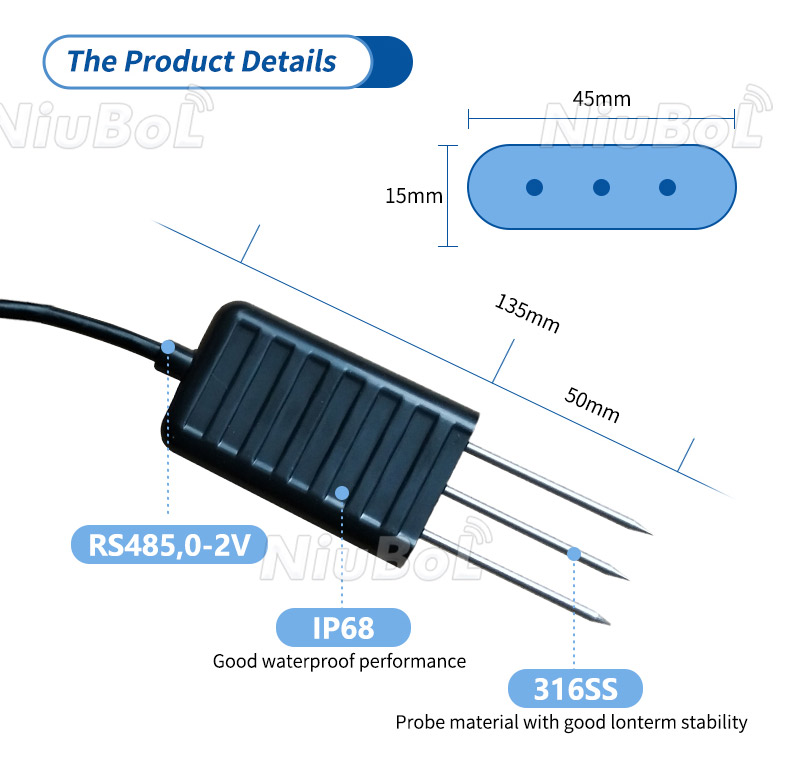
NiuBoL provides several soil moisture sensor configurations for agricultural irrigation, greenhouse monitoring and IoT projects. You can view the soil moisture sensorproduct page or download the corresponding datasheets below.
Suitable for long-term soil temperature and moisture monitoring in agriculture, irrigation and environmental monitoring projects.
Download NBL-S-THR Soil Temperature & Moisture Sensor Datasheet
Measures soil temperature, moisture and electrical conductivity (EC), making it suitable for irrigation, greenhouse and soil salinity trend monitoring applications.
Download NBL-S-TMC Soil Temperature, Moisture & EC Sensor Datasheet
Designed for soil temperature and moisture monitoring where a compact two-parameter sensor is required.
Download NBL-S-TM Soil Temperature & Moisture Sensor Datasheet
This multi-parameter sensor combines soil temperature, moisture, electrical conductivity and salinity monitoring for agricultural and irrigation applications that require more comprehensive root-zone information.
Download NBL-S-TMCS Soil Temperature, Moisture, EC & Salinity Sensor Datasheet
Prev:What is soil moisture sensor for automatic irrigation system?
Next:What is the difference between rain gauge and hygrometer?
Related recommendations
Sensors & Weather Stations Catalog
 Agriculture Sensors and Weather Stations Catalog-NiuBoL.pdf
Weather Stations Catalog-NiuBoL.pdf
Agriculture Sensors Catalog-NiuBoL.pdf
Water Quality Sensor Catalog-NiuBoL.pdf
Related products
 Combined air temperature and relative humidity sensor
 TDR Soil Moisture & Temperature Sensor for irrigation| RS485 |4-20mA| NBL-S-THR
 Soil pH sensor RS485 soil Testing instrument soil ph meter for agriculture |NBL-S-PH
 Wind Speed sensor Output Modbus/RS485/Analog/0-5V/4-20mA
 Tipping bucket rain gauge for weather monitoring auto rainfall sensor RS485/Outdoor/stainless steel
 Pyranometer Solar Radiation Sensor 4-20mA/RS485

Screenshot, WhatsApp to identify the QR code
WhatsApp number:+8615367865107
(Click on WhatsApp to copy and add friends)

