





— Blogs —
—Products—
 Consumer hotline +8618073152920
 WhatsApp:+8615367865107
Address:Room 102, District D, Houhu Industrial Park, Yuelu District, Changsha City, Hunan Province, China
Product knowledge
Time:2026-03-06 17:40:04 Popularity:545
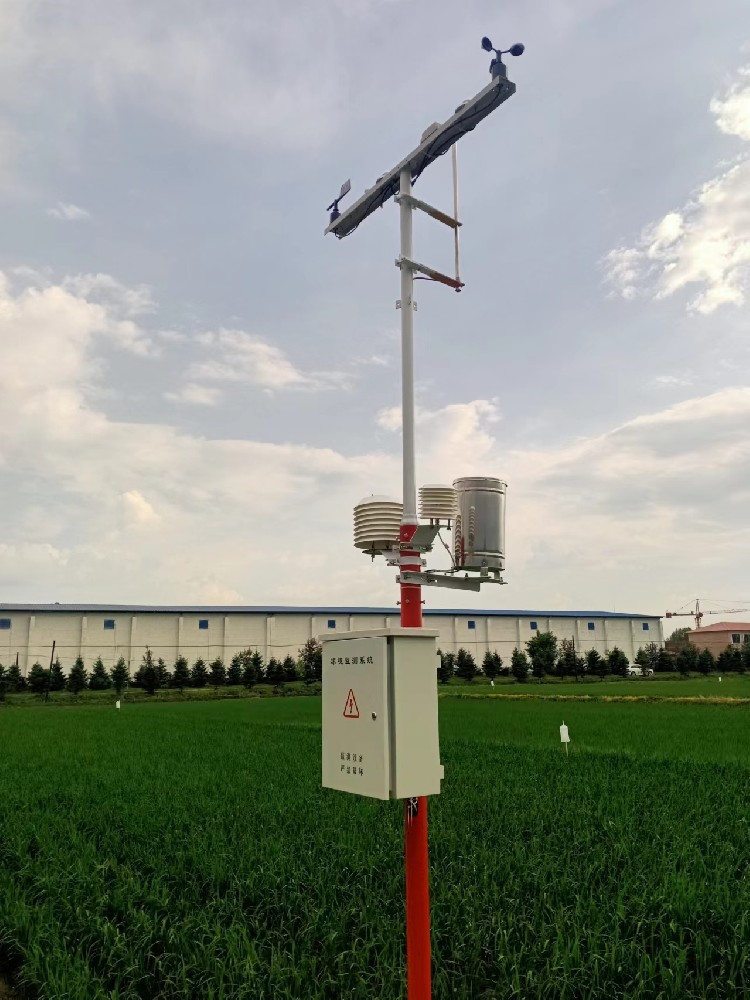
An agricultural weather station supplies local observations; forecasting requires an additional method that uses those observations or compares them with predictions. For a farm project, specify whether the required service is current weather, a future weather outlook, a crop-risk estimate or a yield forecast. Buying a NiuBoL sensor package does not, by itself, establish all four capabilities.
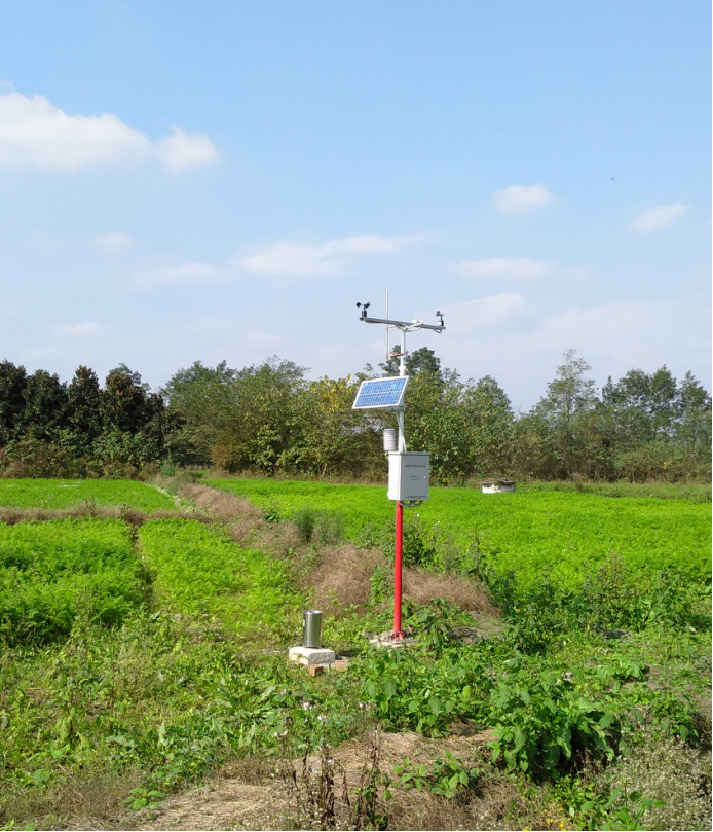
A current high-temperature alarm identifies a measured condition at the station. A forecast estimates a condition at a future time. A crop model interprets weather together with crop, soil and management information. Each can support a different decision, but its inputs, uncertainty and acceptance method are different.
| Requested output | Example farm use | Additional requirement beyond the station |
|---|---|---|
| Observation or threshold alarm | Review present field wind before an operation | Representative exposure, defined statistic and current data |
| Weather forecast | Plan tomorrow's field work | A forecast source or model, issue time and valid period |
| Crop-risk estimate | Evaluate conditions associated with a crop disease | A suitable crop/pathogen model and its required observations |
| Production or yield forecast | Plan harvest labour or supply commitments | Crop state, management, soil and an independently evaluated yield method |
This division also separates supplier responsibilities. The station supplier can provide an acquisition package, while another organisation may supply forecast data or an agronomic model. Identify the owner of each output before asking an integrator to connect them. A shared dashboard does not make them one measurement system.
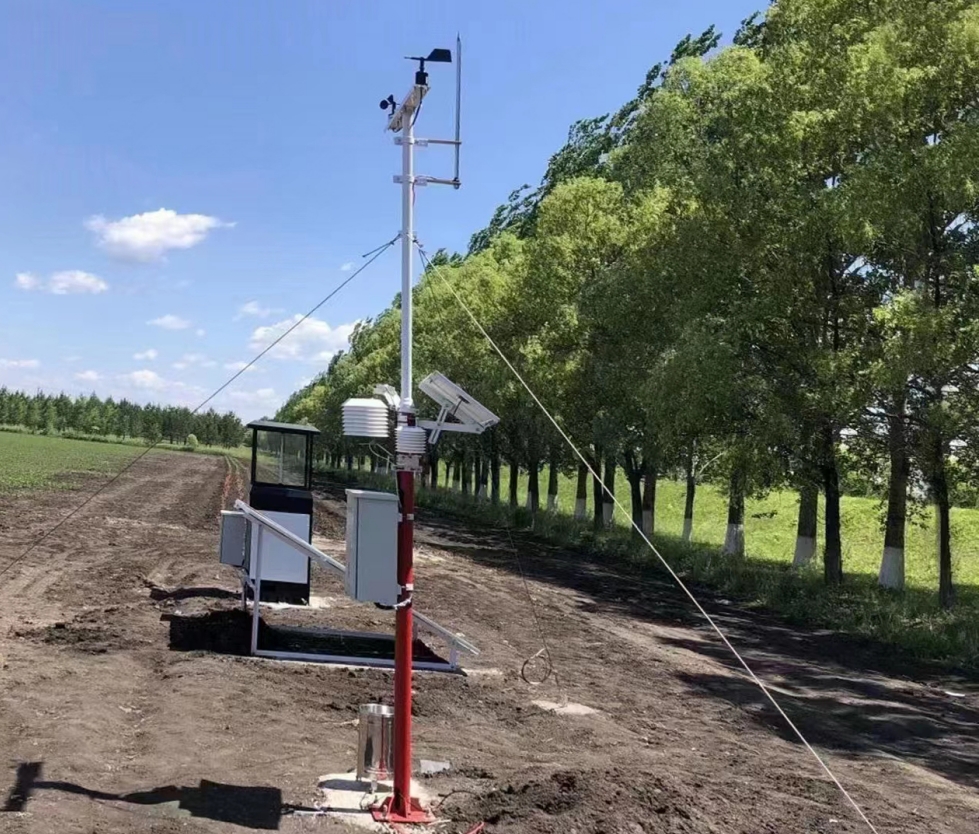
To evaluate a forecast, retain the issued prediction rather than only the latest value from a continuously updated service. Record the source, issue time, target location, valid time or accumulation period and units. The National Weather Service distinction between issued and valid times makes an essential point: when a prediction is published is different from when it applies.
For example, an outlook issued at 08:00 for the following day's minimum temperature cannot be evaluated fairly by downloading a revised forecast after that minimum has occurred. That would mix different lead times and allow later information into the comparison. Keep the version that staff could actually use when making the decision.
The observed value also needs a matching definition. A daily minimum should be based on an appropriate record over the same day boundary, not the temperature on screen when staff arrive. A forecast rainfall total for a 24-hour period should be compared with the total for that period, not the gauge's lifetime counter.
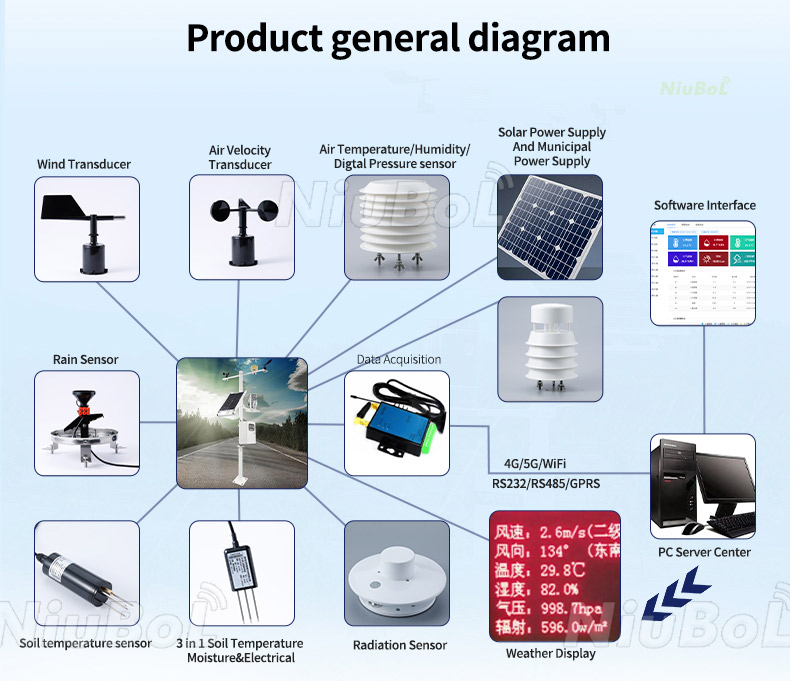
A model requiring leaf wetness cannot necessarily be supplied by relative humidity alone. A model using radiation needs a suitable radiation measurement, not an illuminance channel renamed in software. Soil moisture can provide root-zone context but does not directly measure crop water uptake, future yield or nutrient leaching.
The NBL-W-LBTH atmospheric sensor is one component for a modular agricultural weather station. It measures temperature, relative humidity and pressure. Separate wind, rainfall, radiation and soil instruments can be selected where the intended model or operational task needs them; they should not be described as universally mandatory.
| Measured input | Example NiuBoL specification | Interpretation limit |
|---|---|---|
| Air temperature | NBL-W-LBTH: -40 to 80 C; +/-0.5 C; 0.1 C resolution | Does not establish canopy, leaf or fruit temperature |
| Humidity and pressure | NBL-W-LBTH: 0-100% RH, +/-5% RH; 10-1200 hPa, +/-1.5 hPa | Do not independently establish leaf wetness or a storm forecast |
| Atmospheric electrical interface | 12-24 VDC; RS485 Modbus RTU or separate 4-20 mA version; digital polling at least 1000 ms | Polling speed is not the physical response time |
| Liquid rainfall | NBL-W-RS: 0.2 mm resolution; 0-4 mm/min; 0-50 C operating temperature | Not automatic snowfall measurement or the field's effective rainfall |
| Separate wind sensors | NBL-W-SS speed and NBL-W-DS direction; IP65 | Match the selected output and define average versus peak |
For the NBL-W-RS rain gauge, the stated +/-4% accuracy applies to its specified indoor test at 2 mm/min. Do not carry that number into a promise about all wind-exposed field rainfall. Request cable, power demand and protection details for each ordered module and logger rather than assigning one specification to the complete station.
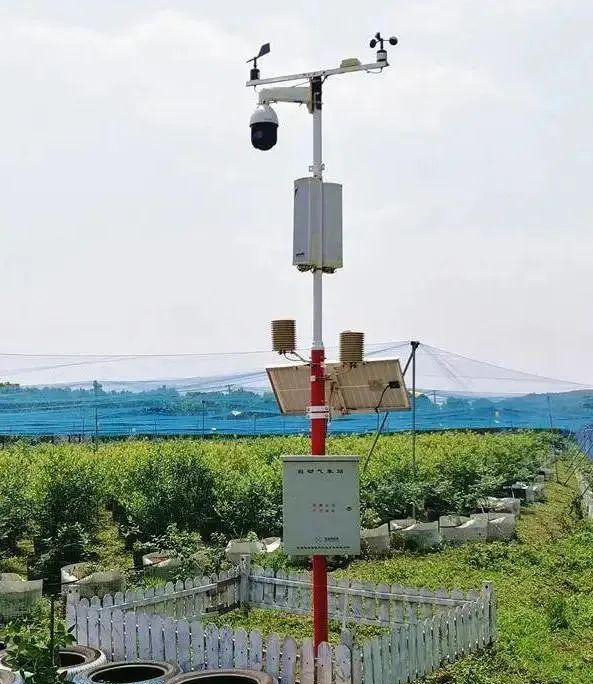
For an open-field weather comparison, record sensor heights, shielding, surrounding crops and terrain. A station next to a heated greenhouse wall should not be treated as an open-field reference. If the purpose is to observe that sheltered greenhouse margin, retain that purpose and avoid extrapolating its conditions to every field.
For strawberries, observations close to the relevant crop environment may help investigate cold conditions, but a shielded air reading is not proof of blossom temperature. In protected cultivation, outside weather and inside climate are different inputs. A project may need both to evaluate ventilation or shading decisions; a single outdoor station cannot validate the conditions in every bay.
For rain-fed cereals, a measured rain event provides local input to a water-balance model. The model still needs appropriate crop and soil assumptions. For orchard disease work, use the required canopy-related observations and local validation rather than treating weather similarity as proof that the pathogen is present.
Pair forecasts and observations using the same quantity, place and period. Keep results separated by useful lead time, such as the prediction available before staff schedule the next day's work. Combining a six-hour outlook and a three-day outlook into one favourable error number can hide whether the service supports the intended operation.
For a continuous quantity, report bias and absolute error with a clear sample count and missing-data treatment. Suppose three hypothetical temperature forecast errors, defined as forecast minus observed, are +1, -1 and +3 C. Mean bias is +1 C, while mean absolute error is about 1.67 C. A small mean bias does not imply that individual predictions are close.
For an event such as a threshold crossing, distinguish detected events, missed events and false alarms. Define the threshold and time window first. A model that frequently predicts an event may capture many occurrences while also interrupting operations unnecessarily. Evaluate the consequences relevant to the farm rather than selecting one flattering percentage.
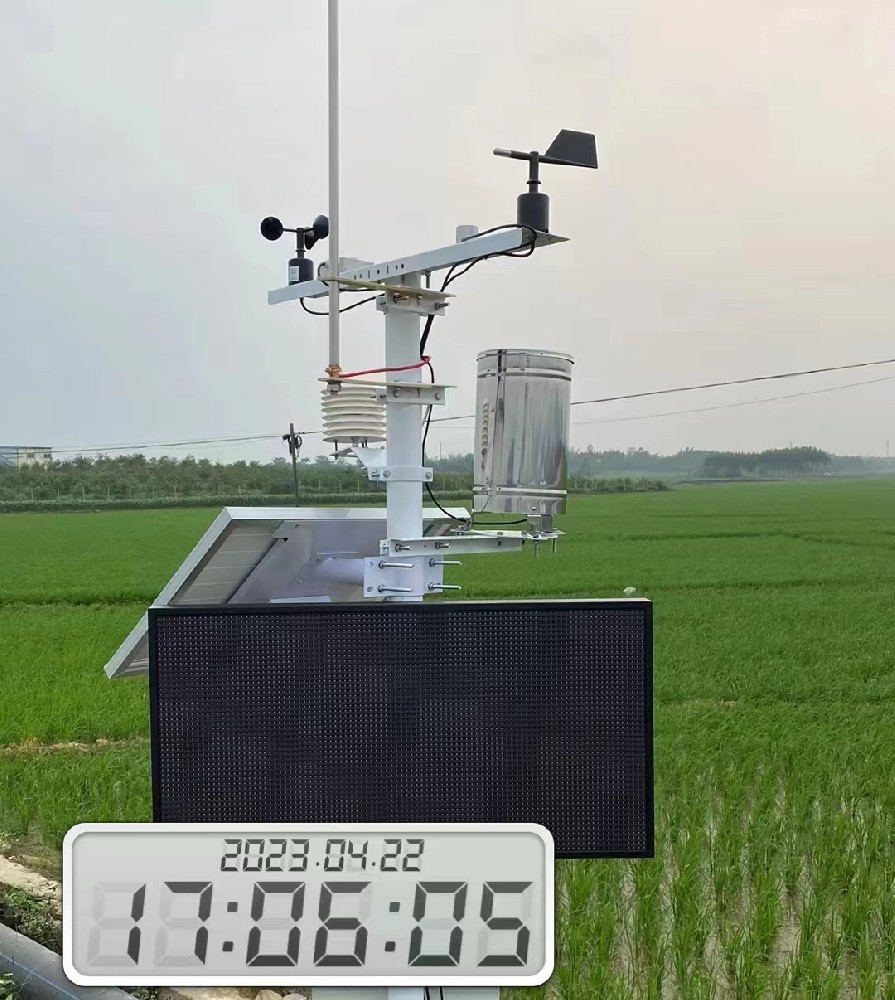
Preserve sensor observations independently of forecast outputs and calculated risk scores. Include units, acquisition times, quality states and model versions in the exported records. RS485 Modbus RTU can carry sensor data to a compatible PLC, RTU or data logger; forecast retrieval, storage and an API connection belong to the selected gateway or software package.
During a pilot, agree which observations and events will be reviewed, who provides the forecast and who checks the model's agronomic meaning. Test missing inputs and expired forecasts as well as normal operation. A model should not quietly use yesterday's humidity as a fresh input merely because a software process is still running.
Send NiuBoL the required observations, site arrangement, receiving format and desired acquisition schedule. Separately identify forecast-service licensing, crop-model work and validation costs. This makes a station quotation comparable without implying that hardware purchase includes guaranteed prediction accuracy, yield improvement or an immediate financial payback.
It supplies observations. A future outlook requires a forecast source or model and its associated processing. Establish that separate function when specifying the project.
Not reliably as a universal claim. Yield methods also depend on crop condition, soil, management and other assumptions. Evaluate the specific method with independent observations before using it for commitments.
Retain the version available at the decision time, with its issue and valid times. Replacing it with a later revision makes the comparison answer a different question.
Not where the decision concerns internal climate or crop-surface conditions. Select additional observations for those environments and keep indoor and outdoor locations identifiable.
No. Positive and negative errors can cancel. Check absolute error, sample count and performance for relevant events and lead times as well as bias.
State the forecast or crop model's required inputs, sensor positions, sampling basis and receiving system. Identify software, external data and validation responsibilities separately from the station hardware.
An agricultural weather station can make local conditions observable and provide evidence for evaluating a forecast. It does not remove the need for a defined prediction method or independent checks. Select NiuBoL instruments around the actual inputs required, preserve forecasts as issued, and compare like-for-like observations at the lead time that matters to the farm.
Prev:Automatic Soil Moisture Monitoring System: Define Irrigation Thresholds
Next:Agricultural Microclimate Monitoring Station: Light Data for Crop Trials
Related recommendations
Sensors & Weather Stations Catalog
 Agriculture Sensors and Weather Stations Catalog-NiuBoL.pdf
Weather Stations Catalog-NiuBoL.pdf
Agriculture Sensors Catalog-NiuBoL.pdf
Water Quality Sensor Catalog-NiuBoL.pdf
Related products
 Combined air temperature and relative humidity sensor
 TDR Soil Moisture & Temperature Sensor for irrigation| RS485 |4-20mA| NBL-S-THR
 Soil pH sensor RS485 soil Testing instrument soil ph meter for agriculture |NBL-S-PH
 Wind Speed sensor Output Modbus/RS485/Analog/0-5V/4-20mA
 Tipping bucket rain gauge for weather monitoring auto rainfall sensor RS485/Outdoor/stainless steel
 Pyranometer Solar Radiation Sensor 4-20mA/RS485

Screenshot, WhatsApp to identify the QR code
WhatsApp number:+8615367865107
(Click on WhatsApp to copy and add friends)

