





— Blogs —
—Products—
 Consumer hotline +8618073152920
WhatsApp:+8615367865107
Address:Room 102, District D, Houhu Industrial Park, Yuelu District, Changsha City, Hunan Province, China
Product knowledge
Time:2023-11-07 15:32:13 Popularity:1967
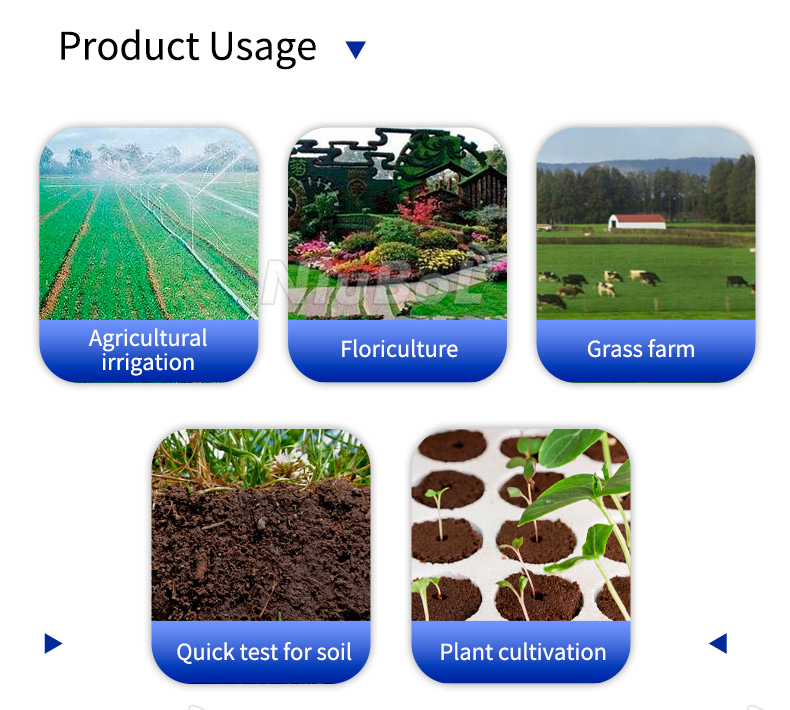
Quick Answer: Practical soil moisture sensor uses include checking irrigation response, following drying between watering events, comparing planted areas and recording soil conditions in experiments. The reading is local soil water content, not a direct measurement of plant stress, nutrient concentration or water use. A useful installation connects each measurement depth and position to a decision: whether to inspect an emitter, change an irrigation schedule, investigate persistent wetness or compare a treatment with a control.
A water-content probe estimates how much water is present near its sensing elements. For a volumetric output, 25% means an estimated water volume equal to one quarter of the sampled bulk soil volume. It does not mean that the crop has 25% of its usable water remaining. Available water also depends on the soil's retention characteristics and the plant's rooting conditions.
Many electronic probes respond to the dielectric properties of the surrounding material. FDR, capacitance and TDR instruments do not use an identical measurement method, even though all may report moisture percentages. Select the actual model and its applicable calibration; do not transfer a TDR performance claim to a different probe solely because the outputs have the same units.
The distinction matters in clay, saline soil, organic growing media and installations with incomplete contact. A repeatable trend may still be useful, but an absolute threshold needs field validation. Soil water content and soil water potential are also different measurements. FAO's discussion of irrigation scheduling methods distinguishes water quantity from how strongly water is retained; neither should be silently substituted for the other.
In irrigated agriculture, a moisture trace can reveal when water reaches a measurement point and how long the increase persists. Place observations at depths relevant to the crop and at known positions relative to an emitter or sprinkler pattern. A sensor immediately beneath a dripper may respond strongly while a nearby section of the root zone remains dry.
For example, suppose a shallow sensor rises after irrigation while a deeper one does not. That supports the limited conclusion that the deeper sensing volume has not shown a response during the observation period. Check event duration, emitter location, soil contact and travel time before increasing irrigation. It does not prove that the entire deeper field layer received no water.
Root-zone monitoring becomes more useful when valve start and stop times, measured flow and rainfall are recorded alongside the probes. Repeated comparisons under similar conditions can support schedule changes. The sensor does not measure delivered irrigation volume; a flow meter or other hydraulic measurement is needed for that quantity. Nor can a moisture reading determine fertilizer dose.
If one point stays dry, inspect the nearest outlet, tubing and wetting pattern. Compare with an independently watered point in the same soil where possible. If a point rises before the valve opens, review rainfall, timestamps and other water sources. This sequence separates an irrigation problem from a misplaced probe or an incorrectly aligned record.
Nursery beds, flower production and managed turf may dry unevenly because of substrate depth, shading, drainage and watering geometry. Group measurements by areas that share an irrigation decision. One reading beside a shaded border should not govern an exposed turf zone, and a probe in a deep planting bed cannot represent a shallow container.
For containers, first check whether the sensing elements can be fully surrounded by the intended material without touching the wall, base or a drainage void. A field-soil probe can be physically too large for a small pot. Peat, coir and mixed media also need an appropriate response check; a percentage obtained using a mineral-soil calibration may not be suitable for direct control.
Horticulture monitoring can therefore be used as a trend-based inspection tool before it becomes an automatic switching input. Observe several watering and drying cycles, compare with plant and substrate condition, and establish a minimum interval between control actions. Avoid rapid valve cycling around one noisy threshold. The irrigation controller, not the probe, must implement those control safeguards.
Restoration areas, slopes and revegetation projects often need to distinguish a short surface wetting event from a longer change in soil conditions. Repeated observations at marked depths can show how different positions respond to rainfall. Record vegetation cover, disturbance and any changes to drainage so that the trend remains interpretable over time.
A persistently high reading can justify an inspection for ponding, blocked drainage or a changed water source. It is not, alone, proof of oxygen deficiency, a measured water-table elevation or a slope-stability warning. Those questions require their own measurements and engineering assessment. Likewise, one dry probe cannot establish the severity of drought across a catchment.
For environmental monitoring, location may be more important than increasing upload frequency. Pairing comparable positions across a restored and an untreated area can answer a specific question more effectively than collecting very frequent data from one unrepresentative point. If erosion exposes the probe, flag the affected period rather than treating the new readings as an uninterrupted soil record.
In agricultural research, moisture data can help explain differences among irrigation treatments, ground covers or planting arrangements. The comparison requires repeated positions and comparable installation, not merely identical sensor labels. A probe placed in a compacted wheel track and one placed in loose cultivated soil are observing different conditions.
Record treatment, replicate, depth, installation date, orientation and calibration used. Keep the sampling interval consistent with the event being studied and preserve the original values if a correction is later applied. Distinguish true independent replicates from several sensors in the same plot; more channels do not automatically create more independent experimental evidence.
A study requiring absolute water storage or small treatment differences may need soil-specific calibration and a reference sampling method with known uncertainty. If only the timing of wetting is required, the evaluation may be different. Define the quantity the experiment needs before selecting an accuracy claim. A data export with timestamps and units is more useful than a dashboard image alone.
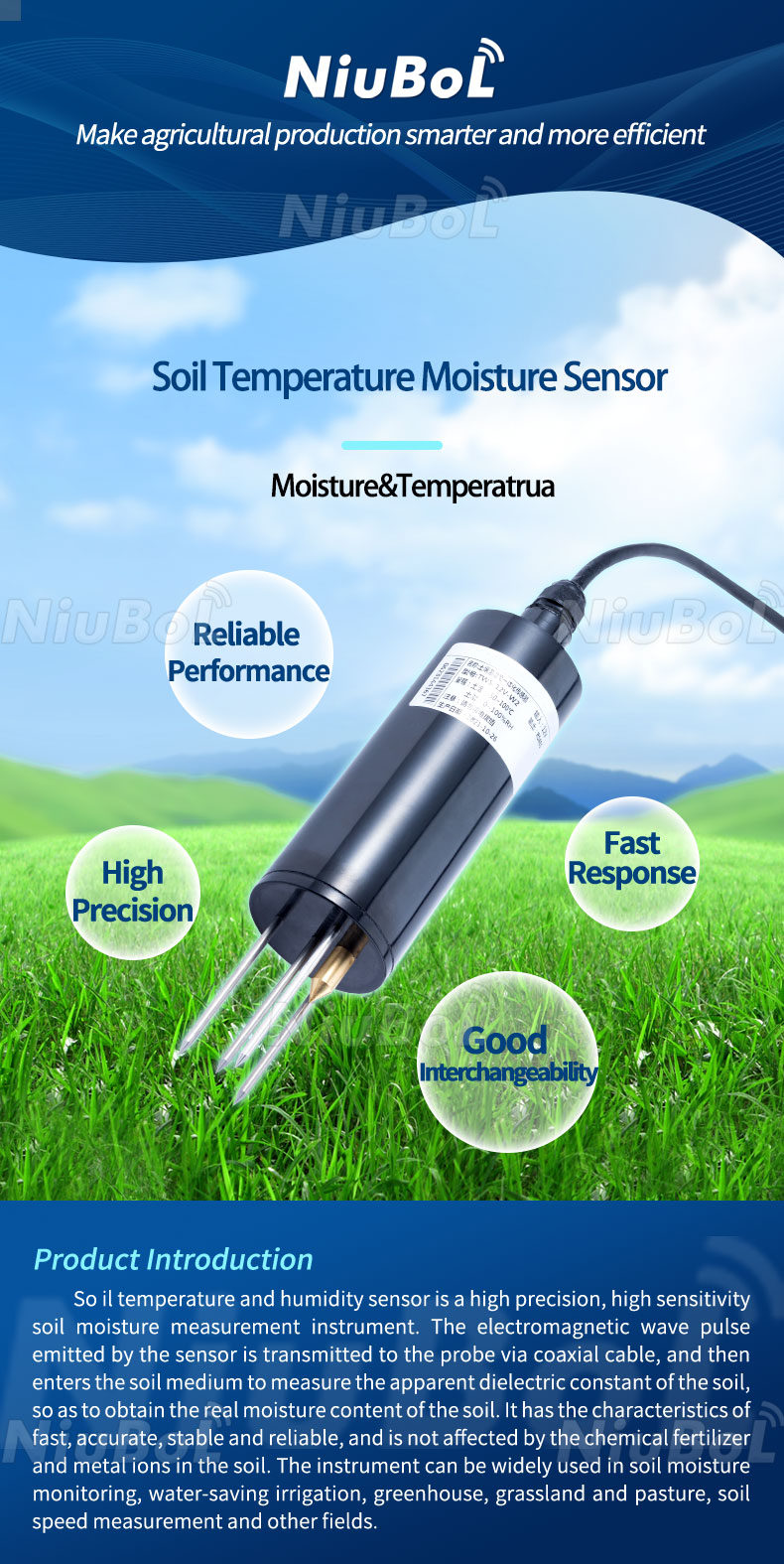
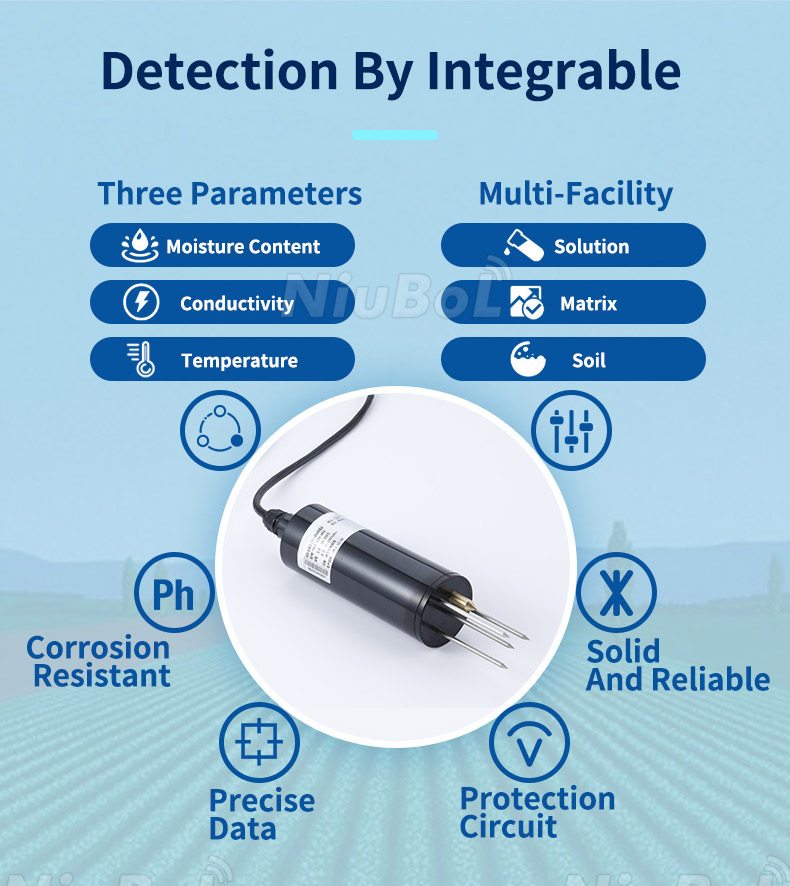
The round NiuBoL NBL-S-THR soil temperature and moisture sensor is one option for local measurements. The following values apply to that configuration, not to every sensor pictured on this page. Temperature and moisture are separate channels; conductivity requires a corresponding product configuration rather than an assumption based on the appearance of the housing.
| Parameter | NBL-S-THR reference configuration | What to check for the application |
|---|---|---|
| Moisture range and resolution | 0-100%; 0.1% resolution | Use the configured moisture scale. Range and display resolution do not establish site accuracy. |
| Moisture accuracy | +/-3% stated specification | The error basis is not identified as reading or full scale. Agree the test basis and verify performance in the intended soil. |
| Temperature measurement | -50 to 100 C; +/-0.5 C; 0.1 C resolution | Do not confuse the measurement span with the permitted operating environment. |
| Operating environment and protection | -40 to 80 C; IP68 probe | Protect joints and cable entries separately; the probe rating does not cover the whole installation. |
| Supply and power | 12-24 V DC; approximately 0.3 W | Include acquisition and transmission equipment when sizing a battery supply. |
| Output options | RS485, 4-20 mA or 0-5 V, according to ordered version | Match the logger input. Current-output load is no more than 250 ohms; voltage-input load is at least 1 kilohm. |
| Cable specification | Length and jacket material to be specified for the supplied assembly | State burial, chemical exposure, routing and connector needs; do not assume every cable is suitable for direct burial. |
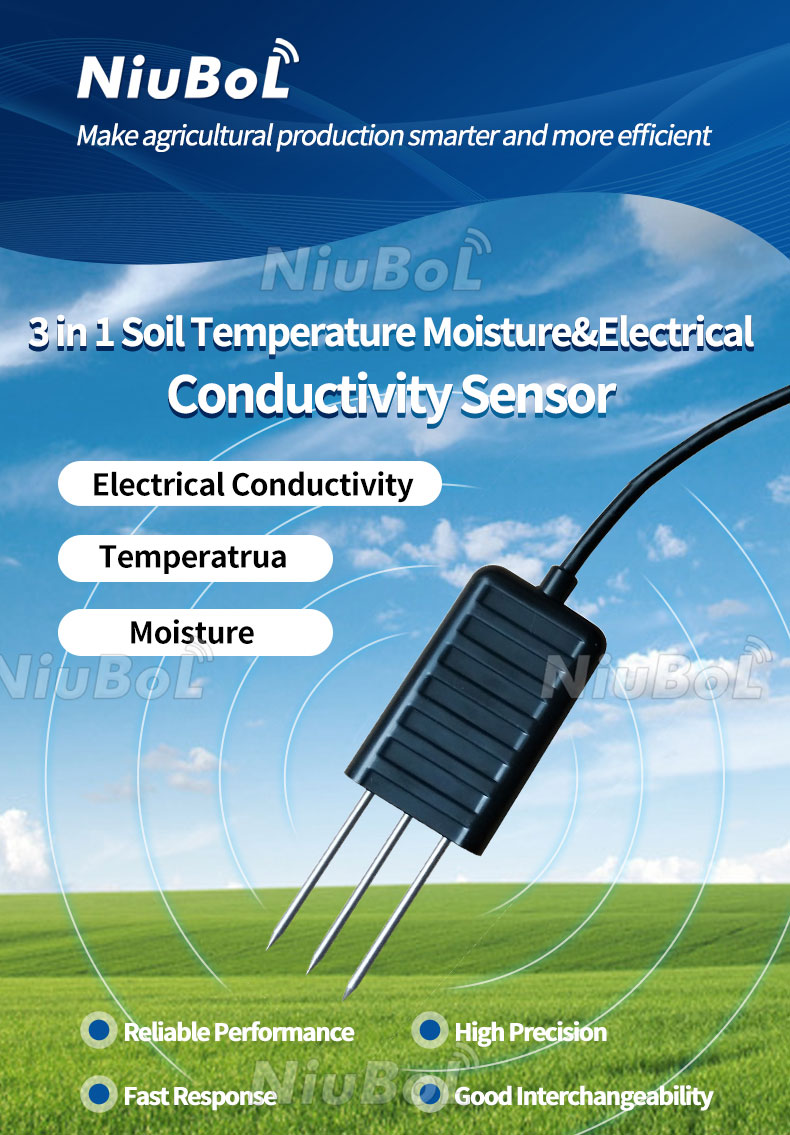
Fertigation and saline irrigation water can introduce an additional question: whether conductivity is changing near the roots. A NiuBoL three-in-one soil probe adds electrical conductivity alongside temperature and moisture. That is a different measurement set from a two-channel probe. Select it when conductivity will change a management decision, not simply to increase the number of displayed values.
Soil conductivity depends on conditions including water content and temperature. An increase cannot be converted directly into nitrogen, phosphorus or potassium concentration. Laboratory soil analyses and a suitable interpretation method remain necessary where fertilizer composition or regulatory reporting is the question. A conductivity channel can prompt a useful investigation without replacing those analyses.
| Observed pattern | Reasonable next action | Conclusion not yet supported |
|---|---|---|
| One irrigated point does not rise | Check water delivery, placement and probe contact | The entire block is dry or the sensor has failed |
| A deep point remains wet between events | Review drainage, root distribution and watering history | A measured drainage rate or proven root disease |
| Two plots dry at different rates | Check soil, cover, treatment and exposure differences | A quantified difference in plant water consumption |
| Moisture changes after a fertilizer application | Review applied water and possible conductivity effects | A direct measurement of nutrient uptake |
To bring these soil moisture sensor uses into a PLC, RTU or data logger, select the electrical output and confirm channel scaling. RS485 versions require the applicable Modbus RTU register map and device settings. Keep measurement timestamps when transferring data remotely. Missing communication must not be converted into zero moisture, particularly when the receiving system can request irrigation.
For a first installation, describe the practical question to NiuBoL along with the soil or growing medium, usable probe depth and existing collector. Whether the task is a blocked-emitter investigation, turf-zone comparison or a research record will affect placement and the required measurement quality. A small evaluated installation can establish those choices before broader deployment.
Checking the response to a known irrigation event is often a useful starting point. It links a timed action to a local measurement. Combine it with flow and field inspection before changing the schedule for a whole block.
Not by itself. The same water content can mean different availability in different soils. Interpret it with the crop, rooting conditions and a locally validated relationship to water availability or plant response.
No universal assumption is appropriate. Check physical fit, full sensing contact, salinity and calibration response in the intended medium. Validate thresholds in that medium before automatic control.
No. Different instruments use different dielectric measurement techniques, and some use other principles. Choose by the actual model's method and performance conditions rather than transferring a claim from a different sensor category.
A moisture-temperature-conductivity probe measures those three quantities. Electrical conductivity is not a selective NPK analysis. Use an appropriate soil or solution analysis when nutrient composition is needed.
Check communication and units first, then compare the response to known wetting and drying events. Where absolute water content matters, use a suitable independent reference and soil-specific evaluation, not a judgment based only on whether the value looks plausible.
It depends on how quickly someone must act and how costly field visits are. Local logging may suit a periodically reviewed experiment. Irrigation operations needing prompt inspection may justify remote reporting, provided power and coverage are adequate.
Useful soil moisture sensor uses begin with a defined question and a representative measurement point. Irrigation, horticulture, environmental work and research each need different interpretation. NiuBoL probes can provide the water-content and temperature measurements, with conductivity where specified; credible decisions still depend on placement, local evaluation and a clear limit on what the reading establishes.
Related recommendations
Sensors & Weather Stations Catalog
 Agriculture Sensors and Weather Stations Catalog-NiuBoL.pdf
Weather Stations Catalog-NiuBoL.pdf
Agriculture Sensors Catalog-NiuBoL.pdf
Water Quality Sensor Catalog-NiuBoL.pdf
Related products
 Combined air temperature and relative humidity sensor
 TDR Soil Moisture & Temperature Sensor for irrigation| RS485 |4-20mA| NBL-S-THR
 Soil pH sensor RS485 soil Testing instrument soil ph meter for agriculture |NBL-S-PH
 Wind Speed sensor Output Modbus/RS485/Analog/0-5V/4-20mA
 Tipping bucket rain gauge for weather monitoring auto rainfall sensor RS485/Outdoor/stainless steel
 Pyranometer Solar Radiation Sensor 4-20mA/RS485


Screenshot, WhatsApp to identify the QR code
WhatsApp number:+8615367865107
(Click on WhatsApp to copy and add friends)


