





— Blogs —
—Products—
 Consumer hotline +8618073152920
 WhatsApp:+8615367865107
Address:Room 102, District D, Houhu Industrial Park, Yuelu District, Changsha City, Hunan Province, China
Product knowledge
Time:2024-05-14 22:13:24 Popularity:38196
Rainfall is measured as the depth of water that would cover a flat, horizontal surface if the rain were distributed evenly and did not run off, soak into the ground or evaporate during the measurement. The most common unit is the millimeter (mm).
A rain gauge collects precipitation over a known area and converts the collected water into rainfall depth. Manual rain gauges measure accumulated rainfall directly, while automatic rain gauges can continuously record rainfall amount, timing and intensity and transmit the data to a weather station, data logger or IoT platform.
The key relationship is simple:1 mm of rainfall = 1 liter of water per square meter (1 L/m²).Therefore, 10 mm of rainfall represents 10 liters of water falling on each square meter of horizontal area.

Rainfall in millimeters describes water depth, not the size of individual raindrops. If 1 liter of water is spread evenly over an area of 1 square meter, the resulting water layer is 1 millimeter deep.
Therefore:
1 mm rainfall = 1 L/m²
5 mm rainfall = 5 L/m²
10 mm rainfall = 10 L/m²
50 mm rainfall = 50 L/m²
100 mm rainfall = 100 L/m²
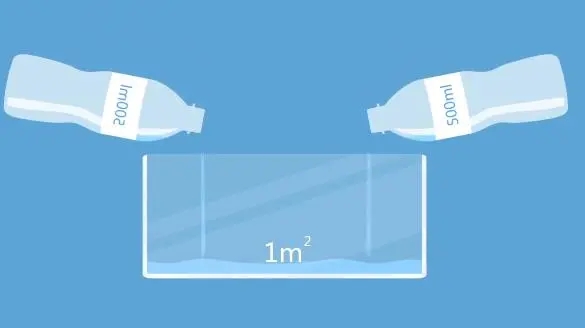
For example, over an area of 100 m², 1 mm of rain represents approximately 100 liters of water. Over one hectare (10,000 m²), 1 mm of rain represents approximately 10,000 liters, or 10 cubic meters of water.
| Area | 1 mm Rainfall | 10 mm Rainfall |
|---|---|---|
| 1 m² | 1 L | 10 L |
| 100 m² | 100 L | 1,000 L |
| 1 hectare | 10,000 L | 100,000 L |
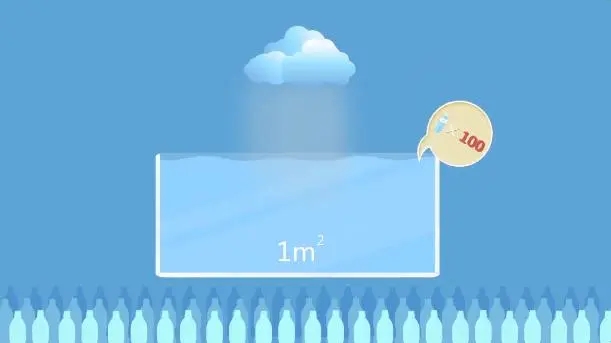
Rainfall depth can be calculated from the volume of collected water and the collection area:
Rainfall Depth = Collected Water Volume ÷ Collection Area
When consistent metric units are used, the result can be converted into millimeters of rainfall.
For practical field monitoring, users normally do not need to perform this calculation manually. A properly designed rain gauge has a known collection area, and the instrument or data logger converts the collected water or tipping events directly into rainfall depth.
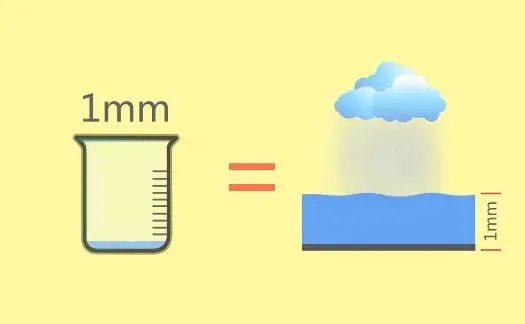
Rainfall amount and rainfall intensity are related but different measurements.
| Parameter | Meaning |
|---|---|
| Rainfall Amount | The accumulated depth of precipitation over a specified period, usually expressed in mm. |
| Rainfall Intensity | The rate at which rainfall occurs, commonly expressed in mm/h or mm/min. |
For example, two rainfall events may both produce 20 mm of total precipitation, but one may occur gradually over several hours while the other falls within a short period. These events have the same accumulated rainfall but very different rainfall intensities.
This distinction is important in flood monitoring, drainage design, agriculture and hydrology because short-duration high-intensity rainfall can have very different effects from the same amount of rain spread over a longer period.
A rain gauge is the standard instrument used to measure rainfall. Different rain gauge designs are available depending on whether the application requires manual observation, automatic recording, rainfall intensity measurement or remote data transmission.
| Rain Gauge Type | How It Works | Typical Use |
|---|---|---|
| Standard / Manual Rain Gauge | Collects rain in a container for manual measurement. | Manual observations, education and simple monitoring. |
| Tipping Bucket Rain Gauge | Each calibrated bucket tip represents a known rainfall depth. | Automatic weather stations, agriculture, hydrology and IoT monitoring. |
| Weighing Rain Gauge | Measures the mass of accumulated precipitation. | Meteorological and research applications. |
| Optical / Electronic Rain Sensor | Detects precipitation using optical or electronic measurement principles. | Specialized automatic monitoring systems. |
For a more detailed comparison, see our guide totypes of rain gauges.
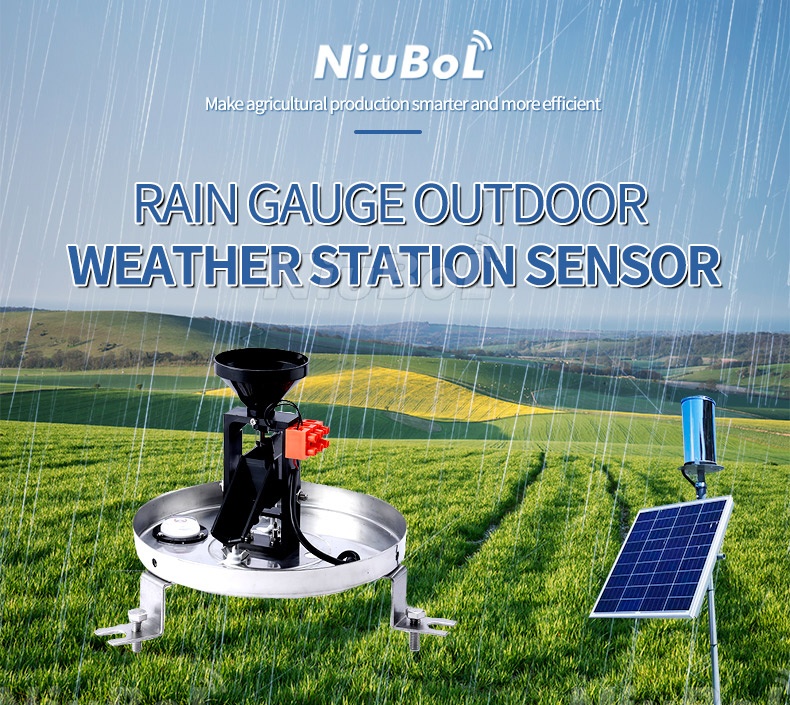
A tipping bucket rain gauge collects rain through a funnel and directs the water into a two-sided tipping mechanism. When one side collects a calibrated volume of water, the bucket tips, empties and moves the opposite bucket into position.
Each tip generates a pulse or measurement event. If the rain gauge has a resolution of 0.2 mm, for example, one completed tip represents 0.2 mm of rainfall.
The number of tips can then be counted by a weather station, PLC or data logger. An RS485 version can process the measurement internally and provide rainfall data through Modbus RTU.
For automatic monitoring projects, see theNiuBoL Automatic Rain Gauge Sensor, which supports automatic rainfall monitoring and integration with data-acquisition systems.
In an automatic rainfall monitoring system, the rain gauge is connected to a data logger, weather station or IoT gateway.
Rain Gauge → Pulse / RS485 → Data Logger → 4G / Ethernet / LoRaWAN → Cloud Platform or Customer Server
The system can continuously record rainfall without requiring an operator to read the gauge manually. Depending on the project, the data can also be combined with air temperature, humidity, wind, atmospheric pressure and solar radiation measurements from anautomatic weather station.
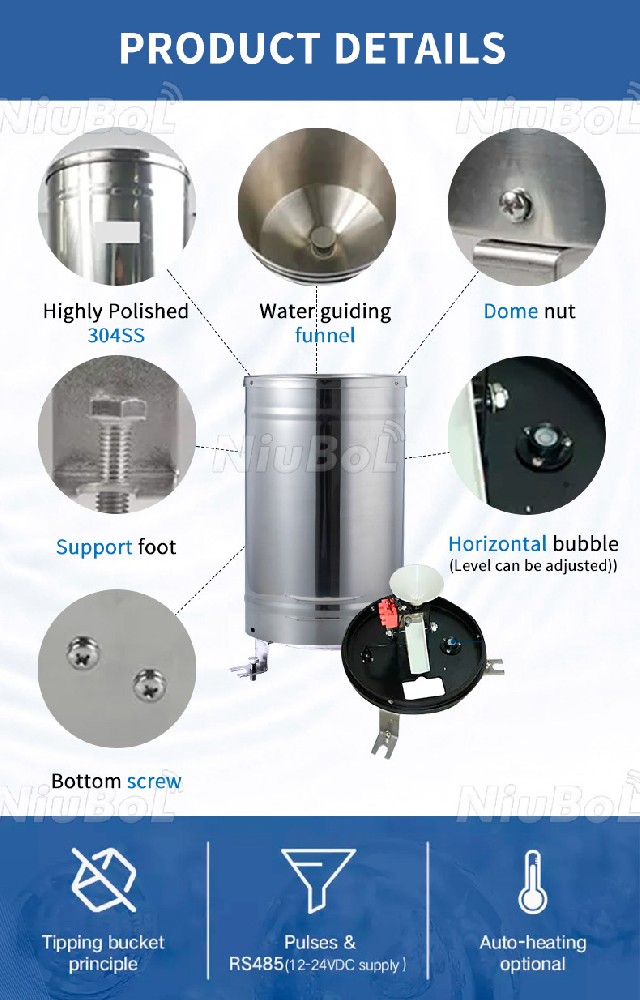
Rainfall measurement accuracy depends not only on the rain gauge specification but also on installation, maintenance and environmental conditions.
Wind can change the path of falling raindrops and cause part of the precipitation to pass over or around the collector. Exposure and surrounding obstacles should therefore be considered when selecting an installation location.
A tipping bucket rain gauge should be installed level. Tilting can affect the tipping mechanism and introduce measurement error.
Leaves, insects, dust and other debris can reduce the amount of water reaching the measuring mechanism. Periodic cleaning is therefore necessary.
Mechanical tipping bucket gauges can have intensity-dependent errors, particularly during very high rainfall rates. The expected rainfall intensity should therefore be considered when selecting an instrument.
A standard unheated tipping bucket rain gauge is primarily intended for liquid precipitation. Snow and freezing conditions may require heated or specialized precipitation instruments.
Reliable rainfall data is useful in many applications because rainfall directly influences soil water, surface runoff, river flow, reservoir levels and agricultural water demand.

Agriculture: Rainfall data can be combined with soil moisture information to support irrigation decisions.
Hydrology: Rainfall is an important input for watershed, river and reservoir monitoring.
Flood monitoring: Rainfall amount and intensity can help operators evaluate developing flood conditions.
Weather monitoring: Precipitation is one of the core parameters measured by automatic weather stations.
Research: Long-term rainfall records support environmental and climate studies.
Water management: Rainfall information contributes to water-resource assessment and operational planning.
Before selecting a rainfall sensor, confirm:
Required rainfall resolution
Expected rainfall intensity
Manual or automatic measurement
Pulse, RS485 or other output
Required data logger or weather station integration
Power supply
Remote communication requirements
Installation temperature and climate
Whether snow or freezing precipitation must be measured
Maintenance accessibility
For automatic meteorological, agricultural or hydrological projects, a tipping bucket rain gauge with RS485 or pulse output is commonly used because it can be integrated with weather stations, PLCs and IoT data-acquisition systems.
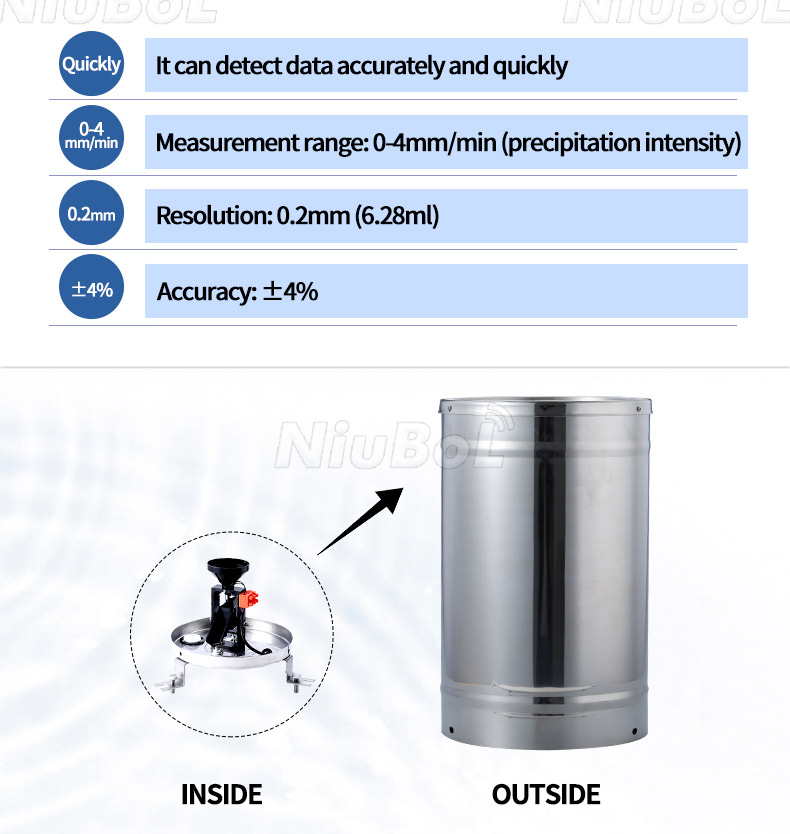
Rainfall is measured using a rain gauge. Common types include manual gauges, tipping bucket rain gauges, weighing gauges and electronic precipitation sensors.
Millimeters describe the depth of water deposited on a horizontal surface. This makes the measurement independent of the total size of the area being discussed.
One millimeter of rainfall equals one liter of water per square meter. Across one hectare, 1 mm of rainfall corresponds to approximately 10 cubic meters of water.
No. Rainfall amount is the accumulated precipitation depth over a period, while rainfall intensity describes how quickly the rain is falling.
Yes. Automatic rain gauges can provide pulse or digital outputs such as RS485 Modbus. A data logger or gateway can then upload the measurements through 4G, Ethernet or other communication networks.
A standard unheated tipping bucket gauge is primarily designed for liquid precipitation. Snow and freezing precipitation may require a heated rain gauge or a dedicated snow and precipitation measurement system.
For automatic rainfall monitoring and system integration, the following NiuBoL technical manuals provide specifications, wiring and installation information.
Download NBL-W-RS 0.5 mm Tipping Bucket Rain Gauge Manual
Download NBL-W-ARS Tipping Bucket Rain Gauge Manual
Download NBL-W-RS Rain Sensor Instruction Manual
NiuBoL provides tipping bucket rain gauges, automatic rain gauges, weather stations and IoT data-acquisition equipment for meteorological, agricultural, hydrological and environmental monitoring.
For a rainfall monitoring project, provide the required resolution, output signal, quantity, installation environment, cable length and whether a data logger, 4G communication, solar power system or complete weather station is required.
Related recommendations
Sensors & Weather Stations Catalog
 Agriculture Sensors and Weather Stations Catalog-NiuBoL.pdf
Weather Stations Catalog-NiuBoL.pdf
Agriculture Sensors Catalog-NiuBoL.pdf
Water Quality Sensor Catalog-NiuBoL.pdf
Related products
 Combined air temperature and relative humidity sensor
 TDR Soil Moisture & Temperature Sensor for irrigation| RS485 |4-20mA| NBL-S-THR
 Soil pH sensor RS485 soil Testing instrument soil ph meter for agriculture |NBL-S-PH
 Wind Speed sensor Output Modbus/RS485/Analog/0-5V/4-20mA
 Tipping bucket rain gauge for weather monitoring auto rainfall sensor RS485/Outdoor/stainless steel
 Pyranometer Solar Radiation Sensor 4-20mA/RS485

Screenshot, WhatsApp to identify the QR code
WhatsApp number:+8615367865107
(Click on WhatsApp to copy and add friends)

