





— Blogs —
—Products—
 Consumer hotline +8618073152920
 WhatsApp:+8615367865107
Address:Room 102, District D, Houhu Industrial Park, Yuelu District, Changsha City, Hunan Province, China
Product knowledge
Time:2024-01-28 20:13:03 Popularity:5766
An anemometer is an instrument used to measure wind speed or air velocity. The four common types are cup anemometers, vane anemometers, hot-wire anemometers and ultrasonic anemometers.
Each type uses a different measurement principle and is suitable for different applications. Cup and ultrasonic anemometers are commonly used for outdoor weather monitoring, while vane and hot-wire instruments are more often used for HVAC, ducts, laboratories and portable airflow measurements.
Choosing the correct anemometer depends on whether the project requires outdoor wind measurement, indoor airflow measurement, wind direction, low starting speed, RS485 integration, low maintenance or specialized research performance.
| Type | Measurement Principle | Typical Application |
|---|---|---|
| Cup Anemometer | Wind rotates cups around a vertical axis | Weather stations, agriculture, outdoor monitoring |
| Vane Anemometer | Air rotates a propeller / vane | HVAC, ducts and portable measurements |
| Hot-Wire Anemometer | Airflow cools an electrically heated element | Low airflow, HVAC, laboratories and research |
| Ultrasonic Anemometer | Measures ultrasonic transit-time differences | Weather stations, environmental monitoring and research |
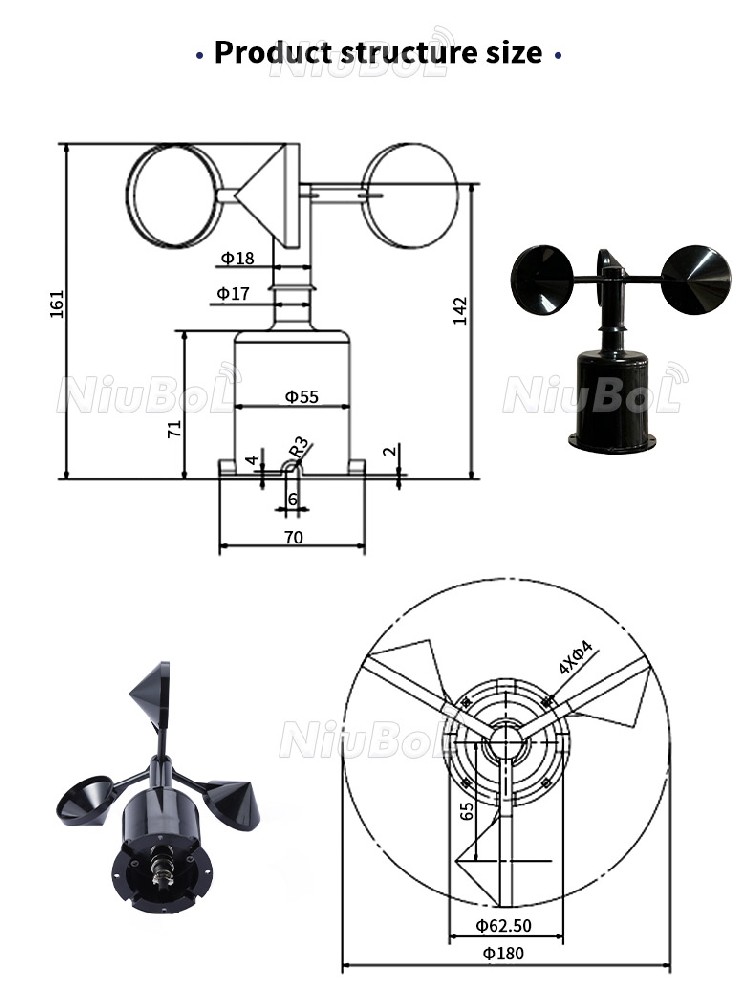
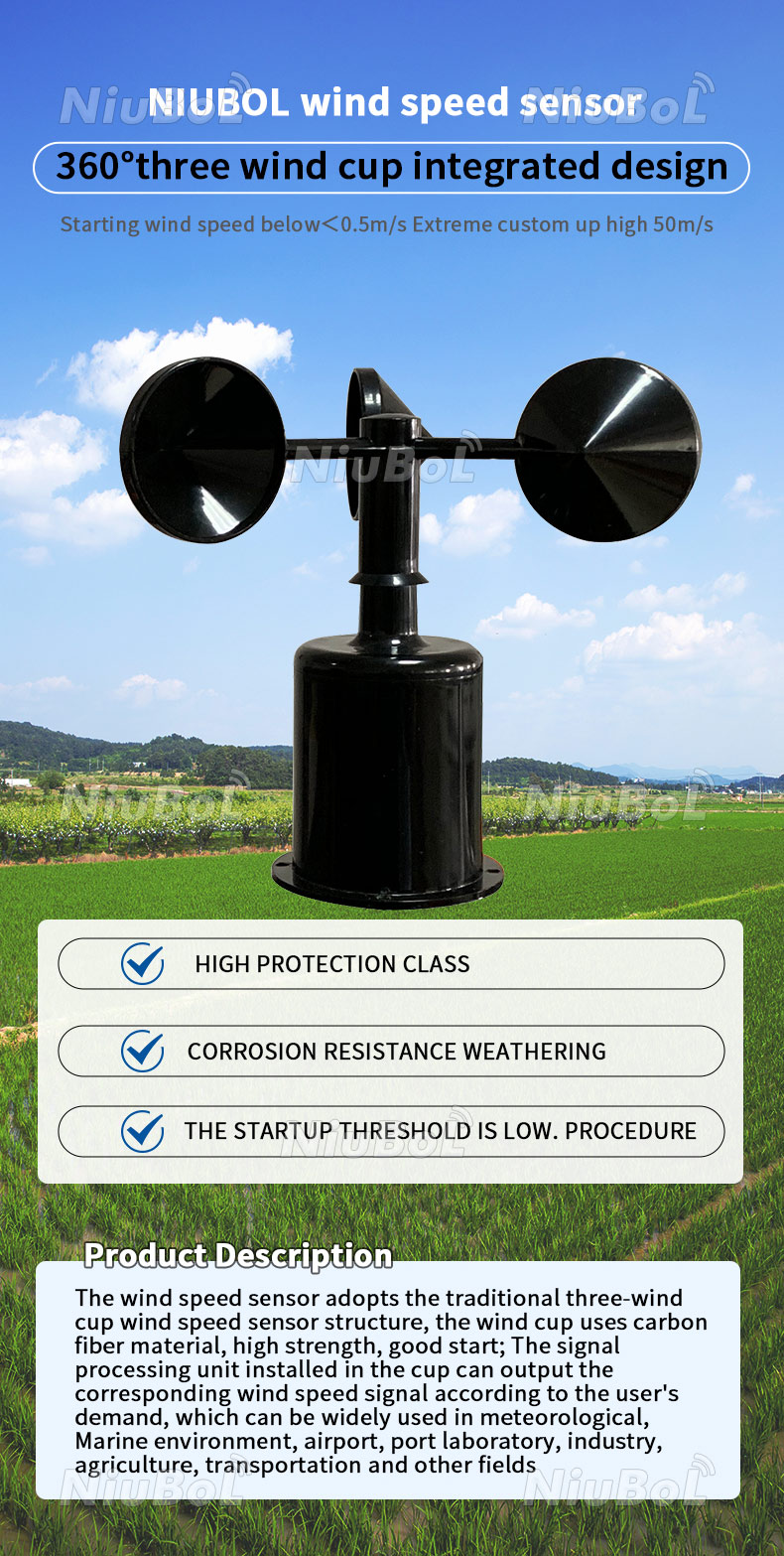
A cup anemometer normally consists of three or four cups mounted around a vertical shaft. When wind acts on the cups, the rotor turns. The rotational speed increases as wind speed increases.
An electronic sensing circuit measures the rotation and converts it into wind-speed data. Industrial versions can output RS485 Modbus, 4–20 mA, voltage or pulse signals.
Cup anemometers are widely used because they are simple, mature and cost-effective for continuous outdoor wind monitoring.
Simple and proven measurement principle
Suitable for continuous outdoor monitoring
Does not need to face the wind before measuring speed
Available with industrial RS485 and analog outputs
Generally lower initial cost than ultrasonic sensors
Contains mechanical bearings and rotating parts
Requires periodic inspection
Wind direction requires a separate sensor
Starting wind speed affects very-low-wind measurement
Icing or contamination can restrict cup movement
A vane anemometer uses a propeller or fan-like rotor. Airflow passes through the vane and causes it to rotate, while the instrument converts rotational speed into air velocity.
Portable vane anemometers are widely used for HVAC testing because they can be positioned directly in ducts, ventilation outlets and air-conditioning systems.
Important: A vane anemometer should not be confused with a wind vane. A vane anemometer measures air velocity, while a meteorological wind vane measures wind direction.
HVAC testing
Ventilation ducts
Air-conditioning outlets
Building ventilation inspections
Portable airflow measurements
A hot-wire anemometer measures airflow using a thin electrically heated sensing element.
When air flows across the heated wire, heat is removed from the element. The instrument measures the electrical change associated with this cooling and converts it into air velocity.
Hot-wire anemometers can respond well to relatively low air velocities, making them useful for laboratory and indoor airflow measurements.
Low-speed airflow
HVAC commissioning
Laboratory experiments
Aerodynamics research
Fluid-dynamics studies
Cleanrooms and ventilation systems
Hot-wire instruments are generally more suitable for controlled airflow applications than for unattended outdoor weather stations exposed to rain, dust and severe weather.
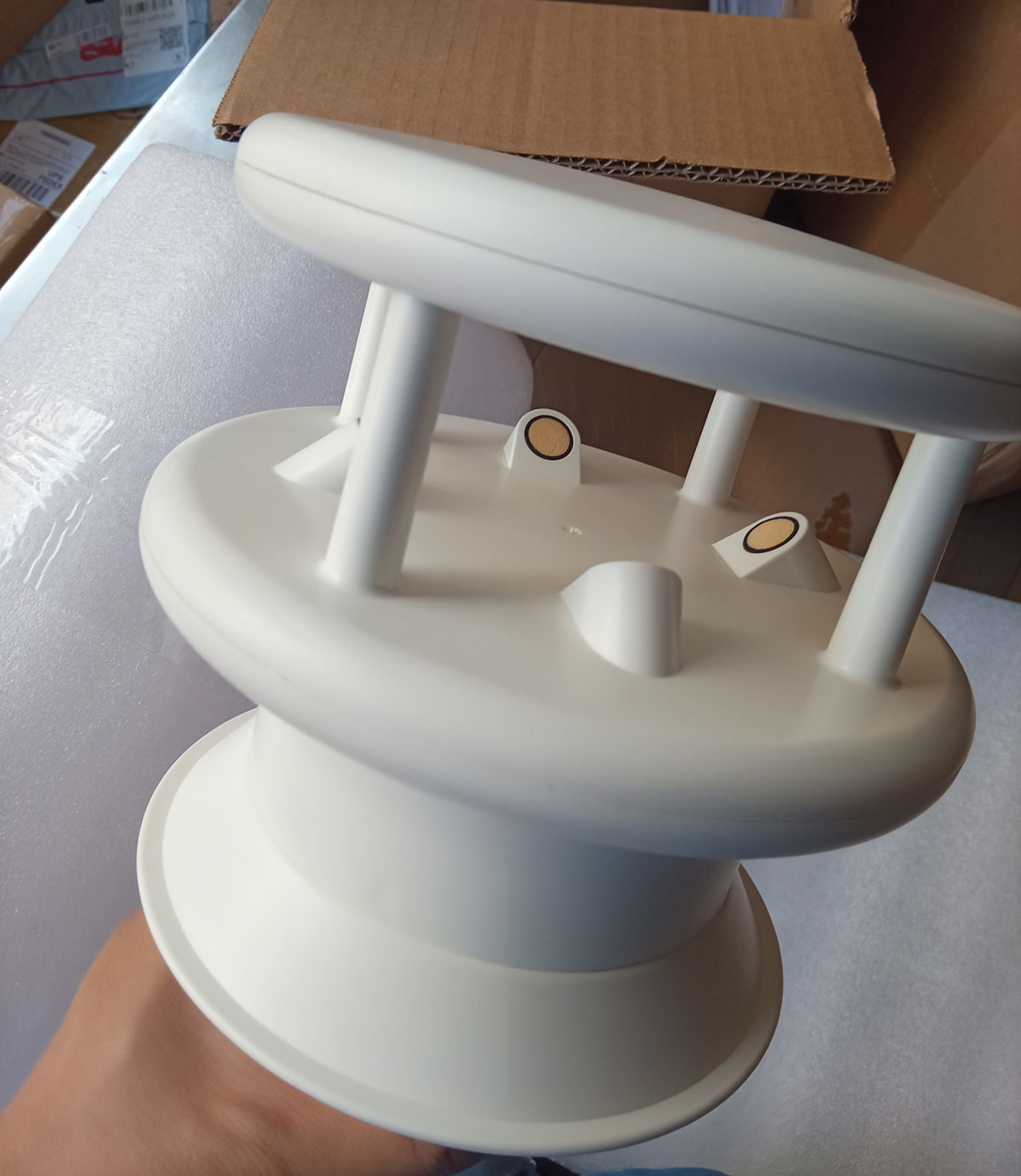
An ultrasonic anemometer measures wind by comparing the travel time of ultrasonic signals between transducers.
When there is no wind, the transit time in opposite directions is approximately equal. When wind is present, the signal traveling with the airflow reaches the opposite transducer faster than the signal traveling against the airflow.
By comparing transit times along multiple directions, the sensor can calculate both wind speed and wind direction.
No conventional rotating cups or vane
Wind speed and direction can be integrated in one sensor
Low mechanical wear
Compact installation
Suitable for automatic weather stations
Digital RS485 output available
Higher initial cost than basic cup sensors
Electronic design is more complex
Ice or contamination can affect ultrasonic paths
Cold-weather projects may require heating
Installation must avoid strong airflow obstruction and vibration
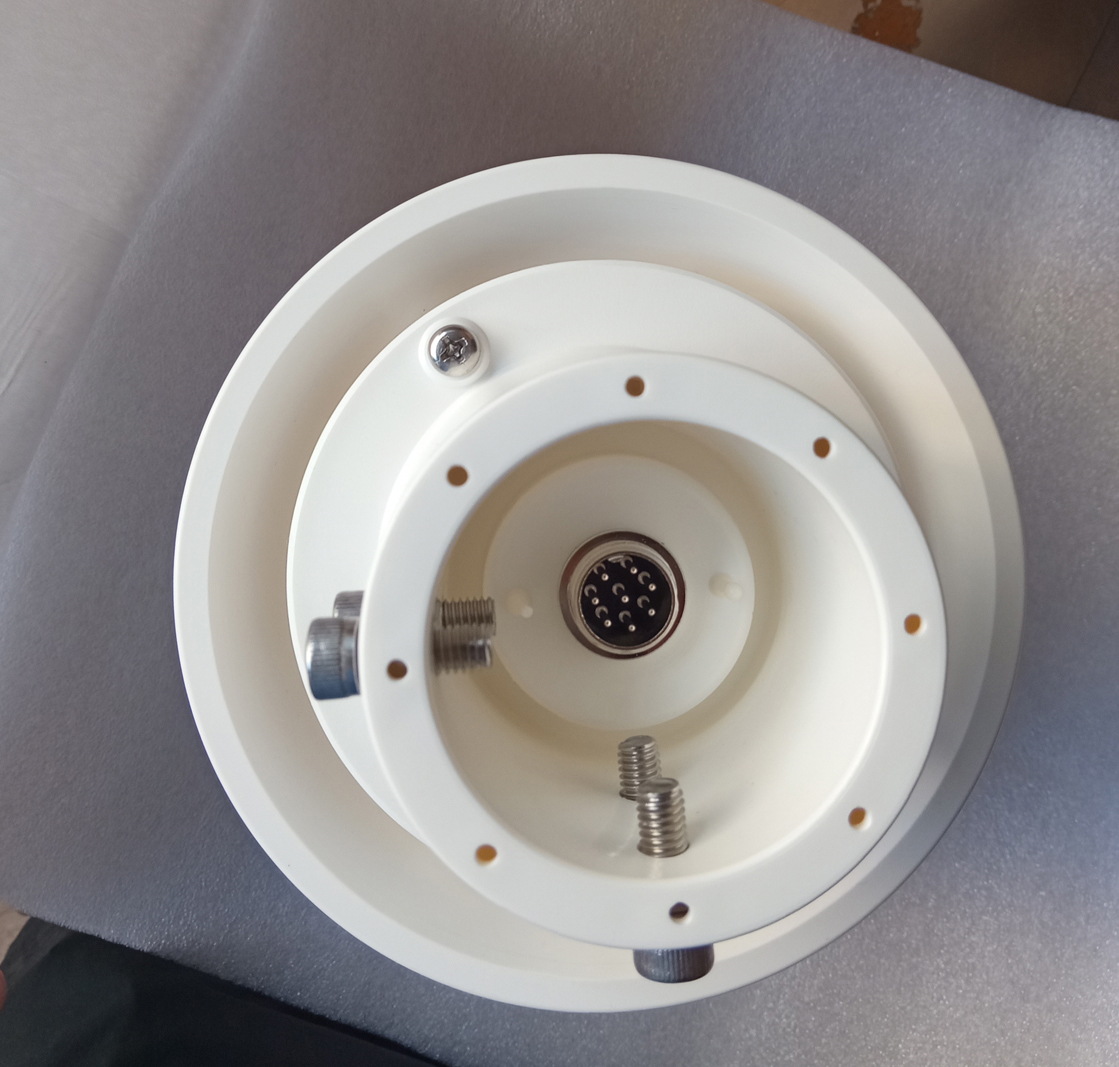
NBL-W-21GUWS Ultrasonic Wind Speed & Direction Sensor
Wind speed: 0–60 m/s
Wind direction: 0–359°
Wind speed resolution: 0.01 m/s
Wind direction resolution: 1°
Output: RS485 Modbus
Power supply: 12–24 V DC
Optional heating: 3 W
Protection: IP65
View NBL-W-21GUWS Ultrasonic Anemometer →
| Feature | Cup | Vane | Hot-Wire | Ultrasonic |
|---|---|---|---|---|
| Outdoor Weather | Excellent | Limited | Limited | Excellent |
| HVAC / Ducts | Not ideal | Excellent | Excellent | Usually unnecessary |
| Very Low Air Speed | Limited by starting speed | Good | Excellent | Model dependent |
| Wind Direction | No | Not normally meteorological direction | No | Yes |
| Moving Parts | Yes | Yes | No rotating parts | No rotating parts |
| Typical Cost | Low to Medium | Low to Medium | Medium | Medium to High |
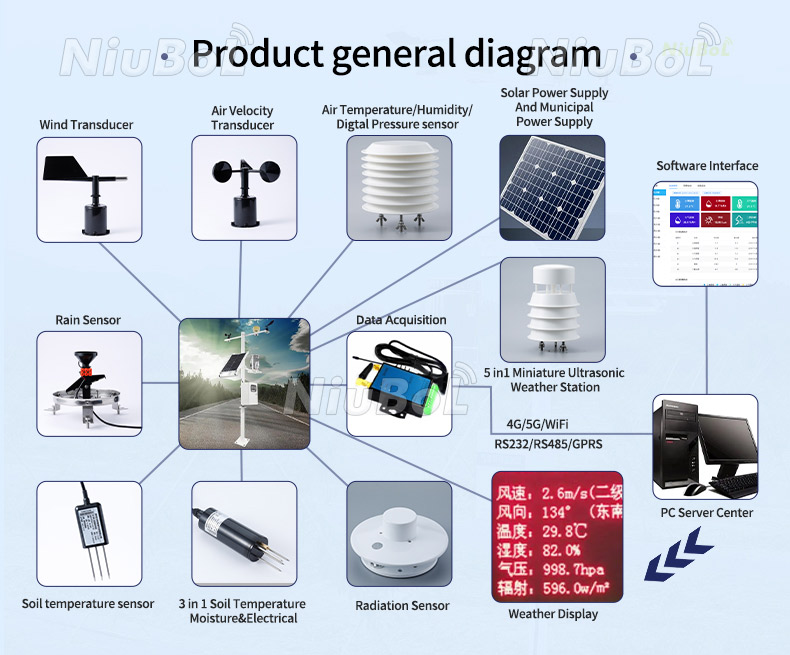
For most automatic weather stations, the main choices are a cup anemometer or an ultrasonic anemometer.
A cup anemometer is suitable when the goal is reliable and economical wind-speed monitoring and a separate wind-direction sensor can be installed.
An ultrasonic anemometer is suitable when wind speed and direction should be integrated into one compact device and lower mechanical maintenance is important.
For HVAC ducts and indoor ventilation testing, a handheld vane anemometer or hot-wire anemometer is normally more suitable than an outdoor cup sensor.
Vane instruments are convenient for general duct and diffuser measurements, while hot-wire instruments are useful when lower air velocities or more sensitive airflow measurements are required.
The correct research instrument depends on what needs to be measured.
General outdoor wind: cup or 2D ultrasonic
Low indoor airflow: hot-wire
Turbulence studies: high-frequency ultrasonic or specialized research instruments
Three-dimensional airflow: 3D ultrasonic anemometer
Remote wind profiling: Doppler LiDAR or similar remote-sensing equipment
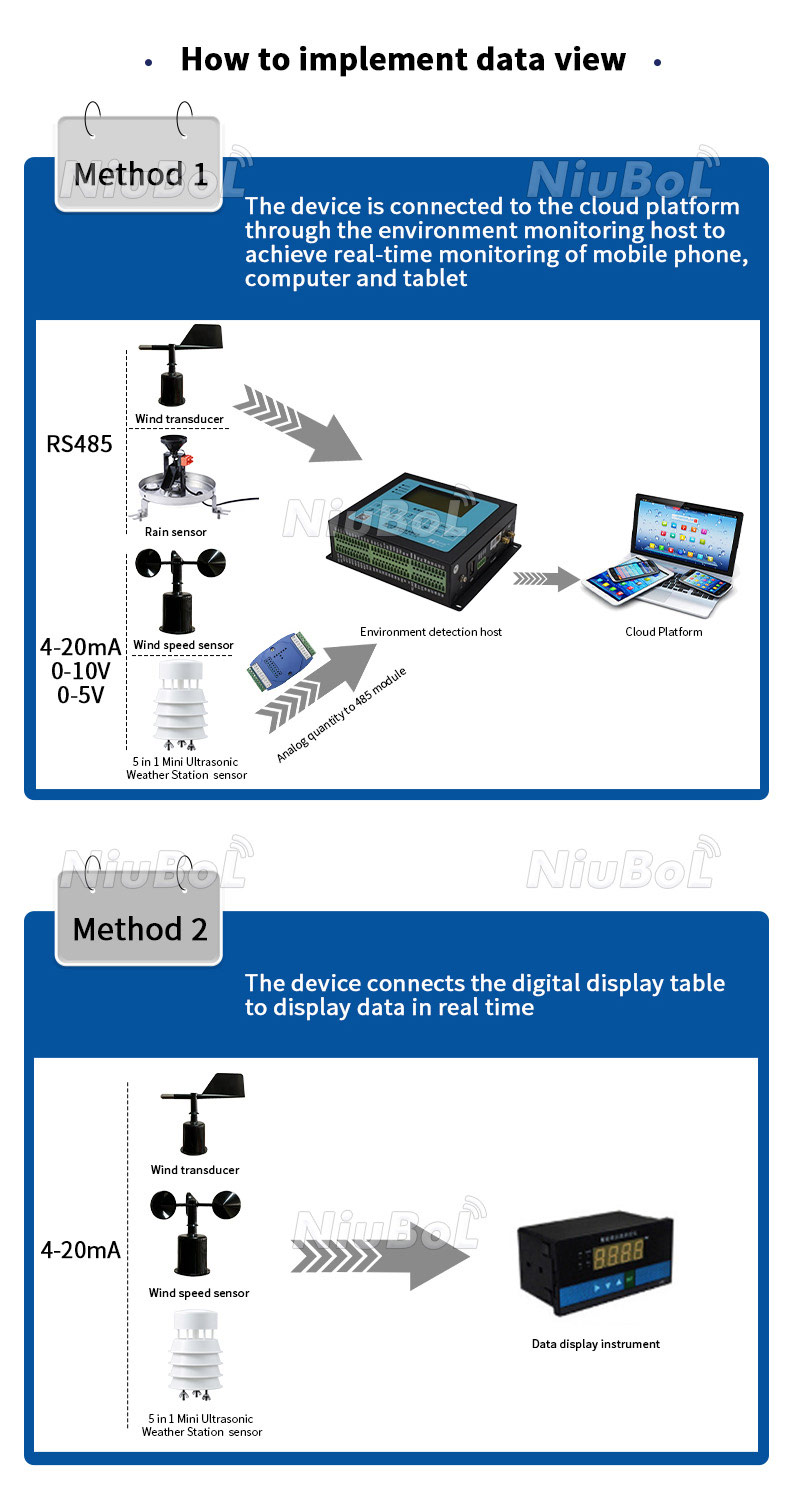
Industrial wind sensors can provide several output types depending on the control or monitoring system.
| Output | Typical Application |
|---|---|
| RS485 Modbus | PLC, RTU, data logger and IoT systems |
| 4–20 mA | Industrial analog control systems |
| Voltage | Analog data acquisition |
| Pulse | Weather loggers and pulse counters |
Anemometer → RS485 / Analog / Pulse → Data Logger → 4G / Ethernet → MQTT / HTTP → Cloud or Private Server
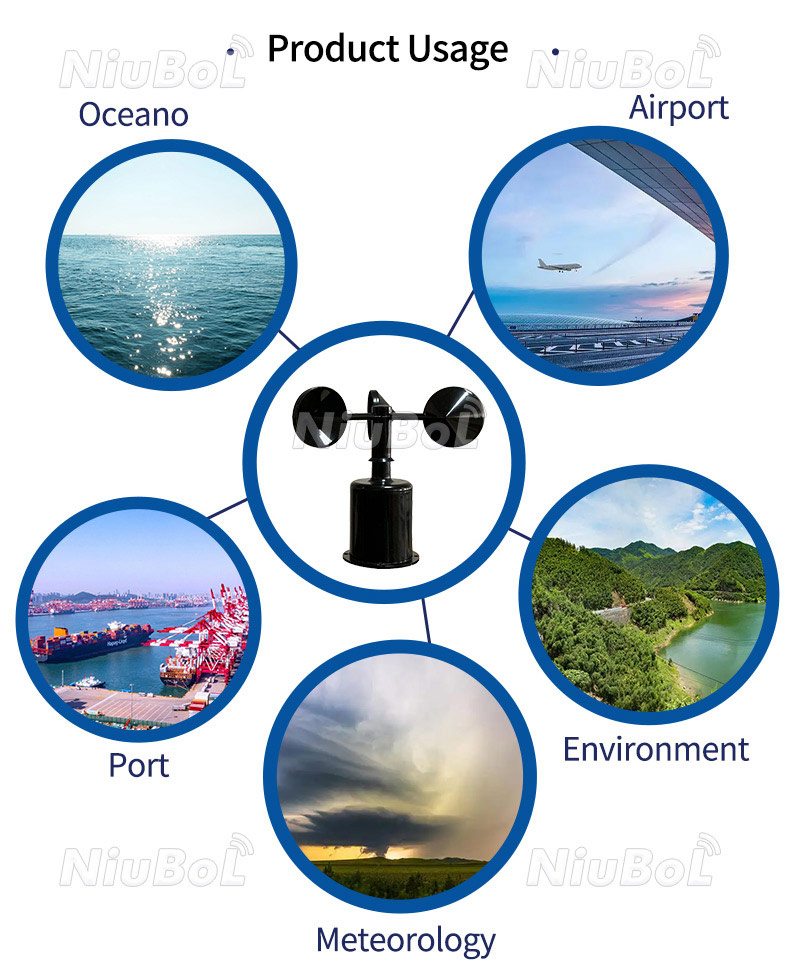
Meteorology: Cup and ultrasonic anemometers
Agriculture: Cup or ultrasonic wind sensors
Ports and Airports: Professional cup or ultrasonic systems
HVAC: Vane and hot-wire anemometers
Environmental Monitoring: Cup and ultrasonic sensors
Wind Energy: Calibrated cup, ultrasonic or specialized wind sensors
Research: Hot-wire, ultrasonic and specialized instruments
Before purchasing, confirm:
Outdoor wind or indoor airflow?
Wind speed only or speed + direction?
Expected measurement range
Required starting wind speed
Required accuracy and resolution
Fixed installation or handheld measurement
RS485, 4–20 mA, voltage or pulse output
Operating temperature and humidity
Marine, dust, icing or corrosive environment
Required maintenance level
PLC, data logger or IoT gateway compatibility
A1. Four common types are cup, vane, hot-wire and ultrasonic anemometers. Specialized technologies such as 3D ultrasonic and LiDAR are also used for research and professional applications.
A2. Cup anemometers and ultrasonic anemometers are both widely used in automatic weather stations.
A3. Ultrasonic anemometers have no conventional rotating cups or vane. Hot-wire sensors also have no rotating mechanism.
A4. Hot-wire anemometers are commonly used for low air velocity and sensitive airflow measurements in HVAC and laboratories.
A5. Vane and hot-wire anemometers are normally more suitable for HVAC ducts than outdoor cup sensors.
A6. No. A standard cup anemometer measures wind speed. A separate wind-direction sensor or integrated ultrasonic sensor is required for direction.
A7. They require ultrasonic transducers, precision timing electronics and digital signal processing, and normally combine wind speed and direction in one device.
A8. Yes. Industrial sensors with RS485 Modbus, 4–20 mA or compatible voltage outputs can connect to PLCs, RTUs and data loggers.
A9. Yes. An RS485 wind sensor can connect to a 4G or Ethernet gateway, which can transmit measurements through MQTT, HTTP or TCP.
A10. Choose a cup anemometer for economical and proven wind-speed monitoring. Choose ultrasonic when speed and direction integration, compact installation and lower mechanical maintenance are more important.
1. NBL-W-SS Cup Wind Speed Sensor
 NBL-W-SS-Wind-Speed-Sensors-Instruction-Manual-V4.0.pdf
2. NBL-W-21GUWS Ultrasonic Wind Speed & Direction Sensor
NBL-W-21GUWS-Ultrasonic-Wind-speed-and-direction-Sensor.pdf
NiuBoL provides cup anemometers, wind-direction sensors, ultrasonic wind sensors and complete automatic weather stations for meteorological, agricultural, environmental and industrial monitoring.
For product selection, provide the measurement range, whether wind direction is required, output signal, quantity, cable length, installation environment and whether the sensor needs to connect to a PLC, data logger, 4G gateway or private server.
Related recommendations
Sensors & Weather Stations Catalog
 Agriculture Sensors and Weather Stations Catalog-NiuBoL.pdf
Weather Stations Catalog-NiuBoL.pdf
Agriculture Sensors Catalog-NiuBoL.pdf
Water Quality Sensor Catalog-NiuBoL.pdf
Related products
 Combined air temperature and relative humidity sensor
 TDR Soil Moisture & Temperature Sensor for irrigation| RS485 |4-20mA| NBL-S-THR
 Soil pH sensor RS485 soil Testing instrument soil ph meter for agriculture |NBL-S-PH
 Wind Speed sensor Output Modbus/RS485/Analog/0-5V/4-20mA
 Tipping bucket rain gauge for weather monitoring auto rainfall sensor RS485/Outdoor/stainless steel
 Pyranometer Solar Radiation Sensor 4-20mA/RS485

Screenshot, WhatsApp to identify the QR code
WhatsApp number:+8615367865107
(Click on WhatsApp to copy and add friends)

