





— Blogs —
—Products—
 Consumer hotline +8618073152920
WhatsApp:+8615367865107
Address:Room 102, District D, Houhu Industrial Park, Yuelu District, Changsha City, Hunan Province, China
Product knowledge
Time:2024-08-30 11:31:14 Popularity:2410
Relative humidity (RH) is a measure of how close the water vapor in air is to saturation at the same temperature. Monitoring RH is important for greenhouse cultivation, meteorology, environmental monitoring, storage, building management and industrial processes.
Relative humidity is expressed in percent (%RH). It changes not only when the amount of water vapor changes, but also when air temperature changes. Interpreting humidity alongside temperature is therefore essential.
A humidity sensor measures atmospheric conditions. It does not automatically control dehumidifiers, ventilation or irrigation equipment; those actions require a suitable external controller and actuators.
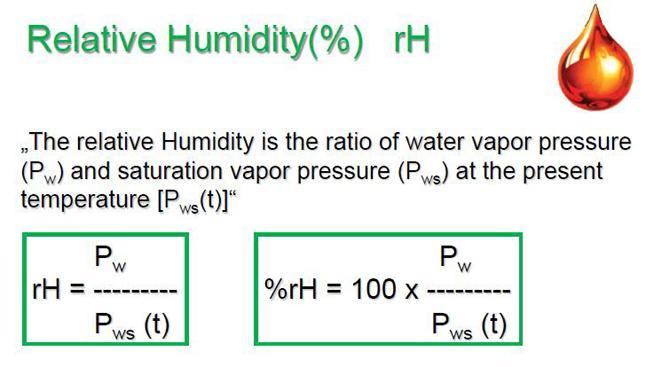
Relative humidity is the ratio of the actual partial pressure of water vapor to the saturation vapor pressure at the same temperature, multiplied by 100.
RH (%) = 100 × Actual Water Vapor Pressure / Saturation Water Vapor Pressure at the Same Temperature
For example, 70%RH means that the water vapor partial pressure is 70% of saturation at the measured temperature. It does not mean that 70% of the air consists of water, and it is different from volumetric water content in soil.
Air humidity influences the water-vapor gradient between leaves and the surrounding air. Together with temperature, radiation and airflow, it affects transpiration and the growing environment.
A greenhouse monitoring system can measure temperature and RH at representative growing-zone locations. The collected data helps operators observe conditions during ventilation, heating, cooling and irrigation.
Vapor pressure deficit is the difference between saturation vapor pressure and actual water vapor pressure. It is commonly calculated from air temperature and relative humidity. VPD is not identical to RH, and a VPD-based agricultural decision needs appropriate crop context.
High RH and condensation can be associated with periods of leaf wetness. Crop disease-risk evaluation requires additional information, suitable models and crop-specific validation; an RH reading alone does not diagnose disease.
Temperature and RH together influence perceived comfort and moisture conditions in occupied indoor spaces. Suitable humidity management depends on the building, ventilation and applicable requirements.
High moisture conditions can contribute to condensation, corrosion or damage to sensitive goods. The required RH range differs for food, documents, electronics and other materials.
Humidity monitoring can support process stability in industries where moisture affects materials, packaging or production quality. Specifications should be set for the actual process rather than using one universal RH target.
Recorded temperature and RH provide environmental context for experiments and equipment performance. Accuracy and traceability requirements depend on the research application.
RH is a routine meteorological variable. When combined with temperature, pressure, wind and precipitation observations, it provides information relevant to local atmospheric conditions.
Electronic humidity instruments often use a capacitive sensing element whose electrical response changes with ambient moisture. The sensing circuit applies a calibration relationship and reports RH in %RH.
Some systems use other humidity measurement principles. When selecting equipment, compare the specified humidity range, accuracy, response characteristics, operating temperature and output interface.
For outdoor measurement, use an appropriate radiation shield and maintain adequate airflow. Avoid direct heating, nearby exhausts, water spray and locations where moisture accumulates unnaturally.
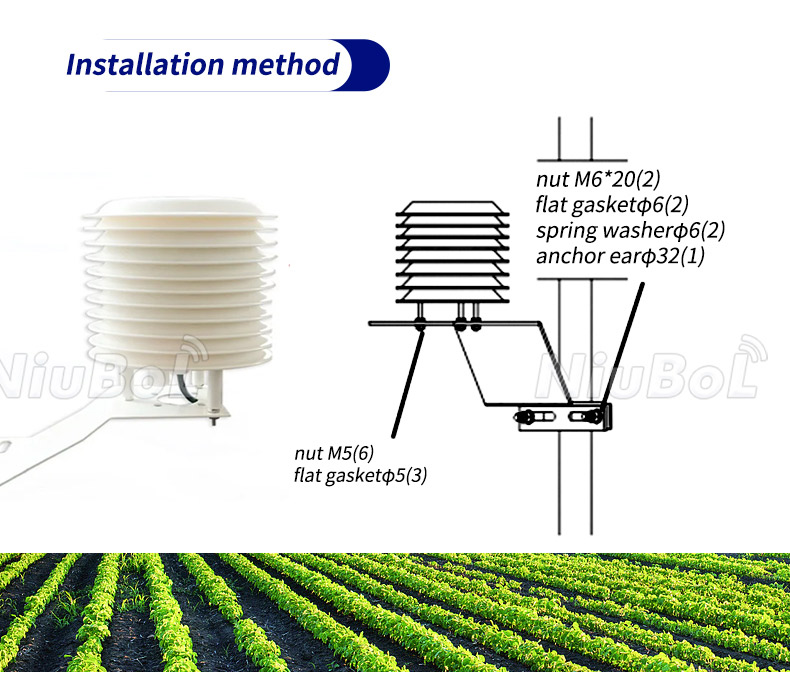
The NiuBoL NBL-W-LBTH combines air temperature, relative humidity and atmospheric pressure measurements in a louvered housing designed for outdoor weather monitoring.
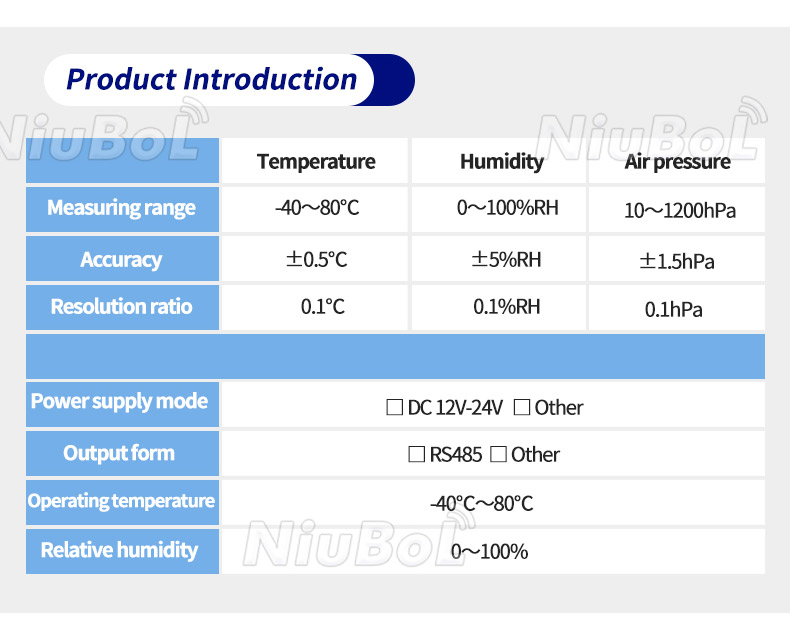
| Parameter | Specification |
|---|---|
| Model | NBL-W-LBTH |
| Air temperature range | −40 to +80°C |
| Air temperature accuracy / resolution | ±0.5°C / 0.1°C |
| Relative humidity range | 0–100%RH |
| Humidity accuracy / resolution | ±5%RH / 0.1%RH |
| Barometric pressure range | 10–1200 hPa |
| Pressure accuracy / resolution | ±1.5 hPa / 0.1 hPa |
| Power supply | DC 12–24V |
| Signal output | RS485 Modbus RTU; 4–20mA configuration available |
| Default RS485 baud rate | 9600 bps |
| Minimum communication interval | 1000 ms |
The listed accuracy is the specified instrument accuracy, while the finer resolution is the reported measurement increment. Air RH, soil VWC and atmospheric pressure are different quantities and should be displayed using their corresponding units.
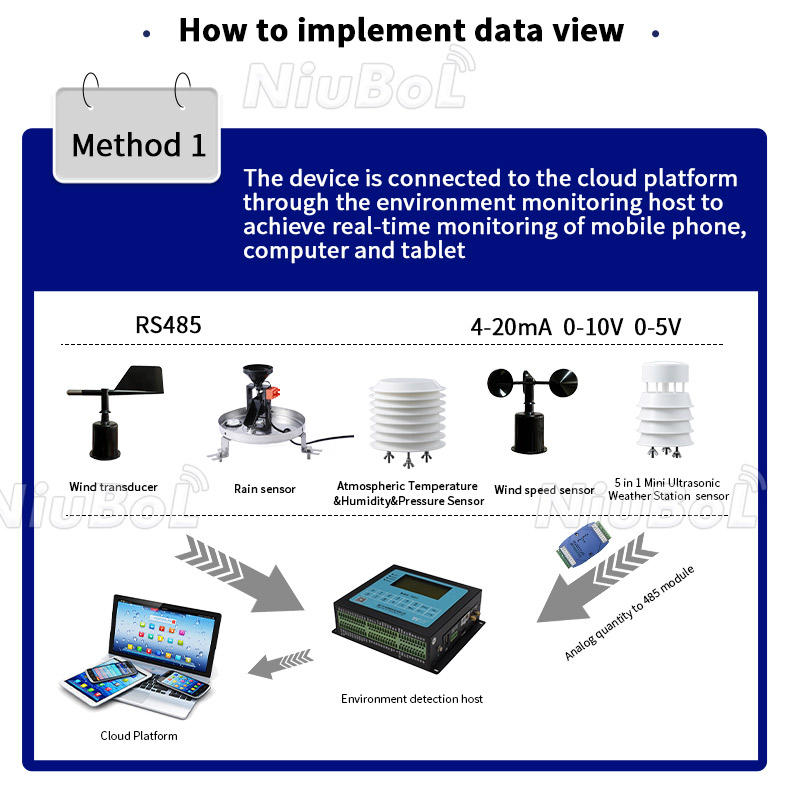
In the RS485 version, the NBL-W-LBTH can connect to compatible PLCs, environmental monitoring data loggers and communication gateways using Modbus RTU.
An external gateway may transmit measurements to a platform or private server through its supported 4G, Ethernet or Wi-Fi connection. The sensing unit does not contain an independent Internet connection.
The standard NiuBoL monitoring platform supports viewing measurement data; SMS and email alarm notifications are not included in its standard functionality.
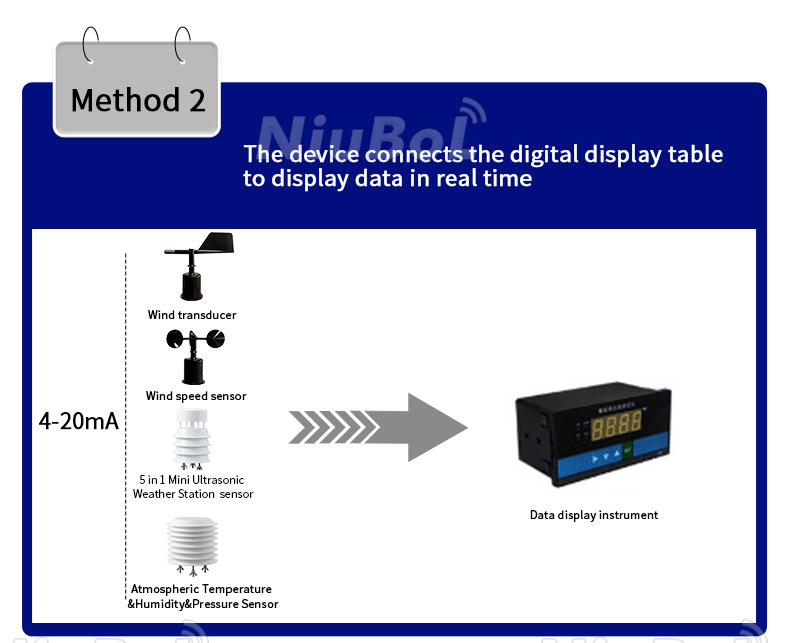
A compatible local display or controller can present RH and temperature readings. The receiving equipment must support the selected electrical interface and data scaling.
RS485 and 4–20mA are alternative sensor configurations. A display intended for analog current signals cannot be assumed to read the RS485 version directly.
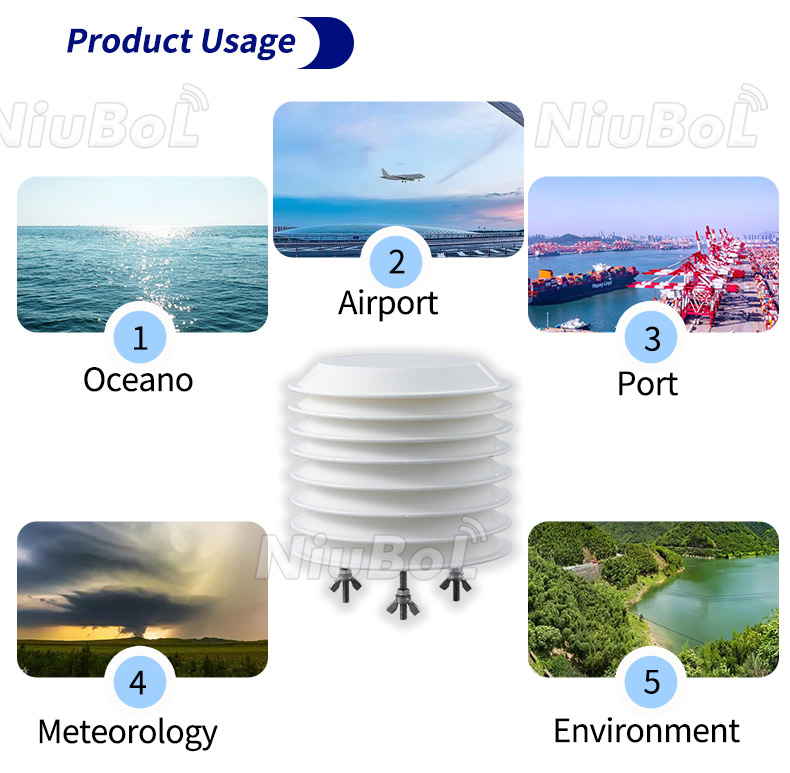
Air humidity measurements are useful in weather stations, greenhouses, storage facilities, ports, environmental observation and industrial projects. Requirements for accuracy, protection, calibration and installation differ across these applications.
For greenhouse monitoring, locate sensors in representative growing zones. For a formal meteorological observation, use suitable exposure and documented measurement height. For industrial processes, evaluate conditions near the materials or equipment of interest.
| Issue | Possible Effect | Practical Check |
|---|---|---|
| Direct sunlight or nearby heat | Temperature bias changes reported RH | Use suitable shielding and location |
| Persistent condensation | Response may be temporarily affected near saturation | Inspect moisture exposure and allow recovery |
| Poor airflow | Measurements may not represent ambient conditions | Review shelter and ventilation |
| Contamination or aging | Measurement drift or slow response | Inspect, maintain and calibrate as required |
| Incorrect software scaling | Wrong displayed RH or pressure | Check Modbus registers, units and scaling |
| Confusing RH and soil moisture | Misleading agricultural decisions | Use %RH for air and % VWC for soil |
Specify the required RH and temperature measurement ranges and accuracy.
Confirm whether atmospheric pressure is also required.
Select an outdoor radiation shield or a suitable process enclosure.
Check RS485 Modbus RTU versus analog output compatibility.
Consider cable routing, power supply, measurement intervals and calibration.
For remote monitoring, specify the gateway, network and data destination separately.
It indicates atmospheric moisture conditions relative to saturation and helps interpret greenhouse, weather, storage and industrial environments.
Yes. RH depends on the saturation vapor pressure at the measured temperature, so temperature changes can alter RH even when water vapor content does not change.
No. Air RH is expressed in %RH, whereas volumetric soil water content is generally expressed in % VWC or m³/m³.
It indicates saturation under the specified temperature conditions. Condensation may occur when a surface reaches or falls below the relevant dew point.
Vapor pressure deficit is the difference between saturation and actual water vapor pressure, commonly derived from temperature and RH.
It measures air temperature, relative humidity and barometric pressure.
Yes. An RS485 Modbus RTU version is available, as well as a selected 4–20mA configuration.
It provides measurement data. Automatic fan operation requires a compatible external controller and actuator.
Use suitable radiation shielding, representative location and adequate airflow; avoid nearby heat and direct water spray.
Specify measurement range, accuracy, outdoor or indoor conditions, power supply, interface, cable requirements and quantity.
The NBL-W-LBTH instruction manual includes measurement specifications, wiring, installation guidance and RS485 Modbus RTU communication information.
NBL-W-LBTH-Atmosphere-temperature-humidity-and-pressure-sensor-instruction-manual-V4.0.pdf
For product details, visit the NBL-W-LBTH Temperature, Humidity and Pressure Sensor. Explore Weather Station Sensors or contact NiuBoL to discuss sensor compatibility and quantity.
Prev:How Much Power Does a Weather Station Use? Solar & Battery Guide
Next:What Does a Meteorological Station Do? 8 Main Functions
Related recommendations
Sensors & Weather Stations Catalog
 Agriculture Sensors and Weather Stations Catalog-NiuBoL.pdf
Weather Stations Catalog-NiuBoL.pdf
Agriculture Sensors Catalog-NiuBoL.pdf
Water Quality Sensor Catalog-NiuBoL.pdf
Related products
 Combined air temperature and relative humidity sensor
 TDR Soil Moisture & Temperature Sensor for irrigation| RS485 |4-20mA| NBL-S-THR
 Soil pH sensor RS485 soil Testing instrument soil ph meter for agriculture |NBL-S-PH
 Wind Speed sensor Output Modbus/RS485/Analog/0-5V/4-20mA
 0.2mm Tipping Bucket Rain Gauge for Weather & Hydrology | NiuBoL
 Pyranometer Solar Radiation Sensor 4-20mA/RS485


Screenshot, WhatsApp to identify the QR code
WhatsApp number:+8615367865107
(Click on WhatsApp to copy and add friends)

