





— Blogs —
—Products—
 Consumer hotline +8618073152920
WhatsApp:+8615367865107
Address:Room 102, District D, Houhu Industrial Park, Yuelu District, Changsha City, Hunan Province, China
Product knowledge
Time:2023-07-23 10:20:32 Popularity:3543
Wind speed and direction sensors for agriculture are important agrometeorological monitoring instruments used to observe airflow conditions around agricultural fields, orchards, greenhouses and other farming environments.
Wind speed indicates how fast the air is moving, while wind direction identifies where the wind is coming from. Together, these measurements provide information relevant to crop spraying, windborne pest and disease risk, pollination, irrigation management and agricultural climate assessment.
Wind monitoring is particularly useful when combined with air temperature, relative humidity, rainfall, solar radiation and soil moisture measurements. However, wind data alone cannot determine crop health, predict all weather hazards or guarantee improved agricultural yields.
This article explains the main agricultural uses of wind speed and direction measurements, common wind monitoring instruments, installation considerations and the integration of wind sensors with automatic weather stations.
A wind speed sensor, also called an anemometer, measures the speed of airflow. Wind speed is commonly expressed in meters per second (m/s), kilometers per hour (km/h) or miles per hour (mph).
A wind direction sensor, commonly called a wind vane, measures the direction from which the wind originates. Meteorological wind direction is normally expressed in degrees clockwise from true north.
For example, a wind direction of 90° means the wind comes from the east and moves generally toward the west.
Traditional agricultural weather stations may use a separate cup anemometer and wind vane. Other systems may use an integrated ultrasonic wind speed and direction sensor.
These instruments can provide measurements to compatible data loggers, PLCs, weather station controllers and monitoring gateways.
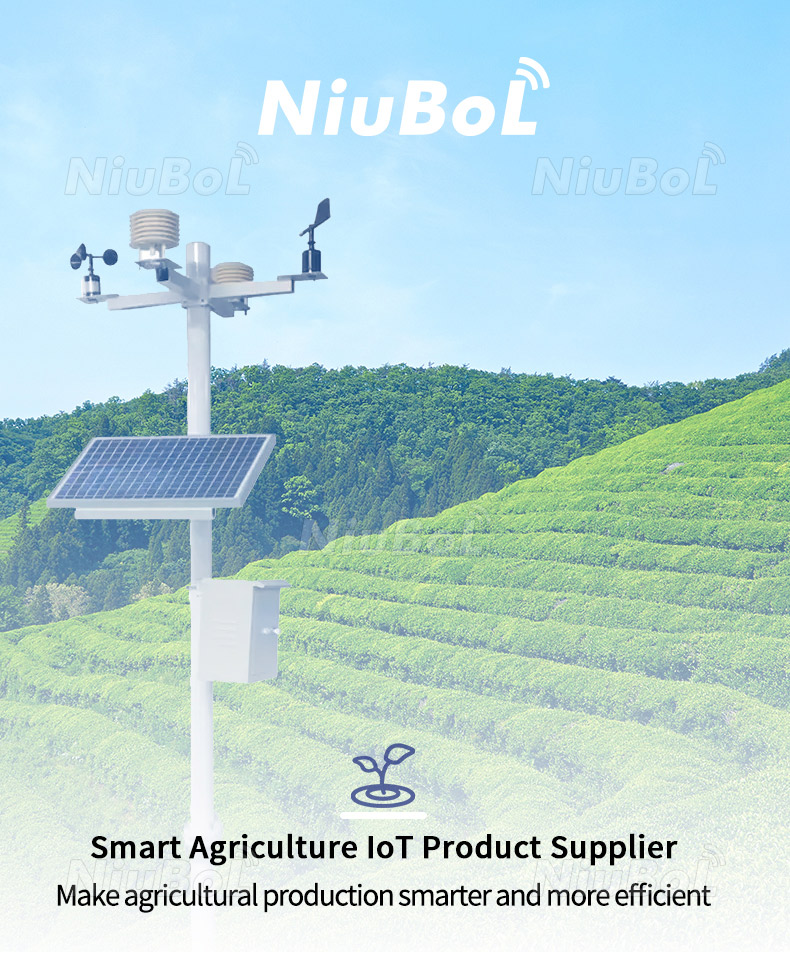
The following original NiuBoL image shows a solar-powered agricultural weather station installed in a plantation environment.
Wind influences several processes affecting agricultural production, including the transport of airborne particles, plant transpiration, evaporation and the movement of agricultural sprays.
The effect of wind depends on its speed, direction, variability, surrounding vegetation, field layout and other meteorological conditions.
| Agricultural Application | Importance of Wind Speed | Importance of Wind Direction |
|---|---|---|
| Pest and Disease Management | Describes airflow conditions relevant to transport | Helps identify potential downwind movement |
| Crop Pollination | Influences pollen transport under suitable conditions | Provides information about prevailing airflow |
| Irrigation Management | Affects evaporation and sprinkler spray drift | Helps evaluate the direction of water distribution |
| Crop Climate Assessment | Supports evaluation of local wind exposure | Helps characterize prevailing wind patterns |
Wind measurements should be interpreted as environmental observations. They are not direct measurements of disease occurrence, pollination success, irrigation efficiency or crop yield.
Wind can contribute to the movement of certain insects, fungal spores and other airborne biological particles.
Wind speed and direction measurements provide environmental information that can support agricultural pest and disease risk assessment.
Some insect species may be transported or dispersed by airflow. Their movement depends on the insect species, behavior, atmospheric conditions and surrounding environment.
Wind direction observations can help describe potential transport paths, while wind speed provides information about the airflow conditions.
However, wind measurements alone cannot predict the presence, population size or arrival time of a particular pest.
Direct pest observation, biological knowledge and appropriate monitoring methods remain necessary.
Some plant pathogens produce spores that can be carried by the wind.
Wind observations may contribute to disease-risk studies when combined with other factors such as temperature, humidity, rainfall, leaf wetness and crop susceptibility.
A wind sensor does not detect pathogens or diagnose crop diseases.
Wind speed and direction are important considerations during pesticide spraying.
Moving air can carry spray droplets away from the intended treatment area. This process is known as spray drift.
Wind direction helps identify areas potentially affected downwind of an application, while wind speed contributes to the evaluation of spray drift conditions.
However, drift risk also depends on droplet size, spray pressure, nozzle design, boom height, temperature, humidity, atmospheric stability and other factors.
There is no single wind speed threshold that is suitable for every pesticide or spraying method. Operators should follow the applicable pesticide label, local regulations and equipment instructions.
Wind conditions can differ between a regional weather station and the actual spraying location.
Vegetation, buildings, terrain and crop height can influence local airflow.
Where spraying decisions require field-level measurements, use a suitable instrument at a representative monitoring location and follow the relevant application procedure.
Wind plays an important role in the pollination of some plant species.
In wind-pollinated crops, airborne pollen may be transported between flowers or plants as part of the reproductive process.
The movement and deposition of pollen depend on wind conditions, pollen properties, plant structure, flowering stage and surrounding vegetation.
Wind pollination is important in crops such as maize and various cereal species.
Wind speed and direction observations can help characterize airflow during flowering and pollen release.
However, monitoring wind does not directly measure pollen viability, fertilization or eventual seed production.
Wind affects the transport and deposition of airborne pollen.
Very weak airflow, turbulent conditions and strong winds can have different effects depending on crop characteristics and field conditions.
It is not correct to assume that increasing wind speed always improves pollination.
Wind observations may be used alongside temperature, humidity, flowering observations and other agronomic information.
For crops primarily pollinated by insects, such as many fruit crops, insect activity and other biological factors are also important.
A wind sensor should therefore be considered a supporting environmental instrument rather than a direct pollination measurement device.
Wind speed and direction are relevant to irrigation because moving air influences evaporation, evapotranspiration and the distribution of water from certain irrigation systems.
These effects are particularly important for sprinkler irrigation and other methods that release water into the air.
Wind can alter the movement of water droplets from a sprinkler.
Under windy conditions, irrigation water may be carried away from the intended distribution pattern.
This can contribute to uneven irrigation coverage or additional losses, depending on the sprinkler design, water pressure, droplet characteristics and installation conditions.
Wind direction provides information about the direction in which droplets may be displaced.
Wind affects aerodynamic exchange between the land surface and the surrounding atmosphere.
Wind speed is therefore an important input for certain reference evapotranspiration calculations.
For example, the FAO Penman-Monteith method uses wind speed at a reference height of 2 m, together with temperature, humidity and radiation data, to estimate reference evapotranspiration (ETo).
If measurements are taken at another height, an appropriate conversion method may be needed for the calculation.
The calculated reference evapotranspiration is not necessarily equal to the actual water requirement of a specific crop.
Wind measurements provide information about atmospheric conditions, while soil moisture sensors provide information about water content near the installed probes.
Combining these observations with rainfall, temperature and other relevant data can support irrigation management.
However, a wind sensor does not directly measure soil water content or independently control irrigation valves.
| Instrument | Measured Information | Possible Use |
|---|---|---|
| Wind Speed Sensor | Wind speed in m/s | Evaluate conditions affecting sprinkler distribution |
| Wind Direction Sensor | Wind direction in degrees | Assess prevailing airflow direction |
| Rain Gauge | Rainfall accumulation | Record incoming precipitation |
| Soil Moisture Sensor | Soil volumetric water content | Observe root-zone moisture conditions |
| Air Temperature and Humidity Sensor | Temperature and relative humidity | Characterize atmospheric conditions |
These measurements can be collected by a compatible agricultural data acquisition system. Automated irrigation decisions require suitable software, controllers and actuators.
Wind conditions vary with location, terrain, vegetation and season.
Wind speed and direction measurements can help describe the local climate conditions experienced by agricultural fields and plantations.
Fields on exposed ridges, slopes or open plains may experience different wind conditions from sheltered areas.
Local wind observations can contribute to evaluating the environmental exposure of planting sites.
Such assessments should also consider temperature, rainfall, soil properties, water availability and other agronomic requirements.
Strong winds can contribute to physical damage in susceptible crops, depending on crop structure, growth stage and other conditions.
Possible effects include mechanical stress, lodging or damage to exposed plant parts.
The actual risk depends on crop characteristics and cannot be determined using a single universal wind speed threshold.
Wind direction observations may help characterize prevailing airflow when evaluating shelterbelts or windbreak arrangements.
However, effective windbreak design also depends on vegetation height, porosity, spacing, terrain and the intended protected area.
Repeated wind observations can contribute to seasonal and long-term agricultural meteorological datasets.
For comparable records, the instrument height, monitoring location, surrounding obstacles and data processing methods should be documented.
A short observation period from one sensor should not be treated as a complete description of the long-term wind climate.
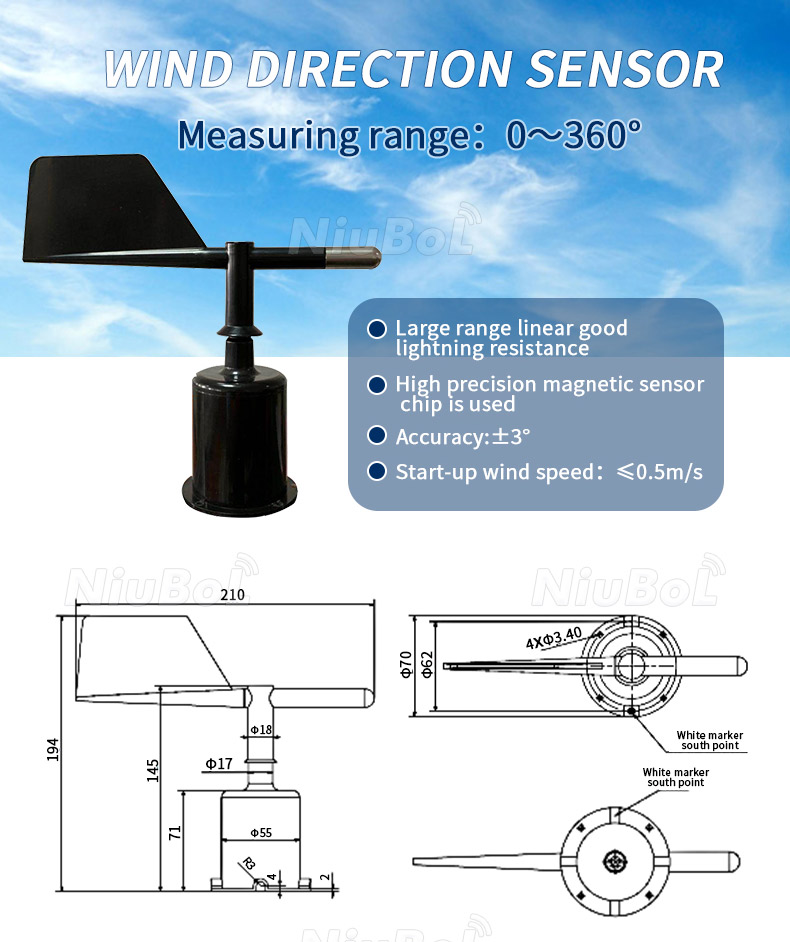
Agricultural weather monitoring systems may use mechanical or ultrasonic wind measurement instruments.
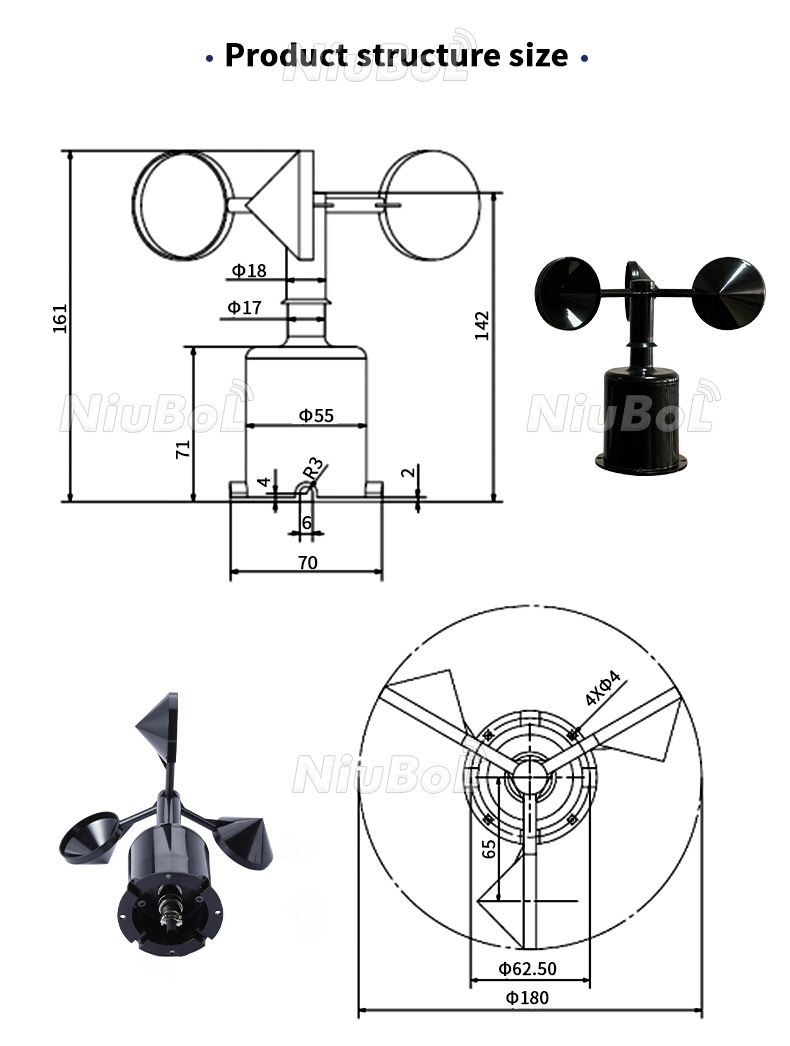
A cup anemometer normally has three cups attached to horizontal arms rotating around a vertical shaft.
Wind produces aerodynamic torque on the cups, causing the rotor to turn.
The sensor detects rotation and converts it into wind speed using a calibrated relationship.
The NiuBoL NBL-W-SS Wind Speed Sensor uses this measurement approach.
A mechanical wind vane turns in response to the horizontal direction of airflow.
The internal sensing mechanism measures the vane orientation and converts it into a wind direction value.
The NiuBoL NBL-W-DS Wind Direction Sensor uses a low-inertia ABS wind vane and magnetic position sensing.
Ultrasonic wind sensors use acoustic measurements between transducers to determine horizontal wind components.
A suitable two-dimensional ultrasonic instrument can measure both wind speed and direction without rotating cups or a mechanical wind vane.
However, accuracy, measurement range, output interfaces and environmental limitations depend on the specific model.
Ultrasonic sensors also require appropriate inspection and maintenance, particularly where contamination, precipitation or icing can affect their measurement paths.
NiuBoL supplies separate mechanical wind speed and direction sensors and compatible integrated ultrasonic instruments for weather monitoring applications.
The following specifications provide examples of two mechanical measurement instruments.
| Parameter | NBL-W-SS | NBL-W-DS |
|---|---|---|
| Sensor Type | Three-Cup Anemometer | Mechanical Wind Vane |
| Measured Parameter | Wind Speed | Wind Direction |
| Measurement Range | 0–45 or 0–70 m/s | 0–360° |
| Accuracy | ±(0.3 + 0.03V) m/s, where V is wind speed | ±3° |
| Starting Wind Speed | ≤0.5 m/s | ≤0.5 m/s |
| Output Options | RS485, 4–20 mA, voltage or pulse | RS485, 4–20 mA or 0–5 V |
| Supply Voltage | DC 5 V or DC 12–24 V, depending on version | DC 5 V or DC 12–24 V, depending on version |
| Protection Rating | IP65 | IP45 |
| Standard Cable Length | 2.5 m, customizable | 2.5 m, customizable |
These are model-specific specifications. The selected electrical output, measuring range and supply voltage must be confirmed for the ordered sensor version.
RS485, analog current, analog voltage and pulse signals are alternative output configurations, not simultaneous standard outputs.
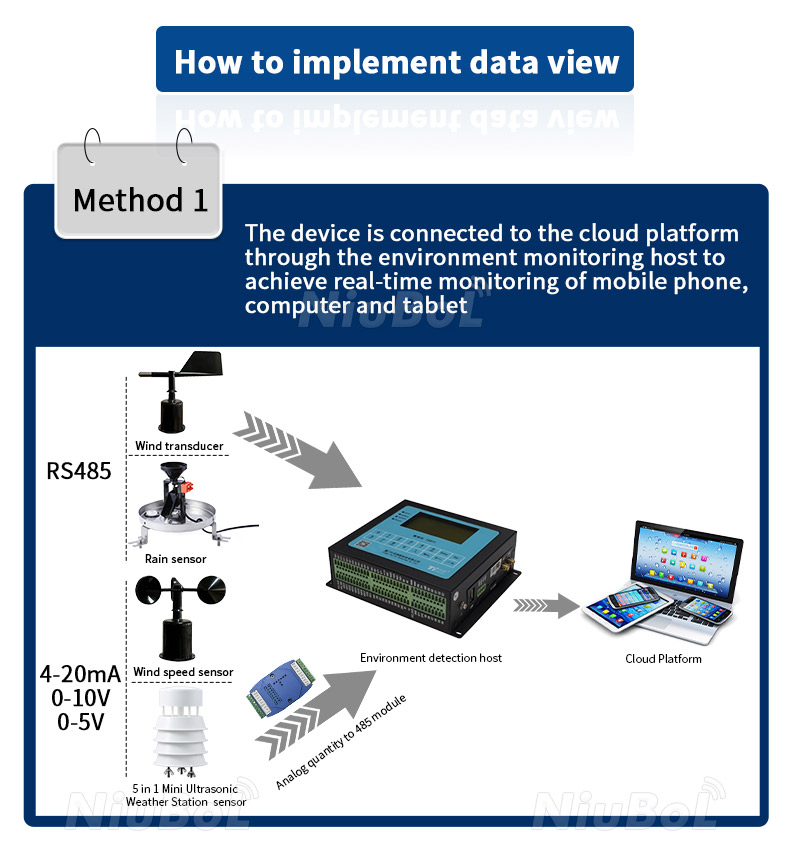
Wind sensors can be connected to data loggers, PLCs, RTUs and compatible IoT gateways.
The receiving equipment must support the sensor's electrical output and communication protocol.
RS485 Modbus RTU wind sensors provide digital readings to a compatible Modbus master.
The data logger or gateway must use the correct device address, baud rate, register map and scaling.
Multiple compatible Modbus devices can share a properly designed RS485 bus when their addresses and electrical conditions are suitable.
Analog wind sensors require matching current or voltage inputs.
Pulse-output instruments require a compatible pulse or frequency input.
An RS485-only gateway interface cannot directly read every analog or pulse sensor without additional appropriate input equipment.
For remote observation, a compatible gateway can transmit collected weather measurements through an available network connection to a server or monitoring platform.
A typical architecture is:
Wind Sensors → Data Logger / Gateway → Network → Monitoring Platform
Network communication, data storage and alarms depend on the selected gateway and software configuration.
Wind sensors themselves do not independently provide 4G communication, cloud storage, agricultural forecasting or automatic warning services.
The following original NiuBoL diagram illustrates how RS485 and analog meteorological instruments can be connected to a compatible environmental monitoring host.
Although this article focuses on agriculture, the same measurement principles are used in other environmental monitoring applications.
The main applications include meteorological observation, airports, ports, coastal monitoring, industrial facilities and wind energy studies.
Different industries may have different accuracy, calibration, reporting and installation requirements.
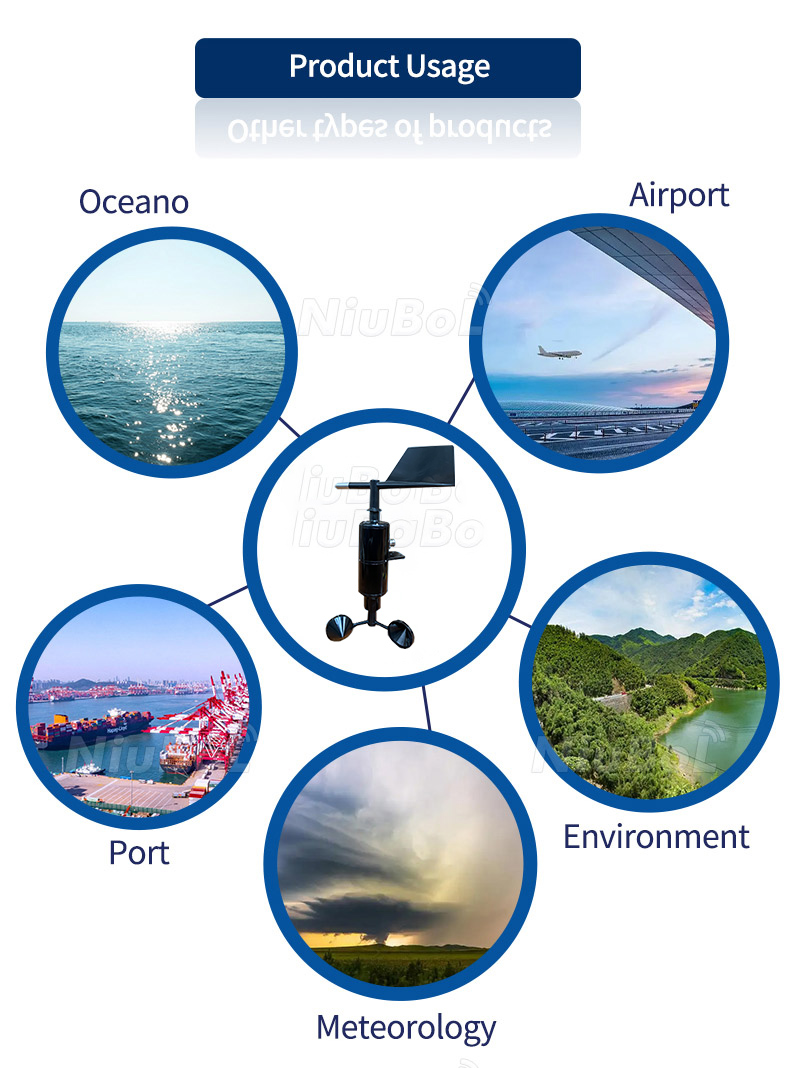
The following original NiuBoL illustration shows applications of mechanical wind speed and direction sensors in meteorology, environmental monitoring, airports, ports and marine environments.
Correct installation is important because wind measurements are affected by sensor height, nearby obstacles and local airflow conditions.
Install the wind sensor where its observations are representative of the intended agricultural monitoring area.
Avoid unnecessary obstruction from buildings, trees, walls and mounting equipment.
In orchards and fields with tall vegetation, airflow near the crop canopy may differ from the conditions measured at an open reference location.
The measurement height depends on the project.
Standard meteorological wind observations commonly use a reference height of approximately 10 m above ground, while agricultural studies and field operations may use other specified heights.
For crop evapotranspiration calculations, the FAO reference method uses wind speed at 2 m or wind measurements converted appropriately to that reference height.
For field spraying, the relevant observation point and procedure should follow the applicable operational guidance.
Mechanical and ultrasonic wind direction sensors require correct orientation according to their installation instructions.
The NBL-W-DS uses a manufacturer-defined orientation reference.
Incorrect alignment can create a systematic wind direction error.
Check cups, wind vanes, bearings, mounting hardware and electrical connections periodically.
Dust, insects, wear, ice or physical damage may affect sensor operation.
For ultrasonic instruments, inspect the housing and acoustic measurement paths for contamination or obstruction.
Wind speed may vary considerably over short periods.
Define whether the agricultural monitoring project requires instantaneous readings, average wind speed, maximum wind speed or gust-related observations.
Wind direction values are circular quantities. For example, 350° and 10° are both close to north and should not be averaged using ordinary arithmetic.
Use an appropriate circular or vector averaging method where average direction is required.
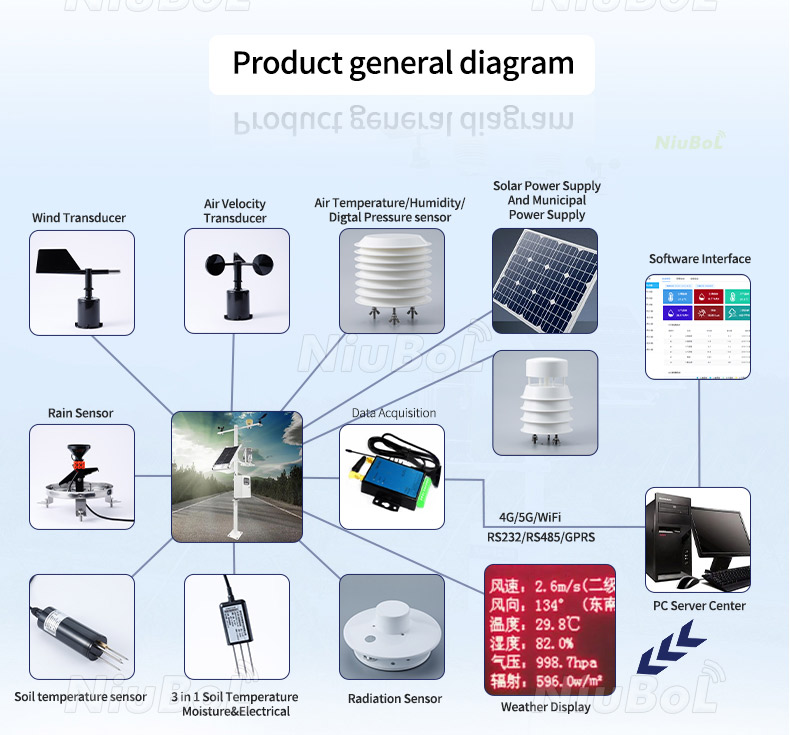
A wind speed and direction monitoring system may be part of a larger automatic agricultural weather station.
Other measurement instruments can include air temperature and humidity sensors, rainfall gauges, solar radiation sensors and soil monitoring equipment.
The required configuration depends on the crops, farming operations and monitoring objectives.
| Component | Function |
|---|---|
| Wind Speed Sensor | Measures wind speed at the monitoring location |
| Wind Direction Sensor | Measures horizontal wind direction |
| Air Temperature and Humidity | Monitors local atmospheric conditions |
| Rain Gauge | Measures precipitation accumulation |
| Solar Radiation Sensor | Measures solar irradiance for suitable applications |
| Soil Moisture Sensor | Provides soil water content measurements at the installed depth |
| Data Logger / Gateway | Collects and may transmit compatible sensor data |
| Power Supply | Provides electrical energy to the monitoring equipment |
Solar-powered systems require suitable panel, battery and charge controller sizing based on the complete station's electrical load and installation conditions.
The following original NiuBoL diagram illustrates the main components of a configurable weather monitoring station, including meteorological sensors, agricultural sensors, data acquisition equipment, power supply and software.
Before choosing a wind monitoring instrument, confirm the required measurements and the conditions under which the equipment will operate.
| Selection Factor | What to Confirm |
|---|---|
| Monitoring Purpose | Spraying, irrigation, crop microclimate or general weather monitoring |
| Measured Parameters | Wind speed, wind direction or both |
| Measurement Range | Expected local wind conditions and required maximum range |
| Accuracy and Response | Required measurement error and observation interval |
| Sensor Technology | Mechanical or ultrasonic measurement |
| Output Interface | RS485 Modbus RTU, analog or pulse as applicable |
| Power Supply | Available voltage and actual sensor consumption |
| Installation Conditions | Measurement height, terrain, crop canopy and obstructions |
| Data Collection | PLC, data logger, gateway and monitoring software requirements |
For an agricultural weather station, mechanical wind sensors may be suitable where separate wind speed and direction instruments are acceptable.
An integrated ultrasonic instrument may be considered when compact installation or elimination of moving wind-sensing parts is important.
The final selection should be based on the actual product specifications rather than a general assumption that one technology is always better.
A1: They provide environmental information relevant to crop spraying, windborne pest movement, wind pollination, irrigation distribution and local agricultural climate conditions.
A2: Wind speed is one of the factors used to evaluate spray drift risk. Spraying decisions must also account for wind direction, droplet size, temperature, humidity, atmospheric stability and applicable product instructions.
A3: No. Wind sensors measure airflow conditions. Their observations may support pest or disease risk assessment, but direct biological monitoring is required to detect pests and pathogens.
A4: No. Wind influences pollen transport in wind-pollinated crops, but pollination success depends on crop biology, flowering conditions, pollen properties and other factors.
A5: Wind can change the movement and distribution of sprinkler droplets, potentially contributing to uneven coverage and water loss under certain conditions.
A6: The FAO Penman-Monteith reference evapotranspiration method uses wind speed at a standard reference height of 2 m. Measurements taken at other heights may need appropriate conversion.
A7: A standard cup anemometer measures wind speed. Wind direction requires a separate wind vane or a suitable combined instrument.
A8: Not universally. Ultrasonic sensors eliminate rotating wind-sensing parts, while mechanical sensors use established measurement principles. The choice depends on accuracy, cost, site conditions and maintenance needs.
A9: Yes. NiuBoL supplies RS485 Modbus RTU versions of wind speed and direction sensors for connection to compatible data loggers, PLCs and gateways.
A10: A typical system requires wind sensors, suitable data acquisition equipment, power supply and a communication gateway connected to a compatible server or monitoring platform.
Wind speed and direction measurements provide valuable environmental information for agricultural meteorology.
Their main applications include pest and disease risk assessment, wind-related crop pollination, irrigation management and the evaluation of agricultural climate conditions.
However, wind observations are supporting environmental data rather than direct measurements of crop health, disease occurrence, pollen fertilization or soil water availability.
For reliable agricultural monitoring, wind sensors should be selected according to the required measurement range, accuracy, installation conditions and data acquisition system.
NiuBoL supplies NBL-W-SS wind speed sensors, NBL-W-DS wind direction sensors and related weather monitoring equipment for agricultural and environmental monitoring applications.
For project-specific equipment selection and integration, contact NiuBoL with the required wind parameters, measurement range, output interface, installation environment and data collection requirements.
Prev:Rainfall recorder for environmental meteorological instruments used in rice cultivation
Next:Commonly used rainfall monitoring equipment, value of for agriculture
Related recommendations
Sensors & Weather Stations Catalog
 Agriculture Sensors and Weather Stations Catalog-NiuBoL.pdf
Weather Stations Catalog-NiuBoL.pdf
Agriculture Sensors Catalog-NiuBoL.pdf
Water Quality Sensor Catalog-NiuBoL.pdf
Related products
 Combined air temperature and relative humidity sensor
 TDR Soil Moisture & Temperature Sensor for irrigation| RS485 |4-20mA| NBL-S-THR
 Soil pH sensor RS485 soil Testing instrument soil ph meter for agriculture |NBL-S-PH
 Wind Speed sensor Output Modbus/RS485/Analog/0-5V/4-20mA
 0.2mm Tipping Bucket Rain Gauge for Weather & Hydrology | NiuBoL
 Pyranometer Solar Radiation Sensor 4-20mA/RS485


Screenshot, WhatsApp to identify the QR code
WhatsApp number:+8615367865107
(Click on WhatsApp to copy and add friends)

