





— Blogs —
—Products—
 Consumer hotline +8618073152920
WhatsApp:+8615367865107
Address:Room 102, District D, Houhu Industrial Park, Yuelu District, Changsha City, Hunan Province, China
Product knowledge
Time:2022-09-22 20:42:47 Popularity:2136
Quick Answer: An agricultural IoT system can monitor field conditions, store records, issue alarms and, with separate control hardware, operate irrigation or ventilation equipment. Monitoring and automatic control should be specified as different scopes. The deciding question is not whether a value appears on a phone, but which device is authorized to act on that value and how the physical result is checked.

Monitoring records physical conditions. Alarming compares a valid value with a rule and notifies a responsible person. Decision support combines records with crop, equipment or operating information. Automatic control sends a command to an actuator and verifies the resulting state. These functions can share one platform, but they do not have the same hardware, safety or acceptance requirements.
A temperature sensor can support a greenhouse ventilation decision, yet automatic fan control also needs relays or a controller, equipment status and an approved response to sensor failure. A soil-moisture reading can support irrigation scheduling, yet reliable valve operation needs output hardware, hydraulic feedback and local interlocks. Keeping these boundaries explicit prevents a monitoring quotation from being mistaken for a complete automation scope.
| Function | What the system does | What it does not establish |
|---|---|---|
| Monitoring | Measures and records a named variable at a defined location. | That the entire field has the same condition. |
| Alarming | Notifies an assigned person when an approved rule is met. | That anyone has received or acted on the notification. |
| Decision support | Combines measurements with the farm's operating method. | That a weather or soil value alone determines the agronomic response. |
| Automatic control | Commands equipment through a controller and checks the response. | That a remote command was physically completed merely because it was transmitted. |
Before selecting a platform, prepare a point list for every measured and controlled variable. For each point, record the sensor model or required range, engineering unit, location, sampling interval, alarm rule and whether it is used for information or control. For outputs, state the actuator, normal state, feedback signal, interlock and manual operating method. Use the point list to agree responsibilities between sensor suppliers, panel builders and software integrators.
For an irrigation block, the operating question may be whether water reaches the active root zone after a scheduled application. That needs a representative soil measurement and an irrigation event record. If the requirement becomes automatic irrigation, the list must also identify the valve, pump permissions, hydraulic feedback and stopping conditions. Adding a cellular modem does not supply any of those missing items.
For greenhouse ventilation, separate the measured air temperature from the fan command and fan-running feedback. If only the command is recorded, an open breaker or failed contactor can leave the screen showing ventilation while no air moves. Include the relevant equipment feedback in the control design rather than trying to diagnose every mechanical fault from the temperature trend.
Weather, soil, greenhouse and water sensors provide measurements to a data logger, PLC or RTU. The acquisition device timestamps and stores readings before a compatible gateway sends them to the application. RS485 Modbus RTU links field devices locally. Cellular, Ethernet or another network connection supplies the remote path; the selected hardware must support the required server interface.
The NiuBoL NBL-S-TMC soil sensor combines soil temperature, volumetric moisture and conductivity. It can provide inputs to root-zone review without implying that it contains a valve controller. An NBL-W-LBTH air sensor provides temperature, humidity and pressure for a different observation purpose. Keep soil and air channels distinct even when both use RS485.
| NBL-S-TMC item | Specification or order requirement | Use in the system |
|---|---|---|
| Soil temperature | -40 to 80 degrees C; accuracy +/-0.5 degrees C | Root-zone thermal record, not air-temperature substitution. |
| Volumetric moisture | 0-100%; resolution 0.1% | Set site-specific thresholds from soil and crop conditions. Agree the moisture accuracy basis for acceptance. |
| Conductivity | 0-10000 uS/cm; accuracy +/-5% | Interpret with moisture and temperature rather than converting directly to a fertilizer dose. |
| Supply | 5-24 VDC or 12-24 VDC, depending on version | Match the ordered version to the field supply. |
| Output | RS485 Modbus | Map actual registers and units in the acquisition device. |
| Probe assembly | IP68; black flame-retardant epoxy sealing; 5 m default cable | Protect extensions and specify the exposed cable jacket and length separately. |
| Operating environment | -40 to 85 degrees C | This is not an expanded soil-temperature measurement range. |
| Electrical load | Obtain operating and startup current for each selected device. | Size supply and switching capacity for the complete field panel. |
Here, uS/cm means microsiemens per centimeter. Soil conductivity is affected by the available water and salt distribution; it is not a direct nitrogen, phosphorus or potassium measurement. A probe with an air gap, disturbed backfill or a position outside the wetted area may produce a repeatable value that does not represent the managed root zone. Check the installation before changing a control threshold.
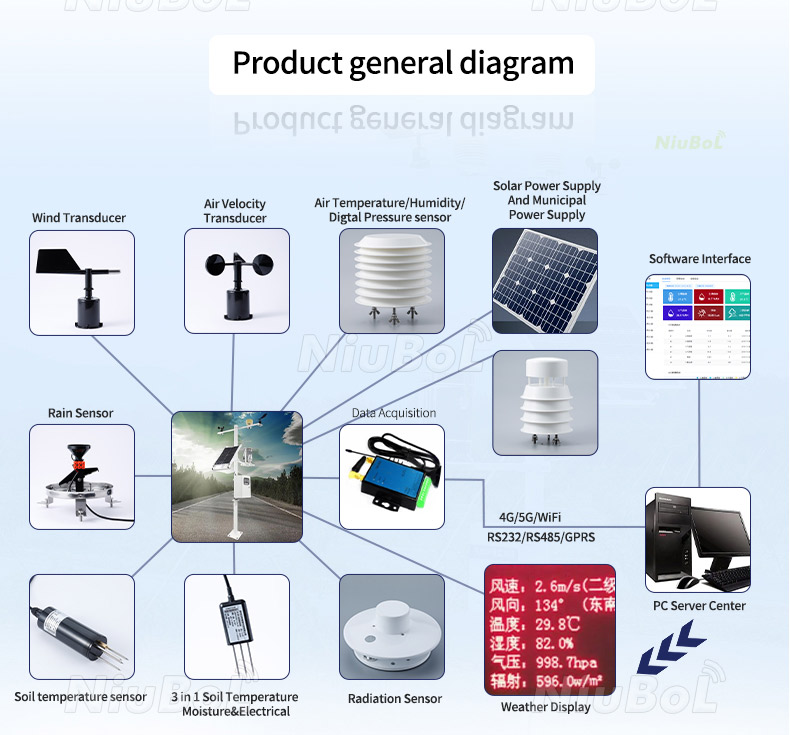
Consider a design example in which a farm manager requests irrigation from the platform. The platform should identify the block and requested operation, while the local controller checks whether that operation is currently permitted. Those checks may include reservoir level, pump availability and any irrigation-zone restrictions defined for the site. This example describes a control sequence, not built-in logic in every NiuBoL logger.
The sequence must address delayed or repeated commands. If the network reconnects after an interruption, an old "start" request should not begin an unintended second irrigation event. Use command identity, expiry and completion status appropriate to the controller and application. The operator needs to see pending, running, completed and failed states rather than a single on/off icon with no age information.
Local manual operation also needs a defined relationship with remote control. A maintenance technician must be able to isolate equipment without a remote command unexpectedly restarting it. After maintenance, returning to automatic mode should follow the farm's approved procedure. A phone application is not a substitute for electrical isolation or equipment protection.
Confirm physical interface and application protocol separately. RS485 describes the electrical bus; Modbus RTU defines messaging, while register addresses and scaling remain device-specific. Analog 4-20 mA inputs need the correct loop arrangement and engineering conversion. Pulse and switch signals need suitable counters or digital inputs. A gateway using MQTT or HTTP does not correct a wrongly scaled field value.
For an existing PLC or SCADA system, exchange an I/O schedule, Modbus map and payload example before ordering. Define whether the supplier provides raw words, engineering values, alarm states or complete dashboards. Test one real value through the complete path. A sensor reporting 25.0 degrees C locally should not appear as 250 degrees C after a second conversion in the platform.
Agricultural IoT system integration must also preserve freshness. A last-known moisture value can remain visible during a cable fault, but it must not look like a current observation. Specify the behavior for stale, invalid and out-of-range inputs. If such an input is used for control, the local controller needs an approved response that does not depend on the unavailable connection.
| Observed condition | First distinction to make |
|---|---|
| One measurement is missing | Check that sensor, its supply and its field connection before resetting the entire platform. |
| Several bus devices disappear together | Inspect shared power, wiring and acquisition status; a common fault is more likely than simultaneous individual failures. |
| Local values update but remote values stop | Inspect gateway, network and server handling rather than recalibrating healthy sensors. |
| A command is accepted but equipment does not respond | Check permissions, output state and physical feedback separately. |
A diagnostic view should show the last valid observation time and communication status alongside the value. Define local storage capacity and retransmission if outage records matter. Receiving an old record after reconnection should restore history without making it appear to be a new event or restarting an actuator.
Remote control requires stronger access management than a read-only dashboard. Use named accounts and appropriate permissions, remove default credentials and record changes to thresholds or logic. Keep the field controller's equipment-protection rules independent of a remote login session. These requirements belong to the delivered controller and network design, not to the sensor enclosure alone.
The quotation should distinguish one-time equipment, installation, communication service, platform subscription, API access, commissioning and ongoing support. It should also state who supplies SIM cards, server hosting and user administration. These items affect operating cost but are often absent from a sensor-only quotation.
Request a demonstrated operating scenario rather than only a populated dashboard. For monitoring, trace a reading and a missing-data condition. For automatic control, test the approved sequence and its fault responses using safe simulation or controlled commissioning. Keep sensor calibration checks separate from command testing: a working relay does not validate moisture measurement, and a correct moisture value does not validate the pump circuit.
Water-source or fertigation monitoring may add pH, conductivity, temperature or other channels. The example display below shows water measurements, not a complete irrigation control panel. Include suitable water-sensor cleaning and calibration access in that subsystem. Do not assume that soil EC, water EC and a dosing command are interchangeable quantities.

No. Monitoring and remote data access can operate without control outputs. Automatic irrigation also needs a controller, hydraulic equipment, feedback and approved protection logic. Ask the quotation to identify each function rather than accepting "smart irrigation" as the scope definition.
RS485 requires compatible local acquisition. A logger or gateway must read the sensor and transmit the required payload through an available network. Confirm both interfaces and test an exported engineering value with its observation time.
Not without checking soil, probe depth, root distribution and irrigation behavior. Establish what the measured point represents before authorizing a threshold. A value from one wetted zone should not automatically command an unrelated block.
The approved local control behavior should continue or stop according to the equipment's risk assessment, not an assumed universal rule. Local logging and later retransmission can preserve measurements when specified. Old commands must not be replayed as new requests.
Compare the request, controller output and appropriate physical feedback. Valve position, pump-running status and hydraulic response answer different questions. Define the required feedback and acceptable timing for the actual equipment before commissioning.
Provide the measured and controlled point lists, layout, operating purpose, cable lengths, supply and receiving system. Identify existing controllers and the division between monitoring and control. Include required documents and service scope so equipment-only and complete-system offers are not confused.
An agricultural IoT system is useful when field measurements lead to defined observations, notifications or verified equipment actions. Keep those functions separate in the specification, select sensors for the operating question and test the actual control sequence where automation is included. NiuBoL sensing, acquisition and communication equipment can then be matched to an explicit integration requirement instead of an undefined promise of farm automation.
Prev:What is an environmental monitoring instrument
Next:Soil moisture real-time monitoring planting irrigation system
Related recommendations
Sensors & Weather Stations Catalog
 Agriculture Sensors and Weather Stations Catalog-NiuBoL.pdf
Weather Stations Catalog-NiuBoL.pdf
Agriculture Sensors Catalog-NiuBoL.pdf
Water Quality Sensor Catalog-NiuBoL.pdf
Related products
 Combined air temperature and relative humidity sensor
 TDR Soil Moisture & Temperature Sensor for irrigation| RS485 |4-20mA| NBL-S-THR
 Soil pH sensor RS485 soil Testing instrument soil ph meter for agriculture |NBL-S-PH
 Wind Speed sensor Output Modbus/RS485/Analog/0-5V/4-20mA
 Tipping bucket rain gauge for weather monitoring auto rainfall sensor RS485/Outdoor/stainless steel
 Pyranometer Solar Radiation Sensor 4-20mA/RS485


Screenshot, WhatsApp to identify the QR code
WhatsApp number:+8615367865107
(Click on WhatsApp to copy and add friends)

