





— Blogs —
—Products—
 Consumer hotline +8618073152920
WhatsApp:+8615367865107
Address:Room 102, District D, Houhu Industrial Park, Yuelu District, Changsha City, Hunan Province, China
Product knowledge
Time:2026-06-06 09:36:31 Popularity:466
Quick Answer: Pond DO and turbidity monitoring should separate an oxygen problem from the cause of cloudy water. Measure dissolved oxygen directly and interpret NTU with rainfall, feeding, aeration and the daily cycle. A high turbidity reading does not identify algae, prove oxygen depletion or justify an automatic chemical treatment. Use paired trends and targeted field checks before selecting a response.
A pond can become turbid through mineral particles, plankton, organic debris or disturbance of bottom deposits. These conditions do not have identical oxygen consequences. An NTU channel detects a change in scattering, but does not distinguish a clay pulse from an algae population or quantify the biological oxygen demand of suspended material.
FAO pond-water guidance describes the separate roles of suspended particles, photosynthesis, respiration and sampling location. The engineering implication is to pair the optical trend with an oxygen measurement rather than calculate DO from water appearance.
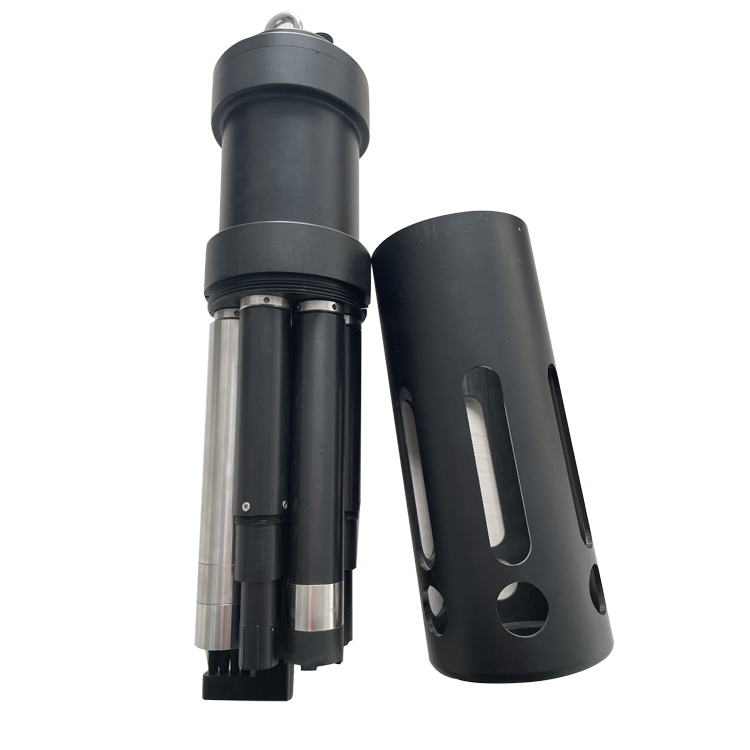
A multiparameter station can collect related observations at one point, as illustrated above. Check which channels are actually fitted, their depths and their measurement definitions. A shared enclosure does not ensure that the point represents every part of the pond or that each channel is suitable for the farm's salinity.
| Observed pattern | Useful investigation |
|---|---|
| NTU rises after rain or bank disturbance | Inspect inlet water and sediment movement; compare DO independently. Do not identify the particles as algae from NTU alone. |
| Large daily DO variation with persistent cloudy water | Compare day and night observations, temperature and pH; examine the water and use appropriate biological assessment if algae identification matters. |
| DO falls after feeding or a process upset | Check feeding records, water circulation and stock behavior; investigate oxygen demand without assuming NTU will rise in proportion. |
| NTU spikes when aeration starts | Check bubbles and resuspended material at the probe. Compare another representative position before interpreting the spike as deterioration across the pond. |
| NTU changes sharply after wiping the probe | Compare a reference and inspect window fouling. Keep cleaning events with the data instead of interpreting the step as a water-treatment result. |
If ammonia risk is also being investigated, add an appropriately defined nitrogen measurement and pH/temperature context. The ammonia nitrogen probe pictured below is a separate channel. Its reading must not be relabelled un-ionized ammonia without checking the measured quantity, analytical basis and any calculation.
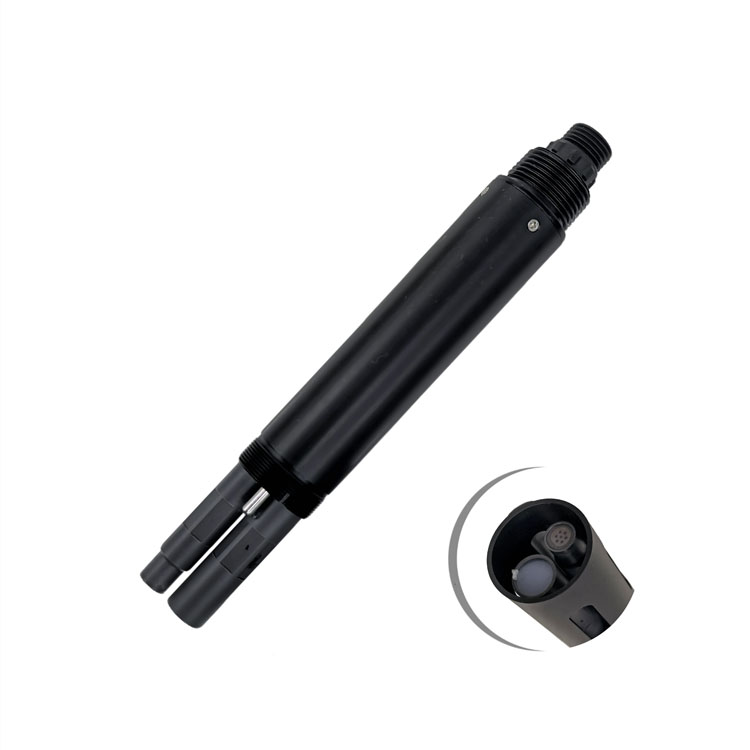
The NiuBoL NBL-WQ-DO-4A is a fluorescence-method option for a continuous oxygen channel. It differs from the basic NBL-WQ-DO and the DO-4S model. Use the exact model's range, accuracy expression and conditions when deciding whether it supports the farm's action limit.
| Item | NBL-WQ-DO-4A |
|---|---|
| Range / resolution | 0-20.00 mg/L or 0-200% saturation; 0.01 mg/L and 0.1 degrees C |
| Accuracy | +/-2% of reading; temperature +/-0.3 degrees C |
| Response / detection limit | T90 below 30 s; listed minimum detection limit 0.08 mg/L |
| Compensation | Pt1000 temperature compensation; configurable salinity compensation |
| Water conditions | 0-50 degrees C; pressure at or below 0.2 MPa |
| Output / supply | RS485 Modbus RTU; optional 4-20 mA; 12-24 V DC |
| Consumption | 0.2 W at 12 V |
| Housing / protection | POM and ABS/PC alloy; IP68 |
| Cap and cable | Cap condition requires inspection and model-specific servicing. Specify cable length, jacket suitability and routing with the installation. |
Salinity compensation uses an appropriate configured value; it does not mean the DO probe measures salinity independently. Confirm the compensation setting after a meaningful salinity change. Do not copy the basic DO model's full-scale accuracy expression into a DO-4A quotation or assume a different housing option is included.
The basic TS turbidity probe shown below measures another quantity. Choose its range from expected pond conditions and verify the optical reading; a DO sensor specification does not qualify the NTU channel.
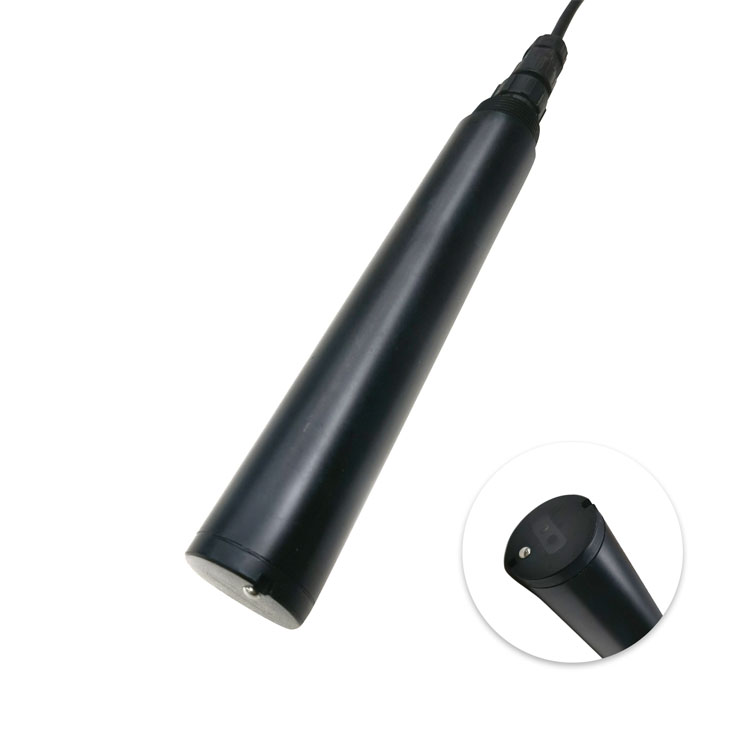
Keep the oxygen sensing region clear of direct aerator bubbles and bottom deposits while maintaining representative water exchange. A reading in the aerator plume can differ from one in poorly circulated water. Before accepting one permanent point, compare relevant depths and locations using suitable field measurements under the operating conditions that concern the farm.
Keep a position record with the trend. If operators move the probe during cleaning or after a water-level change, note the new depth and location. A changed trend may reflect the mounting change rather than an improvement in pond condition. One fixed installation cannot demonstrate that every pond or depth has the same oxygen level.
For broader channel selection, the pond monitoring priorities guide covers which parameters to include. Here the task is narrower: use DO and NTU together to investigate a specific cloudy-water event.
Configure the farm's approved DO limits and escalation procedure for its species, stocking and operating conditions. Record aerator commands and, where provided, running feedback. A start command or message delivery does not establish that the motor ran or that oxygen improved at the relevant point.
Use local control and warning functions appropriate to the risk when cloud access is unavailable. Test the actual sequence for loss of sensor communication, station power or telemetry. Keep an invalid-data condition distinct from an oxygen alarm; neither a zero substitute nor a frozen last value is a dependable measurement.
Do not trigger an algicide or other chemical treatment solely from NTU. An automatic response to the wrong cause of cloudiness can create another problem. Preserve the event record and use the farm's approved management procedure, with additional analysis where identification is necessary.
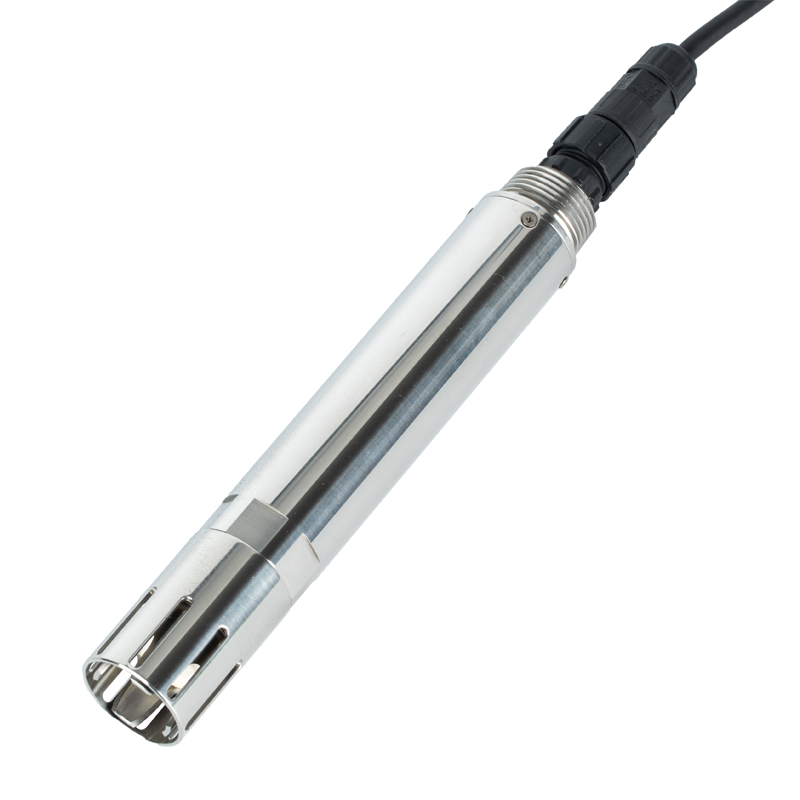
The electrode assembly below represents another type of water-quality instrument. Additional channels should be selected for a defined question, not added simply because they share an RS485 connection.
Not reliably by a universal formula. Mineral particles, plankton and organic debris can produce similar turbidity with different oxygen behavior. Measure DO directly and interpret the paired trends.
DO and turbidity trends can prompt an investigation, but do not identify algae species or toxicity. Use suitable sampling and analysis when those distinctions determine treatment.
No. The DO-4A uses a configured compensation value. Establish an appropriate salinity input separately and review it when the pond composition changes.
It may describe the local aerated water rather than the stock's wider exposure. Compare relevant locations and depths before selecting a permanent monitoring point.
Check reference agreement, representative placement, correct units and salinity setting, alarm delivery and the local response during communications failure. Confirm aerator feedback where that function is included.
Provide pond layout, depth changes, species and stocking context, fresh or saline conditions, observed cloudy-water events, existing aeration controls and power/communications availability. Separate sensors, mounting, local control and telemetry in the quotation.
Pond DO and turbidity monitoring helps operators investigate what changed without guessing from water color alone. Use an identified oxygen sensor, a suitable optical channel and representative placement, then test the farm's response to both a genuine event and missing data. Additional instruments should answer a specific unresolved question.
Prev:ORP Water Analyzer Installation: Removal, Storage and Restart Checks
Next:Chlorine Demand and Residual: Interpreting an Online HClO Reading
Related recommendations
Sensors & Weather Stations Catalog
 Agriculture Sensors and Weather Stations Catalog-NiuBoL.pdf
Weather Stations Catalog-NiuBoL.pdf
Agriculture Sensors Catalog-NiuBoL.pdf
Water Quality Sensor Catalog-NiuBoL.pdf
Related products
 Combined air temperature and relative humidity sensor
 TDR Soil Moisture & Temperature Sensor for irrigation| RS485 |4-20mA| NBL-S-THR
 Soil pH sensor RS485 soil Testing instrument soil ph meter for agriculture |NBL-S-PH
 Wind Speed sensor Output Modbus/RS485/Analog/0-5V/4-20mA
 Tipping bucket rain gauge for weather monitoring auto rainfall sensor RS485/Outdoor/stainless steel
 Pyranometer Solar Radiation Sensor 4-20mA/RS485


Screenshot, WhatsApp to identify the QR code
WhatsApp number:+8615367865107
(Click on WhatsApp to copy and add friends)

