





— Blogs —
—Products—
 Consumer hotline +8618073152920
 WhatsApp:+8615367865107
Address:Room 102, District D, Houhu Industrial Park, Yuelu District, Changsha City, Hunan Province, China
Product knowledge
Time:2026-06-06 09:36:31 Popularity:387
Quick Answer: Chlorine demand and residual describe different parts of chlorination. Demand is assessed from a known applied dose and a suitable residual measurement after defined contact conditions; an online residual sensor does not measure demand by itself. The basic NiuBoL NBL-WQ-CL reports HClO, so its reading must not be substituted directly for a required total chlorine result or a differently expressed free chlorine value.
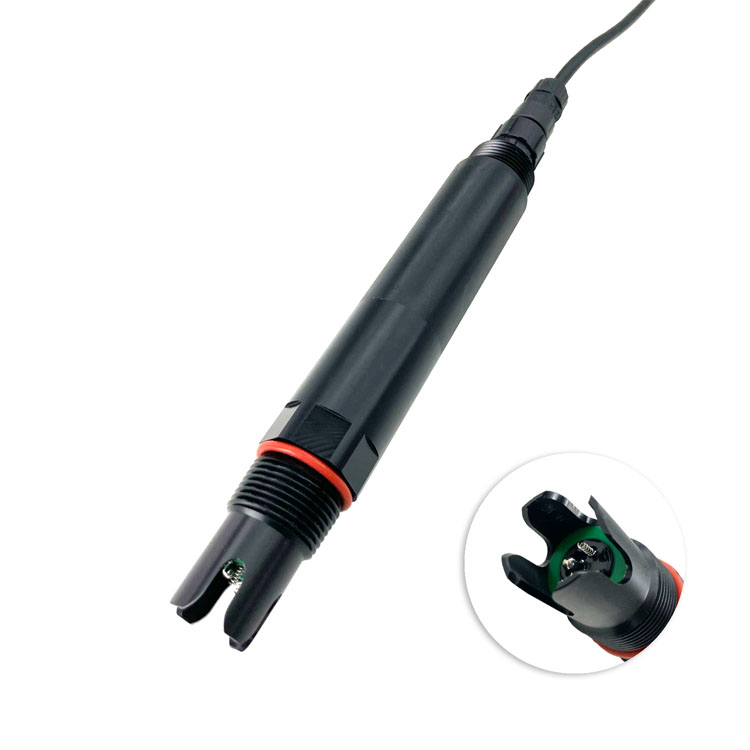
Applied dose is the chlorine added per volume of treated water, expressed on a defined available-chlorine basis. It requires chemical strength and delivered quantity as well as water flow. Pump speed alone is not a verified dose: the delivered volume and chemical concentration can differ from their nominal values.
Residual is the chlorine quantity remaining at the specified sampling point and time. State whether it is free, combined or total chlorine and which method produced the result. Free chlorine and combined chlorine are different fractions; total chlorine includes both. HClO is only part of the free-chlorine chemistry.
Demand is the difference between the dose and the appropriate residual under the stated test conditions. For an overall chlorine-demand assessment, account for the total residual rather than silently treating combined chlorine formation as complete consumption. A process trend using free residual can still be useful, but its definition must remain explicit.
Consider an illustrative test in which a known dose is 2.0 mg/L as Cl2 and the measured total residual after the defined contact interval is 0.7 mg/L on the same basis. The difference is 1.3 mg/L. That value describes those test conditions; changing the contact interval, sample or analytical quantity changes the meaning of the result.
Do not replace the total residual in that calculation with an unconverted HClO reading, a free-chlorine-only measurement or an ORP value in mV. Also do not subtract a dose setpoint from a residual measured in water that entered the system under an earlier dosing condition. Match the water, time and reporting basis.
Changing water flow creates another pitfall. The same chemical-feed rate distributed through twice the water flow gives half the nominal applied concentration, assuming unchanged chemical strength. A falling residual can therefore indicate a dosing-to-flow problem rather than an increase in water demand.
| Possible cause | Check that distinguishes it |
|---|---|
| Lower delivered dose | Check water flow, actual chemical delivery, stock strength and feed-system condition. |
| Changed demand or contact conditions | Use appropriate paired samples and a defined contact interval; review incoming water and hydraulic changes. |
| Changed pH | Compare pH and the specified chlorine fractions rather than assuming an HClO change equals the same free-chlorine change. |
| Sample-system problem | Verify flow, pressure, sample freshness, bubbles and the representativeness of the take-off. |
| Instrument or data problem | Check a suitable reference, electrode condition, calibration state and whether the PLC value is fresh and correctly scaled. |
The Drinking Water Inspectorate's chlorination guidance distinguishes chlorine chemistry and the effect of contact conditions. Residual monitoring supports operation, but a single reading is not a complete demonstration of disinfection performance or a universal water-safety certificate.
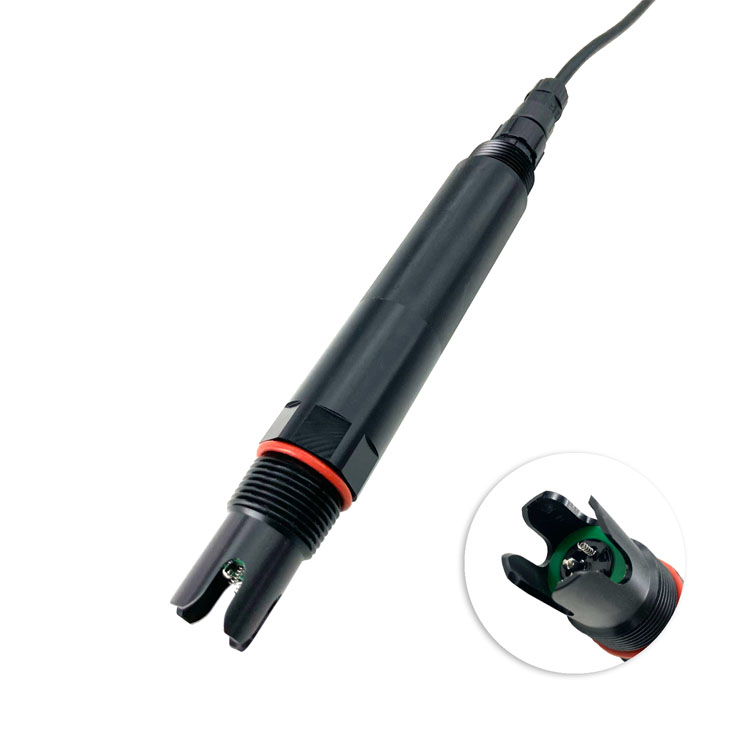
The NiuBoL NBL-WQ-CL is a constant-voltage HClO sensor for a matching flow cell. It can provide a continuous HClO trend where that quantity suits the task. It does not independently measure dose, ammonia, combined chlorine or contact time.
| Parameter | Basic NBL-WQ-CL |
|---|---|
| Range / resolution | 0-2.000 mg/L HClO / 0.001 mg/L |
| Accuracy | +/-5% or +/-0.05 mg/L for chlorine; temperature +/-0.5 degrees C. Agree the percentage basis and acceptance interpretation. |
| Sample flow / pressure | 30-60 L/h through the matching cell; pressure below 0.1 MPa |
| Water conditions | 5-50 degrees C; pH 4-9 |
| Compensation | Pt1000 temperature compensation, not an independent pH measurement |
| Output / supply | RS485 Modbus RTU; 12-24 V DC +/-10% |
| Consumption / response | 0.2 W at 12 V; response below 30 s, with sample transport delay additional |
| Materials / protection | POM and PTFE; IP68 |
| Installation / cable | Matching flow cell; standard 5 m cable, other lengths customizable. Confirm fittings and jacket suitability. |
The higher ranges and optional outputs of CL-4 configurations are separate specifications. Do not combine them with the basic model's flow and material information to create a single purchase description. For detailed sample and control design, use the residual chlorine system design guide.
In the PLC or historian, keep distinct tags for delivered-dose estimate, measured HClO, any other chlorine analytical result, sample time and the calculated difference. Include units and calculation basis. A calculated tag should become invalid when one of its required inputs is stale or unsuitable, rather than retain an apparently current demand value.
Use operating records to identify which change happened first. A dose adjustment followed later by a residual change has a different interpretation from a residual loss during stable delivery. Preserve the sample delay and process-contact context when comparing the curves; polling Modbus more often does not remove those delays.
For a project enquiry, state whether the deliverable is an HClO trend, free/total chlorine measurement, demand investigation or a complete dosing-control function. Provide the disinfectant, water chemistry, expected range and sampling arrangement. That definition helps prevent the purchase of a sensor that communicates correctly but measures the wrong quantity.
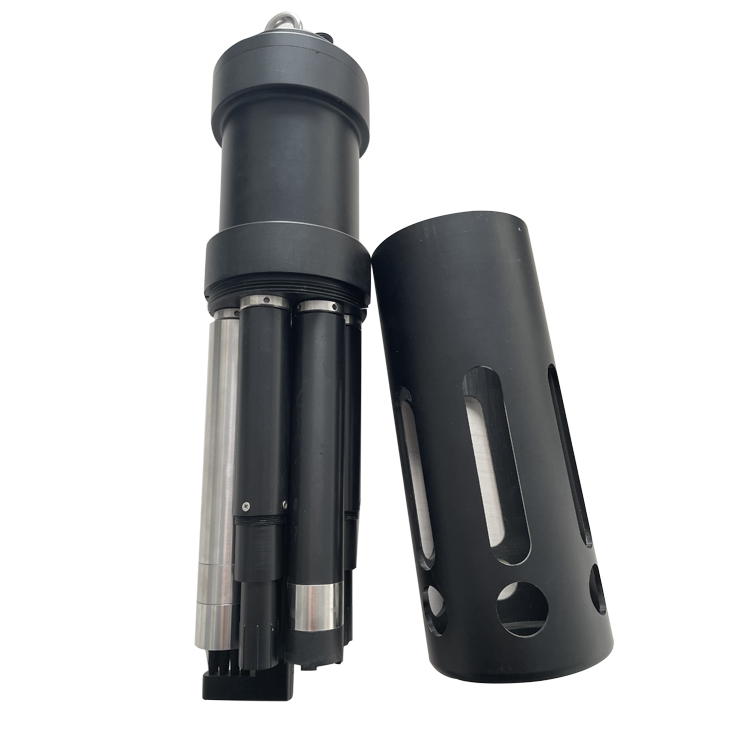
A multiparameter assembly is shown below as a separate station arrangement. Confirm the actual channel list: several water-quality readings in one housing do not automatically provide a total chlorine analyzer or a validated demand calculation.
No. It measures a specified residual quantity. Demand assessment also needs a known applied dose, appropriate residual method and defined contact conditions on a consistent reporting basis.
No. HClO does not establish the combined-chlorine fraction. Use an appropriate total chlorine measurement when that quantity is required.
Check pH, temperature and sample comparability. The distribution of free chlorine between HClO and hypochlorite is affected by water conditions; the two reported quantities are not identical.
No automatic rule is suitable for every fault. Check valid sample flow, delivery, reference result and data freshness. The authorized control response must distinguish a real process need from an invalid measurement.
Not alone. Disinfection assessment also depends on the required organisms, water conditions, effective contact and the applicable treatment plan. A sensor result is one input, not the entire assessment.
Identify the chlorine quantity and range first, then itemize the probe, cell, sample conditioning, any pH or flow channels, controller and analytical verification requirements. Do not compare unlike measurement duties by bare-sensor price.
Chlorine demand and residual must remain separate, defined quantities. Use a suitable NiuBoL HClO channel for its intended trend, verify the dose and analytical basis independently, and investigate falling residual with the sample and process context intact. Correct communications cannot compensate for an incorrect chlorine definition.
Prev:Pond DO and Turbidity Monitoring: Investigate Cloudy Water Without Guessing
Next:Dissolved Oxygen Electrode Types: Galvanic, Polarographic and Optical
Related recommendations
Sensors & Weather Stations Catalog
 Agriculture Sensors and Weather Stations Catalog-NiuBoL.pdf
Weather Stations Catalog-NiuBoL.pdf
Agriculture Sensors Catalog-NiuBoL.pdf
Water Quality Sensor Catalog-NiuBoL.pdf
Related products
 Combined air temperature and relative humidity sensor
 TDR Soil Moisture & Temperature Sensor for irrigation| RS485 |4-20mA| NBL-S-THR
 Soil pH sensor RS485 soil Testing instrument soil ph meter for agriculture |NBL-S-PH
 Wind Speed sensor Output Modbus/RS485/Analog/0-5V/4-20mA
 Tipping bucket rain gauge for weather monitoring auto rainfall sensor RS485/Outdoor/stainless steel
 Pyranometer Solar Radiation Sensor 4-20mA/RS485

Screenshot, WhatsApp to identify the QR code
WhatsApp number:+8615367865107
(Click on WhatsApp to copy and add friends)

