





— Blogs —
—Products—
 Consumer hotline +8618073152920
WhatsApp:+8615367865107
Address:Room 102, District D, Houhu Industrial Park, Yuelu District, Changsha City, Hunan Province, China
Product knowledge
Time:2026-06-06 09:36:32 Popularity:344
Quick Answer: Dissolved oxygen electrode types include galvanic and polarographic electrochemical designs; fluorescence DO sensors use a different, optical measurement principle. The choice changes polarization requirements, oxygen consumption and consumables, but does not determine the controller interface. When replacing an electrode with a NiuBoL optical probe, check the measuring duty and electrical connection separately.
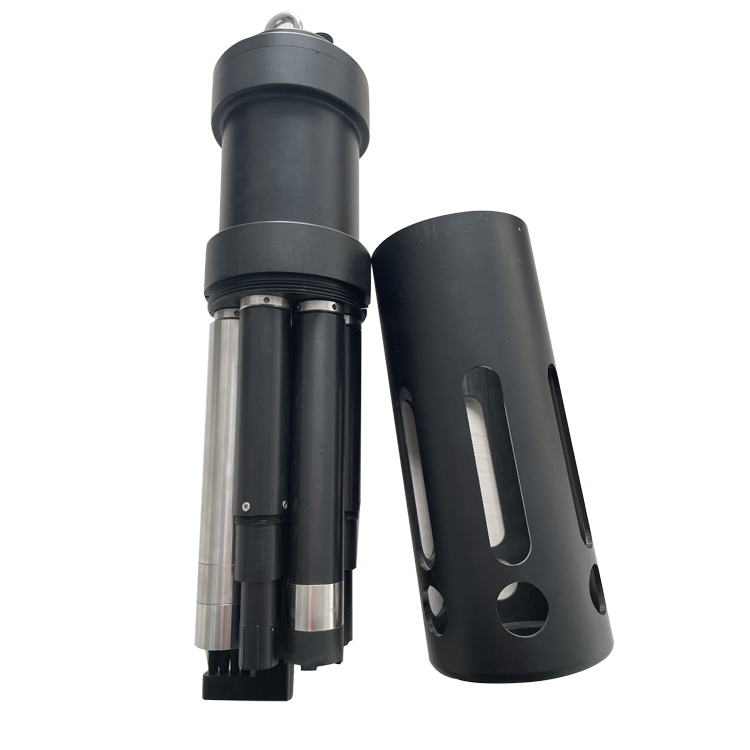
A membrane electrochemical DO electrode detects current associated with oxygen reaching the electrode through a permeable membrane. Polarographic designs use an externally applied polarization potential. Galvanic designs obtain the driving potential from their electrode materials. Both need their particular electrolyte, membrane and electrode service procedure.
An optical DO sensor observes oxygen-dependent luminescence behavior at a sensing cap. It does not consume oxygen through an electrochemical measurement reaction and has no electrolyte refill associated with that reaction. The optical cap is still a service component: deposits, damage and deterioration affect the measurement.
The USGS dissolved oxygen field guidance includes optical measurement, calibration and troubleshooting procedures. Identify the actual technology in a project specification rather than use "DO electrode" to imply that every probe has the same service needs.
| Design | Practical consequence |
|---|---|
| Polarographic membrane electrode | Check the required polarization and recovery after power interruption. Follow its membrane, electrolyte and flow requirements. |
| Galvanic membrane electrode | No external polarization supply is needed for the measuring reaction, but electrolyte, electrode condition and oxygen delivery remain relevant. |
| Fluorescence optical sensor | No electrochemical oxygen consumption or electrolyte refill. Plan cap inspection, cleaning and verification; sample representativeness still matters. |
A conventional oxygen-consuming electrode can depress the local oxygen concentration if water movement at the membrane is insufficient. Its specified minimum flow or stirring condition is therefore part of the measurement. Check the individual design: specialized electrochemical operating modes may have different flow behavior.
An optical probe avoids that oxygen-consumption requirement, but cannot make stagnant water representative of the process. A pocket behind a bracket, a settled sample cup or a poorly exchanged bypass can differ from the main basin. Select the mounting point for water renewal and the operating question, even when no measurement-driven minimum flow is required.
The ammonia nitrogen probe below is a separate instrument, not another DO electrode type. A multi-channel station needs individual procedures for its optical and electrochemical elements; replacing one channel does not change the service requirements of the others.
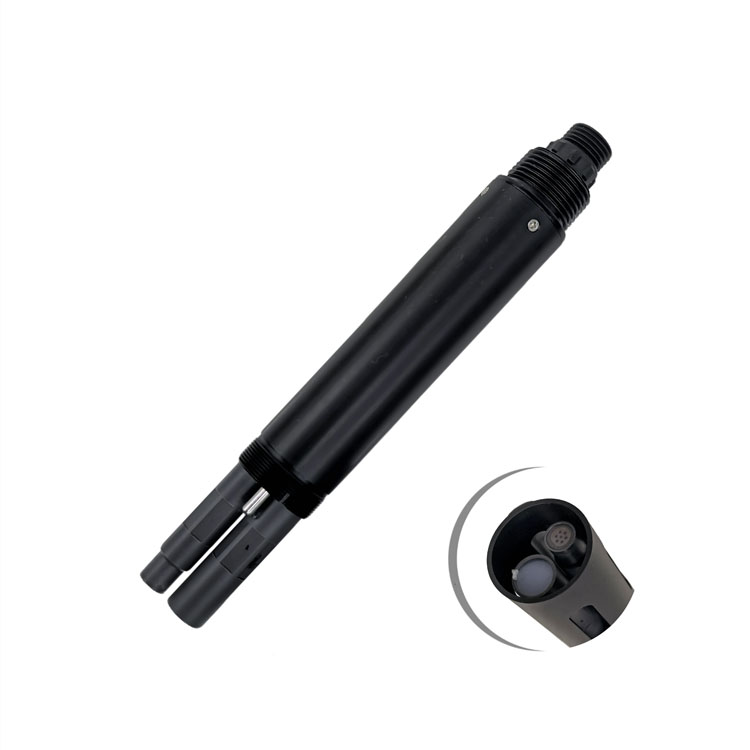
The basic NiuBoL NBL-WQ-DO is an immersion fluorescence sensor. Its parameters provide a defined comparison point rather than a generic specification for every optical DO product.
| Parameter | Basic NBL-WQ-DO |
|---|---|
| Range / resolution | 0-20.00 mg/L; 0-200% saturation at 25 degrees C; 0.01 mg/L resolution |
| Accuracy | +/-2% F.S.; temperature +/-0.3 degrees C |
| Compensation | Pt1000 temperature compensation; configurable salinity correction |
| Operating conditions | 0-45 degrees C; pressure below 0.2 MPa |
| Supply / consumption | 12-24 V DC; below 0.3 W at 12 V |
| Output | RS485 Modbus RTU |
| Housing / protection | POM and 316L stainless steel; IP68 |
| Mounting / cable | Immersion, 3/4 NPT; standard 5 m cable, other lengths customizable |
On the 20 mg/L full scale, the stated 2% F.S. term is 0.4 mg/L. It is not 2% of whichever reading is on screen. The DO-4A has a different accuracy expression and operating envelope; do not combine its values with the basic model. Cable jacket and process compatibility also need checking for the ordered assembly.
An existing instrument may accept an electrode-level current or another dedicated input. The basic digital NiuBoL probe supplies processed readings over RS485 Modbus RTU. A matching connector shape does not establish that the input can read that signal.
Identify the existing controller input, available supply and required outputs before ordering. Where an analog input must be retained, evaluate an explicitly supported transmitter or output configuration. Do not connect RS485 wires to an analog electrode terminal or assume that an interface converter changes the measurement itself.
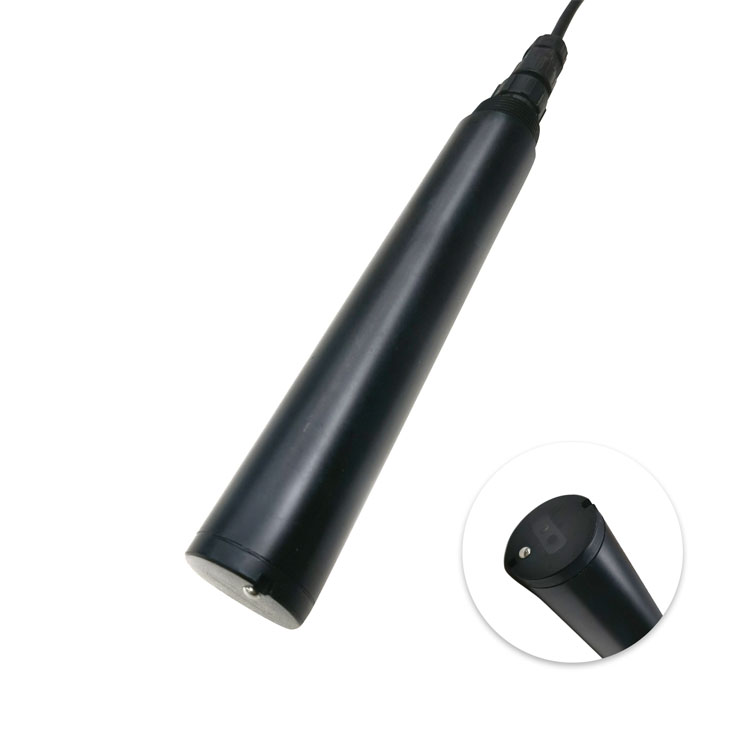
The turbidity probe shown below is also an optical water instrument, but measures particle scattering rather than oxygen-dependent luminescence. An optical appearance or shared communications protocol does not make its sensing element interchangeable with a DO cap.
List the work required by each candidate at startup, after power loss, during routine cleaning and when its consumable is replaced. For a membrane electrode, include electrolyte handling and the required membrane checks. For an optical probe, include cap availability, fitting and verification. Do not assume that removing electrolyte service removes all maintenance.
Compare the same installed duty: representative water, required uncertainty, salinity and temperature settings, access, verification materials and controller connection. For hot or hygienic bioreactors, specify cleaning, sterilization and process-connection requirements explicitly; this general immersion model's temperature and pressure figures do not establish suitability for steam sterilization or a hygienic port.
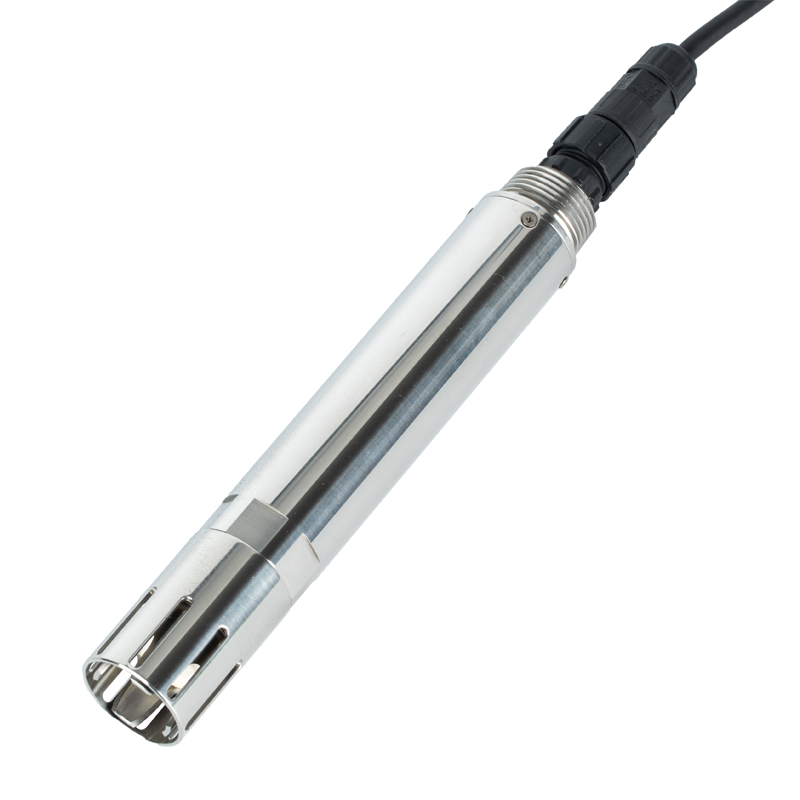
Request quotations with those tasks and interfaces stated. The lowest bare-probe price can omit a transmitter or replacement consumable needed by the existing system. Keep instruments for different water parameters, such as the electrode assembly below, identified separately when building the replacement list.
No. A Clark-type polarographic electrode uses an electrochemical measurement, while a fluorescence sensor uses an optical response. They may report the same oxygen units but need different service procedures.
No. Avoiding an external polarization potential does not remove membrane, electrolyte or electrode-condition checks. Use the procedure for the particular design.
It does not need flow to replace oxygen consumed by the measurement reaction. It still needs contact with water representative of the intended process, without a stagnant or fouled measuring region.
Only if its input and supply are compatible, or a suitable interface arrangement is included. Check raw-electrode inputs separately from RS485 and analog transmitter inputs.
Send the old probe and controller models, input definition, mounting dimensions, water conditions, required oxygen range and accuracy, cable route and current maintenance burden. This allows a comparison of installed options rather than names alone.
Choose dissolved oxygen technology by its measuring conditions, service requirements and supported interface. Optical measurement changes the oxygen-consumption and consumable issues, but does not eliminate representative sampling or verification. An identified NiuBoL model can then be assessed against the actual installation rather than a mixed family specification.
Related recommendations
Sensors & Weather Stations Catalog
 Agriculture Sensors and Weather Stations Catalog-NiuBoL.pdf
Weather Stations Catalog-NiuBoL.pdf
Agriculture Sensors Catalog-NiuBoL.pdf
Water Quality Sensor Catalog-NiuBoL.pdf
Related products
 Combined air temperature and relative humidity sensor
 TDR Soil Moisture & Temperature Sensor for irrigation| RS485 |4-20mA| NBL-S-THR
 Soil pH sensor RS485 soil Testing instrument soil ph meter for agriculture |NBL-S-PH
 Wind Speed sensor Output Modbus/RS485/Analog/0-5V/4-20mA
 Tipping bucket rain gauge for weather monitoring auto rainfall sensor RS485/Outdoor/stainless steel
 Pyranometer Solar Radiation Sensor 4-20mA/RS485


Screenshot, WhatsApp to identify the QR code
WhatsApp number:+8615367865107
(Click on WhatsApp to copy and add friends)

