





— Blogs —
—Products—
 Consumer hotline +8618073152920
WhatsApp:+8615367865107
Address:Room 102, District D, Houhu Industrial Park, Yuelu District, Changsha City, Hunan Province, China
Product knowledge
Time:2026-09-12 08:00:00 Popularity:184
Quick Answer: An automatic water surface evaporation station needs more than a water-level channel. Install the specified evaporation pan on a stable, level foundation, record rain and every refill or drain event, and verify which corrections the logger applies. Unrecorded leakage, overflow or water additions can look like evaporation or conceal it. A reservoir level sensor alone cannot separate those effects.
An evaporation pan observes the behavior of water in a defined vessel and exposure. A reservoir-level station observes a much larger waterbody affected by inflows, withdrawals, rainfall, seepage and operating decisions. The two records answer different questions even when both use millimetres.
Specify the pan type, geometry, working water level and observation method before ordering the sensor. Do not treat a change of pan or installation height as a neutral mechanical alteration. It can change exposure and the relationship between the observation and the intended hydrological interpretation.
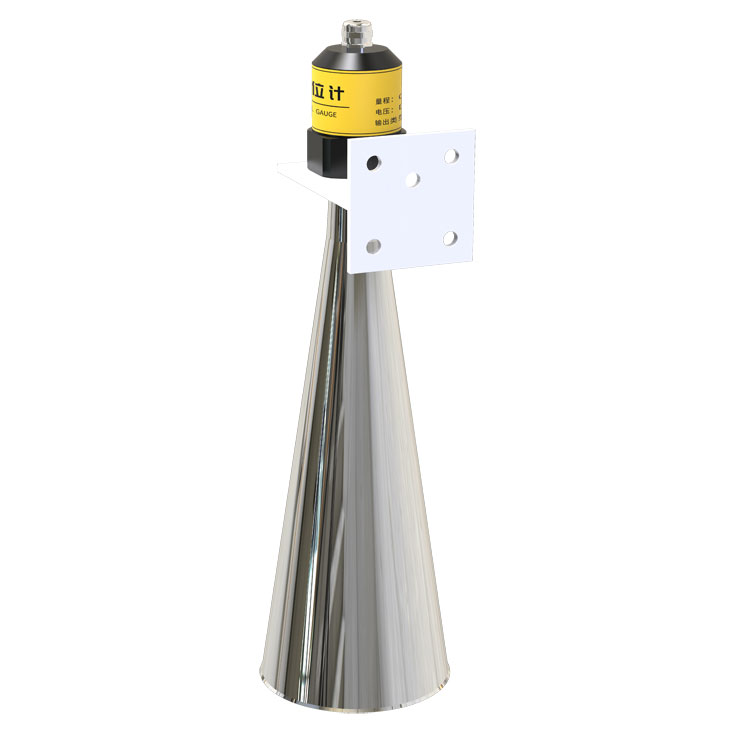
An overhead radar instrument such as the one below may measure level in a separate water-management installation. Its distance output is not, by itself, an evaporation total. Keep the evaporation-pan channel distinct from reservoir level and from a calculated crop evapotranspiration estimate.
The NiuBoL NBL-W-ES evaporation sensor is used with an evaporation vessel and a suitable support. For the described buried-vessel arrangement, the opening is approximately 10-20 cm above surrounding ground. That is an arrangement-specific instruction, not a universal requirement for every evaporation pan.
Choose a location representing the intended exposure, away from abnormal shade, spray, roof drainage and artificial heat. Keep maintenance access clear without paving or landscaping the surroundings in a way that changes the observation conditions. Record the pan position and nearby features before routine monitoring begins.
Level and secure the vessel, then install the sensing assembly at its specified reference. Fill to the marked high-water line and establish the operating baseline. Refill when the low-water mark is reached, keeping a separate record of the addition. If automatic refill is required, include the valve, water supply and event measurement explicitly; a sensor-only purchase does not establish automatic water management.
| Item | NBL-W-ES configuration data |
|---|---|
| Measurement range | 0-1000 mm; confirm the reported quantity and reference in the delivered configuration |
| Resolution | 0.1 mm |
| Stated accuracy | +/-0.5% within 0 to 50 deg C; agree the percentage basis for acceptance |
| Supply versions | 12 V DC or 24 V DC; confirm the supplied version |
| Output versions | 4-20 mA, 0-5 V or RS485 Modbus RTU |
| Power consumption | 177.6 mW for the stated sensor configuration; logger, communications and refill equipment are separate loads |
| Operating temperature | -20 to 85 deg C; this does not mean normal liquid-water observations remain valid while the pan freezes |
| Cable and protection | Standard cable 5 m; confirm sheath, connectors and applicable ingress rating for the delivered assembly |
The 1000 mm span is not a claim that the pan loses 1000 mm in one observation interval. Resolution also is not total field uncertainty. Leakage, disturbed water and incorrect rain correction can exceed the useful measurement increment without any electronic fault.
For a constant-area pan with no unmeasured leakage or overflow, express all terms as equivalent water depth over the same interval: evaporation E = starting level H1 - ending level H2 + rainfall P + added water A - deliberately removed water D. The calculation requires a consistent level reference and a compatible rainfall observation.
For illustration, H1 = 100 mm, H2 = 96 mm, rain = 3 mm and a recorded addition = 5 mm, with no removal, give E = 12 mm. Ignoring the addition would give 7 mm; using level decline alone would give 4 mm. These are bookkeeping examples, not measured station results.
Confirm whether the delivered data channel contains water level, level change or already processed evaporation. Do not add the rainfall correction twice. Where the system reports a corrected total, retain the raw observations and event record needed to reproduce it.
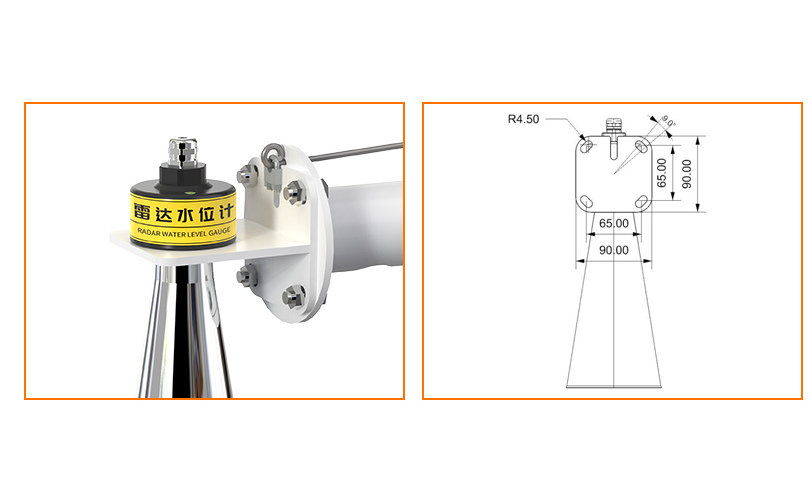
The overhead mounting drawing below concerns a separate level-sensing arrangement. It must not be used to set the NBL-W-ES support position or its pan working level. Each instrument needs its own reference and installation geometry.
Align rain and pan intervals before applying the balance. A rain event straddling the daily boundary must be assigned consistently to the corresponding level change. Ensure the rain collector represents precipitation reaching the pan without assuming that one physical mounting height is prescribed for all observation methods.
Log refill start, finish and quantity or the method used to determine the equivalent depth. Mark cleaning, water replacement and any intentional drainage separately. If a valve operates without measured or otherwise defensible water addition, a corrected evaporation value may be indeterminate for that interval.
Overflow loses information unless its quantity is measured or the selected observation method provides a valid way to account for it. Flag the affected interval rather than inserting an assumed drainage amount. A negative calculated result is a reason to examine timing, precipitation and events; it should not simply be clipped to zero.
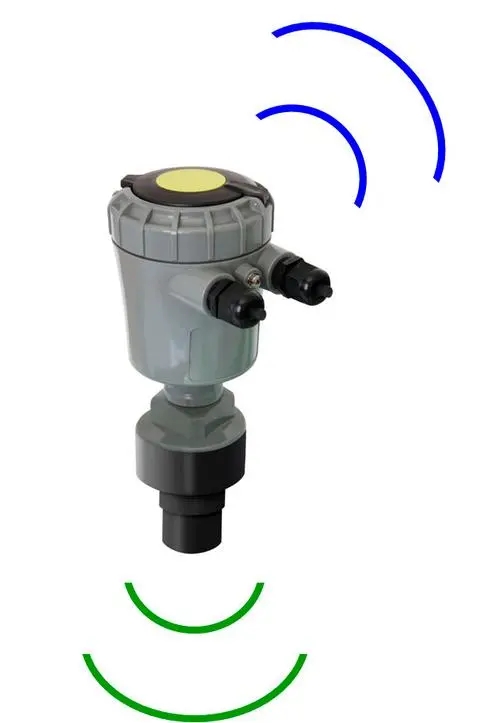
A general non-contact level instrument, illustrated below, may have a large measurement range while being unsuitable for a small daily pan change. Check resolution, repeatability, temperature effects and usable geometry at the actual vessel. The presence of a digital interface does not establish evaporation measurement performance.
For the NBL-W-ES RS485 arrangement, communication uses 9600 bps, 8 data bits and no parity, with at least 1000 ms between communications. Confirm stop bits, reported quantity and scaling for the actual version. For analog outputs, obtain the corresponding range endpoints rather than applying a conversion from another voltage version.
The data logger timestamps level, rain and maintenance events, while a compatible gateway handles remote transmission. Keep those functions separate from the sensor. Test a communication outage to confirm that locally stored observations retain the correct interval and are not duplicated after recovery.
Inspect leakage, mounting movement, algae, debris and interference with the sensing assembly. A water-level decline caused by a leak cannot be separated from evaporation by adjusting an electronic zero. Investigate the water path and vessel condition before changing calibration.
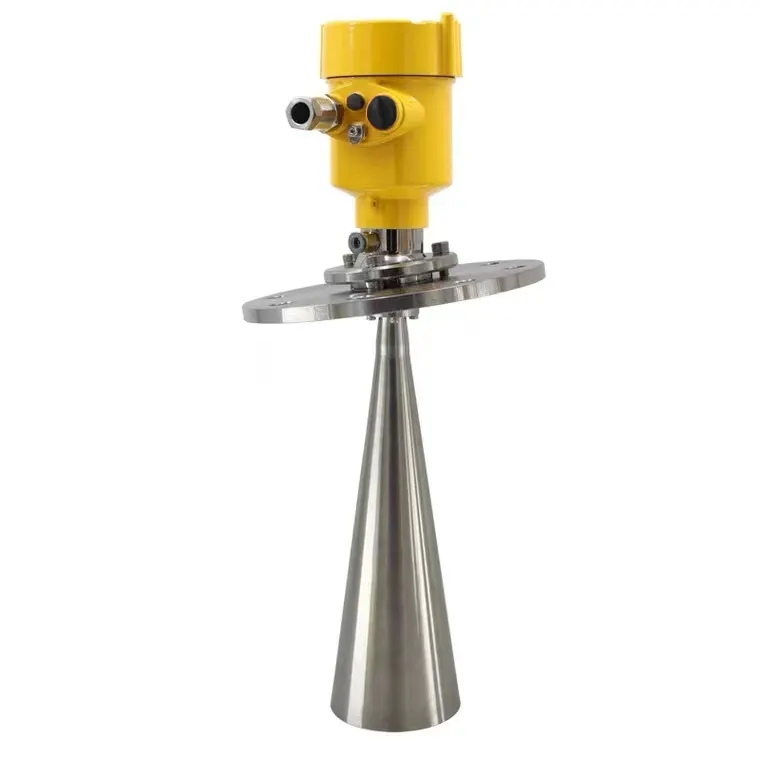
A radar head such as the one below belongs to another level-measurement option. If a project proposes it for a pan, require a suitable measurement and uncertainty assessment instead of transferring a reservoir specification. Its mounting and service needs differ from the dedicated evaporation arrangement.
Keep the water representative of the intended observation method and free from floating material that changes surface conditions. Record cleaning and water replacement; where practical, avoid introducing replacement water with a markedly different temperature. Follow the chosen cold-season procedure rather than adding an unqualified heater that changes the evaporation process.
At commissioning, compare the indicated level with a suitable independent reference, verify a recorded water addition and check the resulting balance. Test rain timing, a controlled restart and the handling of an interval marked invalid. Do not pour unknown quantities into the vessel and call agreement with a changing number a calibration.
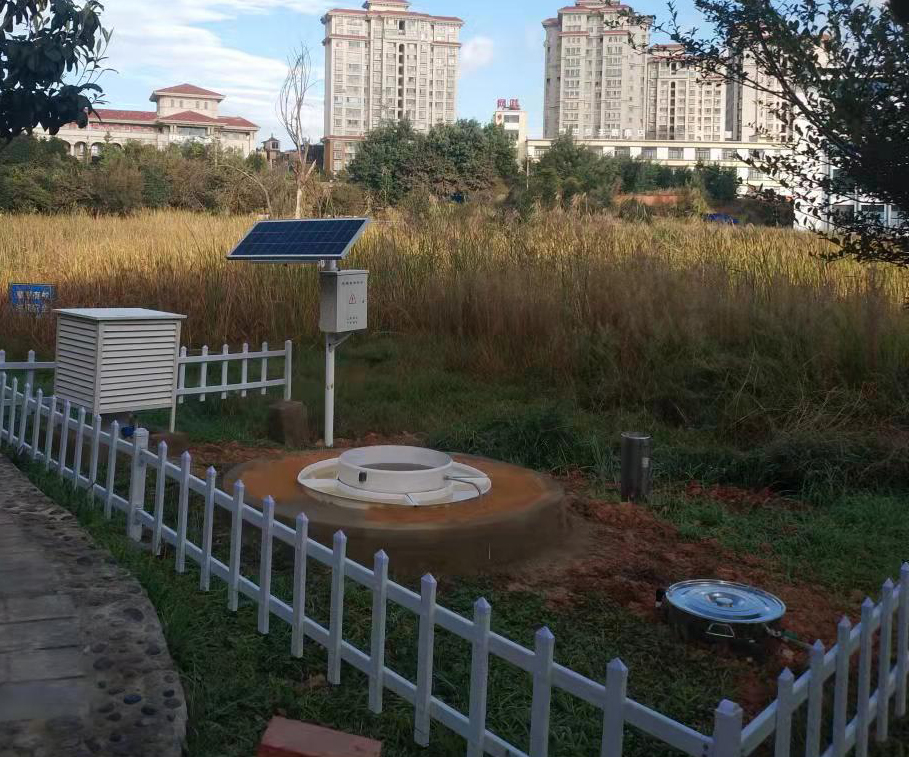
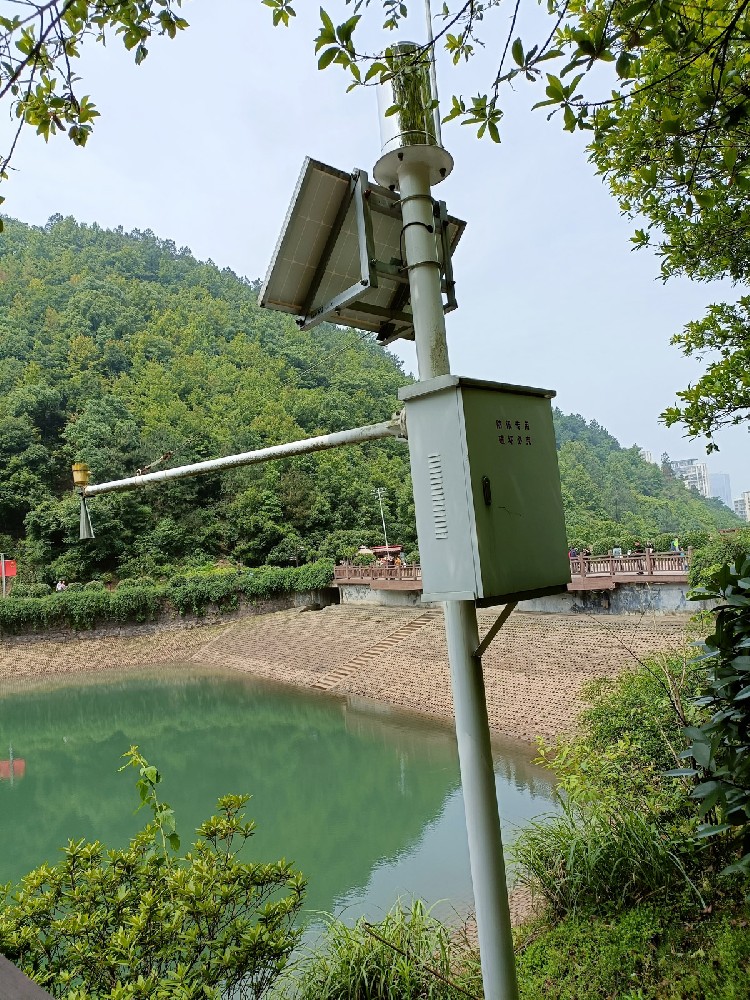
A solar-powered water-level station such as the field installation below can support broader water-management records, but reservoir level changes still contain other water-balance terms. State which quantities are measured and which are estimated before using them to report evaporative loss.
No. Pan evaporation is a specific observation. Crop demand or reservoir evaporation requires the relevant method, coefficients and other information; do not relabel the pan value as crop evapotranspiration.
It can physically refill, but evaporation reconstruction may then be invalid. Record the addition quantity or another method-approved determination, together with its time and the level observations.
No. Electronics temperature capability does not establish a valid liquid-water observation during ice formation. Use the approved seasonal procedure and protect the vessel and sensor as required.
Only after the complete pan geometry, required change detection and uncertainty have been assessed. A suitable range and RS485 connection alone do not establish equivalence.
Identify the pan and support, sensor output, rain input, logger, water-management hardware and communication scope. Include the observation method and maintenance access; a sensor-only price is not a complete automatic station price.
Examples include unmeasured additions, leakage, overflow, disturbed references and missing rain data where correction is required. Retain the observations and reason for exclusion rather than presenting an invented corrected value.
Install the pan and sensor as one observation arrangement and account for every water addition and removal. NiuBoL can assess the NBL-W-ES interface and station configuration from the selected pan, observation interval, rain correction and refill requirements. A trustworthy evaporation record is a reproducible water balance, not just a falling level trace.
Prev:Automatic Ecological Weather System: Monitoring Design for Long-Term Sites
Next:Automatic Field Weather Station Maintenance: Service and Data Checks
Related recommendations
Sensors & Weather Stations Catalog
 Agriculture Sensors and Weather Stations Catalog-NiuBoL.pdf
Weather Stations Catalog-NiuBoL.pdf
Agriculture Sensors Catalog-NiuBoL.pdf
Water Quality Sensor Catalog-NiuBoL.pdf
Related products
 Combined air temperature and relative humidity sensor
 TDR Soil Moisture & Temperature Sensor for irrigation| RS485 |4-20mA| NBL-S-THR
 Soil pH sensor RS485 soil Testing instrument soil ph meter for agriculture |NBL-S-PH
 Wind Speed sensor Output Modbus/RS485/Analog/0-5V/4-20mA
 Tipping bucket rain gauge for weather monitoring auto rainfall sensor RS485/Outdoor/stainless steel
 Pyranometer Solar Radiation Sensor 4-20mA/RS485


Screenshot, WhatsApp to identify the QR code
WhatsApp number:+8615367865107
(Click on WhatsApp to copy and add friends)

