





— Blogs —
—Products—
 Consumer hotline +8618073152920
 WhatsApp:+8615367865107
Address:Room 102, District D, Houhu Industrial Park, Yuelu District, Changsha City, Hunan Province, China
Product knowledge
Time:2026-05-28 15:59:37 Popularity:410
Dissolved oxygen measurement needs both a defined unit and a representative sampling point. In ponds and aeration tanks, establish whether the reported value is concentration or saturation and which water condition it represents. A sensor beside an aerator, an afternoon pond reading and a probe in a poorly mixed tank zone can all give technically valid local readings that do not represent the wider operating condition.
| Decision | Aquaculture pond | Wastewater aeration tank |
|---|---|---|
| Where to measure | A representative animal-occupied depth and location; assess zones that may behave differently | The process zone whose oxygen condition is being controlled, with suitable mixing and safe access |
| What the trend should reveal | Day-night variation, developing low-oxygen periods and response to aeration | Response to load, aeration changes, mixing and the treatment strategy |
| What can mislead | One afternoon reading or a point dominated by an aerator plume | Bubbles on the sensing cap or a point that does not represent the controlled zone |
| How to set an action | Use species, life stage, stocking and the farm's operating plan | Use the process design and operating objective for that biological stage |
One DO target cannot be assigned to every fish species, life stage and wastewater process. The sensor supplies a measurement; the operating team defines the appropriate target and response. Keep the alarm setting separate from the sensor's measuring range and accuracy.
Photosynthesis can raise pond DO during daylight, while respiration and other oxygen demand continue during darkness. A high afternoon reading therefore does not establish the minimum oxygen condition later in the night.
Retain a time series that covers the vulnerable period, and investigate changes with temperature, weather, feeding and aeration records. A second depth or location may be needed when stratification or circulation causes material differences. One probe represents its location; it does not automatically measure every pond corner or water layer.
DO concentration in mg/L and percent saturation are related but different quantities. Temperature, salinity and oxygen partial pressure affect the relationship. Check which quantity the controller receives and which compensation settings the sensor supports. A value of 100% is not a universal concentration that stays constant as the water conditions change.
When comparing a portable instrument with an installed sensor, put them in comparable water and allow their responses to stabilize. Check temperature and salinity settings before adjusting either instrument. Comparing different depths or compensation assumptions can create a disagreement that is not a calibration fault.
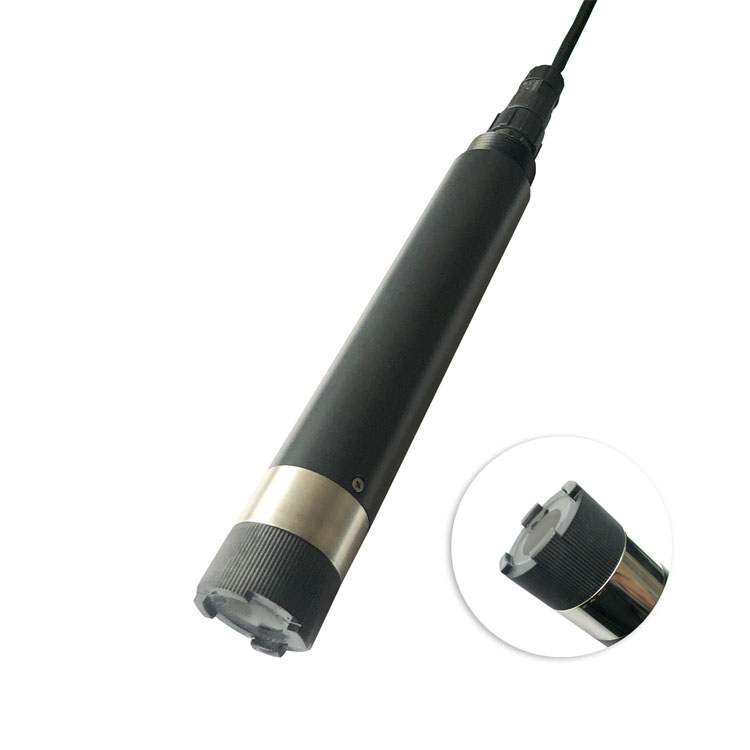
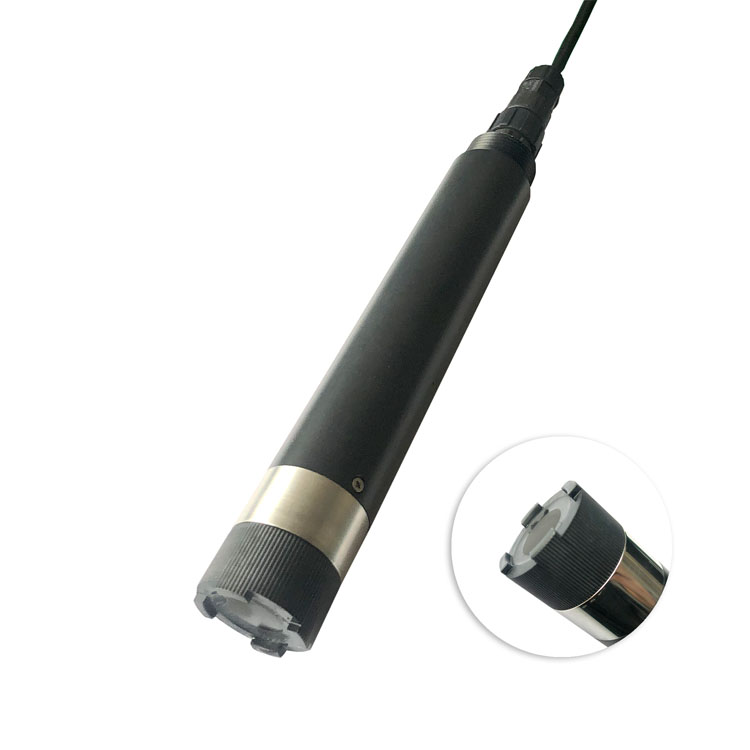
The NiuBoL NBL-WQ-DO uses fluorescence quenching and provides RS485 Modbus RTU data. The optical measurement does not consume oxygen and does not require electrolyte or polarization. Sample representativeness, deposits and bubbles still matter; a non-consuming sensing method does not remove installation influences.
| Characteristic | NBL-WQ-DO |
|---|---|
| DO concentration range | 0-20 mg/L |
| Specified DO accuracy | +/-2% full scale; equivalent to +/-0.4 mg/L on the 20 mg/L span |
| Resolution | 0.01 mg/L; temperature resolution 0.1 degrees C |
| Temperature accuracy | +/-0.3 degrees C |
| Working conditions | 0-45 degrees C; pressure below 0.2 MPa |
| Supply and output | 12-24 V DC; RS485 Modbus RTU |
| Compensation | Automatic temperature compensation and configurable salinity compensation |
| Installation and construction | Immersion installation; POM and 316L stainless steel; IP68 |
| Cable | 5 m standard; confirm the ordered cable and extension arrangement |
Resolution and accuracy are not interchangeable. A display that changes in 0.01 mg/L increments does not establish an uncertainty of 0.01 mg/L. When selecting a control band, consider the specified accuracy, the required operating tolerance and the variation caused by the measurement location.
Secure the sensor below the liquid level and keep the optical cap clear of bottom sediment, scraping and collision. Avoid placing it where bubbles remain attached to the measuring area. Arrange access so the cap can be inspected without pulling on the cable or changing the intended measuring position.
In an aeration tank, assess the location with the process team before using the value to regulate air delivery. An aerator discharge point can show a different local condition from the mixed process zone. In a pond, choose the location and depth according to the occupied water layer and circulation rather than only the nearest convenient bank.
The controller should identify a valid low DO value separately from a communication timeout or invalid measurement. Define the required response to each condition with the operator. A frozen display must not remain indistinguishable from a current reading while the aeration system assumes everything is normal.
Record timestamp, DO unit and temperature with the channel. Check device address, communication settings and returned data scaling during commissioning. Use the instrument's actual register map; do not copy a register layout from another NiuBoL water-quality model merely because both use Modbus RTU.
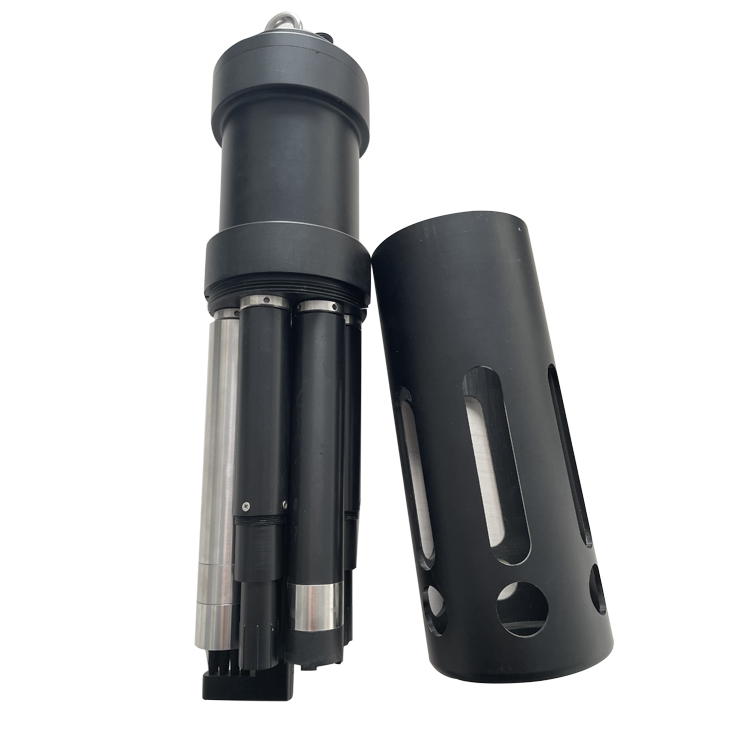
Inspect fouling and clean the fluorescent cap gently without scratching its measuring area. The NBL-WQ-DO storage arrangement uses a protective cover with a wet sponge to keep the measuring surface moist when the sensor is not in use. Apply the storage procedure for the actual sensor version rather than a generic instruction for every optical DO product.
Set field inspection intervals from the observed fouling and access conditions. Keep cleaning, cap replacement and calibration checks with the measurement history. A cap that has been disturbed or coated with deposits can explain a change that would otherwise be attributed to the pond or treatment process.
No. Daylight oxygen production and night-time oxygen demand can produce a substantial daily cycle. Review the time series through the relevant night and early-morning period and assess whether the location represents the occupied water layer.
No. Define the threshold with the responsible farm team according to species, life stage, stocking and operating conditions. The sensor's range is an instrument characteristic, not a biological operating recommendation.
The NBL-WQ-DO optical reaction does not consume oxygen. Nevertheless, the installed water must represent the intended measuring point, and bubbles or deposits can still affect the result. This is different from declaring that all flow and mounting conditions are irrelevant.
Its RS485 output provides measurement data to a compatible controller or logger. The controller, motor switching equipment and operating logic must be specified separately. Confirm the behavior during low readings, signal faults and manual operation before enabling automatic control.
Check location, depth, timing, temperature, salinity settings, response stabilization and cap condition. Compare both in the same representative water before concluding that one needs adjustment. Also check the PLC's unit and scaling against the sensor-side value.
Provide the pond or process application, expected temperature and salinity, proposed location and depth, controller interface and cable route. State whether the requirement is observation, an alarm or a defined control function; these require different system responsibilities.
 NBL-WQ-CL Water Quality Sensor Online Residual Chlorine Sensor.pdf
NBL-WQ-DO Online Fluorescence Dissolved Oxygen Sensor.pdf
NBL-WQ-NHN Ammonia Nitrogen Water Quality Sensor.pdf
NBL-WQ-COD Online Water Quality COD Sensor.pdf
NBL-WQ-PH Online pH Water Quality Sensor.pdf
NBL-WQ-EC water quality conductivity sensor.pdf
NBL-WQ-BOD-4A Online BOD Sensor.pdf
NBL-WQ-TH-4S online total hardness sensor.pdf
Useful dissolved oxygen measurement combines a representative position, a time series and the correct interpretation of concentration and saturation. Set operating targets for the actual pond or treatment process. Use the NBL-WQ-DO as the measurement input, with the receiving controller and maintenance plan defined around that task.
Prev:Electrode Method BOD Fast Analyzer: Method and Sample Requirements
Next:How to Use a Conductivity Meter: Units, Temperature and Range
Related recommendations
Sensors & Weather Stations Catalog
Agriculture Sensors and Weather Stations Catalog-NiuBoL.pdf
Weather Stations Catalog-NiuBoL.pdf
Agriculture Sensors Catalog-NiuBoL.pdf
Water Quality Sensor Catalog-NiuBoL.pdf
Related products
 Combined air temperature and relative humidity sensor
 TDR Soil Moisture & Temperature Sensor for irrigation| RS485 |4-20mA| NBL-S-THR
 Soil pH sensor RS485 soil Testing instrument soil ph meter for agriculture |NBL-S-PH
 Wind Speed sensor Output Modbus/RS485/Analog/0-5V/4-20mA
 Tipping bucket rain gauge for weather monitoring auto rainfall sensor RS485/Outdoor/stainless steel
 Pyranometer Solar Radiation Sensor 4-20mA/RS485

Screenshot, WhatsApp to identify the QR code
WhatsApp number:+8615367865107
(Click on WhatsApp to copy and add friends)

