





— Blogs —
—Products—
 Consumer hotline +8618073152920
 WhatsApp:+8615367865107
Address:Room 102, District D, Houhu Industrial Park, Yuelu District, Changsha City, Hunan Province, China
Product knowledge
Time:2026-09-07 16:27:35 Popularity:310
Quick Answer: Choose weather sensors for coastal and marine environments by separating salt exposure, condensation and platform motion. A fixed shoreline station needs corrosion-resistant mounting and representative exposure; a moving vessel also needs a defined wind reference and motion correction. IP65 protects the specified enclosure against dust and water jets under test conditions, but does not establish resistance to salt corrosion or suitability for immersion.
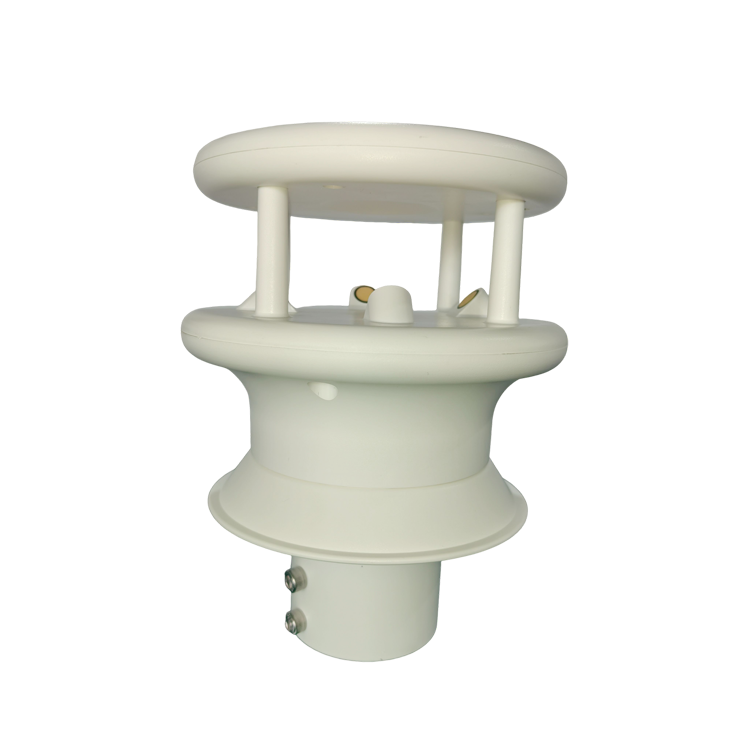
The main challenge for weather sensors in marine environments is not waterproofing alone. Salt spray, condensation, ultraviolet exposure, vibration and long-term corrosion act together. A device that works reliably in normal outdoor conditions may still need additional material, connector and enclosure checks before being used for unattended coastal or offshore monitoring.
At a fixed coastal station, orient the wind sensor to the required geographic reference and record its mounting height. Do not treat a magnetic compass reading as true north without considering local magnetic declination and interference from nearby steel. A sensor above a port building measures the airflow at that position; it does not automatically represent open-water wind beyond the breakwater.
A vessel-mounted sensor measures apparent wind relative to the moving platform. Heading converts direction into an earth-referenced frame, but heading alone does not remove vessel velocity. True-wind calculation requires compatible motion data, synchronized measurements and a consistent vector convention. Course over ground is not necessarily vessel heading, especially when drifting. Pitch, roll and mast movement introduce further errors. A built-in compass, where available, is not proof of a complete marine motion-compensation system.
For navigation or safety-critical control, assess the applicable equipment approvals and system requirements separately. General environmental monitoring capability should not be presented as approval for those duties.
| Installation | Dominant concern | Selection consequence |
|---|---|---|
| Fixed port or coastal solar site | Salt carried by prevailing winds; heat from buildings or equipment | Choose accessible mounting, suitable connector protection and an unobstructed measurement position. |
| Exposed jetty or aquaculture platform | Frequent spray, salt accumulation and difficult service access | Review material combinations, cable entries and replacement access before accepting unattended operation. |
| Moving vessel | Changing heading, vessel velocity, vibration and distorted airflow | Specify apparent or true wind, motion-data inputs and the coordinate convention. |
| Humid coastal greenhouse or enclosed cabinet | Condensation during cooling; restricted ventilation | Separate air measurement from cabinet protection and assess drainage or condensation control. |
Describe whether the equipment receives airborne salt, occasional direct spray, pressure washing or possible inundation. These are different exposures. A sensor mounted high above splash level may be suitable where the same model at the edge of a wet deck is not. Include winter icing, maximum ambient temperature and access restrictions in the selection discussion.
Review the whole exposed assembly: sensor body, bracket, fasteners, connector shell, cable gland and cut cable ends. A stainless bracket does not protect a dissimilar metal screw or an unsealed splice. Chloride deposits can remain in joints after visible surfaces have dried. Avoid water-trapping crevices and assess galvanic compatibility wherever different metals contact each other.
Ask for the actual material grade and coating system when these affect the project specification. Terms such as weatherproof or marine-grade are not a substitute for a defined test. If salt-mist resistance is contractual, identify the test method, exposure cycle, duration and pass criteria, including whether operation is checked afterward. The scope of IEC 60068-2-52 concerns cyclic salt-mist testing; an IP rating is a different classification.
Conformal coating can protect selected circuit-board surfaces, but it does not seal connectors or prevent external metal corrosion. Likewise, a cable sheath suitable for outdoor use does not make an exposed termination waterproof. Request the cable material and connector arrangement for the ordered assembly instead of assigning one generic cable specification to every sensor.
The NiuBoL NBL-W-21GUWS ultrasonic wind speed and direction sensor measures horizontal wind without rotating cups or a mechanical vane. This removes bearing maintenance, but salt deposits and obstructions around the acoustic paths still require inspection. It is an option for fixed coastal environmental monitoring after the mounting, corrosion exposure and service plan have been assessed.
| Item | NBL-W-21GUWS configuration | Coastal design implication |
|---|---|---|
| Wind speed | 0-60 m/s; resolution 0.01 m/s | The measurement range is not a structural survival rating. |
| Wind direction | 0-359 degrees; accuracy +/-3 degrees; resolution 1 degree | Installation orientation and vessel movement add errors beyond sensor accuracy. |
| Power and output | 12-24 V DC; RS485 Modbus; 9600 bps | Check voltage at the sensor and match the logger serial settings. |
| Operating temperature | -20 to 80 degrees C | Check the required cold-weather range before choosing an exposed installation. |
| Protection | IP65 | Do not specify immersion or assume salt-mist qualification from this rating. |
| Optional heating | 3 W | Include heating in the power budget; do not assume it is included or guarantees ice-free operation. |
For additional air measurements, a seven-in-one ultrasonic weather sensor reduces the number of separate mounts. Confirm the included channels and their exposure requirements. A compact assembly can simplify installation, while separate instruments allow different heights and individual replacement. Neither arrangement eliminates the need to keep air inlets and radiation shields clear.
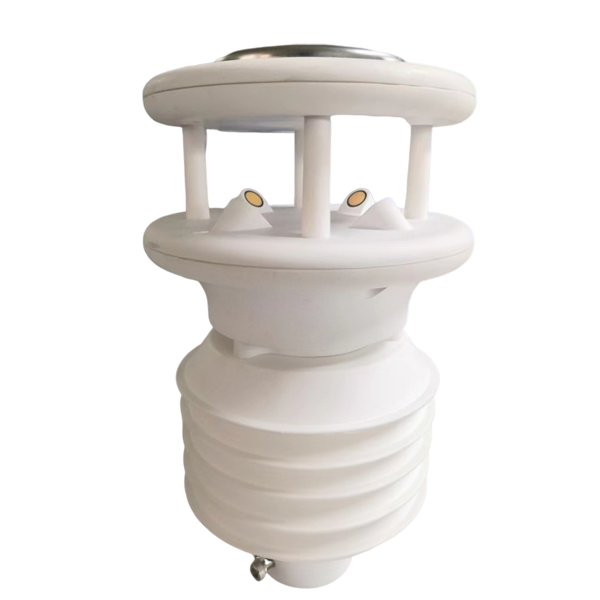
Condensation can form when a surface falls below the dew point, including inside an enclosure after a humid service visit. A high operating-humidity limit alone does not establish tolerance of liquid condensation. Check the sensor, logger and modem individually; they may have different environmental limits.
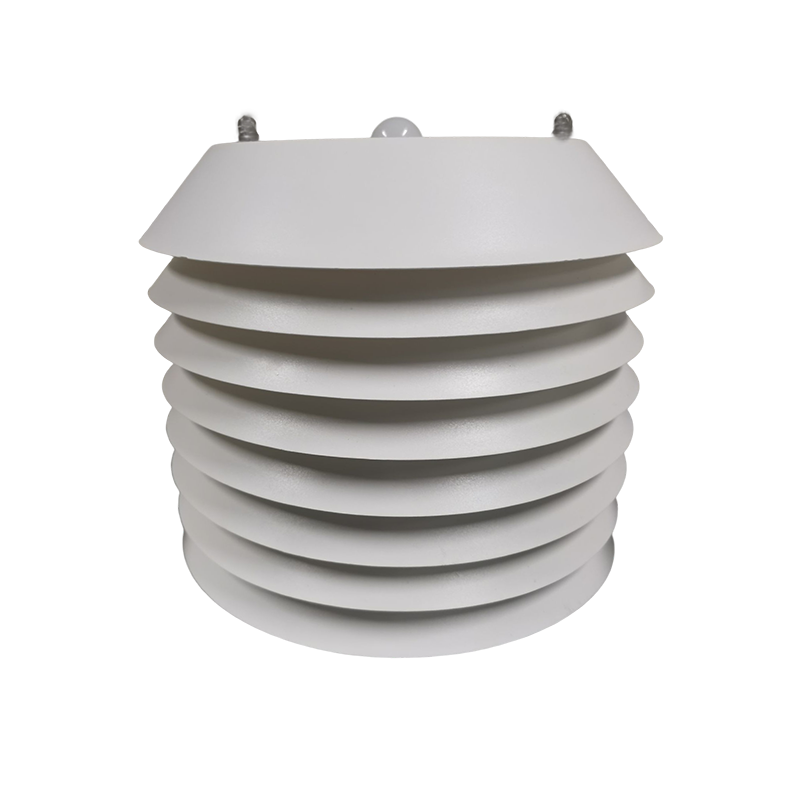
Air-temperature and humidity sensing needs exposure to representative air through an appropriate radiation shield. Placing the sensing head inside a sealed cabinet protects it from spray but changes what it measures. Keep it away from cabinet exhaust, sun-heated metal and engine heat. Pressure ports also need an installation that does not trap water or expose them unnecessarily to direct airflow pressure.
For the electronics enclosure, select sealing, pressure equalization, drainage and condensation control as a coordinated design. Do not drill improvised drain holes into a rated enclosure. Check the suitability of any vent or heater for the enclosure and environment. Route cables with drip loops and strain relief so water does not follow a taut cable directly toward an entry.
The digital wind version can connect to an RS485 Modbus RTU data logger, RTU or compatible gateway. Match the ordered register map, device address, baud rate, parity and stop bits. The NBL-W-21GUWS read example uses function 03 and separates wind speed from direction; keep the correct scaling and units in the host. Allow at least 1000 ms between communications to this sensor configuration.
First test a short connection, then test the installed cable with other equipment operating. Intermittent faults coinciding with a transmitter or motor start suggest a different investigation from errors that begin after rain. Inspect connector sealing, shielding, grounding and supply voltage before altering software. Follow the site electrical design for surge protection and bonding; an RS485 interface is not, by itself, lightning protection.
Check that the platform distinguishes a communication timeout from calm wind. A failed wind channel displayed as zero can mislead an operator. Retain the last valid value only with its age and fault status clearly identified. For moving platforms, also reject or flag wind calculations when the required heading or velocity input becomes stale.
Start with inspections after initial exposure and significant spray events, then adjust the interval using observed deposits and drift. Photograph connector joints, fasteners, acoustic paths and radiation shields at comparable positions. Check for loosened mounting, coating damage, trapped water and salt accumulation. Do not wait for a communication failure to discover a corroding connector.
Use the cleaning method appropriate to the sensing surface. Avoid scraping ultrasonic transducers, applying unapproved solvents or directing pressure jets at seals. Radiation instruments need separate attention to optical cleanliness and level. Record cleaning times alongside measurements so a sudden recovery in irradiance or humidity behavior is not mistaken for a weather change.
Where boat access or shutdown permits make visits expensive, a replaceable cable assembly and a preconfigured spare sensor may matter more than a small unit-price difference. Include commissioning access and replacement work in the quotation comparison. For NiuBoL selection support, send the mounting location, exposure description, required channels and data interface, and state whether the platform moves.
Yes, where the installation remains within the equipment's exposure limits and corrosion risks are addressed separately. IP65 is not approval for direct immersion, sustained seawater spray or any specified service life. Describe the actual exposure before selecting the assembly.
No. Eliminating rotating parts removes one maintenance task, not surface contamination or connector deterioration. Inspect acoustic paths, deposits and mounting after exposure. A maintenance interval should reflect observed conditions rather than a blanket maintenance-free claim.
Not on its own. Heading establishes orientation; vessel velocity is also needed to correct apparent wind. The calculation must use synchronized data, compatible reference frames and the correct wind-direction convention. Platform motion may require further compensation.
Not when the required measurement is ambient humidity. The box has its own temperature and moisture conditions. Mount the sensing element in its intended ventilated shield and protect the logger separately.
Identify bracket and fastener materials, connector and cable construction, surge-protection arrangement, enclosure accessories and service access. For vessel work, add motion-data interfaces and responsibility for wind correction. Request any required environmental test evidence for the actual configuration.
A coastal weather sensor should be selected for the exposure it will actually face and the measurement it must deliver. Fixed sites need corrosion-aware installation and representative air exposure. Moving platforms add motion correction. NiuBoL wind and weather sensors can be evaluated against these requirements without treating IP65, ultrasonic operation or an integrated housing as a substitute for a complete coastal installation design.
Prev:PV Weather Stations: Irradiance, Module Temperature and Wind
Next:How to Choose an Industrial IoT Gateway for Environmental Monitoring
Related recommendations
Sensors & Weather Stations Catalog
 Agriculture Sensors and Weather Stations Catalog-NiuBoL.pdf
Weather Stations Catalog-NiuBoL.pdf
Agriculture Sensors Catalog-NiuBoL.pdf
Water Quality Sensor Catalog-NiuBoL.pdf
Related products
 Combined air temperature and relative humidity sensor
 TDR Soil Moisture & Temperature Sensor for irrigation| RS485 |4-20mA| NBL-S-THR
 Soil pH sensor RS485 soil Testing instrument soil ph meter for agriculture |NBL-S-PH
 Wind Speed sensor Output Modbus/RS485/Analog/0-5V/4-20mA
 Tipping bucket rain gauge for weather monitoring auto rainfall sensor RS485/Outdoor/stainless steel
 Pyranometer Solar Radiation Sensor 4-20mA/RS485

Screenshot, WhatsApp to identify the QR code
WhatsApp number:+8615367865107
(Click on WhatsApp to copy and add friends)

