





— Blogs —
—Products—
 Consumer hotline +8618073152920
WhatsApp:+8615367865107
Address:Room 102, District D, Houhu Industrial Park, Yuelu District, Changsha City, Hunan Province, China
Product knowledge
Time:2026-08-27 09:05:00 Popularity:321
Remote pond DO monitoring should remain informative when mains power fails. If the aerator, oxygen probe, logger and communications all lose the same supply, the dashboard may go silent at the moment the operator needs it. Separate measurement continuity, outage detection and aerator power when specifying a NiuBoL dissolved oxygen station.
Define the required operating response with the farm: who receives a power-loss or low-oxygen alert, who can reach the pond and what approved backup aeration is available. Monitoring equipment does not provide oxygen to the water. A working sensor on a small backup supply cannot compensate for an aerator without an adequate power source.
The oxygen trend after an aerator stops depends on stock, water conditions, mixing and other site factors. Do not promise a universal warning period. Use the pond's operating records and a site-specific response procedure, and keep the low-oxygen threshold separate from the instrument's measurement accuracy.
| Supply or link affected | What may still work | Required indication |
|---|---|---|
| Aerator mains only | A separately backed-up monitoring station | Loss of aeration power or status, if the system includes that input |
| Probe supply | Logger and wireless uplink | Sensor fault; not a fabricated zero-oxygen reading |
| Wireless uplink | Probe and local acquisition | Communication loss and data age at the receiving end |
| Whole monitoring station | An independent server-side supervision service | Missing expected station reports, where that supervision is configured |
An aerator command is not proof of aerator operation. Where the project needs confirmation, specify suitable feedback such as an approved motor-status or electrical-monitoring input. The DO probe itself does not measure motor condition or mains voltage.
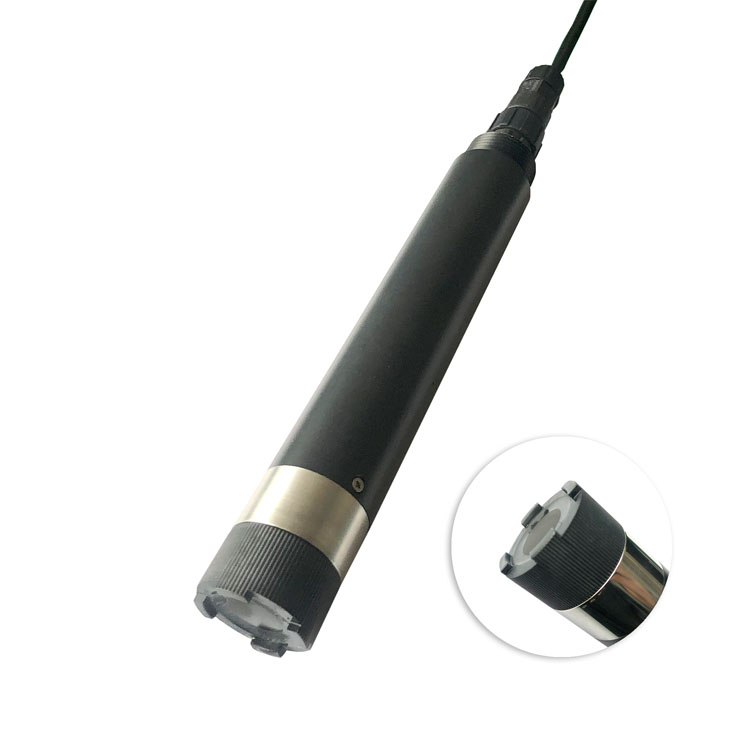
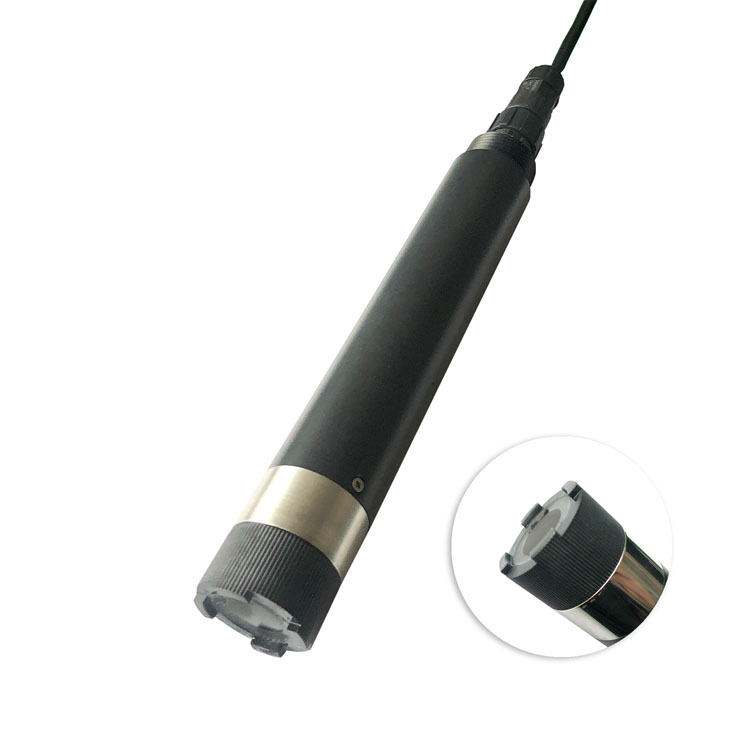
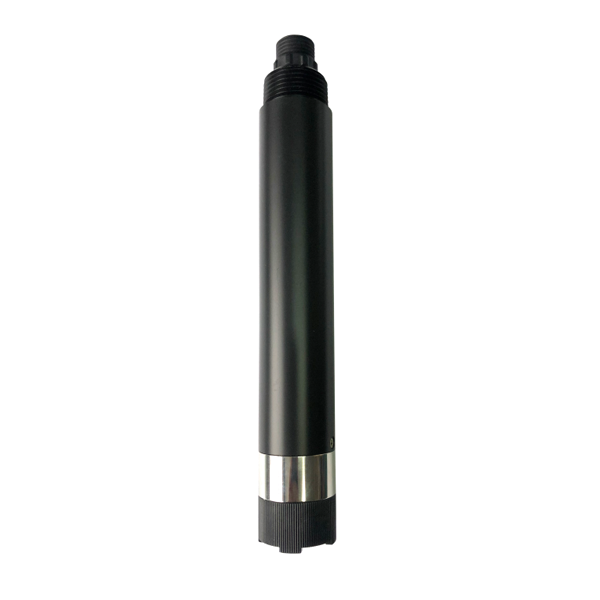
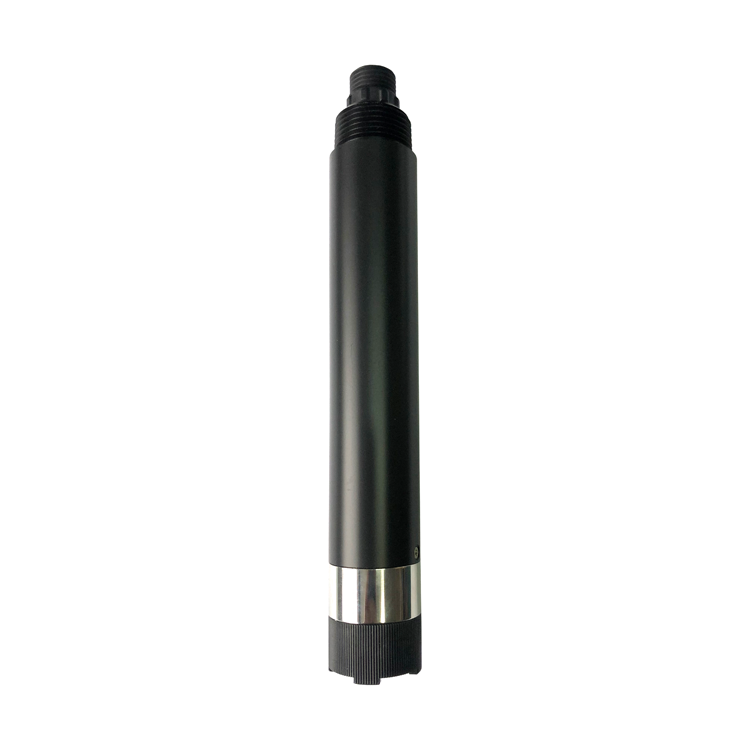
The NBL-WQ-DO and NBL-WQ-DO-4A are wired optical dissolved oxygen probes. They use fluorescence measurement and provide RS485 Modbus RTU data to a compatible PLC, RTU or data logger. Wireless transmission is a separate station function. Its coverage, network availability and power reserve need their own review.
Optical measurement does not consume oxygen, but the probe still needs clean, representative water contact. Keep the sensing cap below the water surface, clear of sediment and away from persistent bubbles. Do not move it into an aerator's immediate discharge simply because that point is close to the electrical cabinet; the local plume may not represent the pond zone of concern.
| Item | Base NBL-WQ-DO | NBL-WQ-DO-4A |
|---|---|---|
| DO range and resolution | 0-20.00 mg/L; 0.01 mg/L | 0-20.00 mg/L; 0.01 mg/L |
| Stated accuracy | +/-2% FS, equivalent to +/-0.4 mg/L on this span; temperature +/-0.3 C | +/-2% of reading; temperature +/-0.3 C |
| Supply and consumption | DC 12-24 V; below 0.3 W at 12 V | DC 12-24 V; 0.2 W at 12 V |
| Communication | RS485 Modbus RTU | RS485 Modbus RTU; optional 4-20 mA |
| Operating limits | 0-45 C; pressure below 0.2 MPa | 0-50 C; pressure at or below 0.2 MPa |
| Protection and mounting | IP68; immersion; 3/4 NPT | IP68; immersion; 3/4 NPT |
| Housing and cable | POM/316L; standard 5 m cable | POM/ABS-PC standard housing; standard 5 m cable |
Do not transfer the DO-4A model's percentage-of-reading accuracy to the base probe. The cable jacket and connector protection also need confirmation for the actual pond and cabinet route. IP68 on the probe does not qualify an open power supply or logger for exposure to rain.
Measure or obtain the power demand of the probe, logger, radio, regulator and any status inputs. Include startup and transmit peaks, not only idle current. A station that restarts whenever the modem transmits has insufficient usable power even if its daily average appears acceptable.
As a calculation example only, a complete monitoring load averaging 3 W for 12 hours requires 36 Wh at the load. This is not a battery specification or a claim about a NiuBoL logger. Battery selection must also account for conversion losses, permitted discharge, temperature, aging and the reserve needed by the site's response plan. Aerator energy is a separate, usually much larger design load.
For a solar-powered station, check the period when low generation and high monitoring demand coincide. A solar panel being present does not prove overnight reserve. Ask for the load assumptions, usable reserve and charging arrangement for the ordered station rather than a generic battery-runtime statement.
Agree a safe commissioning test with the farm operator and electrical contractor. Use approved simulation or controlled isolation of the relevant circuits. Do not stop essential aeration in stocked ponds merely to prove that an alarm works.
A recovered connection must not make old stored readings appear to be current. Retain original acquisition times and a data-age indication. The receiving platform's missing-report supervision is particularly important when the station cannot send its own power-failure message.
Provide safe retrieval for cleaning and fluorescent-cap inspection, label the power circuits and protect above-water joints from rain and cable strain. Compensation settings and the reference-check method should remain available to the service technician; a communication recovery is not a calibration check.
For remote pond DO monitoring inquiries, send NiuBoL the pond layout, measurement depth, available mains and backup arrangements, desired outage coverage and wireless destination. State whether aerator feedback and alarm delivery are included requirements. This separates the oxygen measurement package from the electrical work and emergency response the farm must arrange.
Not by itself. A probe without power cannot transmit. Use a backed-up logger with an appropriate power-status input, or independently configured missing-report supervision at the receiving end, according to the system design.
Do not assume so. Calculate the monitoring load and aerator load separately, including starting demand and required duration. The sensor's sub-watt consumption says nothing about the energy needed for aeration.
No. Alert delivery also depends on station power, the network, receiving service and recipient availability. Test the configured route and provide an escalation procedure suited to the farm.
No. Zero is a possible measurement and must not be used as a substitute for missing data. Expose the fault and data age separately, with the operating response defined by the farm.
No. Biofilm, sediment, bubbles and cap condition can still affect the reading. Plan safe retrieval, cleaning, reference checks and model-specific cap service even when telemetry is working.
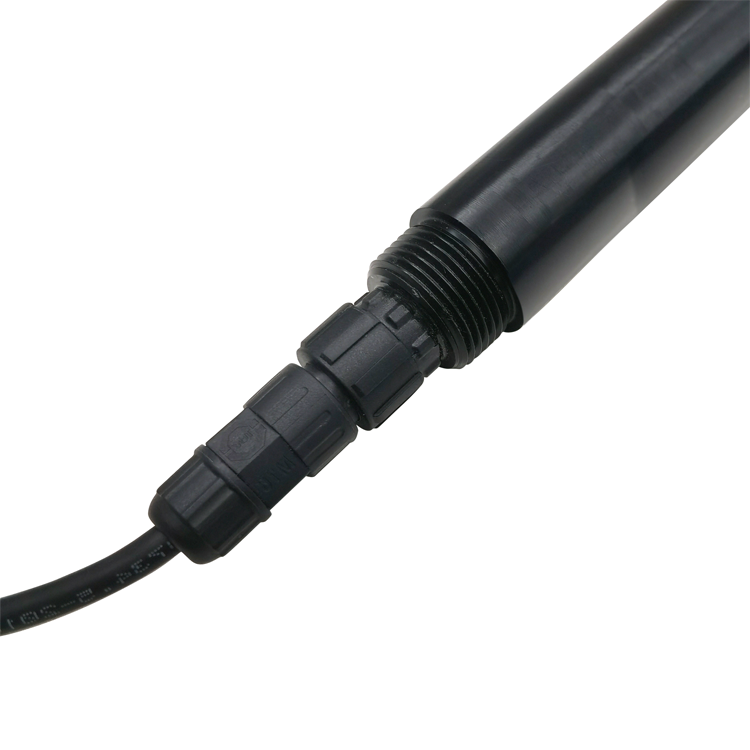
Remote pond DO monitoring needs a deliberate response to loss of aeration power, sensor power and communications. Specify the NiuBoL probe on its own measurement limits, then verify the complete station's reserve and fault indications. A successful design keeps oxygen data and outage status distinguishable and gives the operator a tested route to action.
Prev:TDS and pH Meter Online: Replace One Probe Without Losing Settings
Next:Weather Station Mast Installation: Loads, Cabling and Acceptance
Related recommendations
Sensors & Weather Stations Catalog
 Agriculture Sensors and Weather Stations Catalog-NiuBoL.pdf
Weather Stations Catalog-NiuBoL.pdf
Agriculture Sensors Catalog-NiuBoL.pdf
Water Quality Sensor Catalog-NiuBoL.pdf
Related products
 Combined air temperature and relative humidity sensor
 TDR Soil Moisture & Temperature Sensor for irrigation| RS485 |4-20mA| NBL-S-THR
 Soil pH sensor RS485 soil Testing instrument soil ph meter for agriculture |NBL-S-PH
 Wind Speed sensor Output Modbus/RS485/Analog/0-5V/4-20mA
 0.2mm Tipping Bucket Rain Gauge for Weather & Hydrology | NiuBoL
 Pyranometer Solar Radiation Sensor 4-20mA/RS485


Screenshot, WhatsApp to identify the QR code
WhatsApp number:+8615367865107
(Click on WhatsApp to copy and add friends)

