





— Blogs —
—Products—
 Consumer hotline +8618073152920
WhatsApp:+8615367865107
Address:Room 102, District D, Houhu Industrial Park, Yuelu District, Changsha City, Hunan Province, China
Product knowledge
Time:2026-08-22 09:08:00 Popularity:300
An aquaculture oxygen alarm is only useful if it detects a decline where fish are exposed and prompts an action the farm can complete in time. A handheld reading taken at noon cannot establish what happened before dawn, when respiration and aerator interruptions may be most consequential. This guide treats the instrument used to measure dissolved oxygen in water as one part of an operating system: probe, mounting point, power, communications, alarm logic, aerator control and a person who can respond.
For a pond, document species, stocking density, feeding schedule, aerator locations, water depth and seasonal changes. A sensor beside an aerator may report well-oxygenated water while a quieter part of the pond remains deficient. A bottom-mounted probe can be buried by sediment; a surface-only probe may miss stratification. Begin with a short depth and location survey during the periods most likely to cause low oxygen, then choose a fixed point that remains submerged at the minimum operating level and can be reached for cleaning.
In a recirculating system, the meaningful points may be the tank outlet, biofilter inlet or oxygenation outlet rather than a single central tank value. The alarm at each point has a different purpose: detect stock exposure, evaluate treatment performance or confirm the oxygenation device works. Do not combine them under one threshold without explaining which process each reading represents.
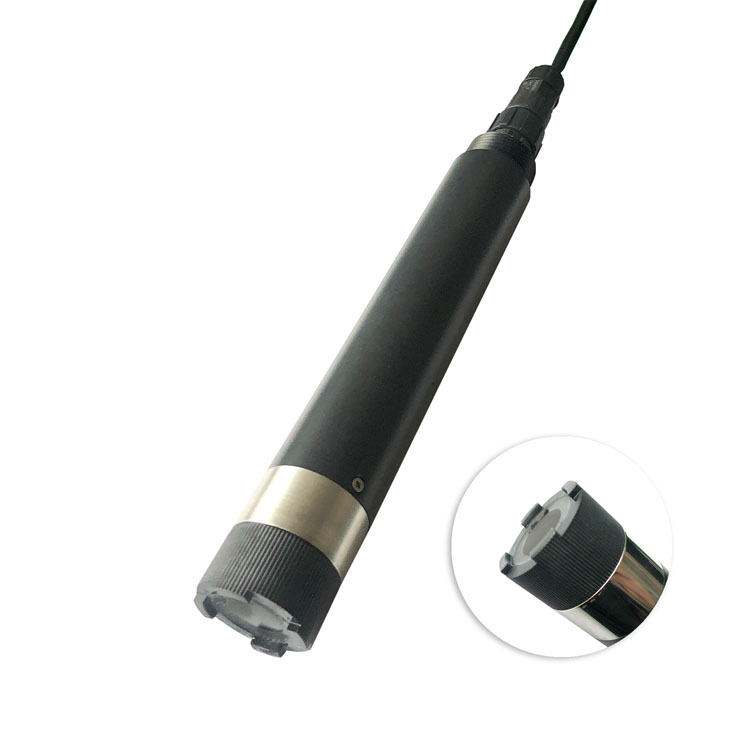
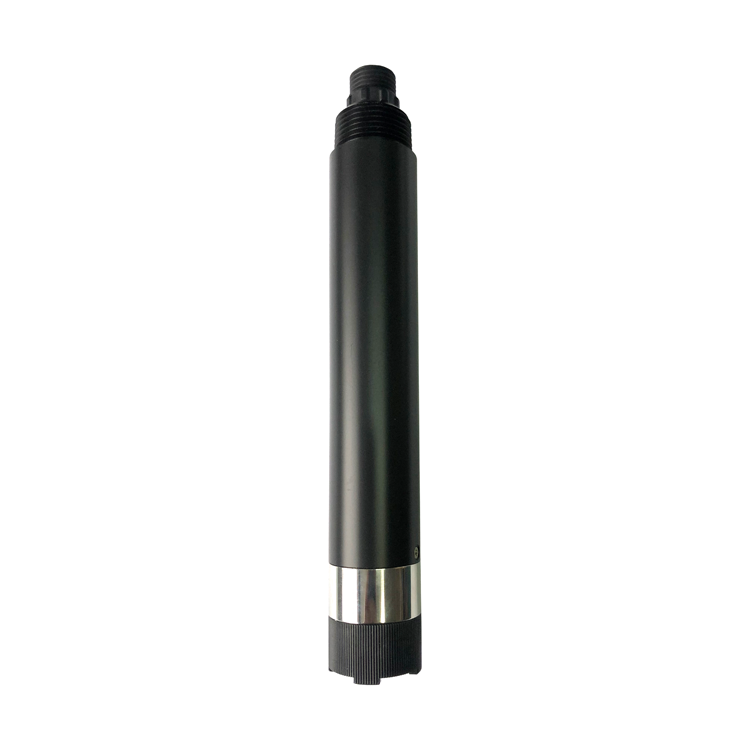
The NiuBoL NBL-WQ-DO online fluorescence dissolved oxygen sensor estimates oxygen from fluorescence quenching at its sensing cap. It does not need electrolyte or membrane polarization and does not consume oxygen during measurement. Those properties make it practical for a fixed monitoring point, but the optical face still requires inspection and the cap is a service part. The integrated temperature measurement supports compensation; salinity compensation must be configured appropriately for the water being monitored. A freshwater setting should not be assumed valid for a brackish site.
The probe is not a complete aeration controller. Its RS485 Modbus RTU reading must be received by a PLC, RTU or data logger; the receiving equipment then applies the site's alarm and control rules. If aerators are switched automatically, independent electrical protection, manual override and fault indication belong in the control design. A communications failure must raise a fault, not silently leave the last healthy oxygen number on screen.
| Item | NBL-WQ-DO value | Project consequence |
|---|---|---|
| DO range and resolution | 0-20.00 mg/L; 0.01 mg/L | Check expected operating and upset conditions; resolution is not accuracy. |
| DO accuracy | ±2% of full scale | Set alarm margin and acceptance tolerance with the published accuracy in view. |
| Temperature | Automatic Pt1000 compensation; 0.1 °C resolution; ±0.3 °C accuracy | Compare temperature as well as DO during commissioning. |
| Power and output | 12-24 VDC; RS485 Modbus RTU; 0.2 W at 12 V | Provide regulated supply and a documented register map. |
| Installation and protection | Immersion, 3/4-inch NPT; IP68 sensor body | Specify holder, retrieval path and waterproof field connection separately. |
| Operating conditions | 0-45 °C; below 0.2 MPa | Verify the process and cleaning arrangement stay within these limits. |
| Cable and calibration | 5 m standard cable; two-point calibration | Measure the real route and agree on reference-check procedure. |
These are NBL-WQ-DO figures, not generic specifications for every optical or electrochemical DO instrument. The useful distinction for purchasing is between the sensor's stated performance and the performance of the installed monitoring point. Incorrect placement, a damaged cap or a wet cable joint can make a nominally accurate probe unfit for alarm duty.
A single universal mg/L alarm threshold is not defensible across species, life stages, temperatures, salinities and culture methods. Set a site-specific warning and critical level with the farm's biological adviser and operating history. Define a short confirmation period to reject obvious electrical spikes without masking a genuine rapid fall. Add a rate-of-change review where a falling trend needs attention before the critical level is reached. Keep sensor fault, stale data and low oxygen as separate events with separate operator responses.
For an automatic aerator start, test the entire chain: lower a simulated input or use a controlled process condition, confirm the PLC interprets the register correctly, verify contactor feedback and log the time between threshold crossing and operating status. If the aerator is already running when DO continues to fall, the system needs a second response such as escalation to an operator, not repeated start commands. At night, verify that alerts reach the responsible person and that the farm has a procedure when communications are unavailable.
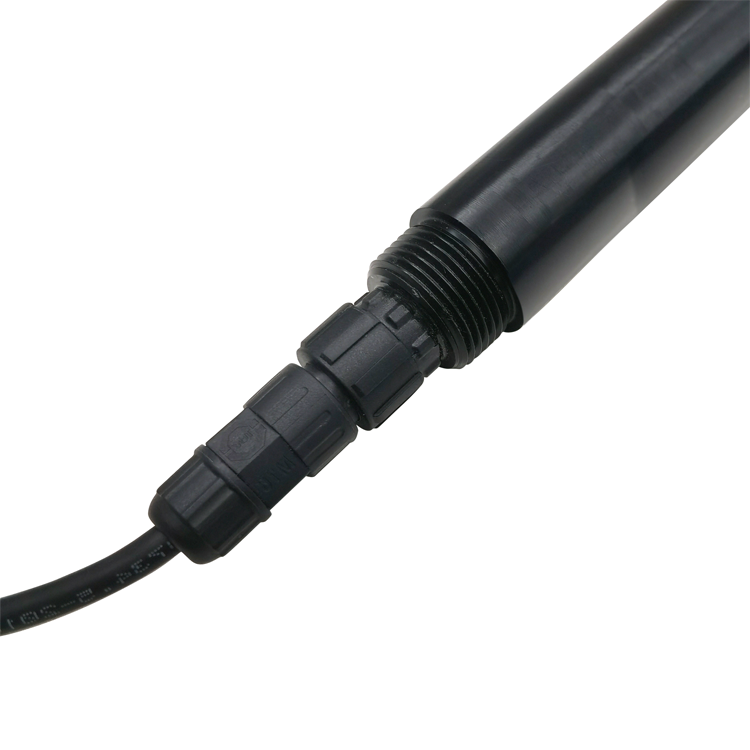
Mount the sensing face below the lowest expected waterline and away from bottom deposits, impact points and locations where the probe can swing into a wall. Protect the fluorescent cap from scratches during installation. Provide enough clearance to withdraw, rinse and reinstall the probe without disturbing an entire cage or draining a tank. Position the cable with strain relief and route any field extension through a properly protected junction; IP68 at the probe does not make an open splice waterproof.
At commissioning, record the probe depth, distance to aeration, normal water level and any nearby flow obstruction. Compare the installed reading with a maintained reference instrument at the same place, depth and time. Allow readings to stabilize and record temperature, salinity setting and aerator operating state. If comparison fails, inspect mounting, cap, bubbles, compensation settings and reference instrument condition before altering calibration. Keep an as-found value before cleaning so fouling can be distinguished from a process change.
Specify the device address, baud rate, register addresses, data type, scaling and poll interval in the PLC or logger schedule. Test the decoded mg/L and temperature against the instrument values, not just whether the serial link responds. Timestamp readings at collection; identify held values after a timeout. For a solar-powered remote pond, budget the entire package, including logger, radio, relay, enclosure and nighttime operation, rather than using the probe's 0.2 W value as the station power demand.
A trace that drops whenever a pump starts may indicate electrical noise or supply sag rather than a real oxygen collapse. Check supply voltage at the sensor under the actual switching load, RS485 wiring and grounding, then compare with an independent measurement. Conversely, do not dismiss an isolated low reading as noise merely because another pond looks normal; water mixing and loading can differ substantially.
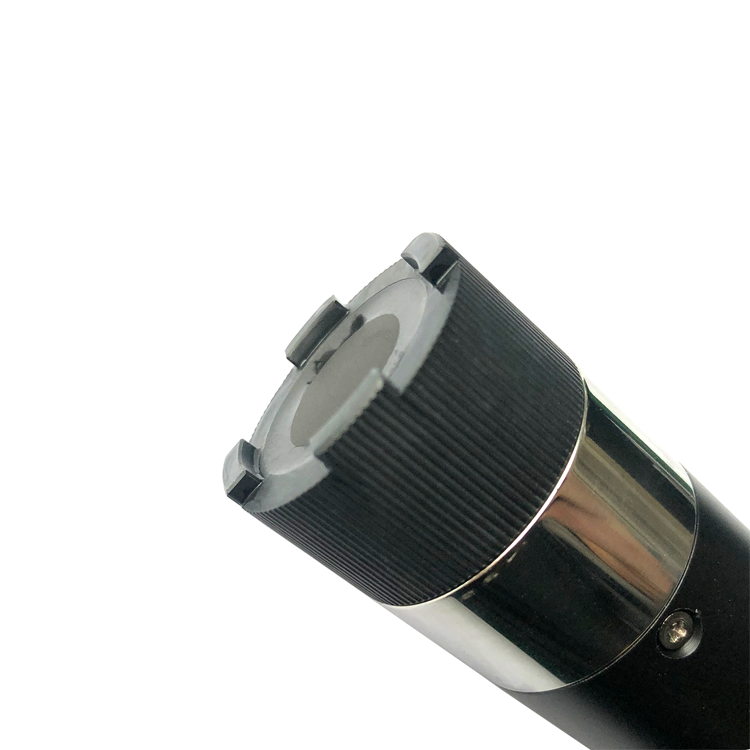
Optical measurement removes electrolyte replacement, not service planning. Inspect the cap for damage, rinse deposits gently and check cable sheath and joints. The NiuBoL product information recommends periodic cleaning and cap inspection; actual frequency should follow the farm's biofouling and as-found comparison history. The fluorescent cap is a replaceable item, with a one-year normal-use replacement recommendation. Keep a spare and plan verification after replacement. Abrasive cleaning or a dry, damaged sensing film can create an error larger than the alarm margin.
Ask for a quotation that identifies the NBL-WQ-DO probe, cable length, holder, protective junction, PLC/RTU or logger interface, alarm output, spares and commissioning support separately. Provide pond layout, depth range, temperature and salinity, desired update rate, power supply, communication distance and the operating response expected at warning and critical levels. A portable meter may be sufficient for routine inspections where no continuous alarm is required. Continuous NBL-WQ-DO monitoring is justified when unattended low-oxygen events demand a timed, traceable response.
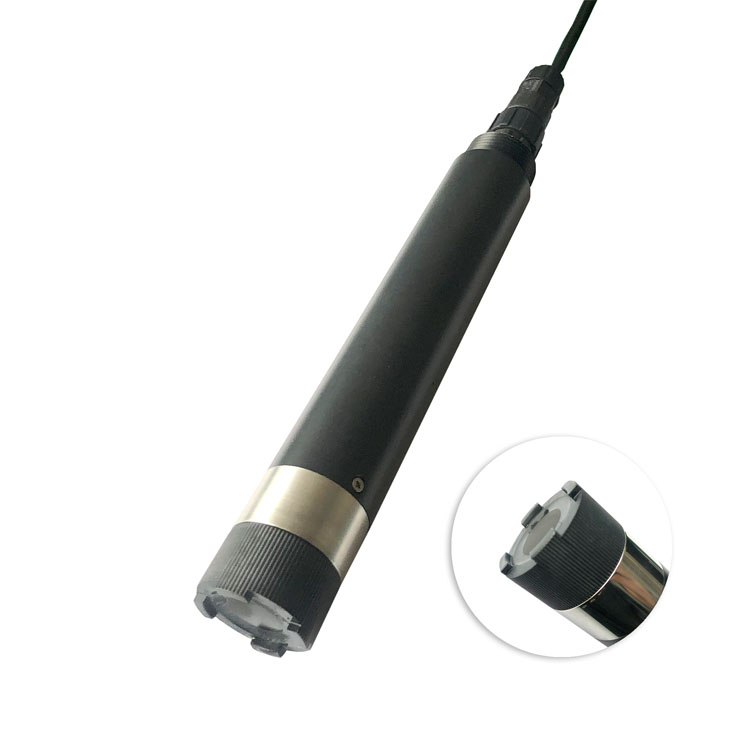
Q1. Which instrument is used to measure dissolved oxygen continuously in a pond?
A1. A fixed online DO probe such as the NBL-WQ-DO provides a Modbus reading for logging and alarms. Select the point by the fish-exposure risk and make the probe retrievable for cleaning; a portable meter remains useful as an independent check.
Q2. Can one probe represent a large or stratified pond?
A2. Not automatically. Survey depth and horizontal differences during critical hours. If zones behave differently, add points or use a defined sampling program rather than labeling one local reading as pond-wide oxygen.
Q3. Does the optical sensor control aerators by itself?
A3. No. It sends measurement data via RS485 Modbus RTU. A PLC, RTU or controller must implement the threshold, delay, relay logic, feedback and failure response.
Q4. What alarm threshold should be requested?
A4. Specify species, life stage, water temperature and salinity, then agree warning and critical levels with the farm's aquaculture specialist. Also define the confirmation delay and what happens if the reading stops updating.
Q5. Is a 0.01 mg/L displayed step the instrument accuracy?
A5. No. It is resolution. The NBL-WQ-DO published DO accuracy is ±2% of full scale; field acceptance must also account for the reference method, mounting and water variation.
Q6. Why might the probe and handheld meter disagree?
A6. First compare at the same depth and time, with both instruments maintained and the correct compensation settings. Then inspect cap fouling, bubbles, temperature and whether aeration was cycling during the check.
Q7. What should the quotation include beyond the probe?
A7. State cable length, mounting hardware, waterproof junction, receiver or PLC interface, alarms, spare cap, reference-check method and site commissioning. Confirm who supplies each item and who responds to a fault at night.
For aquaculture, the decisive question is not whether an instrument displays dissolved oxygen but whether its location and signal path can support a timely intervention. NBL-WQ-DO provides a continuous optical measurement; the integrator must make the measurement representative, decode it correctly, maintain the cap and prove that alarms and aeration actions work under realistic operating conditions.
Prev:TDS and pH Digital Water Tester: Resolve Online Reading Differences
Next:Connected Rodent Pest Control: Separate Trap and Insect Monitoring
Related recommendations
Sensors & Weather Stations Catalog
 Agriculture Sensors and Weather Stations Catalog-NiuBoL.pdf
Weather Stations Catalog-NiuBoL.pdf
Agriculture Sensors Catalog-NiuBoL.pdf
Water Quality Sensor Catalog-NiuBoL.pdf
Related products
 Combined air temperature and relative humidity sensor
 TDR Soil Moisture & Temperature Sensor for irrigation| RS485 |4-20mA| NBL-S-THR
 Soil pH sensor RS485 soil Testing instrument soil ph meter for agriculture |NBL-S-PH
 Wind Speed sensor Output Modbus/RS485/Analog/0-5V/4-20mA
 Tipping bucket rain gauge for weather monitoring auto rainfall sensor RS485/Outdoor/stainless steel
 Pyranometer Solar Radiation Sensor 4-20mA/RS485


Screenshot, WhatsApp to identify the QR code
WhatsApp number:+8615367865107
(Click on WhatsApp to copy and add friends)

