





— Blogs —
—Products—
 Consumer hotline +8618073152920
 WhatsApp:+8615367865107
Address:Room 102, District D, Houhu Industrial Park, Yuelu District, Changsha City, Hunan Province, China
Product knowledge
Time:2023-12-25 15:51:34 Popularity:10216
An anemometer is the instrument used to measure wind speed. Anemometers are widely used in weather stations, agriculture, environmental monitoring, wind energy, ports, airports, construction and industrial applications.
The most common outdoor wind-speed instruments include cup anemometers and ultrasonic anemometers. Handheld vane and hot-wire anemometers are more commonly used for HVAC, laboratory and indoor airflow measurements.
A wind vane should not be confused with an anemometer. A wind vane measures wind direction, while an anemometer measures wind speed. Weather stations often use both instruments together.
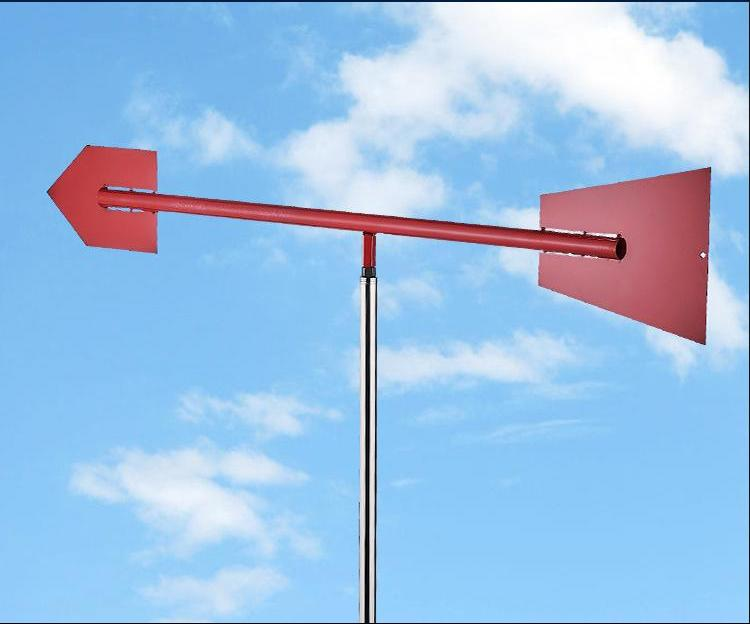
| Instrument | What It Measures | Typical Application |
|---|---|---|
| Cup Anemometer | Wind speed | Weather stations, agriculture, industrial outdoor monitoring |
| Ultrasonic Anemometer | Wind speed and usually wind direction | Professional weather, research and low-maintenance monitoring |
| Vane Anemometer | Air velocity | HVAC, ducts and handheld measurements |
| Hot-Wire Anemometer | Low air velocity | HVAC, laboratories and indoor airflow |
| Wind LiDAR | Remote wind profile | Wind energy, atmospheric research and remote profiling |
An anemometer is an instrument specifically designed to measure the speed of moving air. Outdoor meteorological anemometers measure atmospheric wind speed, while specialized handheld instruments can measure airflow inside ducts, rooms and laboratories.
Depending on the sensor design, wind speed can be converted into a mechanical rotation, electrical signal, ultrasonic transit-time difference or thermal measurement.
Modern industrial wind sensors can provide signals such as:
RS485 Modbus RTU
4–20 mA
0–5 V or other voltage output
Pulse output
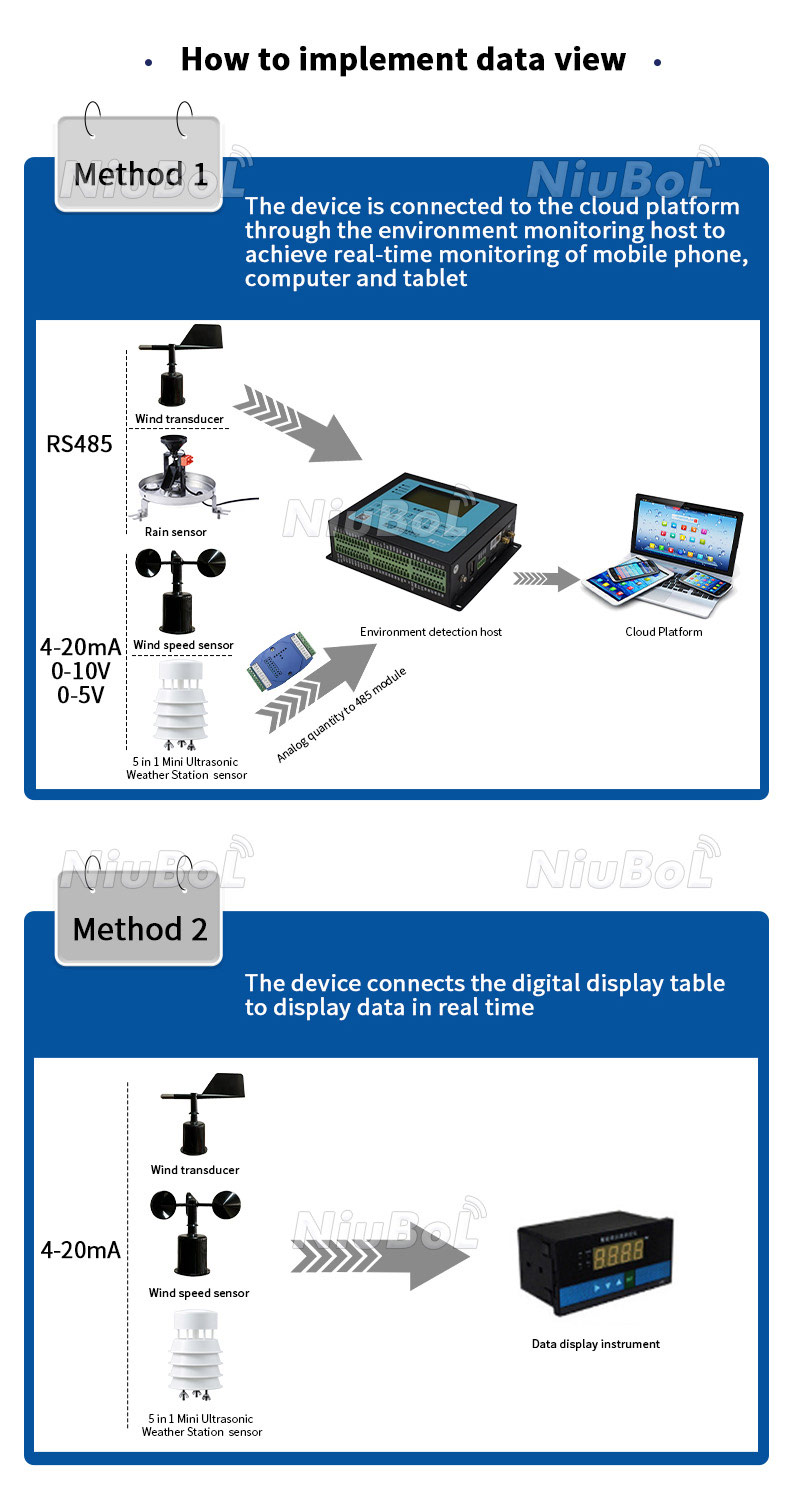
These signals allow the anemometer to connect to PLCs, data loggers, RTUs, automatic weather stations and IoT gateways.
The cup anemometer is one of the most common instruments for outdoor wind-speed measurement. It normally consists of three or four cups mounted around a vertical rotating shaft.
When wind acts on the cups, the assembly rotates. The rotational speed increases as wind speed increases. An electronic circuit detects the rotation and converts it into wind-speed data.
One advantage of a cup anemometer is that it does not need to face the wind direction before measuring speed, making it suitable for long-term unattended weather monitoring.
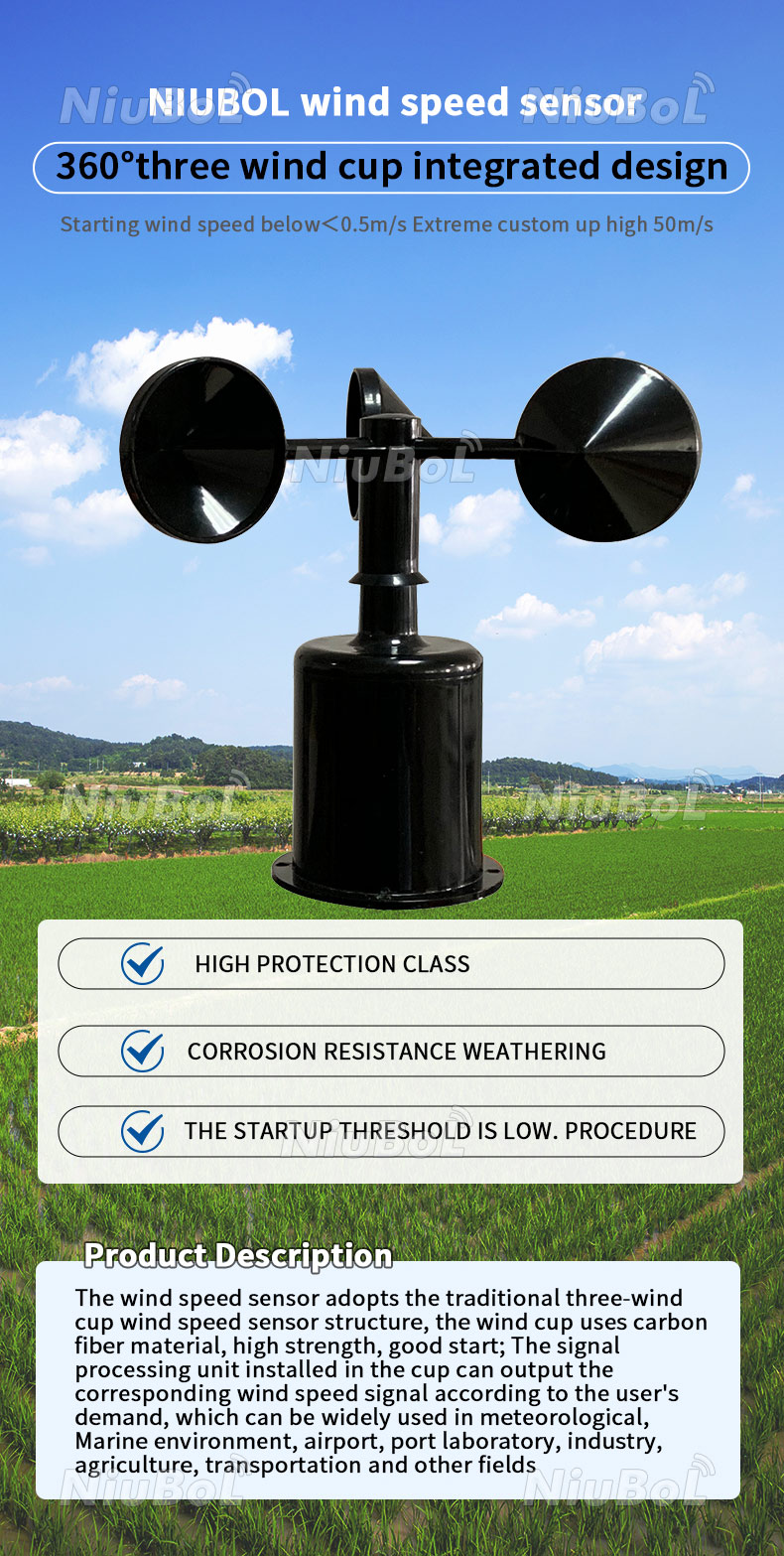
The cups have different aerodynamic resistance on their concave and convex surfaces. When exposed to wind, this difference in force causes the rotor to turn.
The sensor measures the rotational speed and converts it to wind speed using its calibration relationship.
Wind → Cup Rotation → Rotation Detection → Signal Processing → Wind Speed
Industrial models can transmit the resulting measurement digitally or through analog signals to other equipment.
An ultrasonic anemometer measures wind using the travel time of ultrasonic signals between transducers.
If there is no wind, the ultrasonic transit time in opposite directions is approximately equal. When wind is present, sound traveling with the airflow arrives faster than sound traveling against it.
The sensor processes these time differences to calculate wind speed and direction.
Because ultrasonic anemometers have no conventional rotating cups or wind vane, they reduce mechanical wear and are widely used in compact weather stations and professional environmental monitoring.
A vane anemometer uses a small propeller or fan-like rotor. Airflow turns the vane, and the rotation is converted into air velocity.
Vane anemometers are often handheld and are particularly useful for:
HVAC inspection
Ventilation ducts
Air outlets and diffusers
Indoor airflow measurement
They are generally less suitable than fixed cup or ultrasonic sensors for continuous unattended outdoor weather monitoring.
A hot-wire anemometer uses a heated sensing element. Moving air removes heat from the element, and the instrument measures the electrical change required to maintain or track the sensor temperature.
Hot-wire anemometers are especially useful for relatively low air velocities and are commonly used in HVAC, laboratories and airflow research.
Wind LiDAR is a remote-sensing technology that uses laser light and Doppler shift to measure atmospheric wind at a distance.
Unlike a conventional anemometer installed at one fixed point, LiDAR can measure wind at multiple heights or along remote sensing paths. It is used in wind-energy assessment, atmospheric research and specialized meteorological applications.
LiDAR systems are significantly more complex and expensive than conventional cup or ultrasonic anemometers, so they are not normally used as a replacement for basic weather-station wind sensors.
These two instruments are often installed together but perform different functions.
| Instrument | Measures | Typical Unit |
|---|---|---|
| Anemometer | Wind speed | m/s, km/h, mph, knots |
| Wind Vane | Wind direction | Degrees or compass direction |
For more detail, see Cup Anemometer vs Wind Vane.
| Unit | Common Use |
|---|---|
| m/s | Meteorology, engineering and scientific monitoring |
| km/h | Public weather information and transportation |
| mph | Common in some countries for public weather reporting |
| knots | Marine and aviation applications |
For long-term outdoor monitoring, the NiuBoL NBL-W-SS uses a traditional three-cup design and provides several industrial output options.
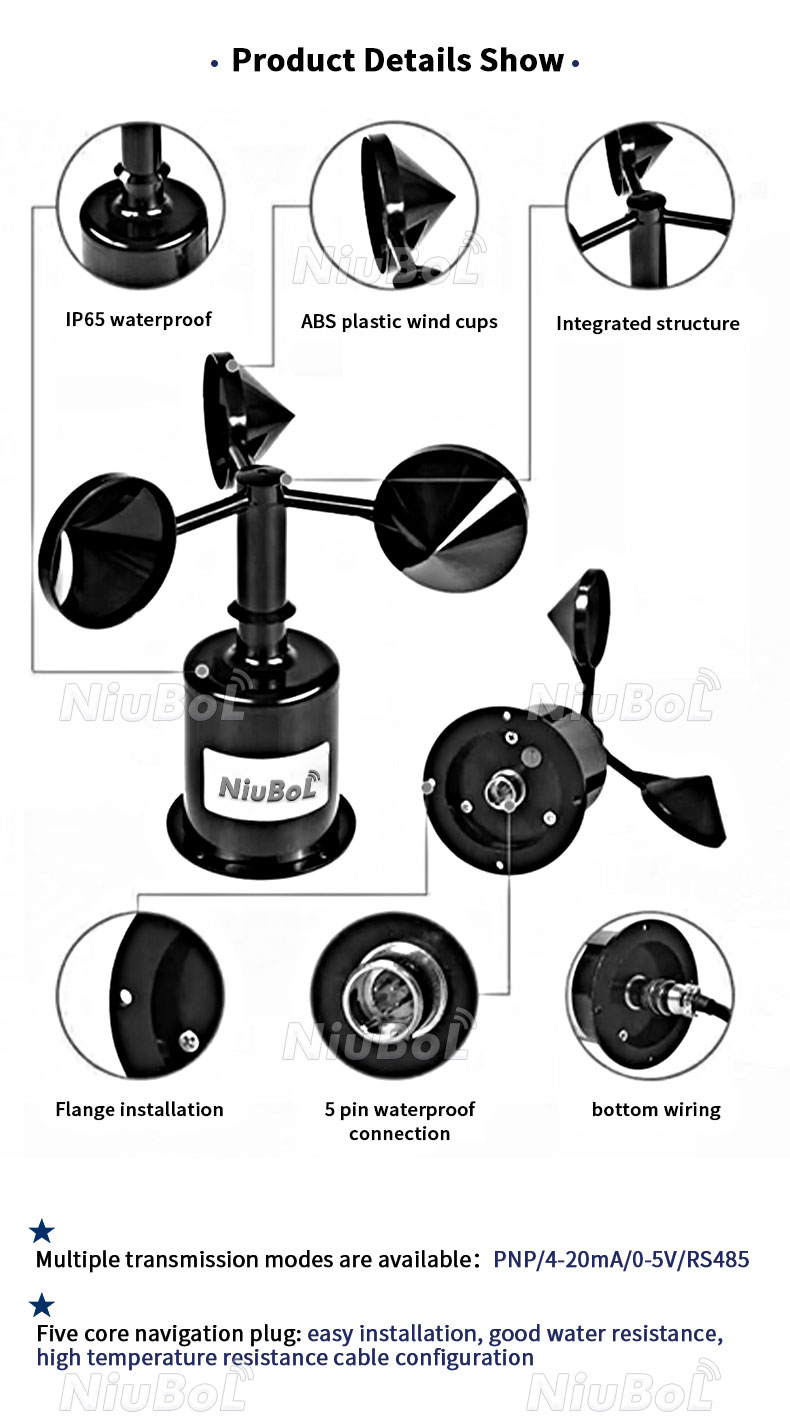
NBL-W-SS Cup Anemometer / Wind Speed Sensor
Measurement range: 0–45 m/s or 0–70 m/s
Accuracy: ±(0.3 + 0.03V) m/s
Resolution: 0.1 m/s
Starting wind speed: ≤0.5 m/s
Outputs: RS485 Modbus, 4–20 mA, voltage or pulse depending on configuration
View NBL-W-SS Wind Speed Sensor →
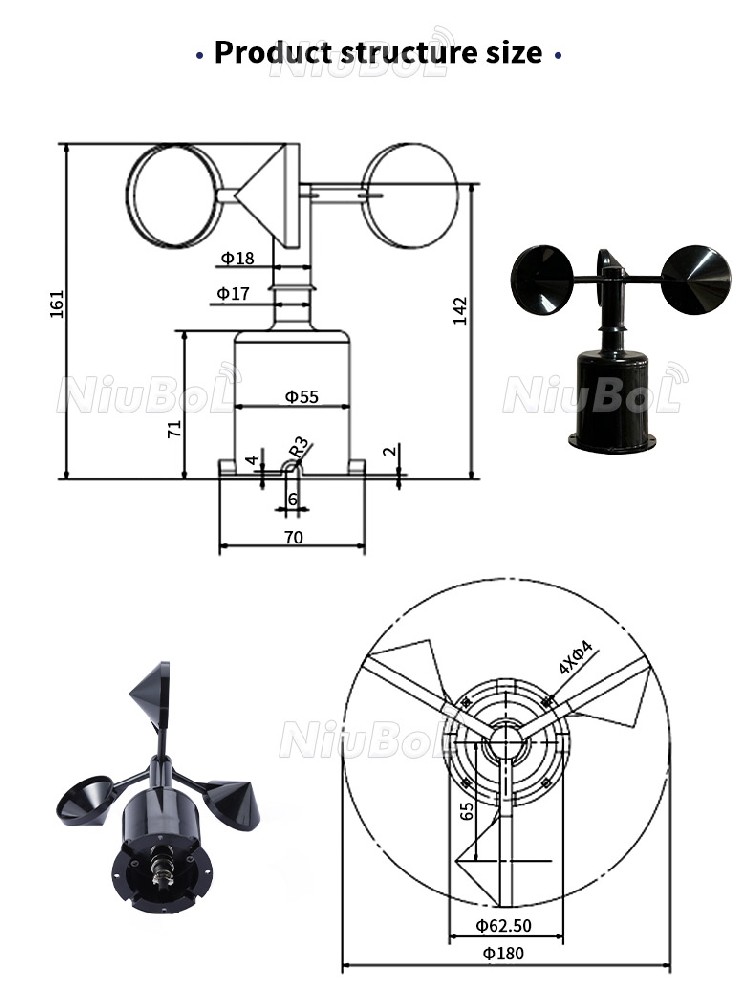
For industrial monitoring, an RS485 Modbus anemometer can connect directly to a PLC, RTU, data logger or IoT gateway.
Anemometer → RS485 Modbus → PLC / Data Logger → 4G / Ethernet → MQTT / HTTP → Cloud or Private Server
If wind direction is also required, a separate wind-direction sensor can be installed on the same monitoring station, or an integrated ultrasonic wind-speed and direction sensor can be selected.
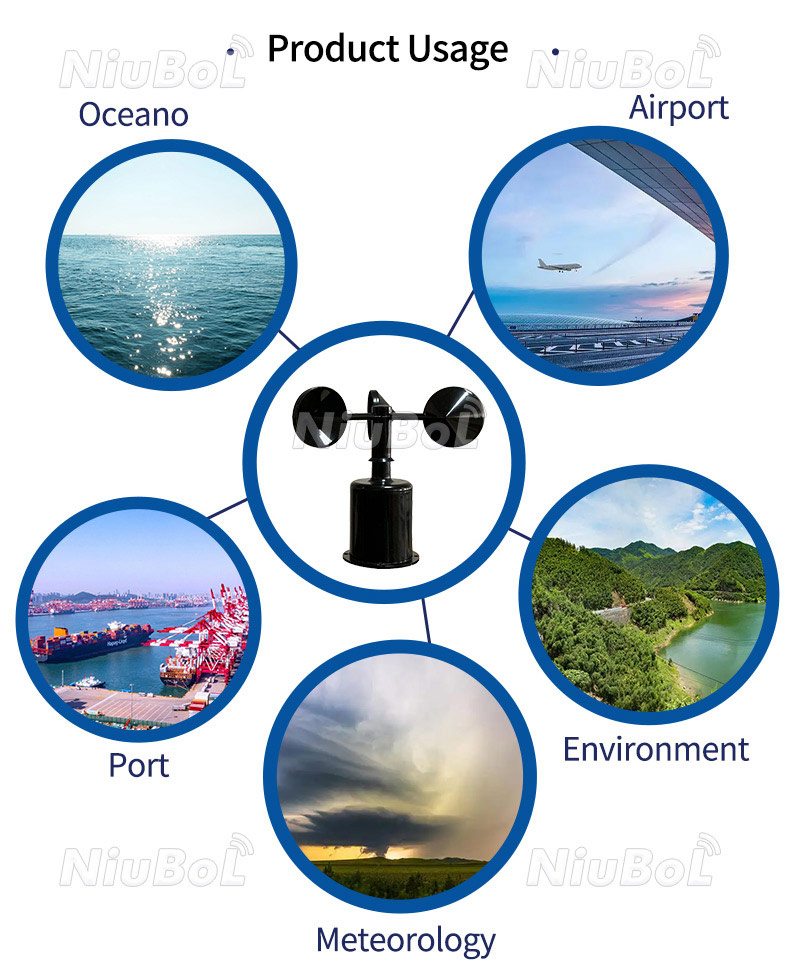
Wind speed is one of the core parameters measured by automatic weather stations and meteorological observation networks.
Wind information is useful for agricultural weather monitoring, spraying decisions, greenhouse ventilation and crop-management systems.
Ports and coastal stations monitor wind because it affects vessel operations, cargo handling and marine conditions.
Wind speed may be monitored around cranes, tall structures and other wind-sensitive construction activities. Operational limits should come from the relevant equipment or safety specification.
Wind speed and direction provide important supporting information when analysing the dispersion of dust, gases and air pollutants.
Wind-speed measurement is essential for wind-resource assessment and turbine operation. Professional wind-energy projects may require specialized calibrated sensors and measurement standards.
| Requirement | Recommended Instrument |
|---|---|
| Outdoor continuous wind speed | Cup anemometer |
| Wind speed + direction in one sensor | Ultrasonic anemometer |
| HVAC duct airflow | Vane or hot-wire anemometer |
| Very low laboratory air velocity | Hot-wire anemometer |
| Remote wind profile at multiple heights | Wind LiDAR |
For an industrial sensor project, also confirm:
Expected maximum wind speed
Required accuracy
Starting wind speed
Wind direction requirement
RS485, 4–20 mA, voltage or pulse output
Available power supply
Cable length
Operating temperature
Corrosion, dust, marine or icing conditions
Required mounting height
PLC, logger or IoT gateway compatibility
Even a good wind sensor can give poor measurements when installed in disturbed airflow.
Choose an open and representative measurement location.
Avoid unnecessary obstruction from walls, buildings and trees.
Use a stable mounting pole and bracket.
Make sure the wind cups rotate freely.
Avoid excessive vibration.
Protect cables from mechanical damage.
Follow the project standard for sensor height and obstacle clearance.
Mechanical cup anemometers should be inspected periodically because they contain rotating parts.
Check the wind cups for cracks or deformation.
Confirm that the rotor turns freely.
Remove dust, insects, ice or other debris.
Check the mounting screws and brackets.
Inspect cables and connectors.
Check readings if bearing resistance increases.
Verify or calibrate the sensor when required by the project.
Ultrasonic sensors have no conventional rotating cup mechanism, reducing mechanical maintenance, but their sensing surfaces, heater function and electrical connections should still be inspected according to the manufacturer's instructions.
A1. An anemometer is the standard instrument used to measure wind speed.
A2. A wind vane or electronic wind-direction sensor measures wind direction.
A3. No. A standard cup anemometer measures wind speed only. Wind direction requires a separate wind vane or an integrated ultrasonic sensor.
A4. Common units include meters per second, kilometers per hour, miles per hour and knots.
A5. Cup and ultrasonic anemometers are widely used in automatic weather stations.
A6. Handheld vane or hot-wire anemometers are generally more suitable for ducts and indoor ventilation measurements.
A7. Yes. Industrial anemometers with RS485 Modbus, 4–20 mA or compatible voltage outputs can connect to PLCs, RTUs and data loggers.
A8. Yes, provided each Modbus device has a unique address and the power supply, cable length, topology and termination are designed correctly.
A9. Not always. Cup sensors are mature and cost-effective, while ultrasonic sensors combine wind speed and direction and reduce mechanical maintenance. The better choice depends on project requirements.
A10. Yes. An RS485 wind sensor can connect to a 4G or Ethernet gateway, which can transmit data using MQTT, HTTP or TCP depending on the system design.
1. NBL-W-SS Wind Speed Sensor Instruction Manual
 NBL-W-SS-Wind-Speed-Sensors-Instruction-Manual-V4.0.pdf
NiuBoL provides cup anemometers, wind-direction sensors, ultrasonic wind sensors and complete automatic weather stations for meteorological, agricultural, environmental and industrial monitoring.
For product selection, provide the expected wind-speed range, whether wind direction is required, output signal, quantity, cable length, operating environment and whether the sensor needs to connect to a PLC, data logger, 4G gateway or private server.
Related recommendations
Sensors & Weather Stations Catalog
 Agriculture Sensors and Weather Stations Catalog-NiuBoL.pdf
Weather Stations Catalog-NiuBoL.pdf
Agriculture Sensors Catalog-NiuBoL.pdf
Water Quality Sensor Catalog-NiuBoL.pdf
Related products
 Combined air temperature and relative humidity sensor
 TDR Soil Moisture & Temperature Sensor for irrigation| RS485 |4-20mA| NBL-S-THR
 Soil pH sensor RS485 soil Testing instrument soil ph meter for agriculture |NBL-S-PH
 Wind Speed sensor Output Modbus/RS485/Analog/0-5V/4-20mA
 Tipping bucket rain gauge for weather monitoring auto rainfall sensor RS485/Outdoor/stainless steel
 Pyranometer Solar Radiation Sensor 4-20mA/RS485

Screenshot, WhatsApp to identify the QR code
WhatsApp number:+8615367865107
(Click on WhatsApp to copy and add friends)

