





— Blogs —
—Products—
 Consumer hotline +8618073152920
WhatsApp:+8615367865107
Address:Room 102, District D, Houhu Industrial Park, Yuelu District, Changsha City, Hunan Province, China
Product knowledge
Time:2026-08-01 10:17:20 Popularity:250
Quick Answer: An online nitrite sensor can follow changes between scheduled samples in aquaculture and wastewater treatment. Before selecting the NiuBoL NOO-4S, confirm the NO2 or NO2-N reporting basis, suitability of its 0-2.000 mg/L range and performance near the intended alarm level. Use a verified nitrite trend with other process observations; do not interpret it as ammonia, nitrate or total nitrogen.

In a recirculating aquaculture system, a nitrite rise can prompt investigation of biological filtration and operating changes. In wastewater treatment, nitrite can help investigate an imbalance in nitrogen conversion. The useful question is not simply whether the instrument displays nitrite, but whether it can distinguish a meaningful change in the actual water before the next operating decision.
A biofilter outlet, a mixed culture tank and an aeration basin answer different questions. Select a point that represents the process under investigation, remains immersed at normal low water level and can be reached for checks. A stagnant corner may show a local condition rather than the water passing through treatment.
Results expressed as nitrite ion, NO2, and nitrite-nitrogen, NO2-N, are not numerically interchangeable. Health Canada's technical guidance gives approximately 3.29 mg/L as NO2 for 1 mg/L as NO2-N. Thus, an illustrative 0.20 mg/L as NO2-N is about 0.66 mg/L as NO2; these represent the same concentration on different mass bases, not different water conditions.
Confirm the ordered sensor's output basis explicitly. Carry it through calibration solution labels, laboratory reports, PLC tags and alarm settings. Writing only mg/L on every screen leaves room for a substantial scaling error. Do not apply the conversion twice if the receiving controller already performs it.
The NiuBoL NBL-WQ-NOO-4S uses a PVC-membrane ion-selective electrode. Its concentration range is narrow compared with many industrial nitrate instruments, but range alone does not demonstrate suitability for a particular aquaculture alarm.
| Parameter | NOO-4S specification | Selection implication |
|---|---|---|
| Range; resolution | 0-2.000 mg/L; 0.001 mg/L | Confirm analyte basis and include foreseeable excursions. |
| Accuracy | +/-5%; temperature +/-0.3 degrees C | Obtain percentage basis and reference conditions; resolution is not detection limit. |
| Water conditions | 0-40 degrees C; pressure at most 0.2 MPa | Review the actual sample and installation, not just ambient air. |
| Supply; power | 12-24 VDC; 0.2 W at 12 V | Include controller and communications loads separately. |
| Digital output | RS485 Modbus RTU | Obtain the delivered register definition before programming. |
| Construction; protection | 316L body; IP68 | Check all wetted parts and junctions for the intended water. |
| Mount; connection | 3/4 NPT; M16 five-core connector; standard 5 m shielded cable | Confirm cable jacket and any extension arrangement. |
| Compensation; calibration | Pt1000 temperature compensation; two-point calibration | Use the specified preparation and standards for this electrode. |
A display changing in steps of 0.001 mg/L does not establish accuracy at 0.001 mg/L. Ask for achievable uncertainty and detection capability around the site's decision level, including reference-method uncertainty and matrix effects. If the required distinction is smaller than demonstrated performance, choose a more suitable analytical arrangement rather than lowering an alarm to match the display's decimal places.

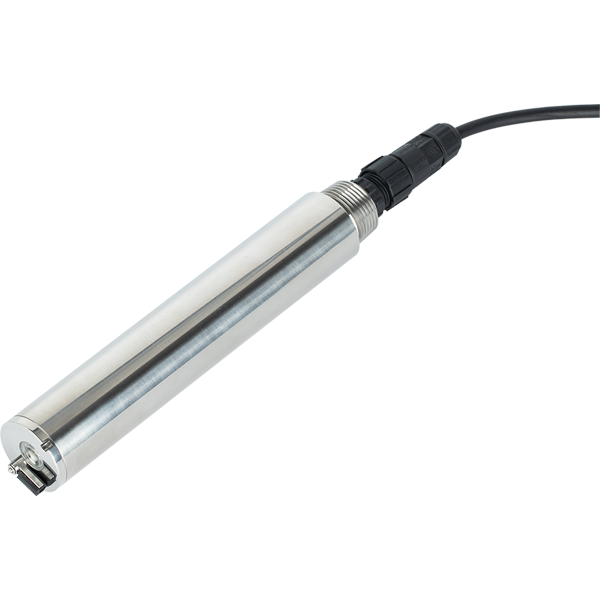
The pictured NON-4A is a nitrate instrument, not an alternative name for the nitrite probe. Nitrate, nitrite and ammonia measurements address different parts of the nitrogen process. A nitrate reading cannot replace a missing nitrite channel, and adding those readings without matching their nitrogen basis is invalid.
For a biofilter investigation, time-align nitrite with relevant ammonia, nitrate, dissolved oxygen, temperature and operating records. A nitrite rise after a feed or flow change needs different investigation from a sudden jump immediately after cleaning the electrode. The trend helps locate a question; it does not establish the cause by itself.

Do not assume the pictured multiparameter assembly includes nitrite. Specify each requested channel and its receiving interface. A separate probe may share a station with other measurements, but it still needs a representative location and independent calibration checks.
Install the NOO-4S with its measuring end downward, at least 15 degrees from horizontal; do not mount it horizontally or inverted. Keep bubbles, accumulated solids and cable strain away from the sensing region. Review a bypass for transport delay and sample changes before using it instead of immersion.
Activate a new or stored electrode using its supplied procedure before evaluating it. Use compatible membrane cleaning and the specified two-point calibration. Establish service intervals from observed deposits, reference checks and response after cleaning, not a promised universal electrode life.
Set aquaculture response levels for the species, life stage, water chemistry and responsible operating plan. This probe's range is not a universal safe nitrite limit or a dosing instruction. Similarly, wastewater process alarms and discharge reporting have different requirements; validate the method for its intended use.
It can add continuous observations between samples. Reduce sampling only under a validated monitoring plan that retains comparison checks and a response to sensor faults.
Not automatically. Confirm the reporting basis, expected peak and demonstrated uncertainty at the intended alarm level. An overrange event also needs a defined response.
Check whether one reports NO2-N and the other NO2. Resolve the basis before investigating drift; a conversion mismatch is not corrected by recalibrating the electrode.
Do not assume so. Compensation addresses temperature-related response; suitability in a changing ionic background needs an actual-water evaluation and the relevant interference information.
Only after performance, alarm behavior and the site's control safeguards are established. Begin with supervised trend and comparison checks where the consequences of a false reading are significant.
Send the NO2 or NO2-N basis, expected concentrations and alarm, water chemistry, temperature, mounting and cable route. Identify the controller, reference test and required electrode replacements so NiuBoL can quote the actual measuring point.
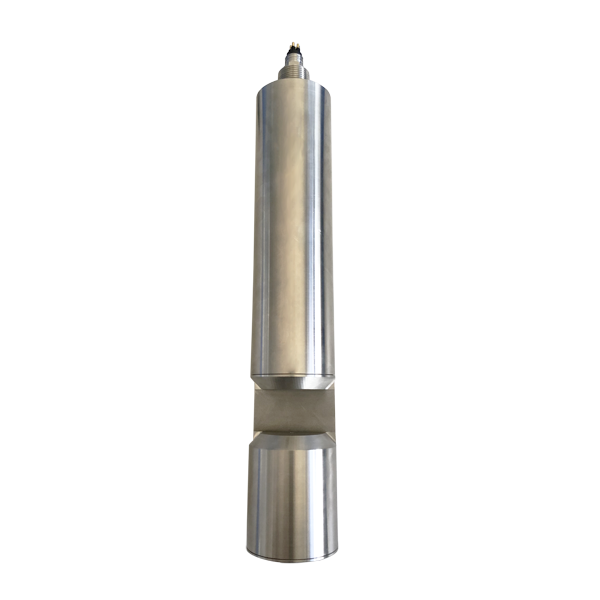
An online nitrite sensor is useful when its range, reporting basis and field performance support a specific process response. The separate turbidity and FUV instruments pictured here provide different water-quality observations; neither establishes a nitrite result. Keep nitrogen species distinct, protect the membrane and prove the complete alarm channel before using the trend for consequential decisions.
Prev:Nitrate Nitrogen Sensor Selection: Units, Error Limits and Site Trials
Next:Fluoride Ion Sensor for Industrial Water: Matrix, Accuracy and Sampling
Related recommendations
Sensors & Weather Stations Catalog
 Agriculture Sensors and Weather Stations Catalog-NiuBoL.pdf
Weather Stations Catalog-NiuBoL.pdf
Agriculture Sensors Catalog-NiuBoL.pdf
Water Quality Sensor Catalog-NiuBoL.pdf
Related products
 Combined air temperature and relative humidity sensor
 TDR Soil Moisture & Temperature Sensor for irrigation| RS485 |4-20mA| NBL-S-THR
 Soil pH sensor RS485 soil Testing instrument soil ph meter for agriculture |NBL-S-PH
 Wind Speed sensor Output Modbus/RS485/Analog/0-5V/4-20mA
 Tipping bucket rain gauge for weather monitoring auto rainfall sensor RS485/Outdoor/stainless steel
 Pyranometer Solar Radiation Sensor 4-20mA/RS485


Screenshot, WhatsApp to identify the QR code
WhatsApp number:+8615367865107
(Click on WhatsApp to copy and add friends)

