





— Blogs —
—Products—
 Consumer hotline +8618073152920
 WhatsApp:+8615367865107
Address:Room 102, District D, Houhu Industrial Park, Yuelu District, Changsha City, Hunan Province, China
Product knowledge
Time:2026-09-11 11:00:00 Popularity:158
Quick Answer: A rainfall monitoring station for smart agriculture should record how much rain fell, when it fell and whether the observation is valid before changing irrigation. Combine a correctly sited rain gauge with field moisture checks and a defined controller rule. Collected rainfall is not automatically effective root-zone water, and a missing rain record must not be treated as a dry day.
A useful farm rain station answers a local operating question. An open-field irrigation scheme may postpone a scheduled run after sufficient rain. A greenhouse may use outdoor rainfall only to describe weather conditions because the roof excludes it from the bed. A drainage project may need short-period accumulations and event timing rather than a daily total alone.
Write the operating rule before configuring the platform. Identify the rainfall accumulation window, the minimum valid data coverage, any soil-moisture condition and the person or controller allowed to change irrigation. Distinguish a temporary pause while rain is occurring from a decision to reduce the next scheduled application.
The greenhouse layout below illustrates why the measurement boundary matters. Outdoor rainfall, indoor crop moisture and irrigation delivery are separate observations. Treating the same rainfall credit as available to both a covered bed and an open plot can create a control error even when the rain gauge works correctly.
One millimetre of rain corresponds to one litre per square metre of horizontal area. Across one hectare, 12 mm therefore represents 120 m3 of incident rain. That arithmetic does not establish how much remains available in the crop root zone: interception, runoff, infiltration and drainage can all change the usable amount.
For an illustrative irrigation calculation, suppose a field assessment credits 8 mm of a 12 mm event toward a 20 mm net requirement. The remaining net requirement is 12 mm. If the project's assumed application efficiency is 80%, gross application is 12 / 0.8 = 15 mm. The 8 mm credit and 80% efficiency are assumptions for this example, not universal factors or a guaranteed station function.
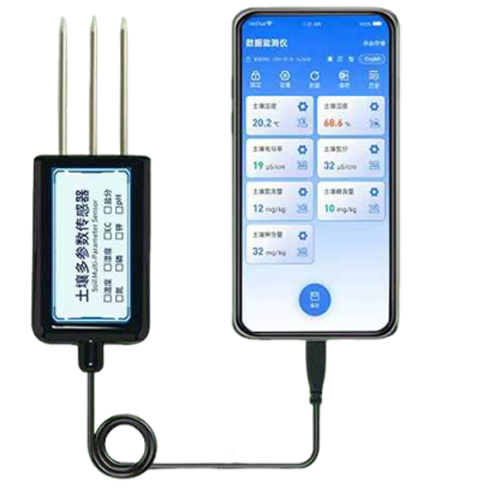
Use a soil-moisture observation at the relevant depth to check whether wetting reached the monitored root zone. A portable instrument can support a field visit, while a fixed probe provides a continuous local trace. Neither substitutes for representative placement across soil and irrigation zones.
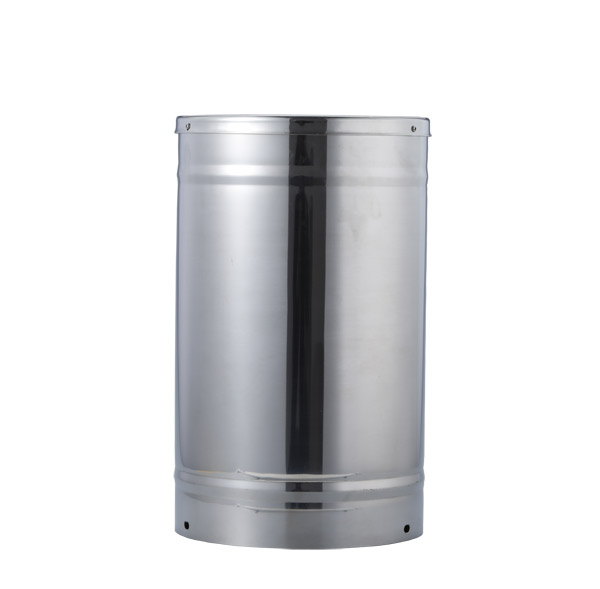
The NiuBoL NBL-W-RS tipping-bucket rain gauge can provide rainfall observations to a compatible logger. The table describes the 0.2 mm configuration. Order the intended resolution and electrical version explicitly rather than applying these settings to a visually similar instrument.
| Item | NBL-W-RS 0.2 mm arrangement |
|---|---|
| Resolution | 0.2 mm per tip; nominal tipping volume 6.28 mL |
| Collector diameter | 200 +/-0.6 mm |
| Intensity range | 0-4 mm/min |
| Stated accuracy condition | +/-4% in the specified indoor test at 2 mm/min |
| Output selections | Reed-switch pulse, voltage or RS485 version; confirm the actual ordered output |
| Supply selections | 5 V DC or 12-24 V DC version according to configuration |
| Working temperature | 0-50 C; do not assume unheated snow measurement |
| Cable and housing | Standard 5 m cable; stainless-steel collector body |
The complete station still needs an enclosure, suitable connectors and a power budget for its logger and modem. Confirm the protection rating of each delivered electrical assembly and the cable sheath where it is exposed to sunlight or cultivation. A passive pulse contact and a powered digital transmitter do not have identical supply requirements.
At 0.2 mm resolution, five accepted tips give 1.0 mm. Forty tips during a 10-minute interval give 8 mm and an interval-average rate of 48 mm/h. That rate describes the chosen interval, not the largest instantaneous intensity within it. Avoid reporting an hourly maximum from a once-per-hour total when the system did not retain shorter intervals.
Keep the collector level on a stable support and provide a clear collection area. Avoid locations under trees, beside sprinkler spray or where roof runoff can enter. Check the full seasonal crop height and the influence of nearby buildings, not just the bare site at installation.
Do not automatically put the rain collector at the top of a tall weather mast. Wind exposure, vibration and service access affect the measurement. Site it according to the chosen observation practice and keep it maintainable from a safe position. Record the collector height and surrounding obstacles for later comparison.
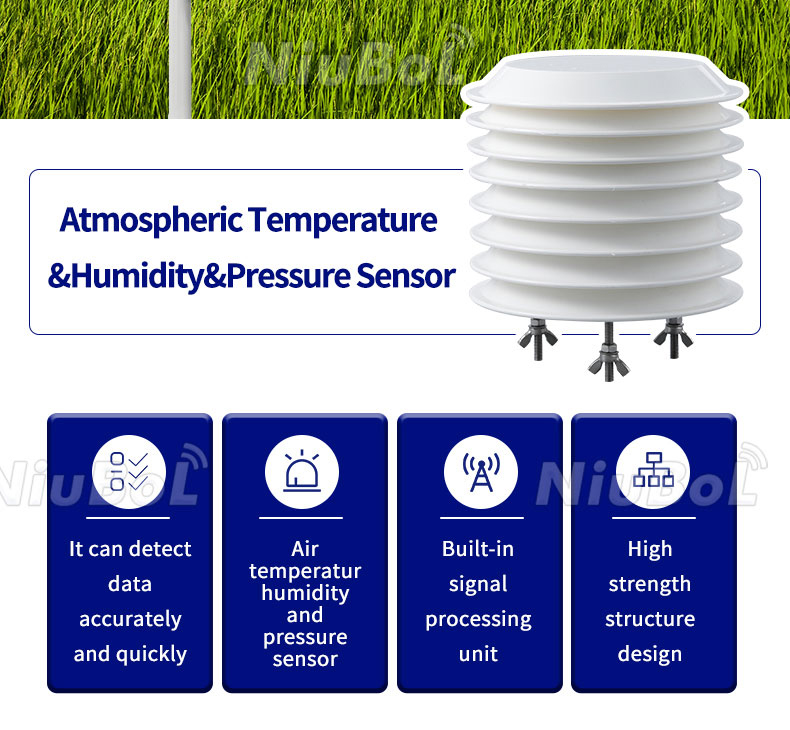
A separate atmospheric temperature, humidity and pressure sensor adds weather context but contributes no rainfall count. Its radiation shield needs its own exposure arrangement; it should not shade or obstruct the rain collector.
With a pulse version, use the logger's supported input and filtering settings, then test a known number of tips end to end. With the RS485 Modbus RTU version, confirm whether the returned value is an accumulation or another configured quantity. Its serial settings include 9600 bps, 8 data bits and no parity, with at least 1000 ms between communications; confirm the stop-bit setting and scaling for the unit.
Keep a cumulative rain value separate from an interval total. If cumulative readings change from 102.4 to 103.6 mm, the difference is 1.2 mm. Adding both readings as interval amounts would produce 206.0 mm, which is wrong. A reset or rollover must also be detected rather than interpreted as negative rainfall.
Choose a consistent daily boundary and time zone. Retain timestamps through network outages and prevent duplicate uploads from being counted twice. For irrigation decisions made locally, the controller needs the relevant valid accumulation even if the remote dashboard is offline.
| Farm condition | How to use the observation |
|---|---|
| Open-field drip irrigation | Review rain and root-zone response before reducing the next application |
| Covered greenhouse production | Keep outdoor rainfall separate from indoor water delivery and bed moisture |
| Orchards on variable slopes | Check interception and runoff differences; one rain total does not prove equal infiltration |
| Drainage-sensitive low areas | Use event timing with waterlogging observations; accumulated rain alone does not measure drainage capacity |
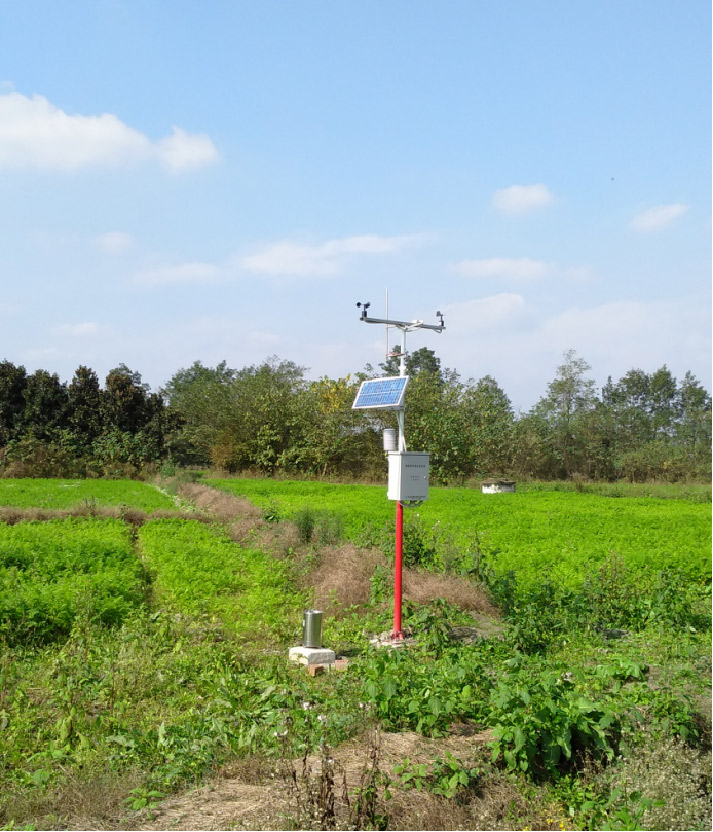
A field station may share a logger with soil and air sensors, as in the installation below. Give rain, moisture and irrigation delivery their own units and quality flags. The controller should apply the agreed rule to these inputs rather than average unrelated quantities into a generic farm-condition score.
During commissioning, verify collector level, removal of transport restraints, free drainage and the complete pulse or digital path. A controlled water test checks more of the measuring chain than moving the bucket by hand. Record the test period so that artificial tips are not credited as natural rainfall.
Then simulate the operational cases: valid rain above the selected threshold, a small shower below it, stale data, a station restart and a missing interval. Verify the displayed total and the resulting irrigation permission in each case. The appropriate fault response depends on crop and process risk; it may be an operator alert or a bounded fallback schedule, not simply permanent irrigation shutdown.
Keep rainfall-only and wider weather functions separate in the quotation. Additional air sensors may support other decisions, but an atmospheric shield such as the one below cannot replace a gauge. Disease-risk calculations also need their required inputs and a suitable model; rain alone does not diagnose infection.

Yes, if a compatible controller has an agreed rule using a valid accumulation window and any required soil checks. The gauge itself does not control a valve. Confirm recovery after the rain event and the response to invalid data before enabling unattended operation.
It depends on rainfall variability, terrain and the decisions being made. Compare observations across separated blocks before assuming uniform rain. Multiple soil zones do not automatically require different rain totals, but a single gauge cannot prove that a localized storm covered every block.
No. It is the nominal accumulation increment. Collection exposure, tipping behavior, blockage and input processing also affect the result. Evaluate accuracy under the stated test condition separately from field uncertainty.
Only through a rule appropriate to the structure. A closed roof prevents outdoor rain from becoming direct bed irrigation. Use indoor moisture and delivered water as the relevant water inputs, with outdoor rain as context where useful.
Identify the gauge resolution and output, logger inputs, enclosure, power, communications and mounting. List installation and controller programming separately. A gauge-only price is not equivalent to an operational rain-linked irrigation station.
Inspect the collector, filter, drain path, level and counting path. Set the visit interval around local leaves, dust and insects, and review unexplained zero periods. Mark tests and cleaning events so their water is not mistaken for rain.
Specify the farm decision before selecting rain-station hardware. Reliable use requires representative collection, correct accumulation and an explicit link to root-zone conditions and irrigation rules. For configuration support, provide NiuBoL with the field layout, intended rain resolution, controller interface and required local or remote decision path.
Prev:Saline Soil Monitoring System: Profile Layout and Installation
Next:Illuminance Sensor Commissioning: PLC Acceptance Test Procedure
Related recommendations
Sensors & Weather Stations Catalog
 Agriculture Sensors and Weather Stations Catalog-NiuBoL.pdf
Weather Stations Catalog-NiuBoL.pdf
Agriculture Sensors Catalog-NiuBoL.pdf
Water Quality Sensor Catalog-NiuBoL.pdf
Related products
Combined air temperature and relative humidity sensor TDR Soil Moisture & Temperature Sensor for irrigation| RS485 |4-20mA| NBL-S-THR
 Soil pH sensor RS485 soil Testing instrument soil ph meter for agriculture |NBL-S-PH
 Wind Speed sensor Output Modbus/RS485/Analog/0-5V/4-20mA
 Tipping bucket rain gauge for weather monitoring auto rainfall sensor RS485/Outdoor/stainless steel
 Pyranometer Solar Radiation Sensor 4-20mA/RS485

Screenshot, WhatsApp to identify the QR code
WhatsApp number:+8615367865107
(Click on WhatsApp to copy and add friends)

