





— Blogs —
—Products—
 Consumer hotline +8618073152920
 WhatsApp:+8615367865107
Address:Room 102, District D, Houhu Industrial Park, Yuelu District, Changsha City, Hunan Province, China
Product knowledge
Time:2026-09-11 12:00:00 Popularity:216
Quick Answer: Illuminance sensor commissioning must prove three things separately: the sensor responds to light, the PLC converts its signal correctly, and the controller behaves correctly during changing light or a fault. Test the analog or Modbus input before enabling automatic outputs. Record the sensing plane and light source, then verify switching delays, manual override and recovery with the actuator isolated where necessary.
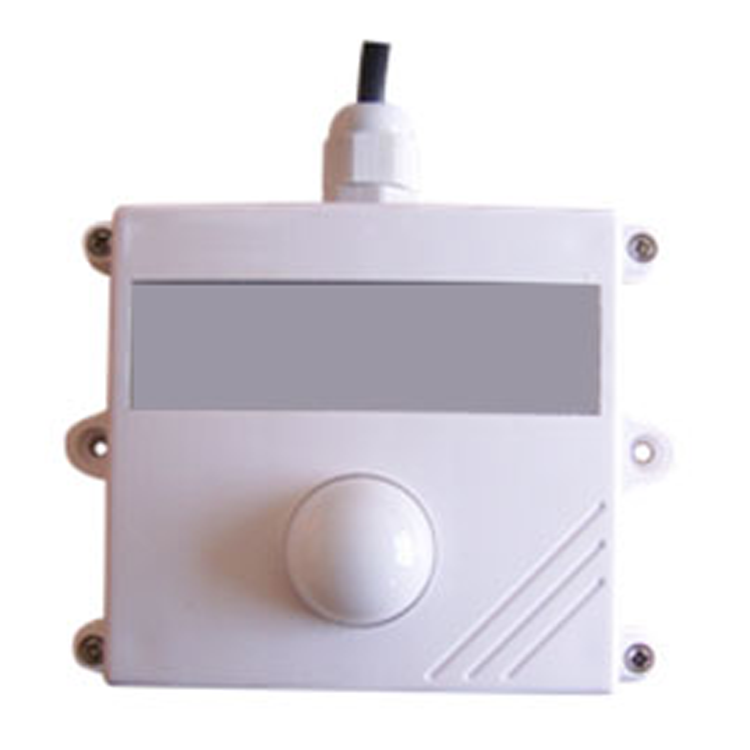
A lamp switching when the sensor is covered is a useful functional observation, but it does not establish optical accuracy or correct scaling across the operating range. Equally, a plausible lux display does not prove that the controller applies its delay, hysteresis and fault rules correctly.
Use separate acceptance stages. First verify model and input configuration. Next check the electrical conversion. Then compare light measurements using an appropriate reference. Finally test the control sequence. Isolate or simulate outputs when an unexpected command could operate a shading mechanism or other equipment during testing.
This procedure concerns a lux-based installation. For the distinction between illuminance, irradiance and photon flux, use the separate illuminance sensor principle and application guide. Do not begin commissioning by renaming a lux channel as solar radiation or PAR.
A weather-station installation may contain several independent instruments. Identify the actual illuminance channel rather than assuming that one of the assemblies in a station photograph supplies light data.
For a NiuBoL NBL-W-LUX installation, check the following items against the delivered unit and the receiving module. Supply and output choices are ordering versions, not interchangeable settings on every device.
| Check | Configuration to record |
|---|---|
| Measurement span | Available range 0-200000 lux; record the actual ordered span |
| Supply | 12 V DC or 24 V DC version; verify at the sensor under operating load |
| Output | 4-20 mA, 0-5 V or RS485 Modbus RTU version |
| Analog loading | Current load no greater than 300 ohms; voltage-input load at least 1 kilohm |
| Optical specification | 380-730 nm response band; stated accuracy +/-7%, with the applicable basis and reference conditions to be agreed |
| Environment | -10 to 70 C; relative humidity 0-80%; verify condensation suitability and IP rating separately |
| Cable and power budget | Standard cable 2.5 m; confirm jacket, extension arrangement and maximum current for the delivered assembly |
Save the PLC channel configuration before changing it. Record whether an analog input expects current, voltage or an internally converted value. For serial input, record the device identity as well as its address. A replacement sensor can have the same physical housing while requiring a different conversion or supply.
Disconnect the field signal only under an approved safe test arrangement. A suitable current or voltage simulator checks the receiving chain independently of the optical sensor. For an illustrative zero-based 0-200000 lux configuration, the expected values are:
| Simulated signal | Expected PLC value |
|---|---|
| 4 mA or 0 V | 0 lux |
| 8 mA or 1.25 V | 50000 lux |
| 12 mA or 2.5 V | 100000 lux |
| 16 mA or 3.75 V | 150000 lux |
| 20 mA or 5 V | 200000 lux |
Apply only the signal appropriate to the configured input. Those values are calculated from the stated endpoints, not measured product results. If the installed span differs, recalculate the table. A constant factor error suggests a span or unit mismatch; an offset affecting all points suggests a zero or input-configuration issue.
Also test around the actual decision region. On that wide span, 100 lux corresponds to 4.008 mA or 0.0025 V. This calculation shows why a successful mid-scale test does not establish a useful dusk threshold. Check the combined input resolution, noise and transmitter performance near the chosen control levels before accepting a low-light application.
A compact multi-parameter instrument such as the one below needs a different input schedule if it supplies several quantities together. Do not reuse the stand-alone transmitter's scale for an integrated sensor without checking its actual channel representation.
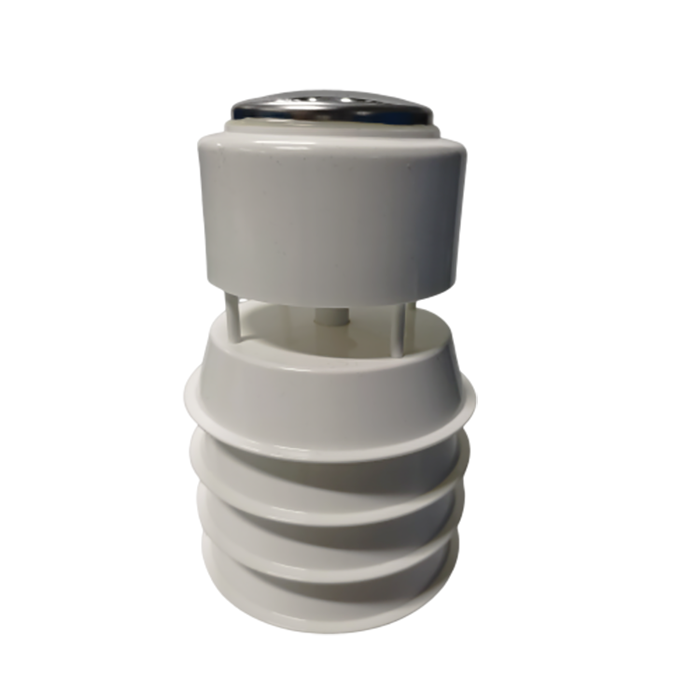
The NBL-W-LUX serial arrangement uses 9600 bps, 8 data bits and no parity, with at least 1000 ms between communications. Confirm the stop-bit setting, register representation and scaling for the delivered firmware. Use the actual protocol definition rather than copying a rain or temperature register just because it is also Modbus RTU.
Test one sensor before connecting a shared bus. Change its light exposure and confirm that the intended PLC tag changes. On a multi-device bus, repeat this identity check for each physical instrument; successful polling does not rule out a swapped address-to-location assignment.
Compare the decoded reading at two or more relevant light levels and include the upper operating region where practical. Retain raw replies with the expected engineering values during commissioning. If a value wraps or changes by a factor at higher light, investigate the data representation before adjusting an optical offset.
Use a suitable reference lux meter close to the sensing face, with matching orientation and no mutual shadow. Compare simultaneous readings while the source is reasonably stable. Record the source, geometry and surface condition; a reference held at a different angle is testing a different light field.
The quoted +/-7% does not define a complete site-comparison tolerance by itself. Agree the percentage basis, reference uncertainty and source conditions before using a numeric pass/fail limit. Keep observed disagreement separate from a guaranteed transmitter error, especially under rapidly changing daylight.
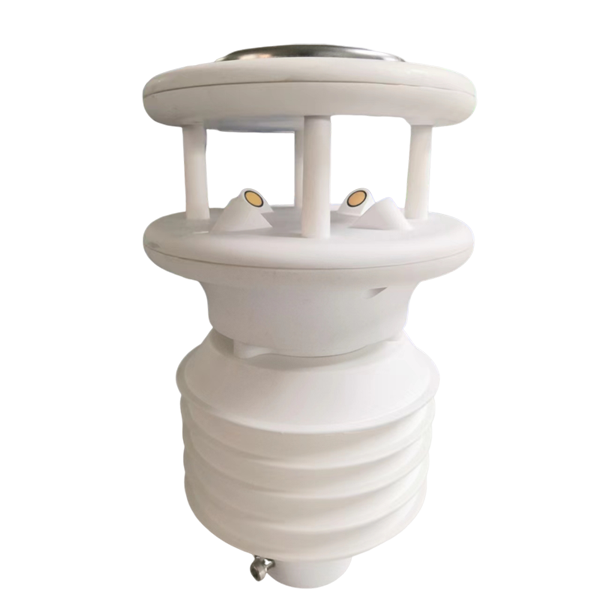
For a combined station, verify that the tag really is illuminance in lux. The multi-parameter assembly below illustrates why a channel name, unit and documented configuration are needed: a count of weather parameters does not identify the light quantity.
Use a documented test profile in the PLC or a controlled signal arrangement. For illustration, assume switching on below 100 lux and off above 150 lux, with a continuous 60-second qualification delay for each command. These are test settings, not lighting standards, sensor defaults or a recommendation for every site.
| Test event | Expected behavior under the example rule |
|---|---|
| 80 lux for 30 seconds, then 120 lux | No on command; the continuous low-light condition did not last 60 seconds |
| 80 lux maintained for 60 seconds | On command after the configured qualification period, within the agreed controller timing tolerance |
| 120 lux after switching on | Remain on because the off threshold has not been exceeded |
| 170 lux maintained for 60 seconds | Off command after the high-light qualification period |
Record the input time, timer state, command time and output feedback where available. Decide whether a threshold equality counts as above or below, and whether interruption resets the timer. These details should come from the control specification, not from assumptions made during a demonstration.
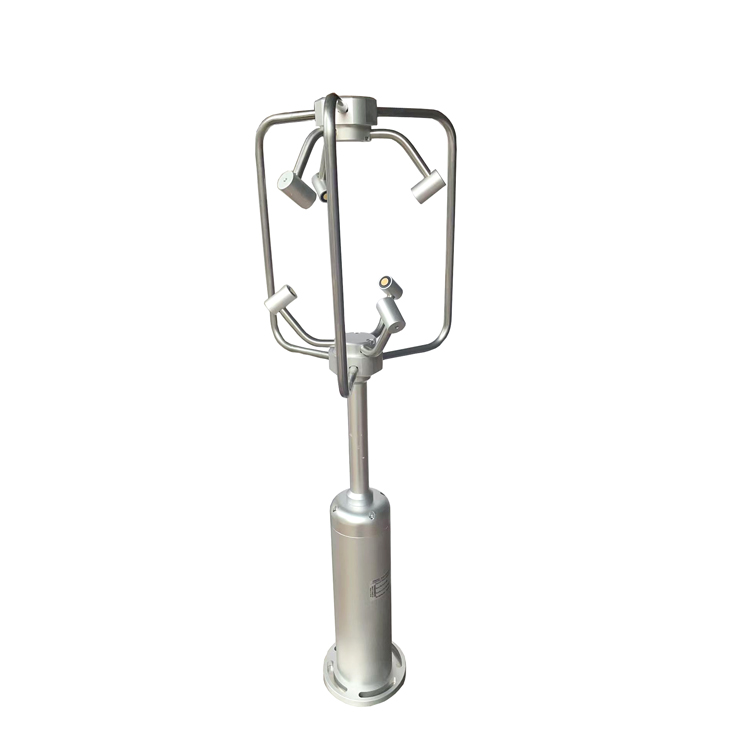
If a separate wind condition restricts a moving shade, test the combined permissions with motion safely inhibited as needed. A wind instrument such as the one below supplies an independent input. It does not make the lux transmitter an actuator or establish a safety-rated control function.
Interrupt communication or the signal through the agreed safe method. Verify that the PLC detects invalid or stale data, shows a distinct diagnostic and applies the specified fallback. Do not assume that every analog fault is zero or that every serial failure immediately removes the last value.
Check manual override separately. Record whether it has a timeout, who can apply it and how automatic control resumes. Test a controller restart while the light value is between the two thresholds; the required initial output may depend on retained state or a defined startup rule.
Finally disconnect the remote uplink while keeping local acquisition operating. A local lighting rule should behave according to its specification, and the platform should show the communication gap rather than a false sensor reading. Restore the link and check that historical records retain observation times.
Keep other environmental channels separate during these tests. A louvered air-temperature, humidity and pressure assembly is not a reference lux meter, and a shared data logger must not copy its status into the light channel.

No. It demonstrates a response to reduced light. Optical comparison needs a suitable reference and controlled geometry; electrical scaling and controller sequence tests are additional independent checks.
A small lux change occupies a very small signal interval on a wide analog span. Receiver resolution, noise and sensor uncertainty may be significant in that interval. Verify performance near the operating threshold or select a more suitable configuration.
No. Check span, units, register scaling and data type first. An offset cannot correct a proportional conversion error across the range and can hide the cause at only one test point.
Use the agreed control response, such as a local schedule, bounded fallback or operator intervention. Invalid input must be identified separately from a genuine low-light reading. Test recovery as well as failure detection.
Keep the model and configuration, sensing plane, electrical test points, reference comparison conditions, control-event timeline and fault results. Distinguish measured observations from simulated inputs so later maintenance can reproduce the relevant check.
Provide the transmitter version, PLC input module, required light levels and control sequence. State whether the work covers wiring, software conversion, optical comparison, actuator testing and operator training; these are separate tasks rather than an implied sensor-only service.
Accept the measurement channel and the control sequence separately. A usable illuminance sensor installation has verified scaling near its operating region, reproducible optical exposure and tested behavior during faults and restart. Give NiuBoL the output version, receiver details and decision levels to assess whether the selected configuration suits the intended installation.
Prev:Rainfall Monitoring Station for Smart Agriculture: Irrigation Decisions
Next:Plant Growth Sensor Principle and Installation for Field Research
Related recommendations
Sensors & Weather Stations Catalog
 Agriculture Sensors and Weather Stations Catalog-NiuBoL.pdf
Weather Stations Catalog-NiuBoL.pdf
Agriculture Sensors Catalog-NiuBoL.pdf
Water Quality Sensor Catalog-NiuBoL.pdf
Related products
Combined air temperature and relative humidity sensor TDR Soil Moisture & Temperature Sensor for irrigation| RS485 |4-20mA| NBL-S-THR
 Soil pH sensor RS485 soil Testing instrument soil ph meter for agriculture |NBL-S-PH
 Wind Speed sensor Output Modbus/RS485/Analog/0-5V/4-20mA
 Tipping bucket rain gauge for weather monitoring auto rainfall sensor RS485/Outdoor/stainless steel
 Pyranometer Solar Radiation Sensor 4-20mA/RS485

Screenshot, WhatsApp to identify the QR code
WhatsApp number:+8615367865107
(Click on WhatsApp to copy and add friends)

