





— Blogs —
—Products—
 Consumer hotline +8618073152920
WhatsApp:+8615367865107
Address:Room 102, District D, Houhu Industrial Park, Yuelu District, Changsha City, Hunan Province, China
Product knowledge
Time:2026-06-06 09:36:40 Popularity:400
Quick Answer: A suspended solids sensor for rivers can reveal particle-related events, but one optical concentration reading does not establish ecological health or total sediment transport. Match the sensor to the local particles, verify it with an appropriate laboratory method and record the event's duration and sampling location. Keep TSS, suspended-sediment concentration and turbidity definitions distinct.
Suspended material is a normal part of many rivers and carries mineral and organic particles. An ecological monitoring project may instead be concerned with an unusual event, a prolonged change, a discharge plume or the effect of a particular activity. Define that question before assigning an alarm to a single concentration number.
A useful record shows the background condition, when the change began, its approximate magnitude and how long it persisted. Add the relevant upstream activity, rainfall or flow context. The concentration alone cannot identify which material is present, whether it is chemically contaminated or what biological effect occurred.
Where the project concerns an industrial discharge rather than the receiving river, use the required effluent analytical definition and sampling point. Do not transfer a wastewater acceptance criterion to a river reach without the appropriate assessment. The same optical probe can serve different investigations only after its measurement relationship is established for each duty.
TSS and suspended-sediment concentration, or SSC, are laboratory quantities with different analytical procedures. USGS research on SSC and TSS comparability found that natural-water results should not simply be treated as interchangeable, particularly where subsampling and sand affect recovery. Identify the reference method used to evaluate the online channel.
Turbidity is an optical quantity rather than a dry-mass concentration. Particle size, shape and composition can change its relationship with concentration. Similarly, a sensor displaying mg/L from an optical response needs a relationship appropriate to the water. The displayed unit does not make it a laboratory gravimetric analysis.
| Reported quantity | Keep this distinction in the project |
|---|---|
| Optical solids concentration | Record the model, calibration and reference samples used to relate optical response to the required concentration. |
| Laboratory TSS | Record the analytical method and sample handling; do not assume it equals SSC in river samples. |
| Laboratory SSC | Use an appropriate sediment-sampling and analysis programme for the river question. |
| Turbidity | Retain the optical unit and method. Any conversion to concentration is a separate, site-specific estimate. |
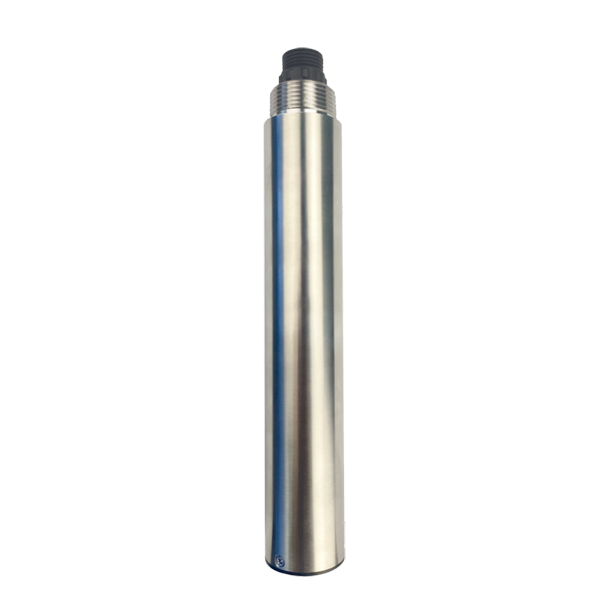
The turbidity probe below measures the last of these quantities. It is a different channel from the stainless steel TSS-4S above. A shared data logger can retain both, but should not merge their names, units or reference procedures.
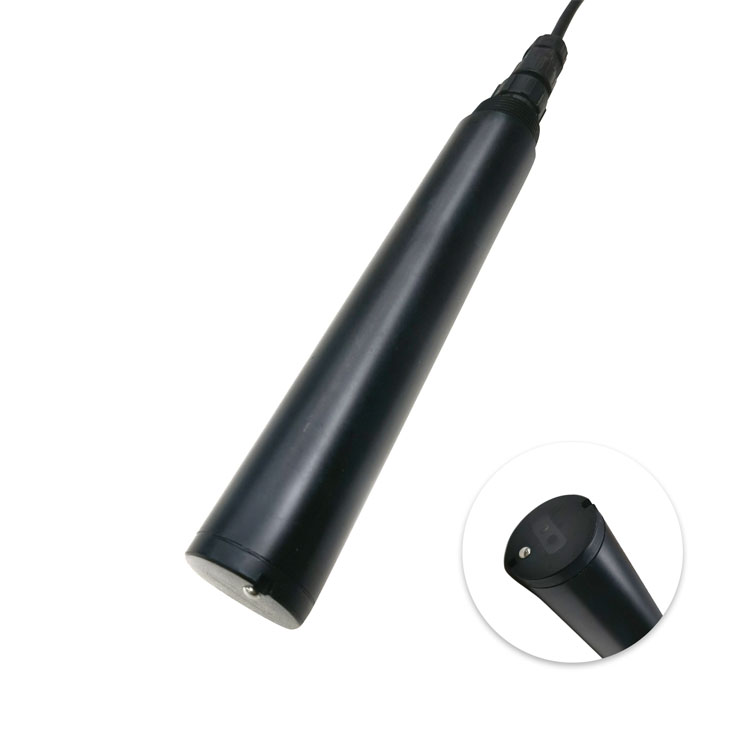
The NiuBoL NBL-WQ-TSS-4S uses scattered-light measurement over 0-2000 mg/L. Assess normal concentrations and credible event peaks before adopting it for an exposed river station.
| Parameter | NBL-WQ-TSS-4S |
|---|---|
| Range / resolution | 0-2000 mg/L; 0.1 mg/L; temperature 0.1 degrees C |
| Accuracy | +/-5%, dependent on sludge homogeneity; temperature +/-0.3 degrees C. Establish the percentage basis and site correlation. |
| Compensation / calibration | Pt1000 automatic temperature compensation; two-point calibration |
| Output | RS485 Modbus RTU; optional 4-20 mA |
| Supply / consumption | 12-24 V DC; 0.2 W at 12 V |
| Water conditions | 0-50 degrees C; pressure below 0.2 MPa |
| Construction | 316L stainless steel; IP68; immersion mounting with 3/4 NPT thread |
| Cable | Standard 5 m; other lengths by agreement. Confirm jacket compatibility, extensions and strain relief. |
These specifications do not establish that 0.1 mg/L changes can be resolved reliably in a particular river. Nor does the 2000 mg/L upper limit guarantee coverage of a storm event. If peaks exceed the selected range, flag the interval as over-range and assess another suitable measurement arrangement instead of reporting a clipped value as the true peak.
A bank-mounted probe observes a local water volume. During a discharge plume or changing flow, that point may differ from the main channel or another depth. Establish whether the task is to track that point, compare upstream and downstream conditions, or estimate a cross-section concentration. Those tasks need different sampling evidence.
Collect representative comparison samples under safe, planned procedures across relevant conditions, not only during convenient low flow. Include different stages of events where practical. Keep the online acquisition time with the reference sample, and review whether changes in particle composition alter the relationship.
For sediment-load estimates, a local concentration trace alone is insufficient. Suitable discharge information and a justified relationship to the transported material are also needed. Retain any calculated load separately from measured or estimated concentration, with its data gaps and limitations visible.
Choose a mount that can be inspected and retrieved safely and remains suitable as the water level changes. Protect against debris impact and cable loading without enclosing the optical region in a stagnant pocket. IP68 does not qualify an arbitrary installation depth or an unprotected field splice.
Record window cleaning, movement and reference checks beside the trend. A sudden drop after cleaning can reflect removal of a film rather than recovery of the river. Conversely, do not delete an apparent spike simply because it is inconvenient; investigate the sample and operating record before classifying it.
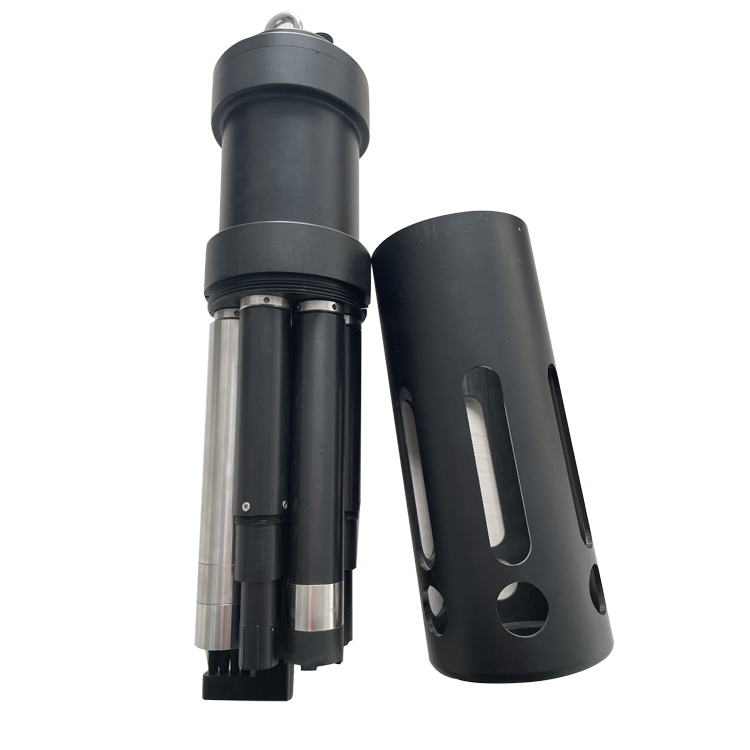
A multiparameter assembly below may provide related temperature, oxygen or other observations, depending on its configuration. Additional channels can support an investigation but cannot turn a solids value into a complete ecological assessment. Send expected particle conditions, event peaks, mounting photographs and the required reference method with an enquiry.
No. It observes an optical response related to particles. Material identity, contamination and biological effect require the appropriate additional assessment.
Not without evidence. Check spatial variation and the intended sampling objective; a fixed local observation should not be labelled a cross-section average by assumption.
Do not assume transferability. River particles may differ, and the required laboratory reference may be SSC rather than TSS. Validate the relationship for the actual site and task.
The selected TSS-4S range cannot quantify the true peak above that limit. Identify the over-range interval and consider an appropriate alternative range or measurement method.
Demonstrate representative placement, appropriate reference agreement, event coverage, cleaning recovery, correct units and visible invalid/over-range states. An isolated clean-water check does not qualify a sediment-event installation.
A suspended solids sensor for rivers is useful when its point record is tied to a defined event question and verified particle response. Select the NiuBoL range for the actual conditions, preserve concentration and reference-method identities, and use additional evidence for sediment transport or ecological conclusions.
Prev:Online DO Meter Remote Monitoring: Sample Time, Data Gaps and Local Control
Next:Aquaculture Water Quality Sensor Package: Compare Quotes and Service Scope
Related recommendations
Sensors & Weather Stations Catalog
 Agriculture Sensors and Weather Stations Catalog-NiuBoL.pdf
Weather Stations Catalog-NiuBoL.pdf
Agriculture Sensors Catalog-NiuBoL.pdf
Water Quality Sensor Catalog-NiuBoL.pdf
Related products
 Combined air temperature and relative humidity sensor
 TDR Soil Moisture & Temperature Sensor for irrigation| RS485 |4-20mA| NBL-S-THR
 Soil pH sensor RS485 soil Testing instrument soil ph meter for agriculture |NBL-S-PH
 Wind Speed sensor Output Modbus/RS485/Analog/0-5V/4-20mA
 Tipping bucket rain gauge for weather monitoring auto rainfall sensor RS485/Outdoor/stainless steel
 Pyranometer Solar Radiation Sensor 4-20mA/RS485


Screenshot, WhatsApp to identify the QR code
WhatsApp number:+8615367865107
(Click on WhatsApp to copy and add friends)

