





— Blogs —
—Products—
 Consumer hotline +8618073152920
 WhatsApp:+8615367865107
Address:Room 102, District D, Houhu Industrial Park, Yuelu District, Changsha City, Hunan Province, China
Product knowledge
Time:2026-06-06 09:36:28 Popularity:318
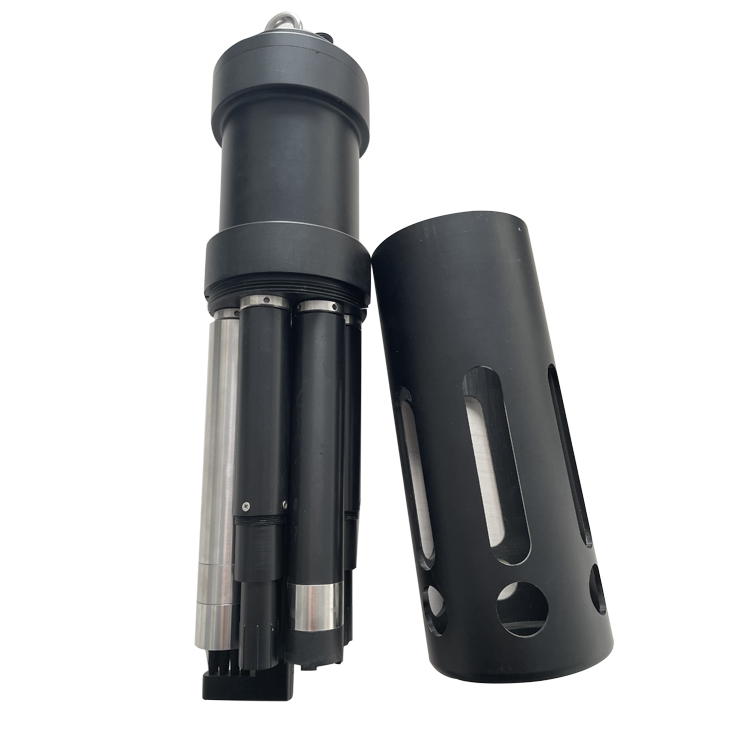
Quick Answer: TOC analyzer selection depends on which carbon fraction must be measured and whether the complete sample reaches the oxidation stage. Define the reporting method, solids and volatile-organic handling, inorganic-carbon treatment and required measurement cycle before comparing interfaces or price. An ordinary water-quality probe or an optical organic-load estimate is not automatically an oxidation-based TOC analyzer.
Total organic carbon is reported as carbon concentration, commonly mg C/L or micrograms C/L. It is not the same quantity as COD expressed as an oxygen-equivalent concentration. A numeric correlation between them may be useful for a stable process, but it does not make the measurements interchangeable.
State whether the project requires whole-water TOC, dissolved organic carbon or a particular non-purgeable measurement. Write the sample preparation beside the result name. A filter added to protect the instrument may exclude organic material attached to particles, changing what reaches the detector.
For example, EPA Method 9060A explains that sample treatment and instrument settings determine the forms of carbon measured. Treat this as a method-selection issue, not a generic feature shared by every online analyzer. Applicable methods depend on the water matrix and project requirements.
| Analytical choice | What the buyer needs to establish |
|---|---|
| Oxidation and detection | Identify the oxidation process and CO2 detection method; demonstrate recovery on representative samples. |
| Inorganic-carbon handling | Identify whether inorganic carbon is removed before analysis or determined separately for subtraction. |
| Filtered or unfiltered feed | Define which particulate material is included, excluded or reduced in size and how that affects the reported quantity. |
| Volatile organic compounds | Establish whether sample conditioning or purging loses material relevant to the measurement objective. |
| Calibration and quality checks | Specify standards, blanks, carryover checks and sample-matrix checks appropriate to the selected method. |
| Online cycle | State sample transport, preparation, analysis, rinse and multi-stream switching times. |
| Utilities and environment | Obtain model-specific power, gas, reagent, drain, ambient-temperature and enclosure requirements. |
| Data interface | Confirm actual protocols, units, result timestamps and valid/invalid states; do not assume RS485 on every analyzer. |
Oxidation-based analysis converts organic carbon to carbon dioxide for detection. High-temperature combustion and chemical oxidation are different analytical arrangements; neither can be qualified for a difficult matrix solely by naming the technology. Request a sample trial covering the compounds, salts and solids expected at the proposed monitoring point.
A wastewater take-off must carry the intended sample to the analyzer without uncontrolled settling or contamination. Ask where particles can collect, what the screen or filter removes, and how the line is flushed. If a side stream represents only clarified liquid, do not label its result as the carbon content of a solids-rich main stream without a justified sampling method.
For low-carbon water, consider contamination introduced by tubing, seals, containers, cleaning agents and the sampling operation itself. Request a blank assessment that includes the relevant sampling path. A clean calibration standard injected at the analyzer does not test the upstream installation.
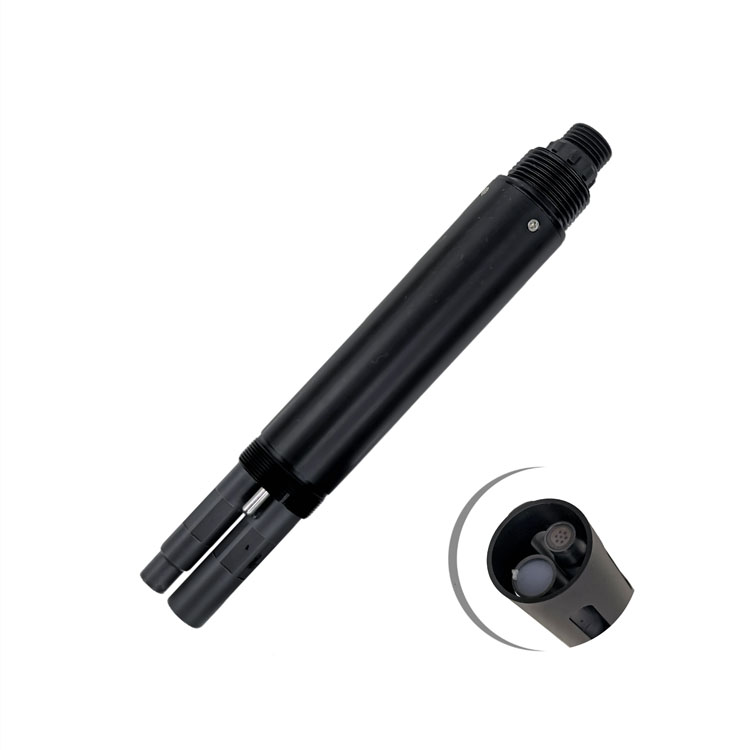
The ammonia nitrogen probe pictured below is a separate water-quality channel. It can provide additional process context at an industrial station, but it does not measure carbon or demonstrate TOC recovery.
Source water and treated drinking water: establish whether the task concerns organic-carbon trends, treatment comparison or a method-defined reported result. EPA Method 415.3 addresses source and drinking water and distinguishes TOC from filtered DOC. Its scope should not be carried over automatically to industrial wastewater.
Industrial wastewater: request recovery and carryover checks using representative high and low samples, including relevant solids, salinity and cleaning-cycle changes. A satisfactory result with one calibration compound alone does not establish performance on the plant's changing mixture.
Purified-water systems: define the required reporting level, method suitability, sample contamination controls and quality-system responsibilities. A generic RS485 probe, a low display increment or a wastewater range is not evidence of suitability for product-release decisions.
For comparison of organic-load technologies, see TOC versus COD method selection. Keep the analytical requirement separate from a fast optical trend channel. They may complement each other, but a correlation must be tested rather than assumed.
A result can be numerically current on the screen while representing water collected much earlier. Add transport delay, preparation, oxidation, detection and any rinse or multi-stream queue. Ask the supplier to distinguish the analysis duration from the interval between valid results for each stream.
As an illustrative timing check, a two-minute sample transfer followed by a five-minute analytical cycle cannot support a decision requiring a response within one minute. Faster PLC polling will only reread the previous result. Establish the needed response time before choosing the analyzer and sample system.
Use sample time and result time where the instrument provides them. During calibration, a failed cycle or maintenance, the control system must not treat the retained result as a new sample. This matters more for a protective diversion or process alarm than whether a dashboard refreshes every second.
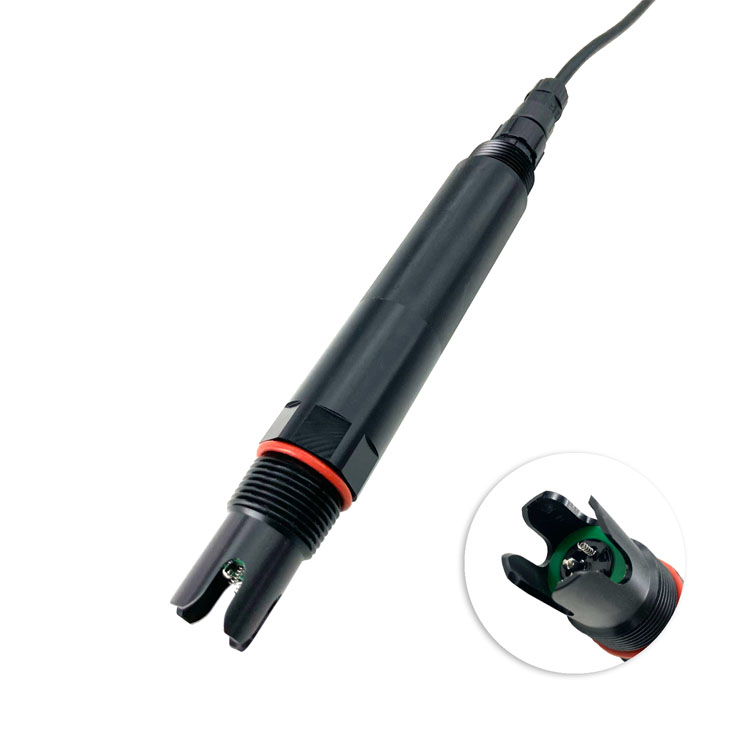
The chlorine probe below is another independent instrument. A chlorine channel may accompany a treatment monitoring station, but its power, cell flow and response specifications do not describe the TOC analyzer.
Prepare a test set spanning the expected concentration and matrix changes. Agree which reference method will be used, how samples will be split and preserved, and what constitutes acceptable recovery, repeatability and carryover. Include a blank after a high sample and document the return to the normal operating band.
Compare quotations that include the same scope: analyzer, sampling and conditioning, reagents or gas where required, calibration materials, waste handling, communications and servicing. A reagent-free optical probe and an oxidation-based analyzer do not have equivalent analytical scope merely because both report a carbon-related trend.
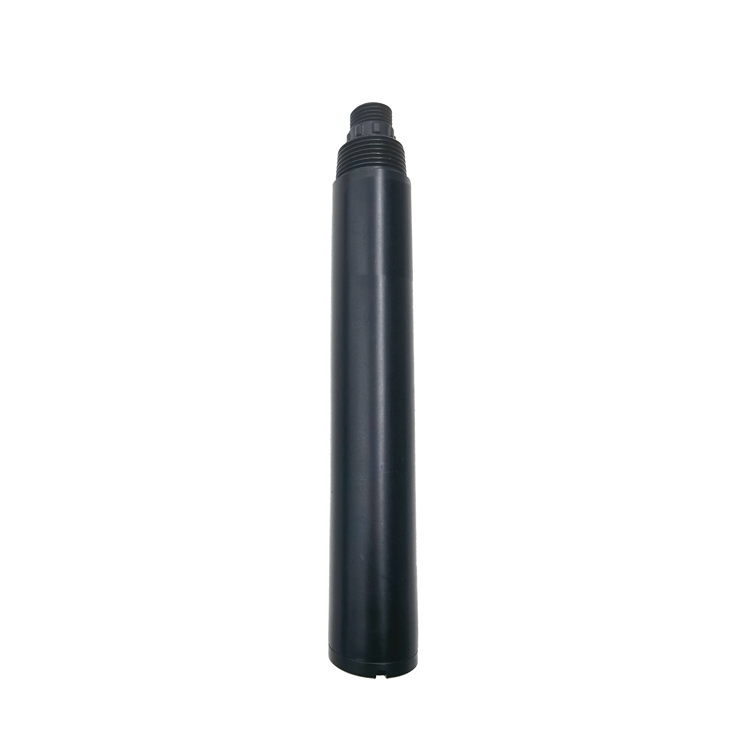
NiuBoL pH, conductivity, turbidity and other water sensors can form associated channels in a broader station. Confirm the fitted configuration and its separate power and communication requirements. The turbidity probe pictured below measures particle scattering, not TOC; retain that distinction in the channel list and operating procedure.
Not simply by changing its unit or label. An optical estimate requires a validated relationship to the required carbon measurement and a defined application range. State whether the output is estimated or obtained by the specified carbon-analysis method.
No. Filtering can change the carbon fraction measured. Choose sample preparation with the required method and matrix in mind, and document what material is excluded.
No. A communications interface transports results; it does not determine the analytical cycle. Confirm the interval between valid results, including switching and cleaning.
Supply expected background, decision limits and credible peaks. Ask for demonstrated quantification and recovery at those levels, not only the analyzer's maximum range or display resolution.
No. Obtain the analyzer and sample-system specifications separately. Include oxidation hardware, pumps, controls and environmental requirements in electrical and enclosure design.
Provide the required carbon fraction and method, water composition, concentration profile, solids and salt content, sample route, response requirement and receiving system. Identify release or compliance duties explicitly so the proposed instrument can be evaluated against them.
A defensible TOC analyzer selection connects a defined carbon result to a representative sample and a demonstrated analytical cycle. Compare recovery, sample treatment and operating scope before price or protocol. Add NiuBoL water-quality channels where they answer separate process questions, without presenting them as substitutes for the required carbon analysis.
Prev:ORP Sensor Temperature Effects: Compare Readings Without False Corrections
Next:NTU Monitoring in Water Treatment: Read Trends Across Process Stages
Related recommendations
Sensors & Weather Stations Catalog
 Agriculture Sensors and Weather Stations Catalog-NiuBoL.pdf
Weather Stations Catalog-NiuBoL.pdf
Agriculture Sensors Catalog-NiuBoL.pdf
Water Quality Sensor Catalog-NiuBoL.pdf
Related products
 Combined air temperature and relative humidity sensor
 TDR Soil Moisture & Temperature Sensor for irrigation| RS485 |4-20mA| NBL-S-THR
 Soil pH sensor RS485 soil Testing instrument soil ph meter for agriculture |NBL-S-PH
 Wind Speed sensor Output Modbus/RS485/Analog/0-5V/4-20mA
 Tipping bucket rain gauge for weather monitoring auto rainfall sensor RS485/Outdoor/stainless steel
 Pyranometer Solar Radiation Sensor 4-20mA/RS485

Screenshot, WhatsApp to identify the QR code
WhatsApp number:+8615367865107
(Click on WhatsApp to copy and add friends)

