





— Blogs —
—Products—
 Consumer hotline +8618073152920
 WhatsApp:+8615367865107
Address:Room 102, District D, Houhu Industrial Park, Yuelu District, Changsha City, Hunan Province, China
Product knowledge
Time:2022-07-06 20:29:50 Popularity:2251
A complete weather monitoring system is more than a group of weather sensors. A practical field system normally includes meteorological sensors, a data logger, communication equipment, power supply, enclosure, mounting structure and software or server platform.
The exact equipment depends on what needs to be measured, where the station will be installed, how data will be transmitted and whether the customer wants to use a cloud platform or a private server.
For most industrial and IoT projects, it is better to define the complete data path before purchasing equipment:
Weather Sensors → Data Logger → Communication Network → Cloud / Private Server → User
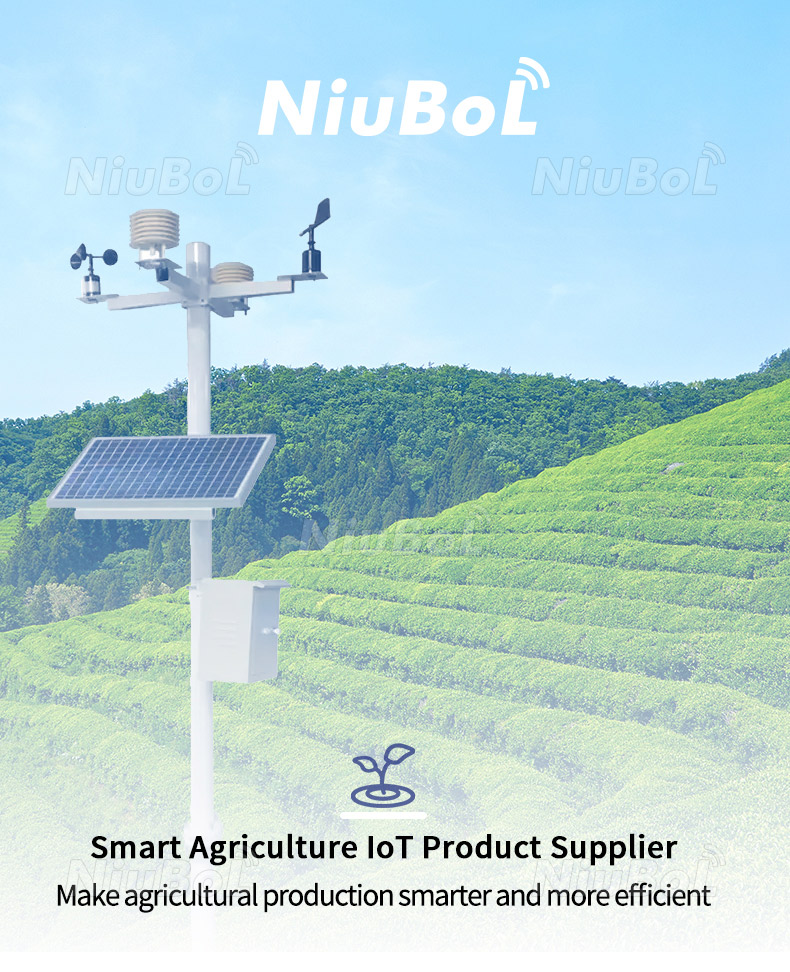
| Equipment | Function | Required? |
|---|---|---|
| Weather Sensors | Measure meteorological parameters | Yes |
| Data Logger | Collects, timestamps and stores sensor data | Usually |
| Communication Device | Uploads data through 4G, Ethernet, Wi-Fi or other network | For remote monitoring |
| Power Supply | Provides DC, mains or solar power | Yes |
| Battery | Provides backup energy for solar systems | For solar systems |
| Protective Enclosure | Protects logger, controller and electrical equipment | Usually |
| Mounting Pole / Brackets | Supports sensors, enclosure and solar panel | For field stations |
| Software / Server | Displays, stores and manages data | For digital monitoring |
Weather sensors are the measurement layer of the system. The correct sensor list should be selected according to the project rather than automatically using every available parameter.
| Parameter | Sensor | Typical Application |
|---|---|---|
| Air Temperature | Temperature sensor | Meteorology, agriculture, environment |
| Relative Humidity | Humidity sensor | Agriculture and microclimate monitoring |
| Atmospheric Pressure | Barometric pressure sensor | Meteorological observation |
| Wind Speed | Cup or ultrasonic anemometer | Weather, energy and safety |
| Wind Direction | Wind vane or ultrasonic sensor | Weather and environmental monitoring |
| Rainfall | Tipping bucket or electronic rain sensor | Agriculture, hydrology, flood monitoring |
| Solar Radiation | Pyranometer | Agriculture, solar energy and research |
| Illuminance | Light sensor | Agriculture and environmental monitoring |
Additional sensors can be added when required, including soil moisture, soil temperature, PAR, UV, CO₂, PM2.5, PM10, visibility and other environmental parameters.
A soil sensor should not automatically be considered part of a meteorological station. It is an additional agricultural or environmental measurement device that can be integrated into the same monitoring system when the project requires it.
The data logger is the central acquisition device of a modular weather monitoring station.
Its main functions can include:
Reading sensor values
Polling RS485 Modbus devices
Receiving pulse or analog signals when supported
Adding timestamps
Recording measurements
Storing data locally
Formatting data for communication
Uploading data to a platform or server
The logger must have enough compatible input channels for the selected sensors. Before ordering, confirm the number of RS485 devices, analog inputs, pulse inputs and required expansion capacity.
View NiuBoL Data Loggers and Data Collectors →
Many industrial weather sensors use RS485 Modbus RTU to communicate with a data logger, RTU or PLC.
Sensor 1 + Sensor 2 + Sensor 3 → RS485 Bus → Data Logger
When several RS485 sensors share one bus:
Each sensor should have a unique Modbus address.
RS485 A and B wiring must be correct.
Daisy-chain wiring is generally preferred.
Twisted-pair communication cable is recommended.
Voltage drop should be considered on long cable runs.
Termination should be added when required by the bus length and communication conditions.
RS485 is used mainly between the field devices and logger. It is different from MQTT or HTTP, which are normally used between a gateway and a server.
If the station must be monitored remotely, the system requires a communication method.
| Communication | Typical Use |
|---|---|
| 4G Cellular | Remote farms, environmental sites and hydrology stations |
| Ethernet | Sites with stable wired network access |
| Wi-Fi | Campus, buildings and local network applications |
| LoRaWAN | Distributed low-power sensor networks with a compatible gateway |
Network availability should be checked at the installation site before the communication hardware is finalized.
Weather monitoring equipment requires a stable power source. The system can use mains electricity, DC supply or solar power depending on site conditions.
This is suitable when a stable local power supply is available and cable installation is practical.
A remote solar-powered station normally requires:
Solar panel
Rechargeable battery
Solar charge controller
Power distribution and protection
Mounting bracket
The solar panel and battery should be sized according to the actual system power consumption, local sunlight conditions and required backup autonomy. A fixed panel or battery size should not be applied to every project.
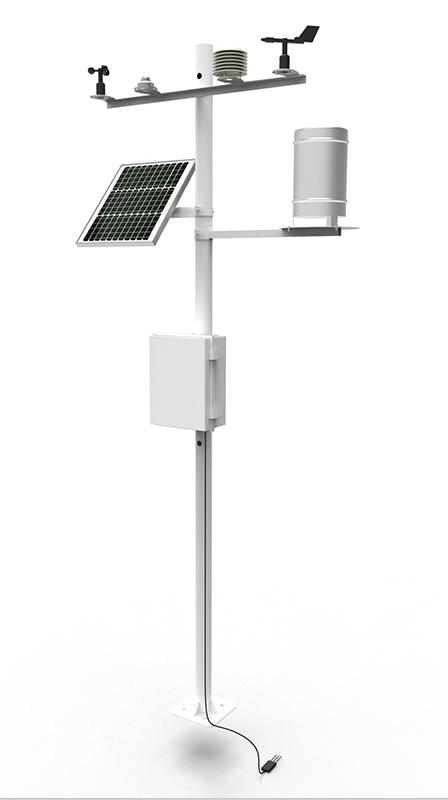
The enclosure protects the data logger, communication equipment, power distribution components and other electronics from the outdoor environment.
When selecting an enclosure, consider:
Outdoor protection level
Internal equipment dimensions
Cable glands
Ventilation or thermal management when required
Mounting method
Accessibility for maintenance
Space for future expansion
A field weather station requires mechanical hardware to position sensors correctly.
A typical mounting package can include:
Main weather-station pole
Cross arm
Wind-sensor brackets
Temperature and humidity shield bracket
Rain-gauge support
Solar-panel bracket
Enclosure mounting bracket
Foundation or anchor hardware
Pole height and sensor mounting position should be selected according to the measurement objective, site layout and applicable project requirements.
The software layer allows users to view and manage data collected by the field station.
Depending on the selected platform, functions may include:
Real-time measurements
Historical data
Trend charts
Data export
Device status
Multiple-station management
User permissions
Configurable alarm thresholds
Projects using a customer-owned server should confirm the required interface before ordering. Depending on the selected logger or gateway, data can be integrated through protocols such as MQTT, HTTP or TCP.
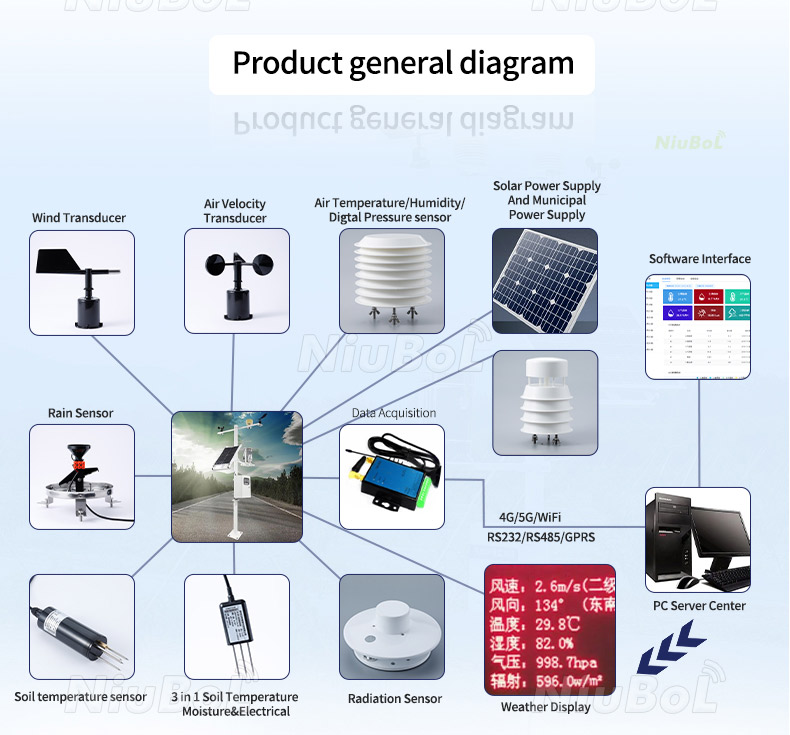
The diagram shows that a complete weather monitoring project contains several layers. The sensors produce measurements, the data logger collects them, communication equipment transfers them and the software or server presents the final data to the user.
| Application | Typical Equipment |
|---|---|
| Agriculture | Weather sensors + rainfall + solar radiation + optional soil sensors + logger + 4G / solar |
| Hydrology | Rainfall + weather sensors + optional water level / flow + logger + remote communication |
| Solar Energy | Pyranometer + temperature + wind + optional rainfall + logger |
| Environmental Monitoring | Weather sensors + optional PM / gas / noise sensors + logger + server |
| Research | Project-specific sensors + data logger + local storage + data export |
| Comparison | Modular Sensors | All-in-One Sensor |
|---|---|---|
| Installation | More components and wiring | More compact |
| Sensor Replacement | Individual sensor can normally be replaced | Integrated assembly |
| Configuration Flexibility | High | Depends on integrated model |
| Pole Space | Requires more mounting space | Compact |
| Typical Use | Flexible engineering and research systems | Compact IoT and distributed stations |
Neither design is universally better. The correct choice depends on required parameters, serviceability, installation space and project budget.
Depending on site conditions, additional equipment may include:
Solar panel and battery
Charge controller
4G antenna
Surge-protection devices
Grounding equipment
Additional RS485 junction box
Extended sensor cables
Lightning protection
Foundation hardware
Local weather display
Before requesting a quotation, define the project requirements first.
| Item | Information to Provide |
|---|---|
| Application | Agriculture, weather, hydrology, research, environment or energy |
| Parameters | Exactly what needs to be measured |
| Quantity | Number of monitoring stations |
| Location | Country and site environment |
| Communication | 4G, Ethernet, Wi-Fi, LoRaWAN or local storage |
| Power | Mains, DC or solar |
| Server | Supplier platform or private server |
| Protocol | MQTT, HTTP, TCP or other required interface |
| Mechanical Hardware | Pole, brackets, enclosure and foundation requirements |
Start with the required data and application. Do not add unnecessary sensors only to increase the number of parameters.
Confirm the measurement ranges, required accuracy and whether RS485, analog or pulse output is needed.
Make sure the logger supports the sensors and the required network connection.
Confirm the solar system, battery, enclosure, mounting pole, brackets and cable lengths.
Confirm whether data goes to the manufacturer's platform or a customer-owned server and verify the required protocol before production.
Buying sensors before confirming the monitoring objective
Choosing a logger that does not support all sensor interfaces
Ignoring cellular or network coverage
Using duplicate Modbus addresses
Choosing solar panel and battery size without calculating power consumption
Forgetting mounting brackets, pole or enclosure in the quotation
Not confirming cable length
Not confirming MQTT, HTTP or server requirements before ordering
Assuming every sensor can be connected directly to LoRaWAN
Ignoring maintenance access
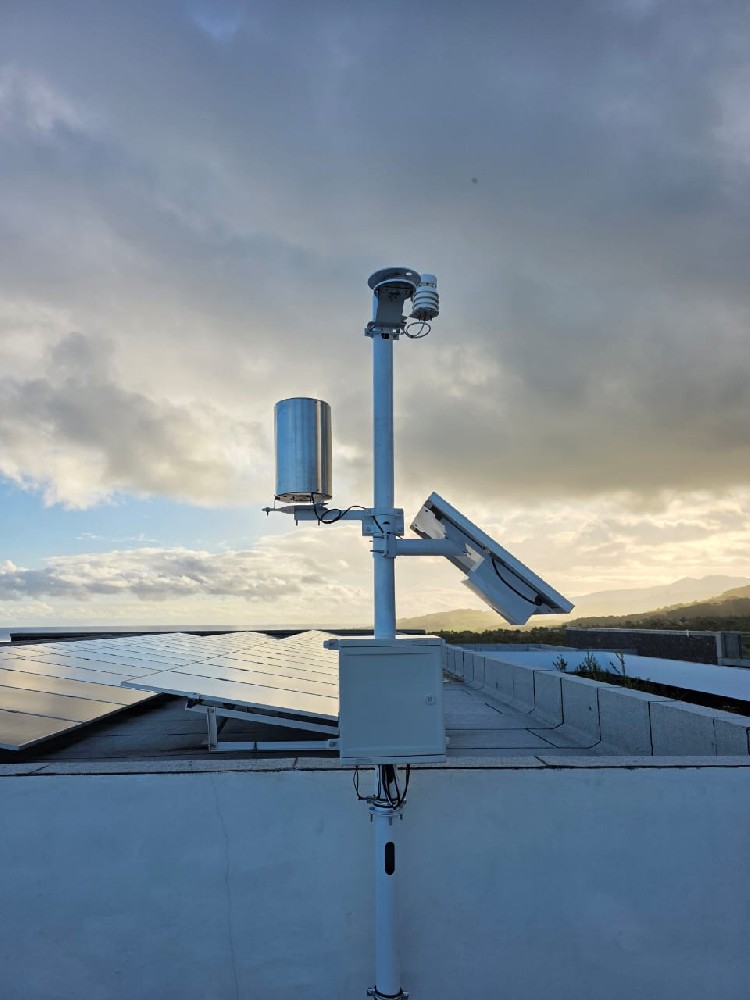
A1. A typical system includes weather sensors, a data logger, power supply, communication equipment, enclosure, mounting hardware and monitoring software or server.
A2. Most multi-sensor automatic stations use a data logger or controller. Some integrated sensors can connect directly to a compatible gateway or PLC.
A3. Common parameters include temperature, relative humidity, atmospheric pressure, wind speed, wind direction, rainfall and solar radiation.
A4. Yes. Compatible soil sensors can be added to agricultural monitoring systems when the logger has suitable inputs.
A5. Yes. RS485 Modbus RTU is widely used in industrial weather monitoring because multiple compatible sensors can share one communication bus.
A6. Yes. A compatible 4G data logger or gateway can upload weather data from remote sites.
A7. Yes, when the selected communication equipment supports the required interface. MQTT, HTTP, TCP and data-format requirements should be confirmed before ordering.
A8. Normally yes. The battery stores energy so the system can continue operating at night and during periods of low solar charging.
A9. There is no universal size. Capacity should be calculated from sensor, logger and communication power consumption, local solar conditions and required backup time.
A10. The quotation should clearly list sensors, data logger, communication device, power system, battery, enclosure, mounting pole, brackets, cables, software scope and any required accessories.
A11. Weather monitoring equipment refers to the individual hardware and software components. A weather monitoring system describes how those components work together as one complete data workflow.
A12. See the IoT Weather Monitoring System Architecture Guide for details about sensors, RS485, gateways, MQTT, cloud platforms and private-server integration.
NiuBoL provides weather sensors, automatic weather stations, data loggers, communication equipment, solar power accessories and monitoring solutions for agriculture, hydrology, environmental monitoring, research and industrial projects.
For quotation, provide the required parameters, quantity of stations, installation country, communication method, power supply, pole height, cable lengths and whether data must be sent to a cloud platform or private server.
Related recommendations
Sensors & Weather Stations Catalog
 Agriculture Sensors and Weather Stations Catalog-NiuBoL.pdf
Weather Stations Catalog-NiuBoL.pdf
Agriculture Sensors Catalog-NiuBoL.pdf
Water Quality Sensor Catalog-NiuBoL.pdf
Related products
 Combined air temperature and relative humidity sensor
 TDR Soil Moisture & Temperature Sensor for irrigation| RS485 |4-20mA| NBL-S-THR
 Soil pH sensor RS485 soil Testing instrument soil ph meter for agriculture |NBL-S-PH
 Wind Speed sensor Output Modbus/RS485/Analog/0-5V/4-20mA
 Tipping bucket rain gauge for weather monitoring auto rainfall sensor RS485/Outdoor/stainless steel
 Pyranometer Solar Radiation Sensor 4-20mA/RS485

Screenshot, WhatsApp to identify the QR code
WhatsApp number:+8615367865107
(Click on WhatsApp to copy and add friends)

