





— Blogs —
—Products—
 Consumer hotline +8618073152920
WhatsApp:+8615367865107
Address:Room 102, District D, Houhu Industrial Park, Yuelu District, Changsha City, Hunan Province, China
Product knowledge
Time:2023-08-18 09:37:17 Popularity:2302
Quick Answer: Wind speed sensor price depends on the measuring technology, specified performance, output and included equipment. Compare a sensor-only price with another sensor-only price, or compare complete installed channels. A low unit price can lose its advantage when it requires a new input module, longer cable, a display or additional commissioning. NiuBoL quotations should identify the exact sensor configuration and separately priced accessories.
A replacement anemometer for an existing logger is a different purchase from an outdoor monitoring point that needs its own power, mounting and communications. Before asking how much a wind sensor costs, define which of these three orders is required. Otherwise the quotations can be technically correct yet commercially incomparable.
| Purchase scope | Include in the comparison | Common omission |
|---|---|---|
| Sensor only | Model, range, output version, cable, connector and mounting dimensions | The receiving instrument and bracket may be excluded. |
| Replacement channel | Sensor plus interface matching, cable adaptation and channel setup | The old analog scale or pulse factor may differ. |
| New observation point | Sensor, mast, acquisition, power, enclosure and communication equipment | Groundworks, installation and network service may be separate. |
For industrial wind monitoring, also distinguish observation from a safety-related control input. A displayed wind value does not establish that a device is approved for a crane interlock, tracker stow controller or other protective function. If a plant manufacturer specifies an approved input, that requirement comes before a general comparison of anemometer prices.
| Factor | Why it changes price |
|---|---|
| Sensing method | Mechanical cup, propeller and ultrasonic designs use different construction and maintenance approaches. |
| Measurement performance | Range, starting threshold, accuracy, response and calibration class affect design and testing. |
| Output | Pulse, analog and RS485 versions require different electronics and receiving equipment. |
| Environment | Heating, corrosion-resistant materials, ingress protection and high-wind survival add requirements. |
| Project scope | Cable, mast, lightning protection, logger, enclosure and software may cost more than the sensor alone. |
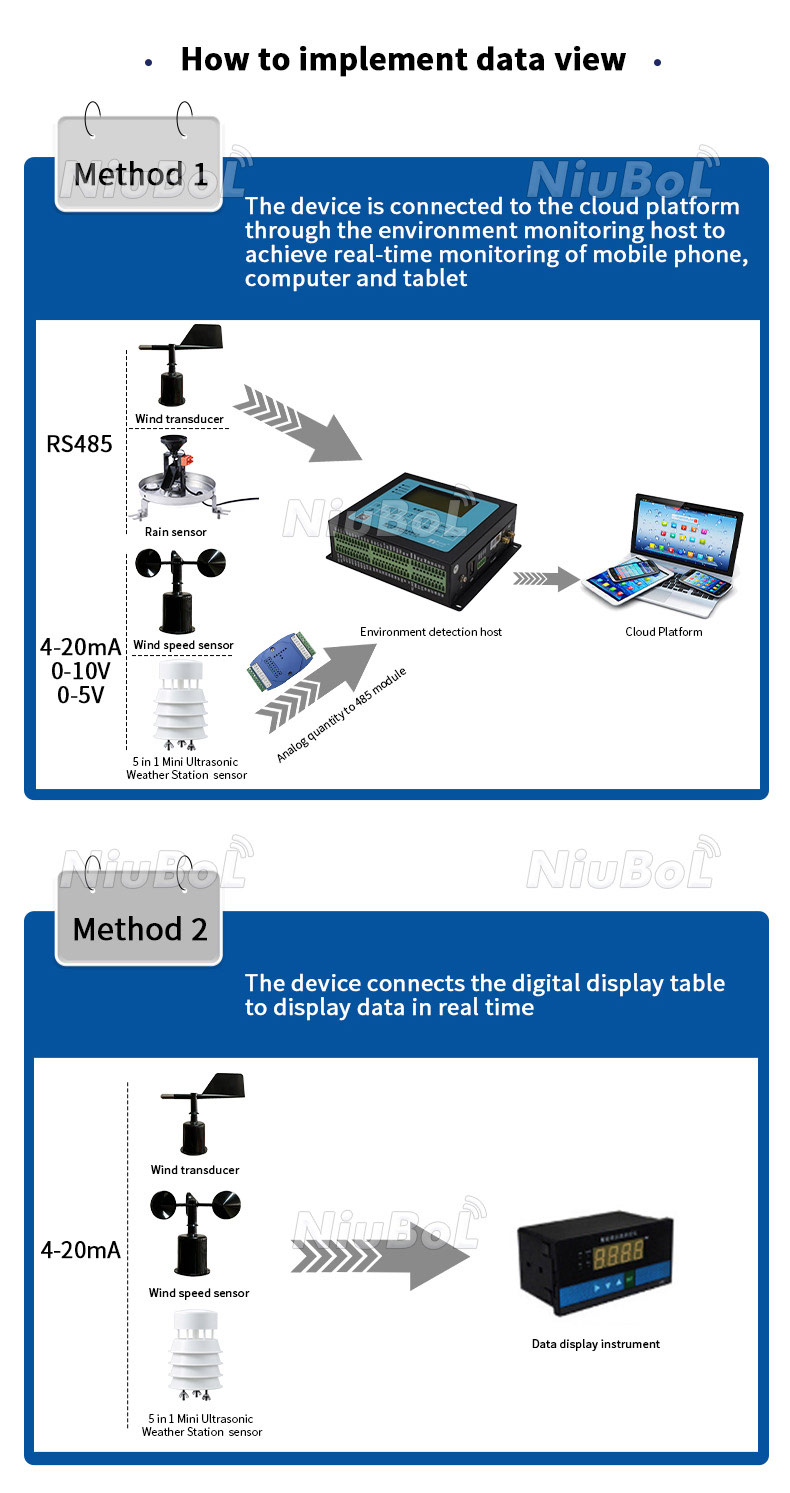
The sensor output determines what the receiving system must provide. An available PLC analog channel can make a current-output replacement economical. A logger with a pulse counter may favor a pulse version. An RS485 anemometer cost comparison must include the work needed to map the actual registers, not just the presence of an RS485 terminal on the controller.
| Output option | Receiver requirement | Cost consequence |
|---|---|---|
| Pulse | Suitable counter input, electrical input limits and the correct pulse-to-speed formula | A basic analog input cannot simply count pulses. |
| 4-20 mA | Matching current input, wiring arrangement, load allowance and configured full scale | Check input-module and loop-power costs, not just transmitter price. |
| Voltage | Compatible voltage range and input impedance | Cable voltage drop and noise exposure can require a different installation. |
| RS485 / Modbus RTU | Compatible master, register interpretation and serial settings | A shared serial interface can avoid extra analog channels, but still needs integration work. |
A cellular router is not automatically a sensor data logger. If the receiver cannot poll the sensor, decode the value and retain timestamps, a router alone will not complete the measurement channel. Similarly, replacing a pulse sensor with an RS485 unit requires more than changing the cable ends. Compare the complete acquisition route before treating a digital output as either cheaper or more expensive.
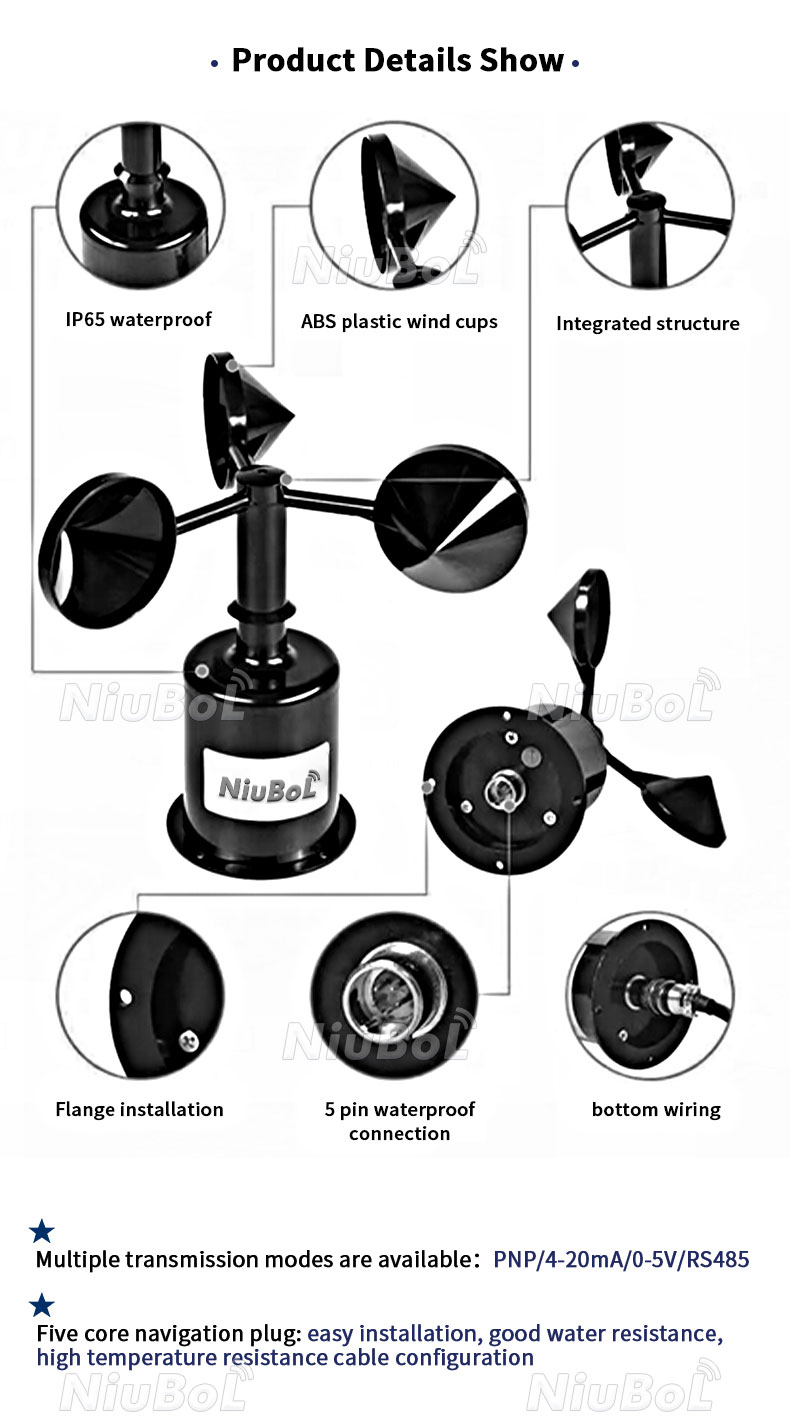
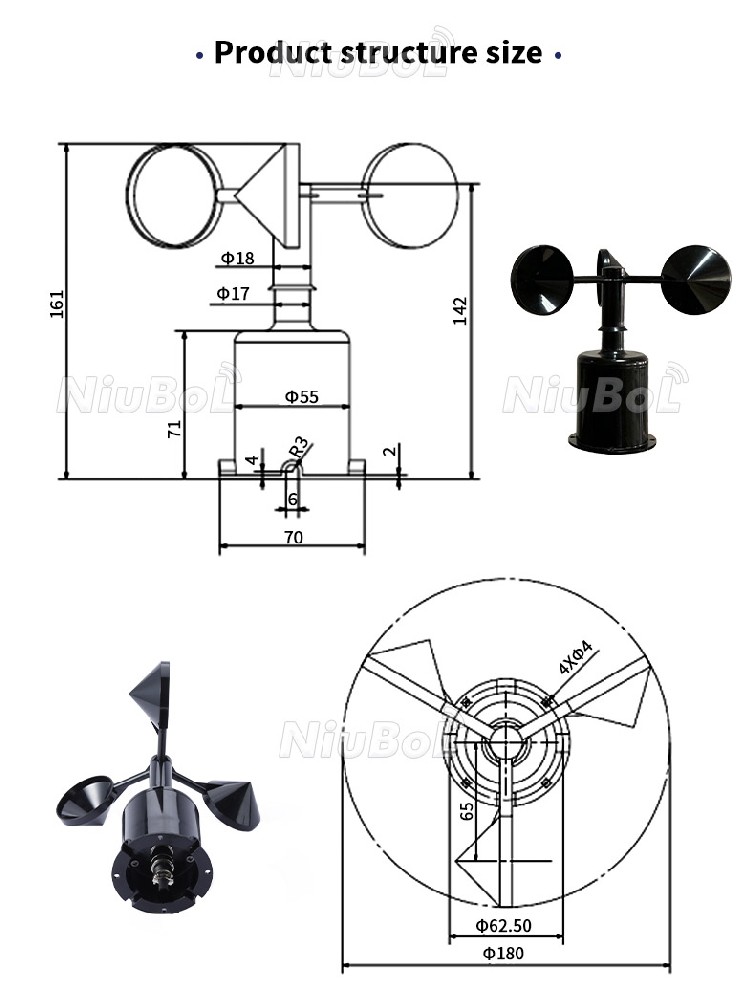
The NiuBoL NBL-W-SS cup wind speed sensor is one reference configuration for weather station procurement. The following figures belong to this model family; they are not a specification for every ultrasonic or integrated wind instrument. Output and supply selections must appear together on the quotation so that an option list is not mistaken for simultaneous outputs.
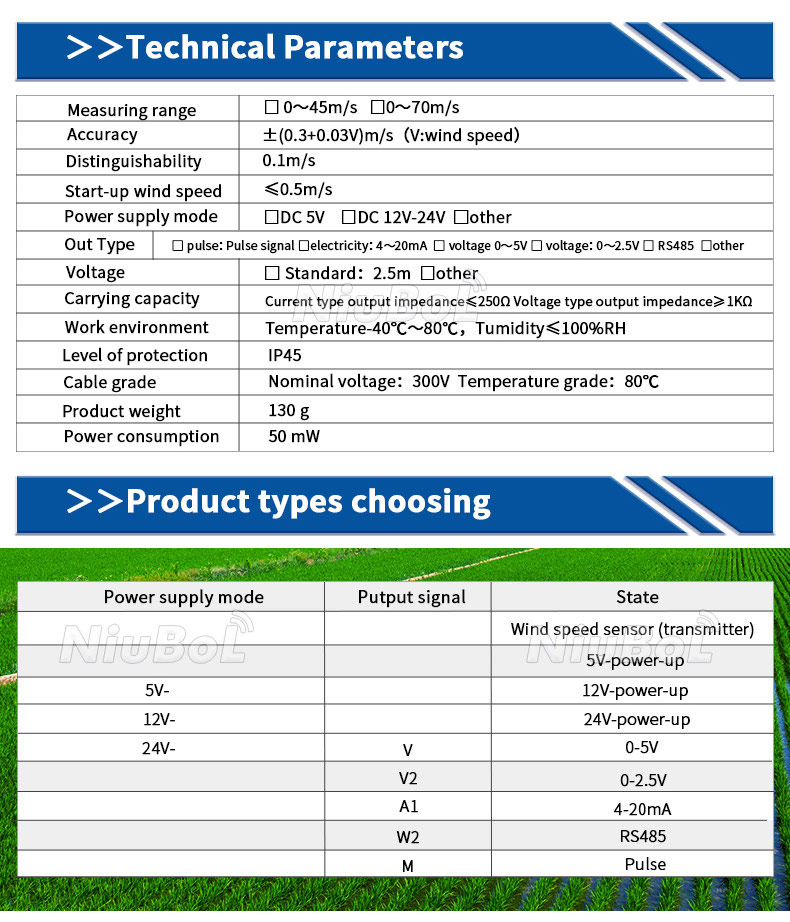
| Item | NBL-W-SS configuration | Why it matters to cost |
|---|---|---|
| Measuring range | 0-45 m/s or 0-70 m/s | Use the required operating range and confirm the receiver scale. |
| Accuracy | +/- (0.3 + 0.03V) m/s, where V is wind speed in m/s | Compare the complete error expression at the relevant speed. |
| Resolution / starting speed | 0.1 m/s / no more than 0.5 m/s | Low-speed reporting needs more than a wide maximum range. |
| Supply selections | 5 VDC or 12-24 VDC versions | The ordered version must match the available supply. |
| Output selections | Pulse, 4-20 mA, 0-5 V, 0-2.5 V or RS485 | Specify one required interface and any separately requested options. |
| Power consumption | 50 mW nominal sensor figure | Not the demand of a complete station or an optional heater. |
| Operating temperature | -40 to +80 degrees C for this configuration | Do not substitute storage temperature for operating capability. |
| Housing protection | IP65 | Connectors, joints and panel entries need their own protection. |
| Cable | 2.5 m standard; other lengths specified separately | Specify jacket material and exposure requirements; length alone does not identify material. |
At V = 10 m/s, the accuracy expression gives +/-0.6 m/s. It does not mean +/-0.3 m/s throughout the range. At a common decision speed, this distinction is more useful than comparing the smallest number printed in two quotations. A higher displayed resolution also does not automatically reduce measurement error.
For new orders, NBL-W-SS housing protection is IP65. The IP45 entry in the earlier-version illustration below does not apply to that configuration. Match the output version, supply and cable assembly to the purchase specification as well; different entries in an option table are not all standard features on one sensor.
Check whether prices include cable length, connector, mounting bracket, calibration document, shipping and local taxes. Confirm the supply voltage and output match the existing logger. A lower sensor price can create panel and converter costs if the interface is wrong.
For a 4-20 mA channel, the speed represented by 12 mA is half of the configured full scale. That is 22.5 m/s on a 0-45 m/s channel and 35 m/s on a 0-70 m/s channel. These are scaling calculations, not test results. A replacement can communicate correctly while displaying the wrong speed if the receiver retains the previous range.
The RS485 version uses Modbus RTU, with 9600 baud, eight data bits and no parity; the supported stop-bit setting must match the delivered unit. Allow at least 1000 ms between communications for this configuration. Request the register map and scaling with the quotation. A one-second communication interval does not, by itself, establish a certified gust-response characteristic.
Mechanical sensors are widely used and their moving parts require inspection. Ultrasonic sensors have no rotating cups, but power, heating, precipitation behavior and data protocol must be checked for the site. The selection should follow the measurement task rather than a price tier.
A fair mechanical-versus-ultrasonic comparison also needs equal scope. A separate cup sensor measures speed; an ultrasonic package may include both speed and direction. Compare speed plus the required direction channel against the combined package, including mounting and acquisition. Conversely, there is no reason to buy a direction channel solely because it is bundled if the specified task requires speed only.
Budget for the complete measurement point: bracket and mast work, cable routing, surge protection, logger channel, power supply, commissioning and calibration. For remote stations, add travel and the cost of replacing a failed unit. A product with a higher purchase price may reduce service work, but only if its environmental design suits the site.
Keep spare compatibility in mind. Replacing one sensor later is easier when its output, connector and data mapping are documented during the original purchase.
Consider a replacement at an accessible agricultural weather station. If the bracket, power and input remain compatible, the incremental work may be limited to fitting the sensor and checking its scale. At a tall industrial structure, access equipment, isolation procedures and a weather-dependent work window can dominate the service bill. The same sensor unit price therefore says little about the wind sensor installed cost.
Another example is a new remote solar site. Its anemometer might consume little power, while the logger, modem and optional heating determine the battery and solar-panel size. Request separate average and peak loads for the actual equipment. Do not estimate autonomy by multiplying the sensor's nominal figure alone, and do not assume IP65 means ice prevention, corrosion certification or direct lightning protection.
For wind sensor quotation comparison, create one total for the equipment and a second for installation and recurring service. State which party provides the mast, earthing, surge devices, access and network subscription. This avoids hiding a genuine scope difference inside a single unit-price column. For export purchasing, compare the same delivery basis and identify separately assessed import charges without guessing destination-specific tax rates.
Send NiuBoL the application, required speed range and accuracy, output, supply voltage, receiver model, cable length and mounting drawing. Include the site temperature, salt exposure, freezing conditions and any heating requirement. For replacement work, attach the existing wiring and scale rather than only a photograph of the old housing. State whether direction measurement, a display or data logging is also needed.
Ask the supplier to separate the sensor, accessories, calibration or test documentation, and optional acquisition equipment. For a repeat order, identify the version used in the first installation. Before committing to a larger quantity, test one configured channel through the actual receiver: power-up, value scaling, communication restart and missing-data behavior. Hand rotation can demonstrate activity, but it is not an accuracy calibration.
A usable price is a dated quotation for a defined configuration. Request the model, output, supply, cable, included mounting and commercial delivery basis. A sensor-only amount without those details cannot be compared reliably with a complete channel. Ask how long the quote remains valid before using it in a project budget.
It depends on the installed receiver. Spare analog capacity may favor a current-output unit; an existing compatible serial bus may favor RS485. Include input hardware, wiring, software mapping and commissioning in the comparison. Neither interface removes the need to verify the measurement scale.
No. Range, accuracy, resolution and survival capability are different properties. Compare errors at the speeds relevant to the project and confirm the configured output range. A 0-70 m/s label alone does not demonstrate smaller error or greater resistance to every environmental hazard.
Specify the evidence required by the project. A functional check, factory test record and traceable calibration are not interchangeable. If a particular laboratory scope or test speeds are required, request them before comparing prices; do not assume that every certificate meets the requirement.
Only after checking the mechanical fit, electrical output, supply and interpretation. Matching connector appearance is insufficient. A pulse factor, current full scale or Modbus register layout can differ even when the displayed unit remains m/s.
Output configuration, cable preparation, requested testing, quantity and accessory availability affect the order. Obtain a dated lead-time commitment for that configuration. For service planning, identify replaceable parts, access requirements and spare compatibility rather than assuming a fixed sensor lifetime.
Compare wind speed sensor price only after fixing the measurement and supply scope. For NBL-W-SS projects, specify range, output, power, IP65 housing and cable requirements, then account for the receiver and installation. This produces a quotation that a purchasing team can evaluate and an engineer can connect without discovering missing equipment after delivery.
Prev:How to use the wind speed sensor and precautions
Next:Wind Speed Sensor Applications and Site Selection Guide
Related recommendations
Sensors & Weather Stations Catalog
 Agriculture Sensors and Weather Stations Catalog-NiuBoL.pdf
Weather Stations Catalog-NiuBoL.pdf
Agriculture Sensors Catalog-NiuBoL.pdf
Water Quality Sensor Catalog-NiuBoL.pdf
Related products
 Combined air temperature and relative humidity sensor
 TDR Soil Moisture & Temperature Sensor for irrigation| RS485 |4-20mA| NBL-S-THR
 Soil pH sensor RS485 soil Testing instrument soil ph meter for agriculture |NBL-S-PH
 Wind Speed sensor Output Modbus/RS485/Analog/0-5V/4-20mA
 Tipping bucket rain gauge for weather monitoring auto rainfall sensor RS485/Outdoor/stainless steel
 Pyranometer Solar Radiation Sensor 4-20mA/RS485


Screenshot, WhatsApp to identify the QR code
WhatsApp number:+8615367865107
(Click on WhatsApp to copy and add friends)

