





— Blogs —
—Products—
 Consumer hotline +8618073152920
WhatsApp:+8615367865107
Address:Room 102, District D, Houhu Industrial Park, Yuelu District, Changsha City, Hunan Province, China
Product knowledge
Time:2026-09-20 10:00:00 Popularity:209
COD, BOD, TOC and turbidity in one online sensor can be useful for coordinated trend monitoring at one water-contact point. It does not necessarily mean four independent analytical measurements. In a full-spectrum instrument, several reported parameters are calculated from shared optical information. Select the arrangement when each required output has been validated for the water and when the project can tolerate the consequences of a shared probe, sampling point and service interruption.
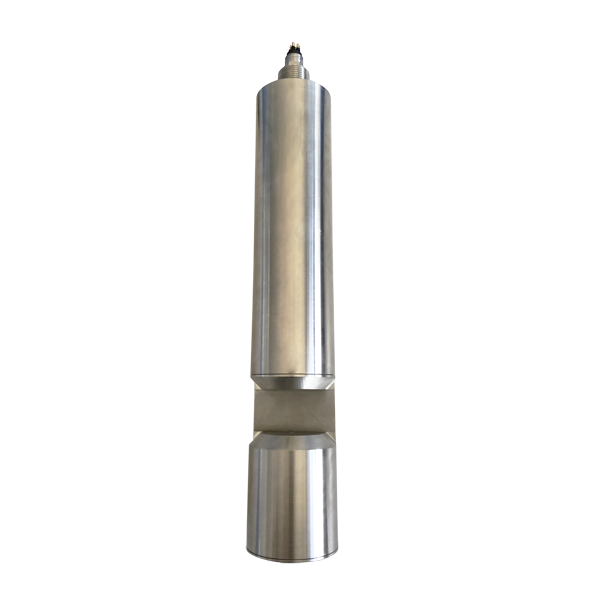
The number of values on a screen is not the number of independent methods in the water. A full-spectrum probe measures spectral response, then applies parameter-specific relationships to produce values such as COD, BOD and TOC. A change in the optical window or water composition can therefore affect several outputs together.
A dual-wavelength COD probe is a different configuration. It provides an optical COD estimate with turbidity and temperature functions, not an automatic four-parameter COD/BOD/TOC package. Naming the actual model prevents a purchasing specification from treating all organic-monitoring probes as interchangeable.
| Output | How the value is derived | Required comparison |
|---|---|---|
| COD | An estimate related to spectral absorption and the configured COD model | Paired chemical COD results for the actual water and sample basis |
| BOD | An optical estimate associated with the configured BOD relationship | The specified biochemical oxygen-demand reference, including its test conditions |
| TOC | A model-derived carbon estimate from optical information | TOC analysis on the agreed sample fraction and reporting basis |
| Turbidity | An optical particle-related output from the instrument's implementation | A suitable turbidity reference and evaluation of the required working interval |
BOD5 describes a biochemical oxygen-demand test with a five-day period. A rapidly changing optical BOD value is not that test completed in seconds. Similarly, an absorption-derived TOC value should not be described as an independent carbon determination simply because the units are mg/L. Keep the measurement principle visible in the instrument specification and data descriptions.
The NiuBoL NBL-WQ-FUV-200 full-spectrum multi-parameter sensor uses a xenon light source and a spectrometer. Its listed outputs include COD, BOD, TOC, chroma and turbidity. This makes it a candidate for observing several aspects of the same water sample through one installation, subject to parameter-by-parameter validation.
| Parameter | NBL-WQ-FUV-200 configuration | Practical interpretation |
|---|---|---|
| COD range | 0-200 mg/L equivalent KHP | Reference-calibrated optical output, not a universal wastewater conversion |
| BOD and TOC ranges | 0-150 mg/L each | Qualify each calculated output against its own reference |
| Turbidity and chroma ranges | 0-400 NTU; 0-500 Hazen | Check expected excursions as well as normal conditions |
| Accuracy specification | +/-5% FS for each listed parameter | Full-scale basis; site-model uncertainty must be evaluated separately |
| Resolution | 0.1 mg/L for COD/BOD/TOC; 0.1 NTU; 0.1 Hazen | Display increments are not measurement uncertainty |
| Power | 12-24 VDC; 0.2 W at 12 V | Allow separately for a controller and any fitted cleaning equipment |
| Communication | RS485 Modbus RTU | Verify the register and scale for every required parameter |
| Working conditions | 0-45 C; pressure below 0.1 MPa | Check the actual water temperature and installation pressure |
| Protection and materials | IP68; 316L stainless steel; immersion installation | Review chemical compatibility and access for cleaning |
| Cable | Standard 5 m, four-core twisted-pair shielded cable | Keep joints dry and specify extensions with the power and bus design |
The full-scale error term deserves attention when an application uses only the bottom of a range. For a 0-150 mg/L BOD or TOC span, 5% FS equals 7.5 mg/L under the stated reference conditions. A 0.1 mg/L display increment does not make that a 0.1 mg/L accuracy claim. At a low-concentration decision point, assess the actual uncertainty before choosing the all-in-one arrangement.
A treatment-stage observation point is a plausible use when the project needs synchronized trends in the same water. One mounting location and a common sampling time can reduce differences caused by measuring separate streams. The value is the ability to relate changes at that point, not an assumption that every output has equal diagnostic strength.
A remote surface-water station may also benefit from fewer separate probes and connections if its objective is screening for changes between site visits. The operating plan still needs cleaning, reference checks and a way to investigate an alarm. Multiple calculated organic indicators should not be counted as independent confirmation that a particular contaminant is present.
For a process with a reasonably consistent water composition, a qualified subset of the outputs may be sufficient. It is acceptable to use the COD and turbidity trends while leaving BOD or TOC out of operational decisions until their relationships have been demonstrated. Purchasing a multi-output device does not oblige the plant to act on every register.
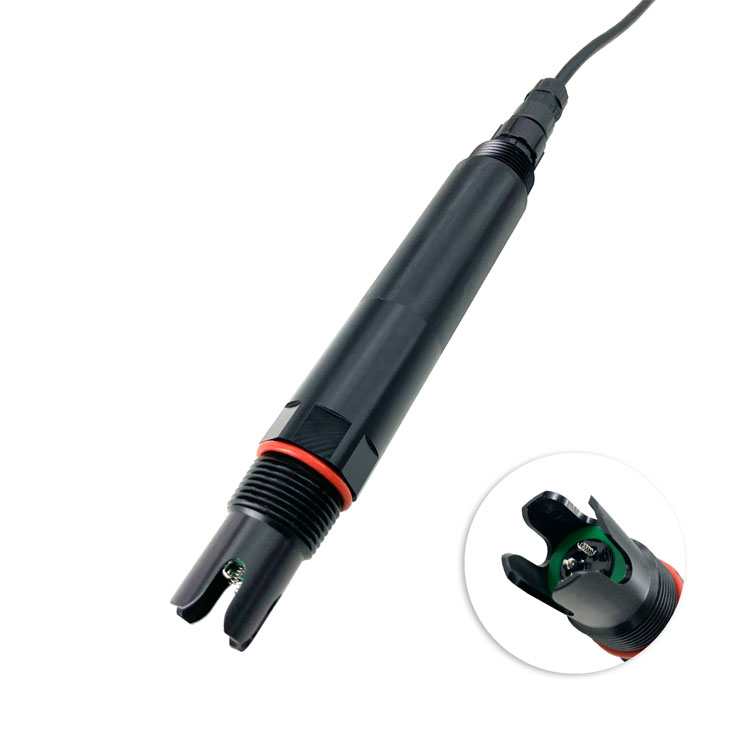
The residual-chlorine electrode below is for a separate disinfectant-monitoring duty. It does not measure COD, BOD or TOC, even when its housing resembles another water-quality probe.
Different measuring points are a strong reason to separate instruments. If COD is needed before biological treatment and turbidity after clarification, one probe at one location cannot provide both observations. Moving a probe or switching a sample manifold also changes the timing and may introduce carryover; it does not create simultaneous coverage.
A different required method is another reason. If a particular TOC or BOD determination is required, select equipment that provides that determination instead of relabeling a spectral estimate. A dedicated NBL-WQ-BOD-4S uses fluorescence rather than the FUV-200's absorption spectrum, but it is still an optical BOD estimate requiring site comparison. It is not automatically a substitute for BOD5.
The BOD-4S has a 0-300 mg/L range, 0.1 mg/L resolution, 12-24 VDC supply and RS485 Modbus RTU with optional 4-20 mA. It provides a different configuration for an identified BOD-monitoring task, rather than proof that adding another sensor removes all uncertainty. Its exact accuracy basis should be agreed before acceptance; do not combine full-scale and percentage-of-reading wording into a single assumed tolerance.
Availability also matters. Cleaning or removing one full-spectrum probe can interrupt all of its outputs. Where a particular alarm must remain available during service, consider a separately qualified measurement or a defined alternative operating procedure. Two values calculated from the same fouled optical path are not redundant sensors.
For COD, BOD, TOC and turbidity in one online sensor, the RFQ should keep surrogate correlation, sample matrix, required output value and laboratory comparison method separate so the buyer knows which numbers are measured and which are calculated. The acceptance trial should follow the same separation.
For each output, define the sample location, reference analysis, relevant concentration interval and acceptable disagreement for the intended decision. Pair samples with the online timestamp. Retain production or treatment-state information when it explains composition changes. An overall statement that "the sensor matches the laboratory" is inadequate if only COD was compared.
Evaluate ordinary operating water and credible changes in source or process conditions. Use independent observations to check a fitted relationship. Where one output becomes unreliable under a particular condition, mark that limitation explicitly rather than using successful performance of another channel as a pass for the entire package.
Shared signals also affect calculated ratios. If BOD and COD are derived from closely related spectral information, their ratio may reflect the model structure as well as the water. Do not use that ratio alone to establish biodegradability or biological-treatment suitability. Those decisions need appropriate reference testing and process evidence.
In the PLC, RTU or data logger, identify each parameter, engineering unit and derivation. A tag such as an optical COD estimate is less ambiguous than a generic "water quality" channel. Avoid putting a laboratory result and an online estimate into the same historical series without a method identifier.
Test the Modbus mapping for every output, not just the first successful response. A correct COD value does not prove that TOC scaling or turbidity units were configured correctly. Check a power cycle and communication interruption, and make stale data distinguishable from a new reading.
Where the probe exposes only a shared instrument status, all dependent values need to respect that status. Do not leave BOD and TOC marked healthy while the common optical assembly is out of service. Parameter-specific limitations may require additional host-side quality flags, even when the serial communication remains normal.
A separate turbidity probe can be justified by a different location, a narrower required range or an independently qualified particle channel. It should not be added merely because the full-spectrum instrument's channel list was overlooked. Ask NiuBoL to quote the required observations and their locations, not simply the largest number of displayed parameters.
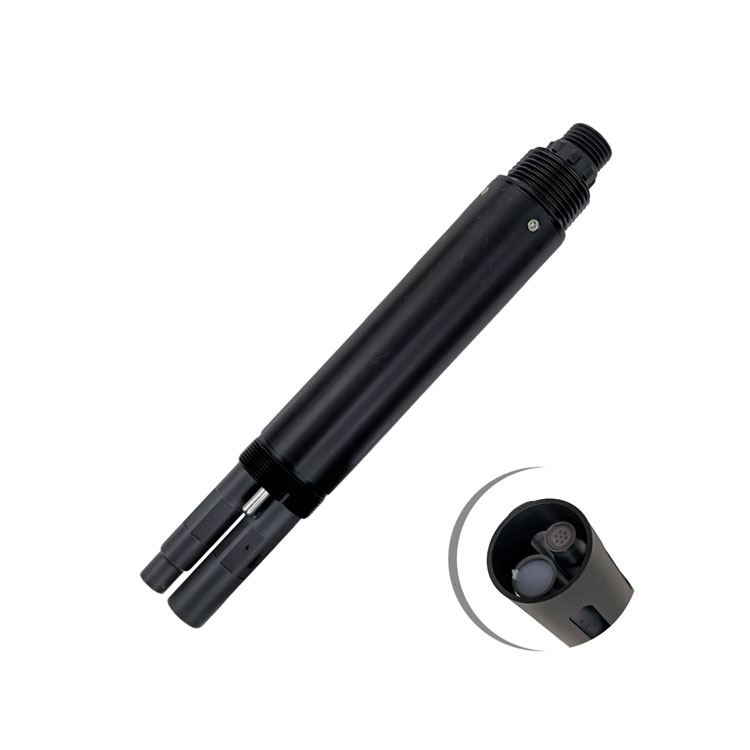
The ammonium electrode below adds a different measurement principle for a separately defined nitrogen task. It does not validate the full-spectrum organic outputs; its range and water-matrix suitability need their own review.
They are separate reported quantities, but they can be derived from shared spectral data. Their agreement with reference analyses must be assessed individually, and shared fouling or model limitations can affect more than one value at the same time.
No. Compensation addresses a defined optical interference; it does not prove that COD, BOD and TOC relationships remain valid after a change in dissolved composition. Check the complete water matrix during the site trial.
Yes, when the cause is understood and the remaining outputs are independently qualified for their duties. A common optical fault or invalid instrument status is different: it may invalidate several dependent outputs and must not be ignored.
No. It measures fluorescence and relates that response to BOD through calibration and site comparison. Its value is rapid trend information where the relationship is useful, not completion of a biochemical incubation test by optical means.
It may reduce mounting and connection work, but qualification, cleaning and service interruptions still have costs. Compare the required measurement coverage and availability. A less expensive package is not equivalent if it leaves a required point or method unmeasured.
Provide required parameters, their locations, normal and peak values, reference methods, relevant water-composition changes and the receiving system. Identify which outputs are for observation and which will trigger actions so that the proposed configuration can be evaluated accordingly.

A multi-parameter optical probe is useful when shared sampling and coordinated trends suit the task. Qualify each required output, account for common failures and use separate instruments where location, analytical method or availability demands them. The engineering benefit comes from answering the required questions with a manageable installation, not from treating every displayed value as an independent test.
Prev:COD Sensor Selection: UV254, Full-Spectrum and Reagent-Based Monitoring Compared
Next:Why Effluent COD Suddenly Increases and What Online Sensors Can Confirm
Related recommendations
Sensors & Weather Stations Catalog
 Agriculture Sensors and Weather Stations Catalog-NiuBoL.pdf
Weather Stations Catalog-NiuBoL.pdf
Agriculture Sensors Catalog-NiuBoL.pdf
Water Quality Sensor Catalog-NiuBoL.pdf
Related products
 Combined air temperature and relative humidity sensor
 TDR Soil Moisture & Temperature Sensor for irrigation| RS485 |4-20mA| NBL-S-THR
 Soil pH sensor RS485 soil Testing instrument soil ph meter for agriculture |NBL-S-PH
 Wind Speed sensor Output Modbus/RS485/Analog/0-5V/4-20mA
 Tipping bucket rain gauge for weather monitoring auto rainfall sensor RS485/Outdoor/stainless steel
 Pyranometer Solar Radiation Sensor 4-20mA/RS485


Screenshot, WhatsApp to identify the QR code
WhatsApp number:+8615367865107
(Click on WhatsApp to copy and add friends)

