





— Blogs —
—Products—
 Consumer hotline +8618073152920
WhatsApp:+8615367865107
Address:Room 102, District D, Houhu Industrial Park, Yuelu District, Changsha City, Hunan Province, China
Product knowledge
Time:2026-09-20 09:00:00 Popularity:208
COD sensor selection depends on what the result must support. A UV254 instrument can provide a useful optical trend when its relationship with the wastewater remains stable. A full-spectrum instrument provides more spectral information but still needs validation of its calculated COD. A reagent-based analyzer uses a chemical reaction and has different sampling, consumable and maintenance requirements. Choose the method before specifying the cabinet or comparing probe prices.
A treatment plant may need an immediate warning of a changing inlet stream and, separately, a result obtained by an approved analytical method. Those duties need not be assigned to the same instrument. Trying to satisfy both with the lowest-cost device can leave the operator with either an unsuitable reporting result or a measurement that arrives too late for the intended process response.
Write down the decision first: investigate a discharge, divert an abnormal stream, compare treatment stages, or obtain a method-defined result. Then identify the maximum acceptable delay and the water conditions under which the decision must remain reliable. A stable municipal effluent and an industrial discharge that changes with production batches should not automatically receive the same COD configuration.
UV254, full-spectrum and reagent-based COD monitoring should be compared by measurement principle, matrix sensitivity, maintenance load and the role assigned to the result. UV254 is an optical surrogate that requires site correlation; full-spectrum methods use more wavelength information to examine the optical matrix; reagent-based analyzers add consumables, waste handling and cycle time but may be selected when a wet-chemistry workflow is required.
| Approach | What produces the result | Selection question that matters |
|---|---|---|
| UV254 or dual-wavelength optical COD | UV absorption converted to a COD estimate, with a reference channel where fitted | Does the relationship remain useful for the expected water composition and solids conditions? |
| Full-spectrum optical monitoring | A measured spectrum interpreted through parameter-specific models | Does the broader spectrum improve performance on the site's changing water, rather than just add displayed values? |
| Reagent-based COD analyzer | Chemical oxidation and an analytical readout within the selected method | Does the complete analyzer meet the required method, range, sample preparation and reporting duty? |
UV absorption is not a universal measure of every substance contributing to chemical oxygen demand. Two waters can have similar laboratory COD but different optical responses because their composition differs. Conversely, a change in absorption can reflect a changed mixture rather than a proportional change in COD. A calibration built on one production stream may therefore be unsuitable after a raw-material or cleaning-process change.
A turbidity reference channel addresses part of the particle-related optical interference. It does not make the sensor insensitive to every particle population, colored compound or deposit. Before choosing dual-wavelength monitoring, test actual samples from normal production, changeovers and plausible high-load conditions. Include conditions around the proposed alarm level, not only the easy middle of the operating range.
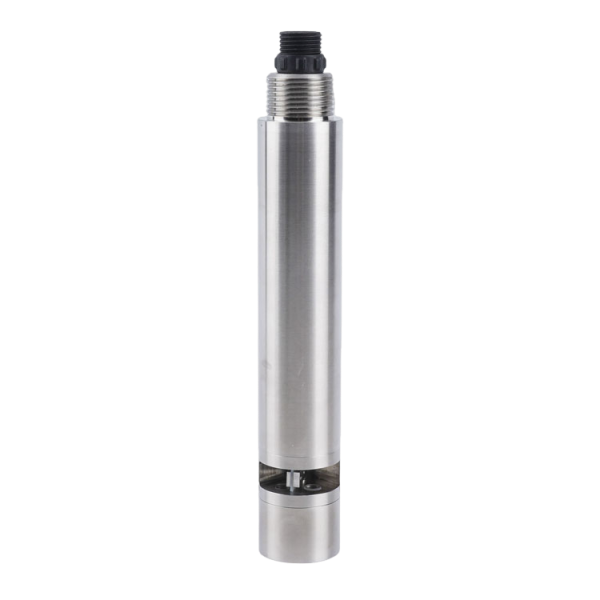
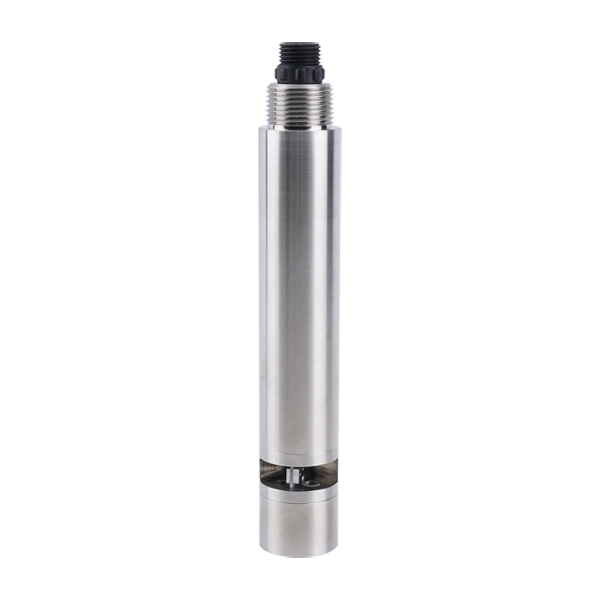
The NiuBoL NBL-WQ-COD is a dual-wavelength configuration with COD, turbidity and temperature functions. Its COD ranges are expressed as KHP-equivalent values. KHP, potassium hydrogen phthalate, provides a calibration reference; agreement with that reference does not establish the relationship between optical absorption and every wastewater mixture.
A full-spectrum instrument can examine a broader absorption pattern instead of relying on one principal analytical wavelength. That can be useful where color and organic composition vary together, provided the parameter models have been evaluated on those variations. It is not evidence that the device identifies every pollutant or supplies an independent laboratory result for each displayed parameter.
The NBL-WQ-FUV-200 uses full-spectrum absorption and provides configured COD, BOD, TOC, chroma and turbidity values. Ask which outputs are required for the plant's actual decisions. If only one qualified COD trend is needed, extra outputs alone do not justify a more complex measurement arrangement.
Compare the two optical approaches using the same paired samples and reference results. Keep a portion of the observations separate from the data used to adjust the model, so the comparison tests prediction rather than only the fit to calibration points. Examine errors at the alarm boundary and during composition changes. A single correlation coefficient can conceal an offset that matters operationally.
Where a contract or reporting requirement specifies a chemical COD method, verify the proposed analyzer against that duty. A cabinet containing reagents is not automatically approved, and an optical probe does not become equivalent simply by displaying mg/L COD. The sampling system, analytical procedure and quality-control arrangements all affect the result.
For example, EPA Method 410.4 uses dichromate digestion followed by a colorimetric determination. It also identifies chloride interference. These features distinguish that analytical procedure from UV absorption in untreated water. The method is a reference example here, not a claim that every online reagent analyzer implements it or that it is the required method in every jurisdiction.
Check the analyzer's complete time to result: sample transport, preparation, analysis and data transfer. Also establish what happens between cycles. A rapid optical trend can complement periodic chemical analysis by indicating when an additional sample is useful, while the analytical channel supplies its separately defined result. Do not silently substitute one channel for the other during downtime.
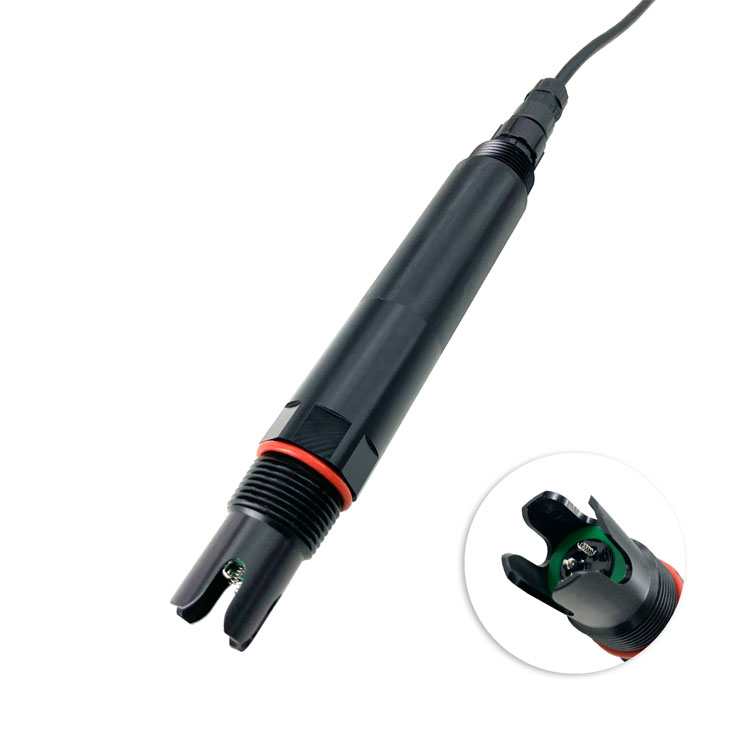
Residual chlorine is a separate analytical duty. The electrode below measures a chlorine-related response, not COD; similar probe housings do not make the measurements interchangeable.
| Parameter | NBL-WQ-COD | NBL-WQ-COD-408-S |
|---|---|---|
| Principle | Dual-wavelength UV absorption | Dual-wavelength UV absorption |
| COD range options | 0-200 or 0-500 mg/L equivalent KHP | 0-200, 0-500 or 0-1500 mg/L equivalent KHP |
| Paired turbidity ranges | 0-100 or 0-200 NTU, respectively | 0-200, 0-400 or 0-1000 NTU, respectively |
| COD resolution | 0.1 mg/L | 0.1 mg/L |
| Accuracy basis for procurement | COD: +/-5% FS; confirm the ordered range and reference conditions | Range-dependent specification; obtain the applicable error expression and reference conditions for the selected version |
| Output | RS485 Modbus RTU | RS485 Modbus RTU; optional 4-20 mA |
| Supply and power | 12-24 VDC; 0.3 W at 12 V | 12-24 VDC; 0.4 W measurement and 2 W cleaning at 12 V |
| Water conditions | 0-45 C; below 0.1 MPa | 0-60 C; maximum 0.2 MPa |
| Protection and installation | IP68; immersion | IP68; immersion, 3/4 NPT |
| Housing and cable | 316L stainless steel; 5 m, four-core twisted-pair shielded cable | 316L stainless steel; 5 m, five-core twisted-pair shielded cable |
Full-scale accuracy and resolution answer different questions. On a 0-200 mg/L span, +/-5% FS corresponds to +/-10 mg/L under the stated reference conditions, not +/-0.1 mg/L because the display has one decimal place. This arithmetic is useful for screening a range; it does not include additional uncertainty from applying an optical conversion to unfamiliar wastewater.
Do not combine the 408-S's different range options into one universal accuracy claim. Obtain the agreed specification for the selected range before setting acceptance limits. Similarly, qualify response time for the delivered configuration and installed sample route rather than taking the shortest advertised optical response as the plant's alarm delay.
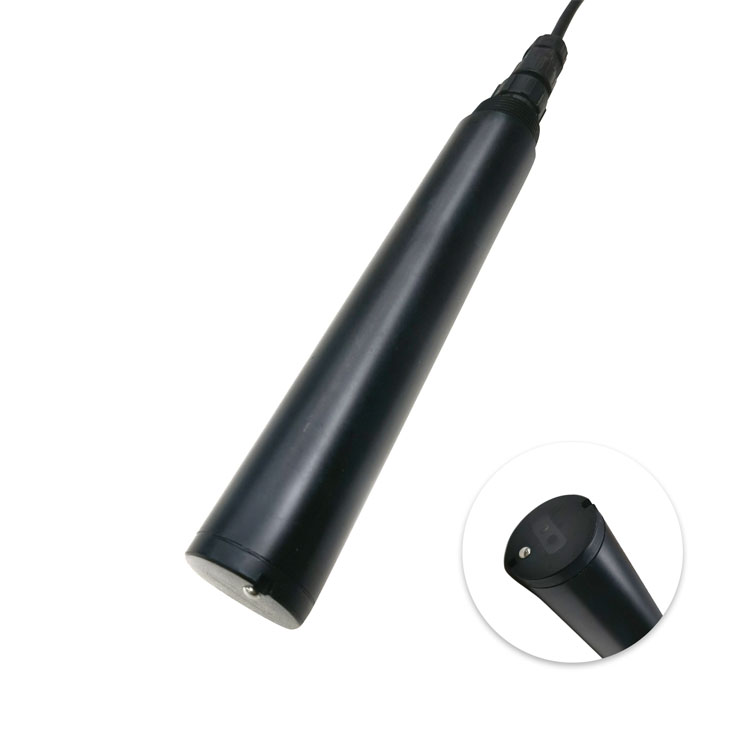
A separate turbidity instrument, shown below, can provide a particle-monitoring channel. It does not supply a COD result or establish that the COD probe's optical compensation remains valid for every particle population.
Sampling equipment is part of the method comparison. Ask what reaches the analytical chamber or optical path after screens, settling devices or filters. Removing material to prevent blockage can change the sample fraction being measured. A proposal for total-sample COD needs a sampling arrangement consistent with that duty, not an unexplained pretreatment step that produces a cleaner but different sample.
For an intermittent discharge, establish whether the measurement captures the event or only the water remaining afterward. A shared sample selector needs a defined sequence, flushing requirement and transport delay for each point. Include those delays in the comparison of optical and reagent-based approaches. Multiple inlet tubes connected to one analyzer do not provide simultaneous readings from every stream, and short events can be missed between visits to a sampling point.
Optical measurement avoids reagent consumption during normal measurement, but the windows still need cleaning and the site relationship needs periodic checking. A self-cleaning brush must be inspected and maintained. An installation that cannot be accessed safely may cost more to operate than one with an appropriate removable holder.
For reagent-based equipment, request consumption per analytical cycle, scheduled checks, waste volume, replacement tubing and the sampling-system service requirements. Compare those quantities at the intended measurement frequency. A reagent-pack price without the number of usable cycles is not a meaningful operating-cost comparison.
For direct RS485 integration, map COD and turbidity separately, with their units and scaling. If an optional current output is selected, identify which parameter it carries. One analog channel should not be assumed to transmit every value available digitally. The host must also distinguish missing communication and maintenance from a valid low-COD result.
Ask NiuBoL to review the water source, operating COD interval, turbidity conditions, required method and host interface. Include representative paired results when available. These inputs determine whether a UV configuration is a reasonable candidate, whether full-spectrum evaluation is useful, or whether the project needs a different analytical arrangement.
No. More spectral information may help with a changing optical matrix, but the result depends on the model, range and water. Compare both candidates on the same representative samples and evaluate the errors that matter to the operating decision.
It can be considered after site validation demonstrates suitable performance around the diversion threshold. Include fault behavior, maintenance states and the consequences of false or missed alarms. A factory calibration alone does not qualify that control function.
No. Chemical methods have their own interference and sample-handling requirements. Check the selected method's limitations and the analyzer's implementation, especially where unusual salts or production chemicals are present.
One sample can reveal a disagreement but cannot establish a reliable relationship across operating conditions. Investigate sampling and instrument condition first, then use representative paired observations to develop and independently check any correction.
Specify the measurement duty, range, method requirement, sample arrangement, output and maintenance access. Separate the instrument, installation hardware and commissioning work. For chemical analyzers, include consumable and waste-handling scope as well.
COD sensor selection should resolve the analytical role before the equipment list. Use UV254 where its site relationship supports the decision, evaluate full-spectrum monitoring where additional spectral information has a purpose, and retain the specified chemical method where that result is required. The selection succeeds when the installed measurement answers the plant's question under the water conditions it will actually encounter.
Prev:TSS and MLSS Sensors for Sludge Process Control in Wastewater Plants
Next:COD, BOD, TOC and Turbidity in One Online Sensor: When It Makes Engineering Sense
Related recommendations
Sensors & Weather Stations Catalog
 Agriculture Sensors and Weather Stations Catalog-NiuBoL.pdf
Weather Stations Catalog-NiuBoL.pdf
Agriculture Sensors Catalog-NiuBoL.pdf
Water Quality Sensor Catalog-NiuBoL.pdf
Related products
 Combined air temperature and relative humidity sensor
 TDR Soil Moisture & Temperature Sensor for irrigation| RS485 |4-20mA| NBL-S-THR
 Soil pH sensor RS485 soil Testing instrument soil ph meter for agriculture |NBL-S-PH
 Wind Speed sensor Output Modbus/RS485/Analog/0-5V/4-20mA
 Tipping bucket rain gauge for weather monitoring auto rainfall sensor RS485/Outdoor/stainless steel
 Pyranometer Solar Radiation Sensor 4-20mA/RS485


Screenshot, WhatsApp to identify the QR code
WhatsApp number:+8615367865107
(Click on WhatsApp to copy and add friends)

