





— Blogs —
—Products—
 Consumer hotline +8618073152920
WhatsApp:+8615367865107
Address:Room 102, District D, Houhu Industrial Park, Yuelu District, Changsha City, Hunan Province, China
Product knowledge
Time:2026-09-22 09:00:00 Popularity:205
A solar-powered river water quality station should be designed around the lowest usable river level, the expected flood exposure and the time available to respond to a water-quality event. Choose direct immersion where a representative, retrievable measuring point remains submerged; consider pumped sampling where safe bank-side servicing justifies the extra power and sample-conditioning work. Select NiuBoL sensors for the required observations, then size the solar supply for the entire installation, including pumps and communications.
A convenient place for a cabinet is not necessarily a useful place to measure water. A probe beside a stagnant bank pocket may describe that pocket while the intake draws from a different flow path. A mounting position that works during commissioning may become exposed in the dry season or buried after a sediment event. Survey the water contact point separately from the cabinet and panel positions.
For intake protection, identify which water reaches the intake and how an upstream alarm will change operations. For an upstream-downstream investigation, compare locations that represent the intended sections and account for travel time. Simultaneous readings at two stations do not necessarily describe the same parcel of water. A station can trigger field sampling, but its selected sensor channels cannot identify every contaminant or establish drinking-water safety.
| River condition | Installation consequence | Check before committing to the site |
|---|---|---|
| Seasonally low water | A fixed probe or suction inlet may leave the water | Minimum operating level and a position that remains representative |
| Rapid rises and floating debris | Loads on brackets, cables and inlet guards increase | Retrieval route, structural assessment and protection without trapping stagnant water |
| Changing sediment bed | The measuring face can become obstructed or sample a local deposit | Clearance through the expected bed changes and access for inspection |
| Shaded or insecure riverbank | The sensing point may be suitable while solar generation or equipment security is not | Separate panel location, seasonal shading and protected cable route |
| Flooded access road | A minor sensor fault may remain unattended for an extended period | Permitted outage, local storage and a realistic service plan |
Set cabinet and electrical-joint elevations from the site's flood assessment rather than an arbitrary height above today's waterline. An IP68 probe does not confer immersion protection on the battery, gateway or cabinet. Avoid a layout that requires personnel to enter floodwater to isolate or retrieve equipment.
Direct immersion avoids the pump's energy demand and sample transport delay. It is often attractive for a remote river monitoring station, provided that the sensor can be cleaned and returned to the same position safely. The mount must carry the mechanical load; the signal cable is not a lifting rope. A protective cage needs enough water exchange and optical clearance to avoid changing the measurement it is intended to protect.
Pumped sampling brings water to an accessible instrument location. It can simplify servicing at a steep bank, but it introduces an inlet, pipework, pump, drain and flow checks. Dissolved oxygen can change through aeration or warming, suspended particles can settle, and deposits can build inside the line. A screen that excludes large debris is different from a filter that removes the particles the turbidity channel is meant to observe.
Estimate transport delay before accepting a bank-side sample cabinet. As an illustrative calculation, a 20 m tube with a 6 mm internal diameter contains approximately 0.565 L. At 0.2 L/min, one nominal tube-volume exchange takes about 2.8 minutes. This is not the complete response time: mixing, dead spaces, instrument stabilization and the actual flow regime can require additional flushing. Verify delay at the installed inlet and operating flow.
Do not place an immersion assembly into an improvised narrow chamber simply because its electrical connector fits. Establish the chamber pressure, sensor clearances, drainage and water exchange first. For a pumped arrangement, a no-flow condition should invalidate the water-quality result or flag it clearly; a powered instrument can continue reporting a plausible value from old water.
Turbidity can help identify suspended-particle changes associated with runoff. Conductivity can reveal changes in ionic composition, while pH, dissolved oxygen and temperature help interpret biological and chemical conditions. These are complementary observations, not interchangeable pollution measurements. An optical turbidity reading does not become a suspended-solids concentration without a suitable site-specific relationship.
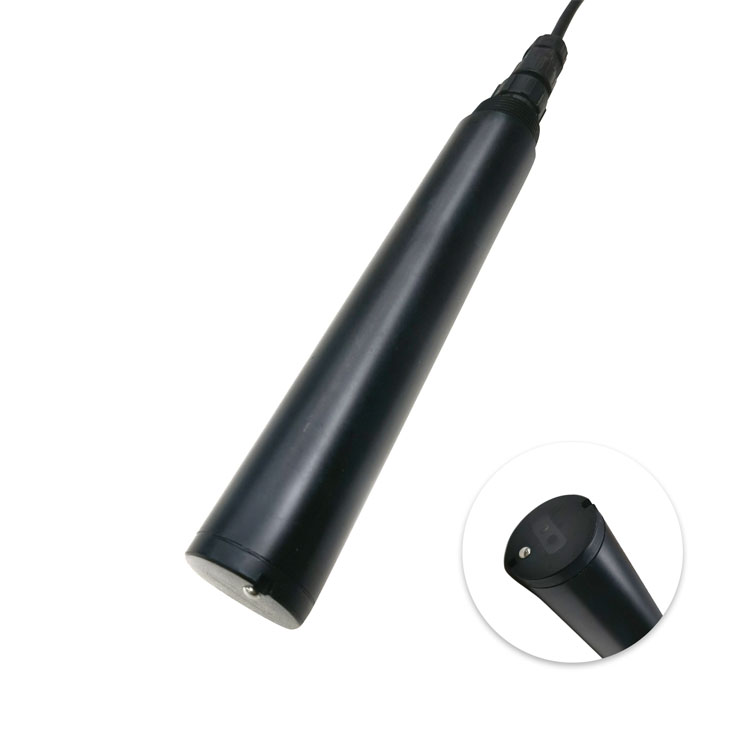
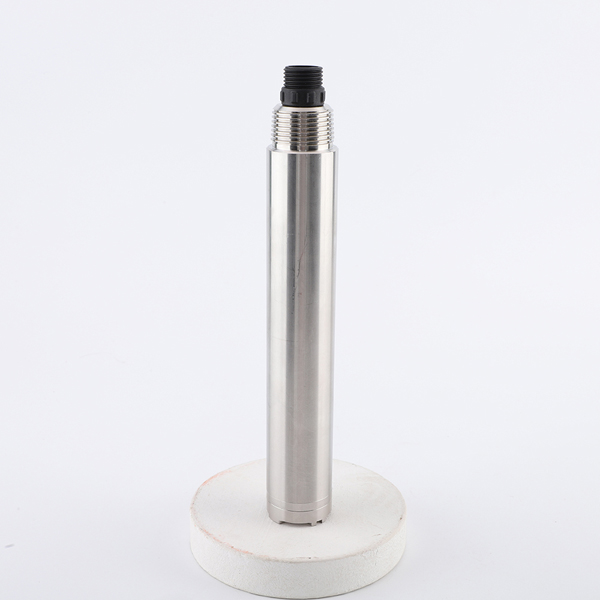
The NiuBoL NBL-WQ-MPS-5B is a configurable multi-parameter assembly with an automatic cleaning brush. A separate NBL-WQ-CHLO-4S chlorophyll sensor is relevant where algal variation is part of the monitoring task. Chlorophyll is not automatically included in an MPS-5B configuration, and chlorophyll fluorescence does not directly identify species or measure algal toxins.
| Integration item | MPS-5B assembly | CHLO-4S chlorophyll sensor |
|---|---|---|
| Measurement configuration | Up to six parameters including temperature, using selected DO, pH, ORP, conductivity/salinity and turbidity modules | Chlorophyll 0-400 ug/L and temperature; chlorophyll resolution 0.1 ug/L |
| Accuracy relevant to selection | Module-specific; pH +/-0.1 and ORP +/-6 mV | Chlorophyll percentage basis must be agreed for the ordered version; temperature +/-0.3 degrees C |
| Supply and rated power | 12 VDC; 2 W at 12 V | 12-24 VDC; 0.2 W at 12 V |
| Communication | RS485 Modbus RTU | RS485 Modbus RTU; optional 4-20 mA version |
| Operating environment | 0-50 degrees C; pressure at or below 0.2 MPa; IP68 | 0-50 degrees C; IP68; specified maximum depth 20 m |
| Body and cable | POM and 316L; standard 5 m four-core shielded twisted-pair cable | 316 stainless steel; standard 5 m shielded cable, with connection requirements matched to the ordered output |
The CHLO-4S installation requires more than 3 cm clearance from the side wall and more than 10 cm from the bottom. Include these clearances when designing a guard or chamber. Its optical window still needs inspection; low power consumption is not a substitute for clean optics. Select its measurement range against expected river conditions and qualify readings against an appropriate comparison method.
At a riverbank installation, sample pumping can dominate the electrical budget. For example, a hypothetical 60 W pump running for 10 minutes every hour consumes 240 Wh/day, before controller losses. An MPS-5B drawing its rated 2 W continuously would account for 48 Wh/day. The example explains why a system designed for immersed probes cannot be converted to pumped sampling without recalculating its energy requirements.
Include the RTU, data logger, gateway, heaters if fitted, voltage converters and cleaning cycles in the load schedule. Measure pump startup and radio-transmission peaks as well as daily energy. Use the limiting seasonal solar resource and shading conditions, then allow for required outage autonomy and battery recovery. Panel nameplate watts alone do not establish winter operating capability.
A nominal 12 V battery installation also needs a voltage-compatibility check across charging and discharge. Do not connect a fixed-12 V assembly directly to an uncontrolled battery bus on the assumption that the labels match. Specify the regulator, protection and low-voltage behavior for the complete arrangement. If power saving requires switching sensors off, demonstrate the stabilization time after restart before treating the first returned value as valid.
RS485 Modbus RTU connects the probes to the local acquisition equipment. The gateway's radio or network connection is a separate link. Check each device's address, serial settings, register layout and scaling before combining it with other channels. An available register does not mean that the corresponding sensor module is fitted.
Retain measurement time separately from upload time. An alarm should identify the river section, parameter, value, unit and data age, with a clear distinction between a water-quality event and a station fault. Low battery, lost communication and no sample flow should not masquerade as normal water conditions. Arrange local timestamped storage and controlled backfill if remote communications fail, subject to the selected logger's actual capabilities.
Test commissioning at the water contact point: retrieve a sensor safely, restore it to its operating position, compare an appropriate field reference, interrupt the external network and check recovered records. For pumped stations, test inlet blockage detection and restart after loss of flow. Assign alarm recipients who can initiate sampling or an operating response; otherwise, remote notifications merely document a problem after it has passed.
Only if its water contact point, mechanical support and service arrangement cover that operating envelope. A flood-resistant cabinet does not solve an exposed dry-season probe. Where one fixed position cannot remain suitable, plan an adjustable mounting method or another measuring location and record any resulting change in sampling depth.
Not inherently. It improves access in some locations but can alter temperature, gases or suspended particles during transport. Select it when the servicing advantage outweighs those effects, and verify sample representativeness and delay for each parameter rather than assuming the cabinet reading equals instantaneous river conditions.
It may reduce communications demand, but it will not remove a large pump or continuous sensor load. Measure the separate loads first. Changing the measurement interval also changes event coverage, so power savings must remain compatible with the required detection and response time.
No. A fluorescence trend can help target investigation and sampling, but it is not a species identification or toxin analysis. Use it where that trend supports a defined river or intake-monitoring decision, with comparison checks appropriate to the water and intended interpretation.
Direct immersion versus pumping, channel configuration, solar reserve, network availability and mounting works can change the price substantially. Send NiuBoL a site layout, water-level envelope, required observations, reporting intervals and service constraints. Request separate instrument, sampling, power and installation items so the quotation identifies what the project still needs.

A solar-powered river water quality station is viable when the chosen water contact point remains representative, the equipment can be serviced safely and the power supply supports the actual sampling method. NiuBoL probes provide the measurement channels; the station design must also account for changing river levels, transport delay, alarm response and recoverable records. Resolve those site-specific questions before fixing the cabinet and solar configuration.
Prev:Water Quality Monitoring Buoy System: Sensors, Power, Gateway and Maintenance
Next:Water Quality Sensor Modbus Registers: Decode Decimal-Place Values
Related recommendations
Sensors & Weather Stations Catalog
 Agriculture Sensors and Weather Stations Catalog-NiuBoL.pdf
Weather Stations Catalog-NiuBoL.pdf
Agriculture Sensors Catalog-NiuBoL.pdf
Water Quality Sensor Catalog-NiuBoL.pdf
Related products
 Combined air temperature and relative humidity sensor
 TDR Soil Moisture & Temperature Sensor for irrigation| RS485 |4-20mA| NBL-S-THR
 Soil pH sensor RS485 soil Testing instrument soil ph meter for agriculture |NBL-S-PH
 Wind Speed sensor Output Modbus/RS485/Analog/0-5V/4-20mA
 Tipping bucket rain gauge for weather monitoring auto rainfall sensor RS485/Outdoor/stainless steel
 Pyranometer Solar Radiation Sensor 4-20mA/RS485


Screenshot, WhatsApp to identify the QR code
WhatsApp number:+8615367865107
(Click on WhatsApp to copy and add friends)

