





— Blogs —
—Products—
 Consumer hotline +8618073152920
WhatsApp:+8615367865107
Address:Room 102, District D, Houhu Industrial Park, Yuelu District, Changsha City, Hunan Province, China
Product knowledge
Time:2024-04-09 10:56:03 Popularity:2823
Tipping bucket rain gauges and piezoelectric rain gauges are two technologies used for automatic rainfall monitoring. Although both can measure precipitation, they use different sensing principles and have different requirements for installation, maintenance, data processing and system integration.
A tipping bucket rain gauge collects liquid precipitation and counts calibrated bucket movements. A piezoelectric rain gauge detects the mechanical impact of raindrops and processes the resulting electrical signals to estimate rainfall.
The choice between these technologies should be based on measurement accuracy requirements, rainfall intensity, expected environmental conditions, output interface, maintenance access and project budget. Neither technology is universally more accurate or suitable for every application.
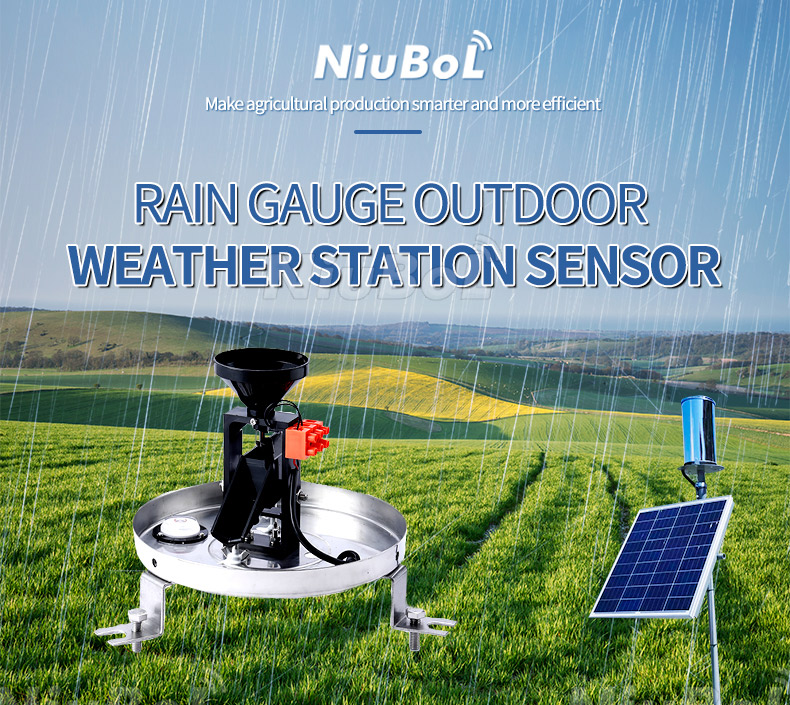
The following table summarizes the main differences between the two rainfall measurement methods.
| Comparison | Tipping Bucket Rain Gauge | Piezoelectric Rain Gauge |
|---|---|---|
| Measurement Principle | Collects rainwater and counts calibrated bucket tips | Detects raindrop impact signals and estimates rainfall electronically |
| Moving Measurement Parts | Mechanical tipping mechanism | No conventional tipping mechanism |
| Rainfall Resolution | Determined by the calibrated rainfall increment | Determined by electronic processing and output configuration |
| Accuracy | Depends on calibration, rainfall intensity and collection conditions | Depends on impact response, algorithms and environmental conditions |
| Heavy Rainfall | Dynamic errors may occur during bucket movement | Performance depends on impact detection and supported intensity range |
| Maintenance | Funnel, filter, leveling and tipping mechanism inspection | Sensing surface, contamination and mounting inspection |
| Environmental Sensitivity | Wind, blockage, freezing and mechanical conditions | Vibration, wind, debris and raindrop characteristics |
| Typical Output | Pulse, analog or RS485 depending on model | Model-specific digital or analog interface |
These are general technology differences. Actual performance must be evaluated using the specifications of the selected sensor models.
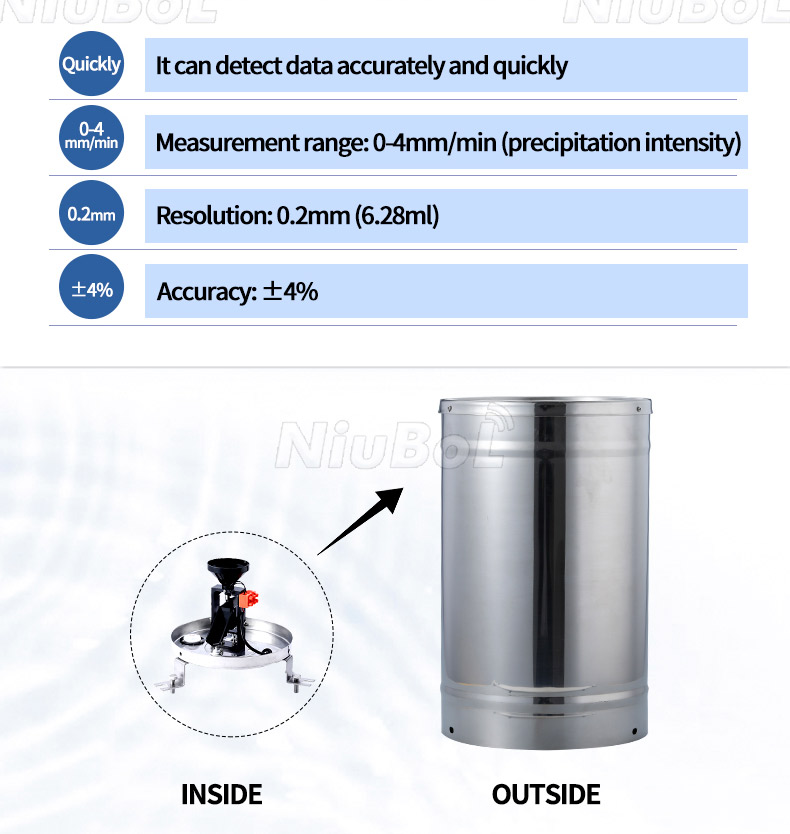
A tipping bucket rain gauge uses a funnel to collect rainwater over a defined opening area. The collected water flows into a calibrated two-sided tipping mechanism.
When one side accumulates the specified amount of water, the bucket tips, empties and positions the opposite side to receive the next amount.
Each tipping event can operate a reed switch or another sensing mechanism. The number of tips is converted into accumulated rainfall using the specified rainfall increment.
Rainfall Accumulation (mm) = Number of Tips × Rainfall per Tip (mm)
For example, if a rain gauge is calibrated for 0.2 mm per tip and records 20 complete tips, the calculated rainfall is 4.0 mm. This is an illustrative calculation rather than a field measurement.
The tipping bucket method is an established approach for automatic liquid precipitation monitoring. Its construction is relatively straightforward, and passive contact-output versions can be connected to compatible electronic counters.
The self-emptying mechanism supports repeated rainfall measurements without requiring an observer to empty a collection container after every event.
During heavy rainfall, water can continue entering the instrument while the bucket is moving. This may introduce dynamic errors depending on the mechanical design and calibration.
At the beginning or end of a rainfall period, water may remain in the bucket without having produced a complete tip.
Wind exposure, debris, incorrect leveling and ice accumulation may also affect the results.
Regular maintenance remains important for reliable long-term operation.
A piezoelectric rain gauge uses a sensing element that generates an electrical response when raindrops strike its measurement surface.
The instrument detects the characteristics of these impact signals. Electronic processing estimates precipitation from the number, amplitude and other characteristics of the detected impacts.
Unlike a tipping bucket instrument, a piezoelectric rain sensor does not need to collect a specified volume of rainwater before producing an individual impact signal.
However, the conversion from impact signals to rainfall amount depends on the instrument's sensing characteristics and estimation algorithm.
Piezoelectric rain gauges do not use a conventional tipping bucket mechanism. This eliminates the particular mechanical wear and blockage risks associated with a moving tipping assembly.
Compact electronic designs can be suitable for integrated weather stations and remote monitoring systems. Impact detection can also provide information about changing rainfall activity without waiting for a collecting bucket to fill.
Raindrop impact signals depend on droplet size, impact velocity, impact angle and the properties of the sensing surface.
Mechanical vibration, surface contamination, wind-driven impacts and other environmental disturbances may affect the recorded signal.
A piezoelectric sensor does not directly weigh each individual raindrop. Rainfall is estimated through signal processing and calibration relationships.
Its electronic resolution should not automatically be interpreted as laboratory-equivalent or superior outdoor measurement accuracy.
There is no universal answer to whether a tipping bucket or piezoelectric rain gauge is more accurate.
Accuracy depends on the actual instrument design, calibration method, rainfall conditions and the way the results are evaluated.
A tipping bucket rain gauge physically collects water and reports calibrated increments. The actual measurement may be affected by bucket movement, collection losses, installation and mechanical condition.
Higher rainfall intensity can increase the importance of dynamic tipping errors. A smaller rainfall increment does not automatically eliminate these errors.
A piezoelectric rain gauge estimates rainfall from detected impacts. The measurement depends on how the instrument responds to the actual distribution of raindrop sizes, velocities and impact conditions.
Environmental vibration and surface conditions may also affect measurement performance.
Rainfall resolution is the smallest reported measurement increment. Accuracy describes the agreement between the measured result and the actual rainfall under specified conditions.
For example, a sensor with 0.01 mm resolution is not automatically more accurate than a tipping bucket sensor with 0.2 mm resolution.
To compare accuracy meaningfully, use measurement results obtained under comparable test conditions and appropriate reference methods.
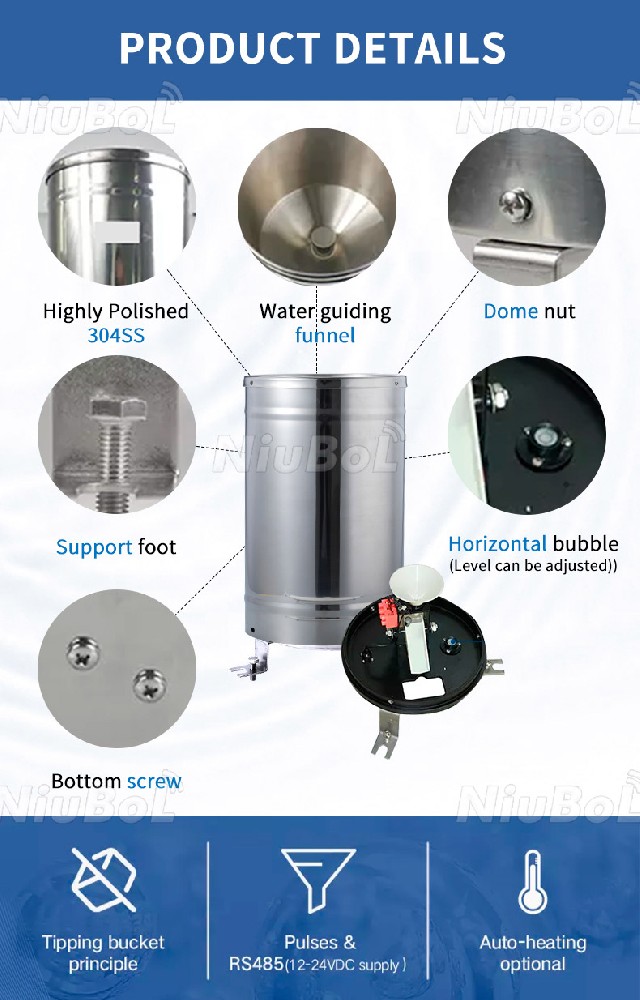
NiuBoL supplies the NBL-W-RS tipping bucket rain gauge and the NBL-W-PRS piezoelectric rain sensor.
The following table compares specifications documented in their respective instruction manuals.
| Parameter | NBL-W-RS | NBL-W-PRS |
|---|---|---|
| Measurement Principle | Tipping bucket | Piezoelectric impact detection |
| Rainfall Resolution | 0.2 mm | 0.01 mm |
| Rainfall Intensity Range | 0–4 mm/min | 0–8 mm/min |
| Declared Accuracy | ±4% at 2 mm/min under specified indoor static test conditions | ±4% for daily cumulative rainfall, according to product documentation |
| Power Supply | DC 5 V or DC 12–24 V, depending on version | DC 12–24 V |
| Output Options | Reed switch, 0–2.5 V, 0–5 V or RS485 | RS485 Modbus RTU |
| Operating Temperature | 0–50°C | −40 to 80°C |
| Protection Rating | Check selected installation and enclosure requirements | IP66 |
| Moving Tipping Mechanism | Yes | No |
Accuracy comparison: The two declared ±4% values refer to different measurement conditions or definitions. They should not be treated as directly comparable results from the same test.
Similarly, the NBL-W-PRS 0.01 mm resolution describes the reporting increment; it does not establish superior accuracy under all rainfall conditions.
The NBL-W-RS output options are alternative configurations. The selected instrument should be ordered with the correct interface and power supply.
Both rainfall measurement technologies need appropriate installation and periodic inspection, but their main maintenance requirements differ.
The NBL-W-RS uses a collecting funnel and calibrated tipping mechanism. It should be mounted level and in a suitable location with minimal unnecessary rainfall obstruction.
Inspect the funnel, filter and internal mechanism regularly. Leaves, insects and debris can block water flow or interfere with tipping.
Ordinary unheated tipping bucket gauges are not suitable for reliable measurement of snow or freezing rain without an appropriate configuration.
The NBL-W-PRS is designed for mounting in an open location with the sensing surface appropriately oriented.
Its installation instructions recommend mounting at the top of a suitable support and keeping the instrument away from significant vibration sources.
Unwanted vibration from unstable brackets, wind-excited structures or nearby machinery may interfere with the impact measurements.
Although the sensor does not contain a conventional tipping mechanism, the sensing surface still requires inspection for contamination, damage or unwanted deposits.
| Maintenance Item | Tipping Bucket | Piezoelectric |
|---|---|---|
| Collection Funnel Cleaning | Required as site conditions demand | No conventional collection funnel |
| Tipping Mechanism Inspection | Required | Not applicable |
| Sensing Surface Inspection | Inspect collector and water path | Inspect impact surface and contamination |
| Mounting Stability | Important for leveling and correct operation | Important for reducing vibration interference |
The choice between tipping bucket and piezoelectric sensors also affects the electrical interface and receiving equipment.
A passive reed-switch tipping bucket gauge generates a contact event each time the calibrated mechanism tips. A compatible pulse counter or data logger must count these events and apply the correct rainfall-per-tip conversion.
For example, an NBL-W-RS with a 0.2 mm increment requires the receiving system to interpret each valid tip as 0.2 mm of rainfall.
Other NBL-W-RS versions provide active electronic outputs, including RS485 Modbus RTU.
The NBL-W-PRS uses RS485 Modbus RTU communication to transmit its processed rainfall measurements.
It requires DC 12–24 V power and a compatible Modbus master, PLC, data logger or communication gateway.
The NBL-W-PRS instruction manual specifies the following standard wiring assignments:
| Wire Color | Function |
|---|---|
| Red | DC Power Positive |
| Black | DC Power Negative |
| Yellow | RS485 Positive |
| Blue | RS485 Negative |
Verify the actual cable assignments and receiver terminal definitions before wiring. Disconnect power before connecting the instrument.
A typical remote rainfall monitoring architecture can be:
Rain Gauge → RS485 Data Logger or Gateway → Communication Network → Monitoring Platform
RS485 provides local wired communication. It does not independently provide internet access, cellular communication or cloud storage.
For remote operation, select a gateway that supports the required Modbus configuration and the intended network and server protocols.
Both rain gauge technologies are suitable for selected meteorological, agricultural, hydrological and environmental monitoring applications.
The decision should be based on the actual monitoring requirements instead of assuming that one technology is always more advanced.
| Application | Selection Considerations |
|---|---|
| Agricultural Weather Stations | Required rainfall accuracy, maintenance access, power supply and output interface |
| Hydrological Monitoring | Measurement quality, rainfall intensity, site exposure and data continuity |
| Compact IoT Weather Stations | Sensor size, wiring, power consumption and maintenance requirements |
| High-Intensity Rainfall Monitoring | Supported intensity range, dynamic performance and applicable accuracy tests |
| Research Measurements | Calibration documentation, reference methods and project-specific performance requirements |
| Remote Unattended Sites | Environmental conditions, maintenance access, system power and communication reliability |
For research or professional acceptance testing, confirm whether the available calibration documentation and measurement specifications meet the actual project requirements.
The price of a tipping bucket rain gauge or piezoelectric rain sensor depends on the model, materials, measurement specifications, output configuration and required accessories.
It is not technically justified to assume that all piezoelectric rain gauges cost more than all tipping bucket models.
When comparing quotations, check whether the following components are included: rainfall sensor, data logger, communication gateway, power supply, mounting structure, cable, monitoring software and delivery.
Maintenance requirements may also influence long-term operating costs.
For a meaningful comparison, request quotations with equivalent project scope and clearly specified measurement requirements.

A1: A tipping bucket rain gauge physically collects rainwater and counts calibrated bucket tips. A piezoelectric rain gauge detects raindrop impacts and uses electronic processing to estimate rainfall.
A2: No. Accuracy depends on sensor design, calibration, rainfall conditions and the measurement method. Different accuracy specifications should only be compared when their test conditions and definitions are compatible.
A3: Rainwater continues entering the instrument while the bucket tips. Depending on the mechanism and calibration, this can introduce dynamic measurement errors during intense rainfall.
A4: No. It detects impact-related electrical signals and estimates rainfall using signal processing and calibration relationships. It does not directly weigh each raindrop.
A5: Piezoelectric sensors avoid maintenance of a mechanical tipping bucket, but their sensing surfaces, mounting structures and connections still need inspection. Maintenance requirements depend on site conditions.
A6: Yes. The NBL-W-RS is available with an RS485 Modbus RTU output option, while the NBL-W-PRS provides RS485 Modbus RTU as its documented standard output.
A7: Select an instrument with a suitable rainfall intensity range and documented measurement performance for the intended conditions. The NBL-W-RS and NBL-W-PRS have different specified intensity ranges, but that alone does not prove superior accuracy.
A8: No. Rainfall measurements can provide input data for flood monitoring systems. Reliable warnings may also require water level measurements, hydrological models, thresholds, communication equipment and operational procedures.
The following original NiuBoL technical manuals provide detailed specifications, installation instructions, wiring information and communication settings.
 NBL-W-RS-Rain-sensors-instruction-manual-V4.0.pdf
NBL-W-ARS-Tipping-bucket-rain-gauge-instruction-manual.pdf
NBL-W-PRS-Piezoelectric-Rain-Sensor-Operator's-Manual.pdf
Tipping bucket and piezoelectric rain gauges are both used for automatic precipitation monitoring, but their measurement methods differ significantly.
Tipping bucket rain gauges measure calibrated volumes of collected rainfall through mechanical tipping events. Piezoelectric rain gauges detect raindrop impacts and estimate precipitation through electronic processing.
Neither technology should be selected solely on the basis of resolution or generalized accuracy claims. Compare the actual measurement specifications, installation requirements, maintenance needs, electrical interfaces and project conditions.

NiuBoL supplies tipping bucket rain gauges and piezoelectric rain sensors for agricultural, meteorological and environmental monitoring applications.
For model selection, quotation or integration support, contact NiuBoL with your rainfall measurement range, required accuracy, power supply, communication interface and installation requirements.
Related recommendations
Sensors & Weather Stations Catalog
 Agriculture Sensors and Weather Stations Catalog-NiuBoL.pdf
Weather Stations Catalog-NiuBoL.pdf
Agriculture Sensors Catalog-NiuBoL.pdf
Water Quality Sensor Catalog-NiuBoL.pdf
Related products
 Combined air temperature and relative humidity sensor
 TDR Soil Moisture & Temperature Sensor for irrigation| RS485 |4-20mA| NBL-S-THR
 Soil pH sensor RS485 soil Testing instrument soil ph meter for agriculture |NBL-S-PH
 Wind Speed sensor Output Modbus/RS485/Analog/0-5V/4-20mA
 Tipping bucket rain gauge for weather monitoring auto rainfall sensor RS485/Outdoor/stainless steel
 Pyranometer Solar Radiation Sensor 4-20mA/RS485


Screenshot, WhatsApp to identify the QR code
WhatsApp number:+8615367865107
(Click on WhatsApp to copy and add friends)

