





— Blogs —
—Products—
 Consumer hotline +8618073152920
WhatsApp:+8615367865107
Address:Room 102, District D, Houhu Industrial Park, Yuelu District, Changsha City, Hunan Province, China
Product knowledge
Time:2026-01-05 09:30:35 Popularity:810
Quick Answer: A soil moisture tester helps a field team investigate uneven wetting, compare selected root-zone depths and check soil temperature during planting operations. The useful result is a repeatable comparison tied to a location and irrigation event. One handheld reading does not prescribe fertilizer, establish a universal irrigation threshold or guarantee better crop yield or quality.

A portable instrument is useful when the operator needs to move between places that fixed probes do not cover. An irrigation contractor can compare the start and end of a lateral, an agronomist can investigate a dry patch, and a trial team can repeat observations across treatment plots. The question should be chosen before taking measurements.
For uneven irrigation, ask whether the suspected area wets differently from a comparable reference area. For a planting check, ask what the temperature is at the actual seed depth and time of observation. For a root-zone investigation, compare selected depths without averaging away the difference between them. These are distinct tests, even when one meter can display all the readings.
Prepare a route that can be repeated. Identify the block, row or lateral position, insertion depth and relationship to an emitter. Include normal-looking locations as well as the visible problem area. A survey that samples only stressed plants cannot establish whether the pattern is local, widespread or associated with the irrigation layout.
Volumetric water content expresses the volume of water relative to the volume of soil. For example, 0.24 m3/m3 is 24% VWC. It is not air relative humidity, a percentage of the irrigation requirement or a direct measure of water readily available to the crop. Soil-water tension is a different quantity, normally expressed in pressure units.
A useful irrigation threshold depends on the soil, rooting conditions and crop management plan. The same VWC can have different significance in different soil textures. FAO's soil-water reference distinguishes moisture content, field capacity and plant-available water. Do not assign the same wet/dry color bands to every field simply to standardize a report.
Moisture is also not a nutrient assay. A wet reading cannot show that nitrogen, phosphorus or potassium is adequate, and a dry reading does not establish a fertilizer deficiency. The measurement can help investigate water conditions affecting management, but nutrient decisions require the relevant soil, plant or solution analysis.
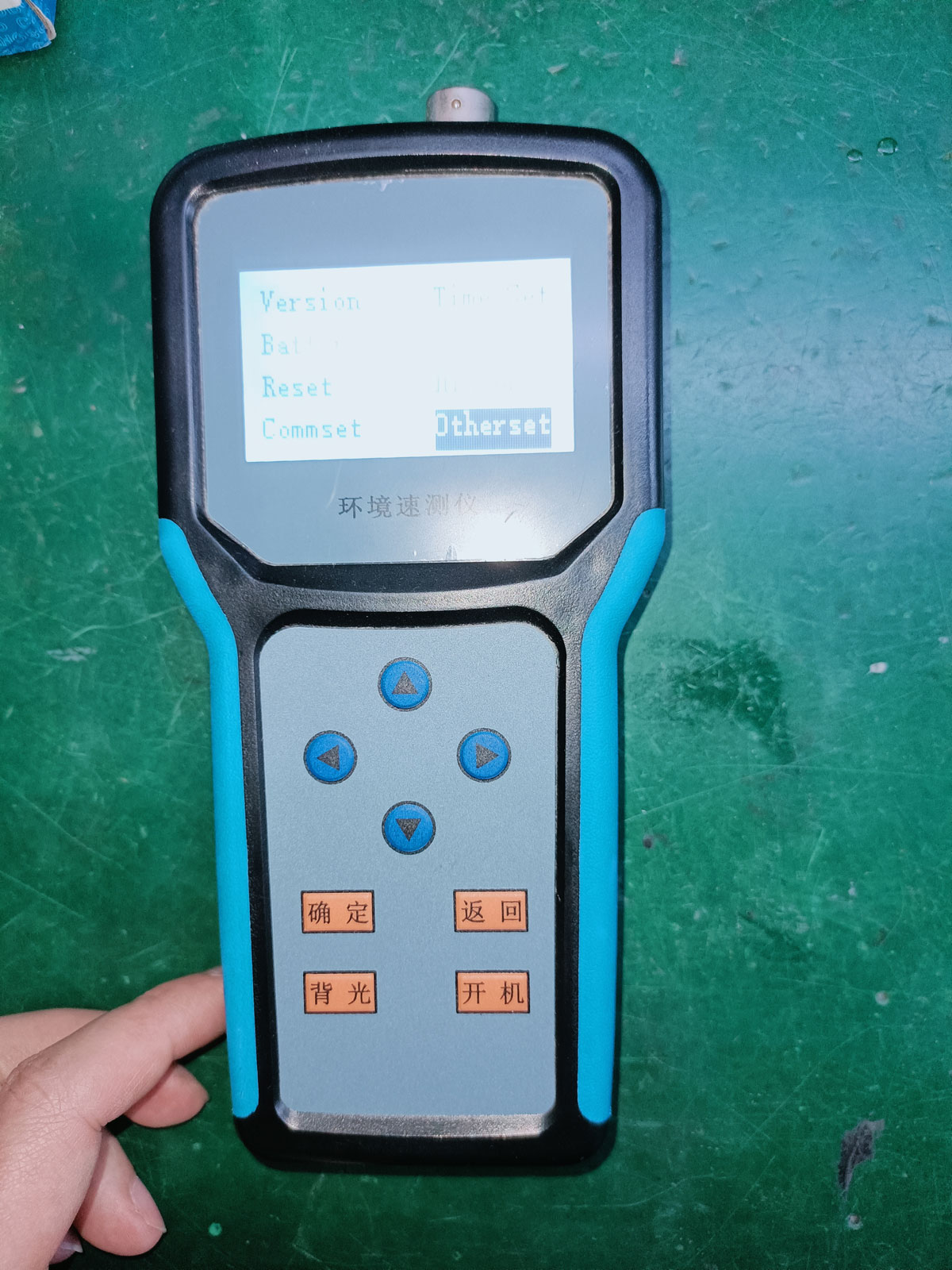
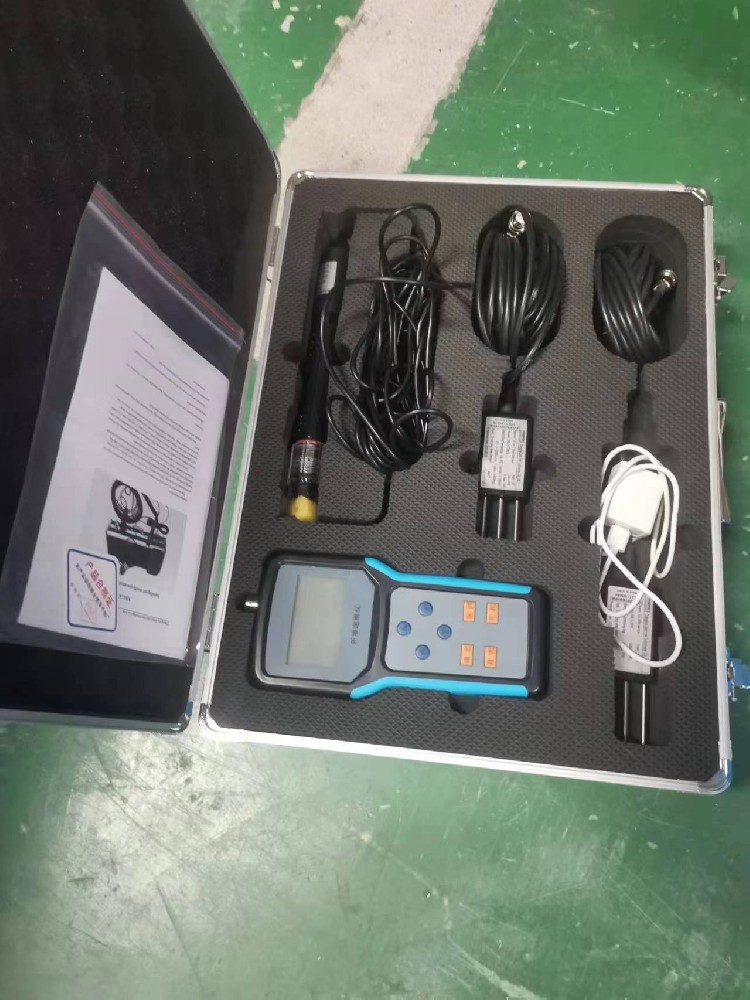
NiuBoL's portable soil moisture and temperature tester combines a handheld display with the appropriate sensing probe, local recording and USB data transfer. A multi-parameter kit can contain additional probes, but their presence and interpretation must be specified separately. A photograph of several probes does not establish that every channel is included in a two-parameter package.
| Item | Soil moisture and temperature configuration | Field-use implication |
|---|---|---|
| Soil moisture range | 0-100%; resolution 0.1%; stated accuracy +/-3% | Use the correct soil-water label and confirm the accuracy basis for the ordered probe. A decimal display is not proof of a change that small. |
| Soil temperature range | -50 to +100 degrees C; resolution 0.1 degree C; accuracy +/-0.5 degrees C | Measure at the depth relevant to the planting or root-zone question. |
| Power supply | Rechargeable lithium-ion battery | Specify charging arrangements and test runtime with the intended probes and recording routine. |
| Recording and communication | Local storage and USB data download | Agree record capacity, export format and software compatibility for the ordered version; this is not a promise of built-in cellular upload. |
| Handheld display | 128 x 64 LCD; English/Chinese language options for this configuration | Confirm labels, units and menu language before equipping a field team. |
| Host weight | Approximately 0.5 kg | Allow separately for the probe, cable and carrying case when planning a survey kit. |
| Host operating environment | -20 to +80 degrees C; 5-95% RH | The probe's measuring span does not extend the handheld host's operating limit. |
| Protection and cable | Specify host protection, cable length and jacket material with the kit | Do not infer an immersion rating for the display from the rating of a separate buried probe. |
| Consumption and endurance | Dependent on the ordered host, connected probes and operating routine | Confirm with a representative field-use test; no universal weeks-long runtime is assumed. |
USB download from a portable meter and RS485 Modbus RTU acquisition from a fixed sensor serve different workflows. If the project requires continuous PLC input, use the appropriate fixed sensor and acquisition arrangement. Do not assume that an RS485-capable probe can be connected to any handheld socket without checking its power, connector and protocol compatibility.
A lower reading at the end of a drip lateral is a reason to investigate, not proof of a blocked emitter. Check emitter discharge and pressure before attributing the difference to irrigation hardware. The area may have different soil, rooting or antecedent moisture. Conversely, normal pipeline pressure does not prove that each emitter has delivered the intended volume.
A handheld survey is particularly useful for locating where permanent monitoring would add value. If repeated visits show that two areas respond differently, keep that distinction when choosing fixed points. Do not place a new permanent probe in the most accessible corner and assume that it represents both areas.
The following example is an illustrative survey, not a reported NiuBoL field result. It assumes comparable soil, depth and timing, with measurements taken at different nearby locations rather than repeated in the same disturbed hole.
| Survey area | Example VWC observations | Interpretation to investigate |
|---|---|---|
| Reference area after irrigation | 31%, 32%, 32% | Establishes the local comparison for that visit, not a universal target. |
| Suspected dry area after the same event | 23%, 24%, 24% | A repeatable difference warrants checks of water delivery, soil and placement. |
| One isolated reading near either area | A value substantially different from its neighbors | Recheck contact and local conditions before changing a whole block's schedule. |
The difference between 24% and 32% VWC is eight percentage points, not eight percent of the same value. Even a clear difference does not specify how many minutes to run an irrigation system. That decision needs an appropriate soil-water objective, the volume to be replenished, application efficiency and the system's actual delivery rate.
Keep the range of observations and the site notes available instead of reporting only a field average. An average can conceal a wet headland and a dry tail end. Repeat a suspected pattern under comparable conditions before applying a permanent correction to the instrument or the irrigation plan.
Soil temperature is useful for checking the environment at a chosen seed or root depth. It does not create a universal 10-12 degrees C sowing rule. Suitable planting conditions depend on the crop, variety, soil condition and local agronomic recommendation. A midday surface reading cannot establish that the soil at seed depth remains above a required threshold overnight.
Where a kit includes conductivity or salinity measurements, keep the unit and measurement method explicit. Direct soil EC, an extract result and irrigation-water EC are not automatically equivalent. Water content and contact can change the direct reading, so differences between visits need to be interpreted with the moisture record.
Adding probes also does not turn the meter into an automatic fertilizer or irrigation controller. A portable survey can inform a decision; continuous feedback requires fixed acquisition and a separately configured control system. Do not repurpose a soil-moisture kit as a grain-moisture or food-release instrument without a validated method for that material.
Check the clock and download a small test file before a major survey. Ensure that location identity, depth, measurement time and unit remain associated with each result. If the meter cannot store all those notes directly, maintain a field sheet or companion record with a clear reference to the saved readings.
Before clearing memory, verify that the exported file contains the expected observations and that another team member can identify the measurement points. A large advertised storage capacity does not guarantee a long unattended record: capacity, sampling interval, battery use and the intended operating arrangement are separate constraints.
For research or a suspected calibration problem, compare the probe with an appropriate reference method for the soil and measurement quantity. A gravimetric water-content result requires the correct conversion, including bulk density, before it can be compared directly with VWC. Empty air and a bucket of water are not a complete soil-specific validation across the working range.
Have operators repeat the same procedure at comparable locations, then review differences in depth, contact and timing. This checks the method as well as the instrument. A probe that performs adequately on a bench can still produce inconsistent field surveys if insertion technique varies between operators.
Inspect the kit for the required probes, cable assemblies, charging equipment and export software. Confirm the host language and units. Where spare probes are required, identify the matching version and connector rather than assuming interchangeability from appearance. Test a replacement with the actual host before field deployment.
When requesting a NiuBoL survey kit, describe the crop, soil conditions, intended sampling depths, required parameters and how the records will be used. A two-parameter water-and-temperature investigation need not include every available soil probe. More measurements help only when the team has a method to interpret and act on them.

It provides observations for that decision. The threshold must reflect soil-water limits, crop conditions and the management plan. One percentage does not specify the application volume or operating time of an irrigation system.
Handheld testing suits surveys and investigations across locations. Fixed probes suit continuous event tracking and ongoing alarms. They can complement one another, but a portable meter is not automatically an unattended telemetry station.
Check depth, distance from an emitter, soil variation, contact and observation time. A difference can be real or procedural. Do not apply a calibration offset solely to force agreement between non-equivalent locations.
No. It describes a soil-water condition, not nutrient concentration or crop nutrient status. Use appropriate nutrient measurements and agronomic interpretation before changing fertilizer application.
No. Record capacity does not establish battery endurance, environmental protection or suitability for unattended installation. Verify the intended logging routine and power behavior, or use a fixed monitoring arrangement.
Verify the ordered probes, units, host language, charging and data export, then compare results using a consistent field method. Confirm compatibility of spare probes and distinguish host environmental limits from the sensing probe's measuring range.
A soil moisture tester adds value when a field team can repeat the measurement and explain the resulting pattern. Use NiuBoL portable testing for defined checks of wetting, selected depths and soil temperature, retain the site context and verify suspected hardware problems independently. The outcome should be a better-supported field decision, not an unqualified promise of higher yield.
Prev:Soil Sampling for Nutrient Testing: Field Composites and Rapid Analysis
Next:Soil Moisture Measurement Methods: Water Content, Tension and Field Checks
Related recommendations
Sensors & Weather Stations Catalog
 Agriculture Sensors and Weather Stations Catalog-NiuBoL.pdf
Weather Stations Catalog-NiuBoL.pdf
Agriculture Sensors Catalog-NiuBoL.pdf
Water Quality Sensor Catalog-NiuBoL.pdf
Related products
 Combined air temperature and relative humidity sensor
 TDR Soil Moisture & Temperature Sensor for irrigation| RS485 |4-20mA| NBL-S-THR
 Soil pH sensor RS485 soil Testing instrument soil ph meter for agriculture |NBL-S-PH
 Wind Speed sensor Output Modbus/RS485/Analog/0-5V/4-20mA
 Tipping bucket rain gauge for weather monitoring auto rainfall sensor RS485/Outdoor/stainless steel
 Pyranometer Solar Radiation Sensor 4-20mA/RS485


Screenshot, WhatsApp to identify the QR code
WhatsApp number:+8615367865107
(Click on WhatsApp to copy and add friends)

