





— Blogs —
—Products—
 Consumer hotline +8618073152920
WhatsApp:+8615367865107
Address:Room 102, District D, Houhu Industrial Park, Yuelu District, Changsha City, Hunan Province, China
Product knowledge
Time:2025-01-17 16:47:49 Popularity:1930
Piezoelectric rainfall in ultrasonic weather stations is measured from raindrop impact, while ultrasonic transit time measures wind. Combining them in one housing simplifies installation, but it does not make every rainfall channel equivalent. Select the actual integrated model, use its rainfall specification and decode its own registers rather than transferring the standalone NBL-W-PRS specification.

A piezoelectric sensing element produces an electrical response when droplets strike the sensing surface. The instrument processes impact signals to estimate rainfall. It does not collect a measured bucket volume, and an individual impact signal alone is not a complete, direct measurement of droplet mass and velocity.
The ultrasonic wind channel works differently: airflow changes the travel time of acoustic signals between transducers. A compact head can therefore have ultrasonic wind measurement and piezoelectric rainfall at the same time. Calling the whole instrument an ultrasonic weather sensor does not mean that its rain measurement is ultrasonic.
This distinction matters when specifying test methods. A fan check exercises the wind channel, not the rainfall algorithm. A splash on the upper surface may demonstrate a response, but it does not establish rainfall accuracy. Treat the weather head as several measurement channels sharing a mounting and electrical arrangement.
The independent NBL-W-PRS piezoelectric rain gauge and integrated weather heads have different product specifications. The PRS daily accumulation accuracy cannot be substituted for the integrated rain channel's figure merely because both use piezoelectric detection.
| Rain measurement item | Standalone NBL-W-PRS | NBL-W-61MUWS / NBL-W-71GUWS integrated rainfall |
|---|---|---|
| Measurement range | 0-8 mm/min | 0-8 mm/min |
| Stated accuracy | +/-4% for daily cumulative rainfall | +/-10% rainfall specification |
| Rainfall resolution | 0.01 mm | 0.01 mm |
| Housing configuration | Dedicated rain instrument | Rainfall combined with other weather channels |
| Protection rating | IP66 | IP65 |
The 0.01 mm figure describes reported resolution, not a +/-0.01 mm accuracy guarantee. The range uses mm/min, a rate unit; accumulated depth uses mm. For reference, 8 mm/min equals 480 mm/h by unit conversion, not a promise of a particular field accuracy under every storm condition.
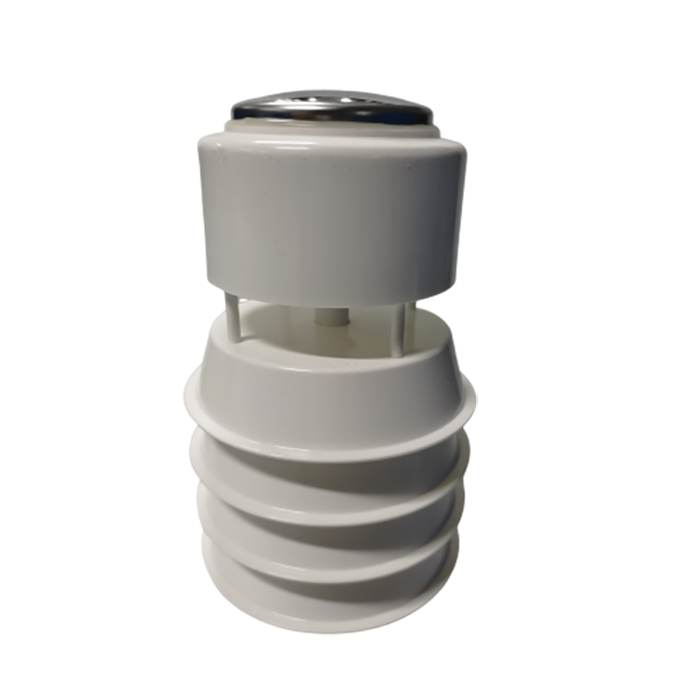
The NBL-W-61MUWS combines wind speed, wind direction, air temperature, relative humidity, pressure and rainfall. It is useful when these six observations cover the project requirement and a compact head is preferred to several separate instruments.
The NBL-W-71GUWS adds either solar radiation in W/m² or illuminance in Lux as the seventh parameter. Choose one: the standard seven-parameter configuration does not include both. Neither light option measures soil moisture, and the rainfall channel does not measure soil-water content.
| Integration parameter | NBL-W-61MUWS | NBL-W-71GUWS |
|---|---|---|
| Wind speed range | 0-40 m/s | 0-60 m/s |
| Supply | DC 12-24 V | DC 9-24 V or DC 12-24 V configuration; identify the ordered version |
| Average power | Approximately 0.35 W | 0.4 W |
| Digital output | RS485 Modbus RTU, 9600 bps | RS485 Modbus RTU, 9600 bps |
| Operating temperature | -20 to 50 C | -40 to 80 C |
| Installation and cable | Stable vertical support; standard cable 2.5 m | Stable vertical support; cable length specified with the order |
For the 61MUWS, the air-temperature measurement range extends beyond its stated whole-unit operating range. Use the whole-unit operating limit when assessing an installation. Likewise, a low average sensor load excludes the logger, modem and any separately specified heating or other accessories.
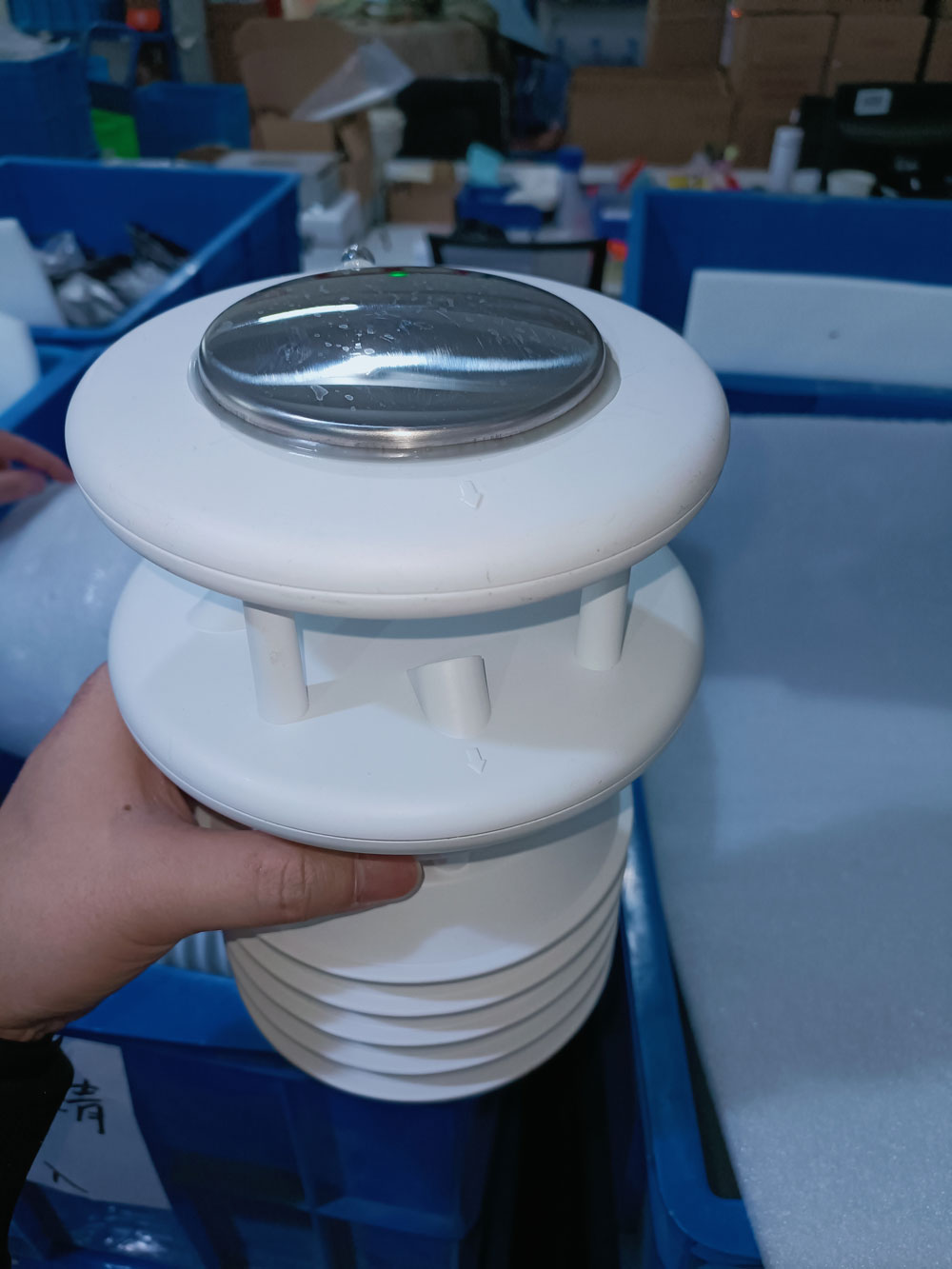
Piezoelectric rainfall in ultrasonic weather stations depends on an exposed impact surface and a stable mounting. Keep the top clear of solar panels, crossarms and overhanging vegetation. Avoid a position where a structure drips onto the head after natural rainfall has ended.
A flexible sidearm or vibrating platform can introduce mechanical disturbance into an impact-based measurement. Secure the mast and cables, and assess vibration from machinery or nearby construction. A configuration with no tipping bucket still has installation requirements; it is not suitable for any arbitrary surface or orientation.
Align the wind reference to geographic north and maintain the specified vertical orientation. For the standalone PRS, the installation instructions call for top-of-column placement and horizontal mounting above 500 mm from the ground. Do not apply that standalone arrangement as a substitute for the integrated head's mounting instructions.
The receiving PLC, RTU or data logger must know whether a value is cumulative depth, depth since the last reading or a rate. Record the unit, scaling and reset behavior. Modbus RTU compatibility establishes the communication method, not identical rainfall meaning across different products.
The standalone PRS illustrates the risk: its output can be configured for accumulation or clearing after a read. If two systems read a clear-on-read quantity independently, one can consume rainfall that the other expected to record. This PRS behavior must not be assumed for a 61MUWS or 71GUWS; check the selected integrated model's own register document.
Where an application derives intensity from interval depth, retain the interval. A hypothetical 0.25 mm recorded over one minute corresponds to an average 15 mm/h over that minute. It is not an instantaneous droplet measurement. Confirm the station's reporting period before comparing its chart with another instrument.
Use the model-specific read timing, address and serial settings; the integrated listings specify a minimum communication interval of 1000 ms. Check timestamp, restart and accumulation behavior in a controlled commissioning test. Remote 4G or Ethernet upload requires a suitable logger or gateway rather than being inherent to the RS485 weather head.
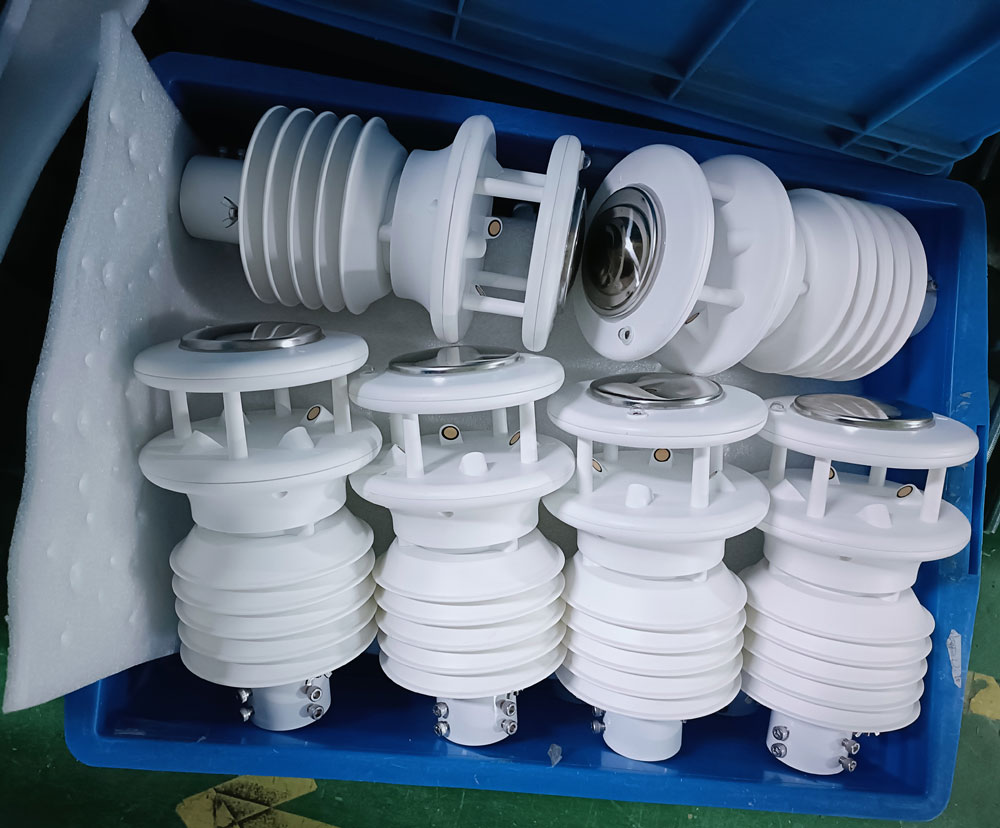
Not in these configurations. NBL-W-61MUWS and NBL-W-71GUWS use ultrasonic wind measurement and piezoelectric rainfall detection in the same integrated assembly.
No. The +/-4% daily cumulative figure belongs to NBL-W-PRS. The named integrated models have a +/-10% rainfall specification. Match the offered model and the required test conditions.
No. Removing the tipping mechanism changes the service work but does not remove the need to inspect exposure, surface contamination, mounting and cables. Use site conditions to establish inspection frequency.
No. Rainfall describes water arriving at the observation point. Soil moisture depends on soil, infiltration, root depth and other factors; measure it separately when the irrigation decision requires it.
Specify six or seven parameters, the seventh light measurement if required, rainfall acceptance criteria, temperature limits, mounting conditions, receiver and cable route. Include any need for a separate reference rain gauge rather than assuming the integrated head meets every rainfall standard.
Piezoelectric rainfall in ultrasonic weather stations can reduce the number of separate sensing assemblies. Its engineering value depends on choosing the correct model, preserving rain exposure and decoding the rainfall quantity correctly. Compare dedicated and integrated specifications before ordering, then verify both the physical measurement and the receiving-system records.
 All-in-One-Ultrasonic-Weather-Sensor-Instruction-Manual.pdf
NBL-W-61MUWS-Ultrasonic-Weather-Station-Instruction-Manual.pdf
Related recommendations
Sensors & Weather Stations Catalog
 Agriculture Sensors and Weather Stations Catalog-NiuBoL.pdf
Weather Stations Catalog-NiuBoL.pdf
Agriculture Sensors Catalog-NiuBoL.pdf
Water Quality Sensor Catalog-NiuBoL.pdf
Related products
 Combined air temperature and relative humidity sensor
 TDR Soil Moisture & Temperature Sensor for irrigation| RS485 |4-20mA| NBL-S-THR
 Soil pH sensor RS485 soil Testing instrument soil ph meter for agriculture |NBL-S-PH
 Wind Speed sensor Output Modbus/RS485/Analog/0-5V/4-20mA
 Tipping bucket rain gauge for weather monitoring auto rainfall sensor RS485/Outdoor/stainless steel
 Pyranometer Solar Radiation Sensor 4-20mA/RS485


Screenshot, WhatsApp to identify the QR code
WhatsApp number:+8615367865107
(Click on WhatsApp to copy and add friends)

