





— Blogs —
—Products—
 Consumer hotline +8618073152920
WhatsApp:+8615367865107
Address:Room 102, District D, Houhu Industrial Park, Yuelu District, Changsha City, Hunan Province, China
Product knowledge
Time:2025-09-07 11:09:25 Popularity:1136
Quick Answer: Weather station buying mistakes often begin with approving an incomplete configuration. Before ordering, check the measurement task, calibration evidence, installation exposure, controller compatibility and replacement arrangements. Each check should produce a specific acceptance requirement, rather than relying on a price, product label or general promise.
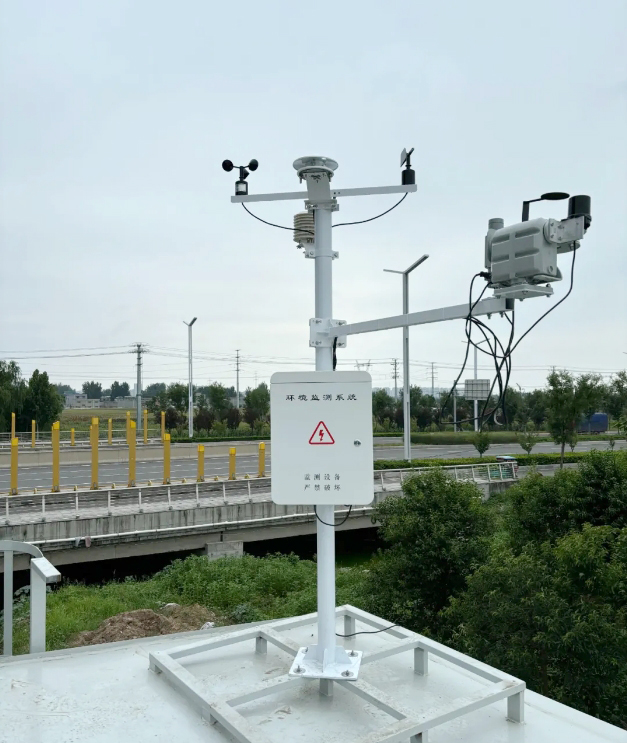
A weather station for irrigation scheduling may need rainfall and representative soil observations. A wind-exposure assessment needs suitable wind measurements and mounting. A research station may need a defined observation interval and calibration documentation. Starting with a channel count can produce a technically functional station that does not answer the project's question.
Write a short measurement schedule before requesting prices: variable, required range, location, sampling or reporting interval and intended decision. Distinguish a sensor reading from a derived result. An evapotranspiration calculation, for example, requires suitable input observations and a calculation method; installing a generic weather head does not establish that result.
Read the quotation as a complete installed scope. Identify who provides the mast, mounts, enclosure, cable lengths, power and data connection. A missing component is not necessarily a supplier error, but leaving responsibility unresolved can delay installation. Compare offers only after these boundaries are clear.
For longer-term budgeting, use a weather station total cost of ownership comparison with the same scope and planning period. Do not infer quality from the initial price alone or assume a higher-priced package automatically meets the measurement task.
A certificate must be read for what it covers. An enclosure or product compliance document is not a calibration report for wind speed, temperature or rainfall. Likewise, a calibration at selected points does not prove that all channels, ranges and field installations meet the same uncertainty.
NIST explains metrological traceability as a property of a measurement result, established through a documented calibration chain with uncertainty contributions. It is not a blanket attribute acquired by placing a laboratory name in a quotation. Traceability also does not, by itself, establish fitness for the buyer's particular task.
Check instrument identification, measured quantity, test points, method, uncertainty and relevant conditions. If the project requires accredited calibration, check that the laboratory's accreditation scope covers the requested work. Specify the requirement before ordering; do not assume every supplied sensor includes the same documentation or that an unspecified certificate will be acceptable.
Keep installation effects separate. A temperature sensor can be calibrated correctly and still read high when its shield is beside a heated wall. A rain gauge can pass a controlled test and underperform when its collector is blocked. Document review is one check, not a substitute for field acceptance.
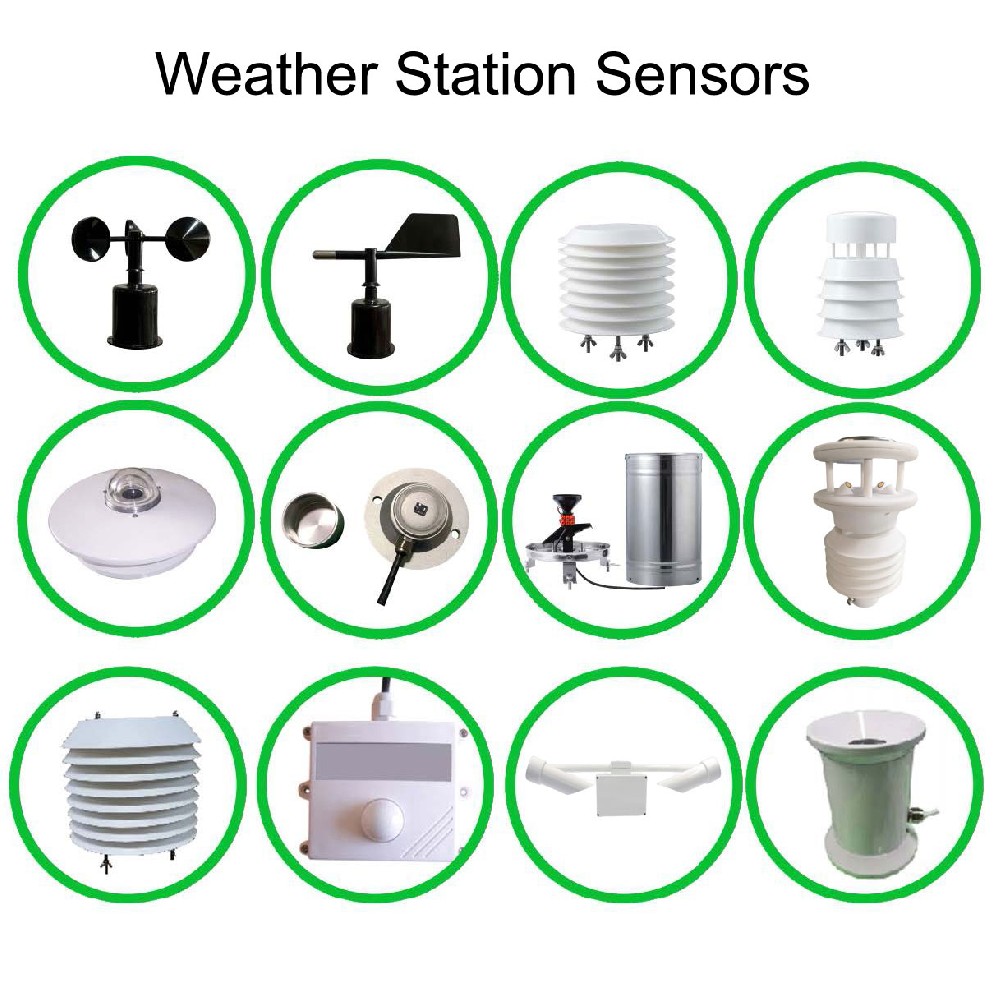
IP ratings describe specified protection against ingress; they do not establish measurement representativeness or immunity to every outdoor condition. The NiuBoL NBL-W-SS wind speed sensor is IP65. That does not justify placing it behind a building where airflow is disturbed, or ignoring the connector and cable-entry protection of the complete installation.
| Equipment example | Relevant characteristic | Purchase check |
|---|---|---|
| NBL-W-SS wind speed sensor | IP65; rotating cup measurement; selectable output versions | Review mast exposure, mounting and the ordered electrical interface. |
| NBL-W-LBTH air sensor | Louvered shield; temperature accuracy +/-0.5 degree C | Allow ventilation and separation from local heat sources. |
| NBL-W-RS rain gauge | 0.2 mm resolution; working temperature 0-50 degree C | Check a level collector, access for cleaning and suitability for freezing conditions. |
| TG462 logger | IP30; mixed data interfaces | Provide an appropriate outdoor enclosure and verify required sensor acquisition. |
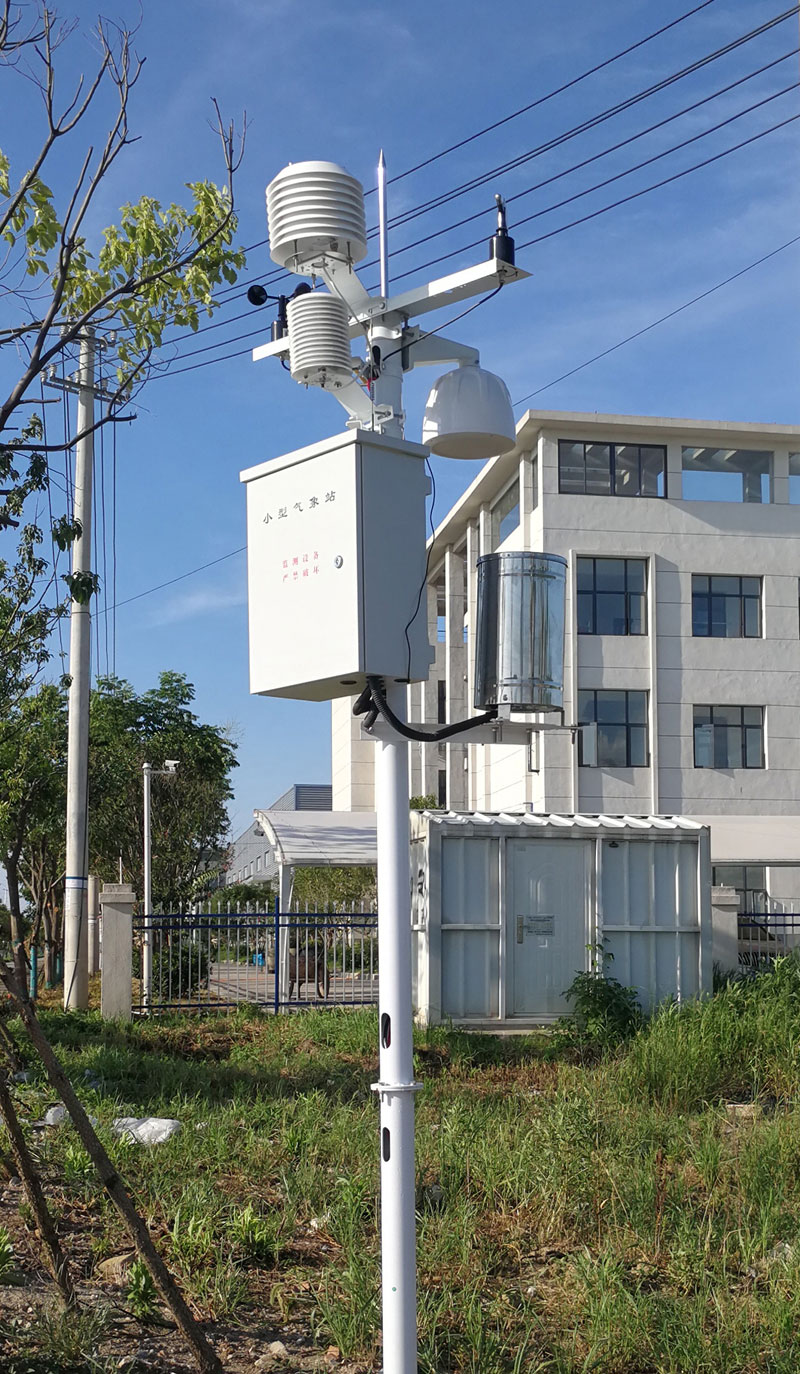
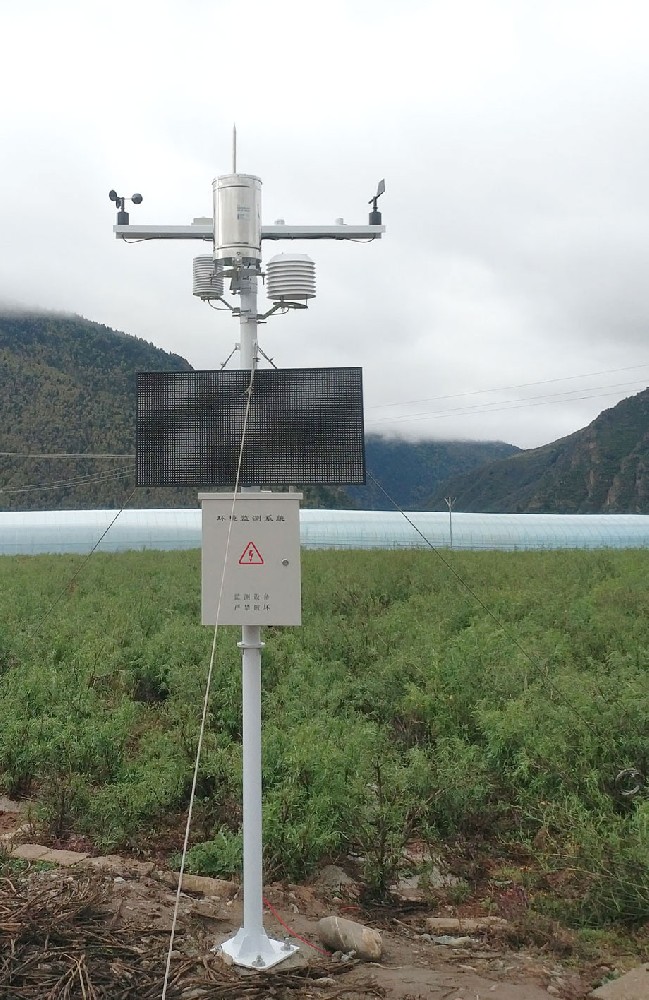
Ask for a proposed mounting layout, not just a mast height. Sensors may need different exposures: air temperature needs shielding and airflow, rainfall needs an unobstructed collector, and wind needs a position suited to the observation objective. One convenient bracket location is not necessarily suitable for all three.
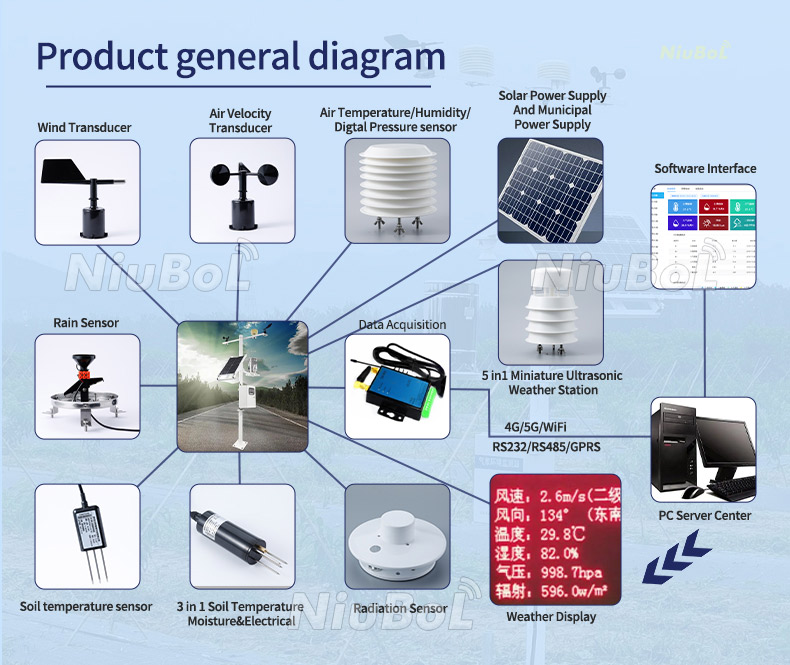
RS485 Modbus RTU compatibility requires more than matching connector labels. The logger or PLC needs the sensor address, baud rate, parity, register map, scaling and data type. An analog version of a sensor cannot be read as a Modbus device, and a rainfall pulse needs a counting input or an appropriate conversion device.
Cellular and wireless links serve another part of the path. They transfer data between locations, but do not automatically translate every field sensor. Before approval, identify which device polls the sensors, which stores records and which sends them to the receiving platform.
Read one sensor with the intended controller and compare its engineering value with a local reference or known condition. Check a negative temperature if the application needs it, confirm rainfall increments and inspect timestamp handling. Then disconnect a sensor and interrupt the backhaul separately. The receiving software should distinguish missing data from a valid zero or an old value.
Agree on the required data format and delivery method. A statement that a station has an Ethernet port or optional cellular service does not specify an API, export format or cloud subscription. Require only the functions the project needs, but make those functions testable.
A general assurance of support does not tell an operator how to restore a failed channel. Determine which components can be replaced at site, whether the replacement needs configuration, and who supplies the required register information or wiring details. For remote stations, decide whether a spare sensor is more practical than waiting for a repair.
Ask about the actual warranty, repair process and available service arrangements for the quoted configuration. Do not assume training, software upgrades, international on-site service or a particular turnaround are included unless they are stated in the offer. The same applies to calibration after replacement.
Record model and serial identification, channel assignments, cable labels and configuration files. When a component changes, retain the replacement date and any conversion or calibration changes with the dataset. This makes a later discontinuity easier to investigate without turning routine maintenance into a full system reconstruction.
No. Check whether each parameter is a direct measurement, an estimate or a calculated result, and whether its range and exposure suit the project. Extra channels have little value when the required measurement is missing or poorly located.
Request documents for the quantities and test points needed by the project, with instrument identification and uncertainty information where required. If accreditation is mandatory, specify the applicable scope. Do not use a general compliance certificate as a substitute for channel calibration evidence.
Do not assume so. The NBL-W-RS working temperature is 0-50 degree C. A project involving frozen precipitation needs a specifically suitable collection and measurement arrangement; an ordinary tipping-bucket configuration should not be presented as a heated snow instrument.
It should demonstrate correct engineering values, units, channel assignments and timestamps with the intended controller. It should also show how a timeout or disconnected sensor is represented. A successful serial connection alone does not complete the trial.
Choose after comparing exposure needs, mounting, replaceable scope and the channels required. An integrated head may simplify wiring; separate sensors may allow different mounting positions and individual replacement. Evaluate those differences for the site rather than treating either design as universally preferable.
Provide the monitoring objective, variables, site conditions, available power, controller or data destination, mounting constraints and documentation requirements. Include any mandatory service or calibration scope so it can be addressed explicitly rather than assumed.
The NiuBoL weather station range supports configuration discussions around the actual measurement task. Use the inquiry to resolve missing scope and compatibility questions before approving equipment, not simply to request a longer list of channels.
Avoid weather station buying mistakes by turning each requirement into a check: what is measured, what the evidence covers, where sensors operate, how data is interpreted and how service restores the system. A complete, testable configuration is more useful than broad claims about quality, certification or support.
Prev:Digital Humidity and Temperature Meters: Accuracy, Exposure and Data
Next:Weather Station Total Cost of Ownership: Compare Installed Scope
Related recommendations
Sensors & Weather Stations Catalog
 Agriculture Sensors and Weather Stations Catalog-NiuBoL.pdf
Weather Stations Catalog-NiuBoL.pdf
Agriculture Sensors Catalog-NiuBoL.pdf
Water Quality Sensor Catalog-NiuBoL.pdf
Related products
 Combined air temperature and relative humidity sensor
 TDR Soil Moisture & Temperature Sensor for irrigation| RS485 |4-20mA| NBL-S-THR
 Soil pH sensor RS485 soil Testing instrument soil ph meter for agriculture |NBL-S-PH
 Wind Speed sensor Output Modbus/RS485/Analog/0-5V/4-20mA
 Tipping bucket rain gauge for weather monitoring auto rainfall sensor RS485/Outdoor/stainless steel
 Pyranometer Solar Radiation Sensor 4-20mA/RS485


Screenshot, WhatsApp to identify the QR code
WhatsApp number:+8615367865107
(Click on WhatsApp to copy and add friends)

