





— Blogs —
—Products—
 Consumer hotline +8618073152920
WhatsApp:+8615367865107
Address:Room 102, District D, Houhu Industrial Park, Yuelu District, Changsha City, Hunan Province, China
Product knowledge
Time:2026-01-18 20:05:18 Popularity:923
A Type-C soil sensor is useful when an agronomist or field technician needs comparable spot measurements across beds, plots or greenhouses. It is not a substitute for a buried sensor feeding a PLC continuously, and its displayed N, P and K values should not be mistaken for laboratory nutrient assays. For procurement, the decisive questions are whether the proposed phone will run the app, whether the probe matches the survey method and how the data will be recorded.
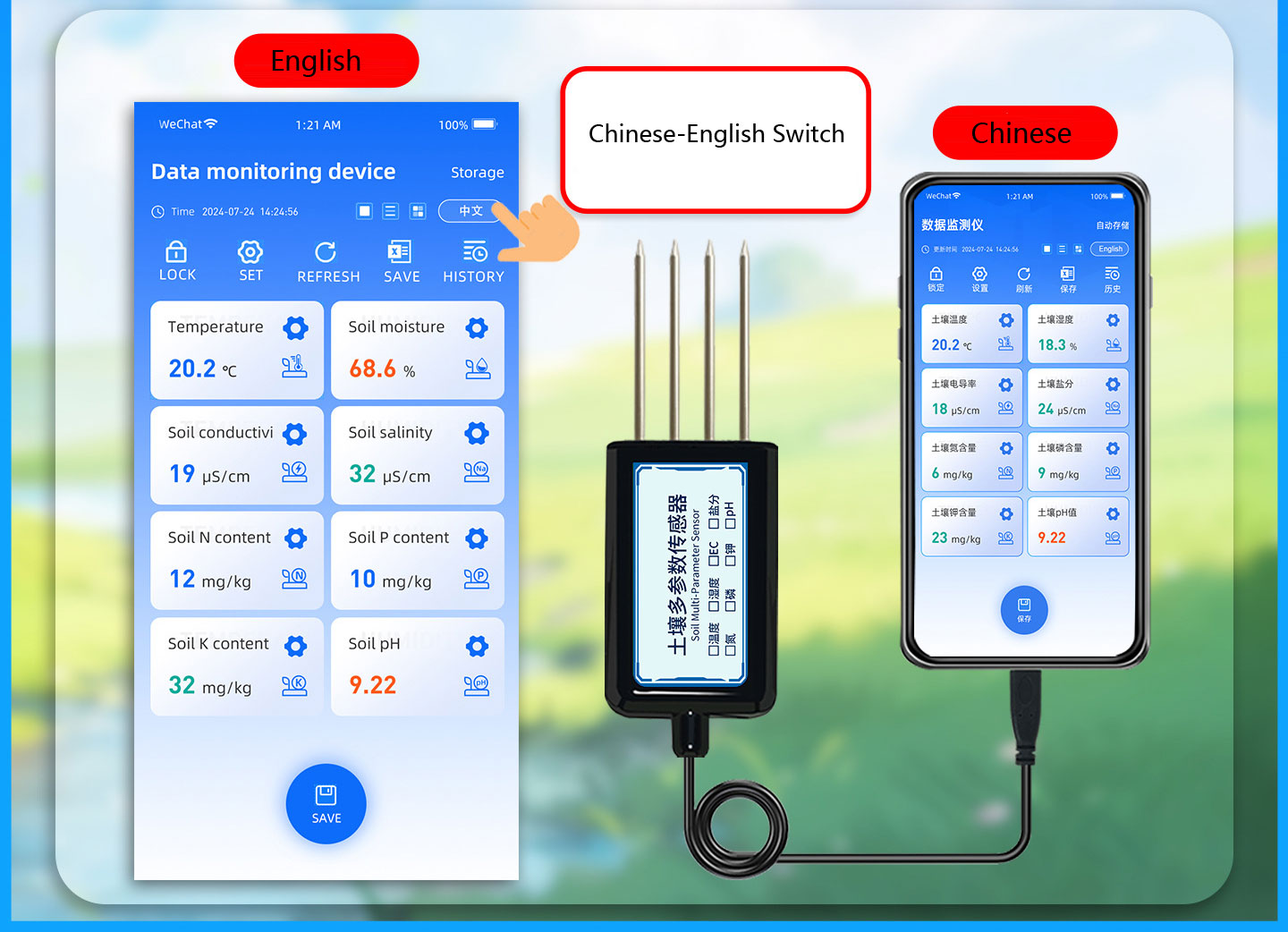
The NiuBoL portable tester uses the phone for power, display and local records. A technician can carry one instrument between sampling points and keep temperature, moisture, electrical conductivity (EC), salinity, pH and displayed nutrient estimates together in the same visit. This is useful for comparative field surveys, troubleshooting a suspected irrigation problem and documenting before-and-after checks in a defined plot.
A continuously monitored irrigation controller needs a different architecture: an installed probe, its specified power supply and an output the logger or PLC can poll. A USB Type-C tester cannot be assumed to provide RS485 Modbus RTU, autonomous logging or unattended alarms. If the scope calls for a 24-hour trend, ask for a fixed soil monitoring product rather than buying multiple phone testers to solve the wrong problem.
Before ordering, list the actual handsets that technicians will use. A Type-C socket alone does not establish app compatibility. Confirm the supported Android or HarmonyOS version, USB host/OTG behavior, permissions, connector fit with a protective case, app installation method and whether the project allows locally stored records. Test the exact phone and sensor together before a fleet purchase. Do not promise iOS support without a demonstrated compatible version.
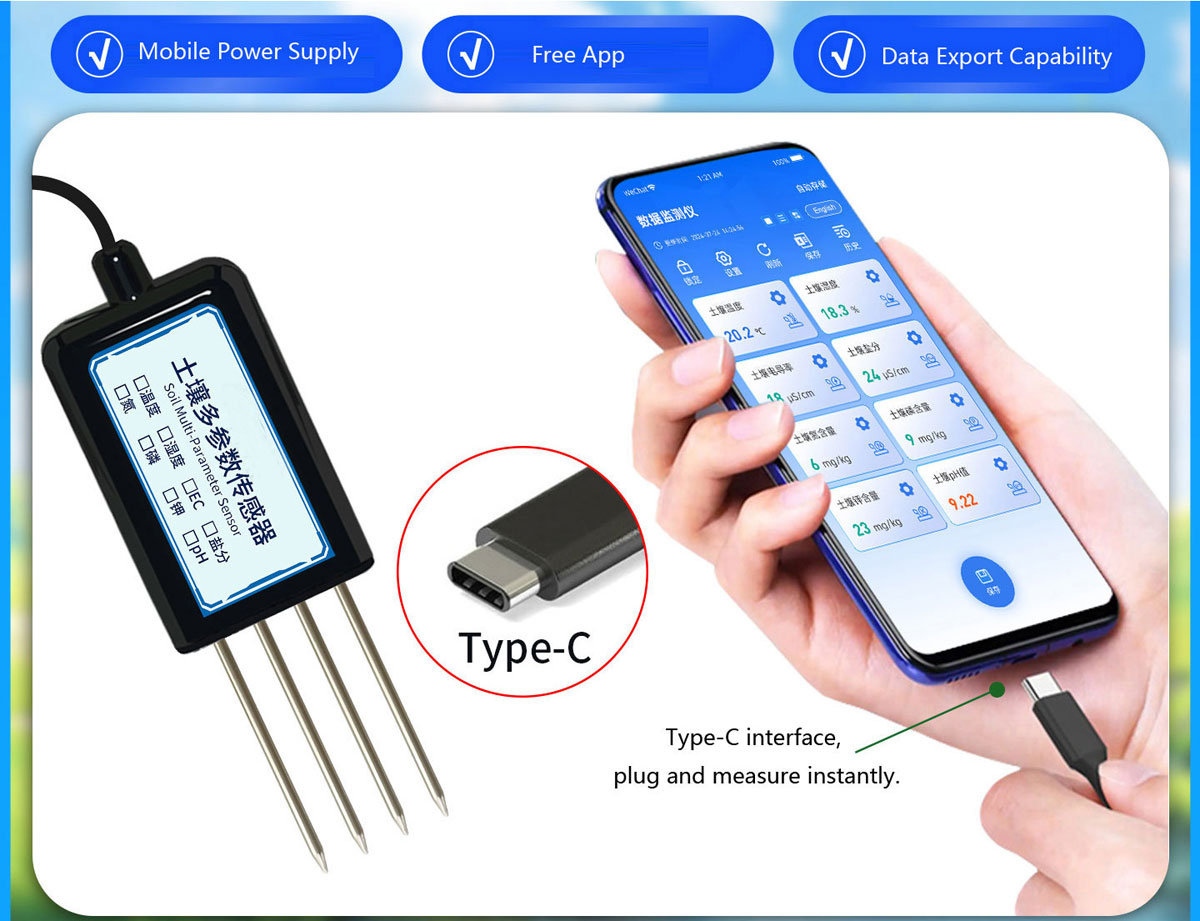
Temperature and volumetric moisture can expose differences caused by shade, irrigation distribution or drainage. EC reflects the conductive ionic background of the contacted soil; salinity is a related displayed estimate, not an independent laboratory salt extraction. pH is useful for comparing managed zones when insertion technique and soil contact are controlled.
The N, P and K readings require the greatest care. The NiuBoL product information describes these values as algorithmic estimates derived from electrical measurements and empirical coefficients, not direct chemical determinations of each nutrient. They can support screening or a repeated trend within a consistent soil type. They should not alone set fertilizer rates, certify nutrient content or replace an accredited laboratory result where a contract or agronomic recommendation requires one.
| Displayed channel | Published range | Practical interpretation |
|---|---|---|
| Soil temperature | -40 to 80 °C | Log with moisture and time of day for repeatable comparisons. |
| Volumetric moisture | 0 to 100% | Compare only like soil and insertion conditions; do not infer the whole root zone from one point. |
| EC | 0 to 20,000 µS/cm | Useful for ionic-background changes; moisture and soil contact affect interpretation. |
| Displayed salinity | 0 to 20,000 mg/L | Confirm conversion basis before reporting it as a laboratory salt result. |
| Displayed N, P and K | 0 to 1,999 mg/kg each | Empirical estimates; validate locally against laboratory samples when decisions depend on absolute concentrations. |
| Soil pH | 3 to 10 | Maintain full probe contact and compare repeated readings under the same field method. |
These ranges describe the published eight-parameter portable configuration. They are not accuracy guarantees for every soil matrix or a specification for other NiuBoL soil probes. Confirm the ordered configuration and current data sheet in the quotation, particularly where a project has a formal acceptance tolerance.

Define the sampling unit before a technician walks the field. A greenhouse bay, irrigation valve zone or soil-management block is a workable unit; an entire farm with different soil textures is not. Mark the location, crop stage, recent irrigation or fertilizer event and planned insertion depth. Keep the probe orientation and insertion method consistent so that differences in the spreadsheet are more likely to reflect soil conditions than operator technique.
At each point, remove stones or surface debris that prevent full contact, insert the probe as specified for the model and wait for the readings to settle. Do not twist the electrodes against gravel or force them into hard, dry ground. Clean adhering soil between points without scraping the sensing surfaces. If a value is obviously inconsistent with the field situation, repeat the reading nearby and record both results rather than deleting the first one without comment.
Moisture gradients can be steep after drip irrigation. A reading immediately under an emitter should not be compared as though it represents the entire bed. Record whether the sample came from the wet bulb, between emitters or a reference strip. For pH and EC, remember that contact and moisture conditions matter; a dry, poorly contacting insertion is a reason to investigate the method, not proof of a sudden soil chemistry change.
For nutrient decisions, pair selected portable readings with labeled soil samples sent to a laboratory. Use those pairs to establish whether the instrument's displayed trend is useful in that particular soil and management regime. If the relationship is weak, retain the tester for temperature, moisture, EC and pH scouting but do not build a fertilizer-control rule around the NPK display.

The app is described as supporting local data storage, curves and Excel export. Confirm the export format and the identifiers that the receiving agronomy team needs: point ID, date, time, operator, location, depth and units. A spreadsheet without a stable site code is difficult to compare across visits. For projects with personal-phone restrictions, supply or approve a dedicated Android device and document who owns the app records.
Ask the supplier to quote the exact tester variant, connector and any adapter, software access, replacement probe availability, operating instructions and the proposed phone-compatibility test. If simultaneous field teams need instruments, calculate the quantity from routes and work windows rather than from the number of plots alone. There is no defensible universal online price for a package whose adapters, shipping, support and order quantity vary; request an itemized project quotation.
Site acceptance can be simple but should be documented. Connect each supplied tester to the specified handset; confirm that all eight channels appear with the correct units; take repeat readings in a stable reference area; export one record and reopen it on the recipient's computer. Compare a selected set of pH or EC results with an agreed reference method if those channels drive a formal decision. Record the phone model and app version so a later software change does not erase the context of the baseline test.
Use a fixed RS485 soil probe when a controller must observe one location between staff visits. Use a laboratory analysis when a nutrient concentration will determine a fertilizer prescription, regulatory report or payment. Use a separate field pH or EC method when the contract names a specific analytical procedure. The Type-C tester earns its place in comparative field visits, not by claiming to replace those methods.
Q1. Does the tester work with any phone that has USB Type-C?
A1. No. Check the operating system, USB host/OTG capability, app permissions and physical connector fit on the exact phone model. Validate one complete handset-and-tester pair before ordering multiple units.
Q2. Can it feed an irrigation PLC continuously?
A2. The phone-connected portable version is for attended measurements. A PLC project needs a fixed probe and a specified output, commonly RS485 Modbus RTU, plus permanent power and mounting.
Q3. Are the N, P and K numbers laboratory measurements?
A3. No. They are empirical displayed estimates. Use them as screening or within-field trends, and compare against laboratory samples before making quantitative fertilizer decisions.
Q4. Can one reading represent a whole greenhouse?
A4. Only if the greenhouse is demonstrably uniform at the decision scale. Sample different irrigation zones, soil types and crop blocks separately, and record the sampling position.
Q5. What should be included in a fleet quotation?
A5. State the exact eight-parameter variant, phone and connector, number of simultaneous operators, app/export needs, accessories, replacement parts, destination and acceptance method. Ask for an itemized response.
Q6. How should results be accepted after delivery?
A6. Verify connection and channel display on the approved phone, repeat a measurement at a stable point, export a sample record and check its units and site identifier. Add a reference comparison where a channel has a contractual tolerance.
Q7. Is it suitable for long-term burial?
A7. A portable probe may be inserted for a field check, but an unattended buried installation requires a model specifically rated and powered for that duty. Do not infer such duty from the Type-C connector or a product photograph.
Specify a Type-C soil sensor for repeatable, attended soil surveys when the phone, app, sampling procedure and data export have been checked together. State the limits of NPK estimates in the project report. Send NiuBoL the intended phone models, soil types, survey route and acceptance requirements to confirm the correct portable package; request a fixed monitoring design if unattended PLC data is the actual requirement.
The NiuBoL eight-parameter portable soil tester page and the product manual provide the configuration details for the final order.

Prev:7-in-1 USB Soil Sensor: Check Channels Before Ordering
Next:Why Use Water Level Sensors? Applications and Measurement Limits
Related recommendations
Sensors & Weather Stations Catalog
Agriculture Sensors and Weather Stations Catalog-NiuBoL.pdf
Weather Stations Catalog-NiuBoL.pdf
Agriculture Sensors Catalog-NiuBoL.pdf
Water Quality Sensor Catalog-NiuBoL.pdf
Related products
 Combined air temperature and relative humidity sensor
 TDR Soil Moisture & Temperature Sensor for irrigation| RS485 |4-20mA| NBL-S-THR
 Soil pH sensor RS485 soil Testing instrument soil ph meter for agriculture |NBL-S-PH
 Wind Speed sensor Output Modbus/RS485/Analog/0-5V/4-20mA
 Tipping bucket rain gauge for weather monitoring auto rainfall sensor RS485/Outdoor/stainless steel
 Pyranometer Solar Radiation Sensor 4-20mA/RS485


Screenshot, WhatsApp to identify the QR code
WhatsApp number:+8615367865107
(Click on WhatsApp to copy and add friends)

