





— Blogs —
—Products—
 Consumer hotline +8618073152920
WhatsApp:+8615367865107
Address:Room 102, District D, Houhu Industrial Park, Yuelu District, Changsha City, Hunan Province, China
Product knowledge
Time:2026-08-11 09:09:00 Popularity:247
Quick Answer: A pest monitoring layout should identify the target pest, the crop area and the decision the observations will support. Connected traps can improve the timing and traceability of records, but the monitoring plan still needs representative locations, inspection and a person responsible for interpreting the results. Set point numbers from those requirements, not from a universal acreage-per-device claim.
A layout intended to detect insects arriving from neighboring vegetation differs from one intended to compare activity inside crop blocks. Mark those purposes separately. A boundary station can provide useful arrival information without representing the whole field. A centrally located station may suit a block comparison while missing a particular entry route.
Use crop blocks, borders, nearby vegetation and management history to plan the layout. The required point count depends on the pest and monitoring objective. A uniform distance rule can overlook a relevant boundary or overrepresent a convenient access route.
For each proposed point, write the observation question beside its identity: border arrival, interior activity, a separate planting date or a historically affected area. If every point has the same label but different crop and exposure conditions, the dataset will be difficult to interpret. Distinguish representative points from deliberately targeted investigation points before installing the foundations.
| Point purpose | Location to evaluate | Interpretation limit |
|---|---|---|
| Observe likely arrivals | A relevant crop boundary or neighboring habitat interface. | A boundary catch cannot be extrapolated directly to interior crop injury. |
| Compare management blocks | Locations with comparable crop stage and observation exposure. | Different lamp schedules or trap methods can invalidate the comparison. |
| Investigate a recurring problem | A documented problem area, paired with suitable field inspection. | A targeted point is not an unbiased farm-wide sample. |
| Support an advisory network | Stable, accessible sites with retained method and location records. | More dashboard points do not automatically mean better regional coverage. |
Choose a trap or observation method appropriate to the target organism and project purpose. Attraction, collection and image review are different functions. Ask which functions are included in the proposed equipment, and verify any claimed automatic identification on relevant examples.
A light-attraction monitoring cabinet samples insects that encounter and respond to that arrangement. It does not directly measure eggs on leaves, larvae inside fruit or the percentage of damaged plants. A pheromone trap and a light trap also produce different observations. Do not merge their totals into one continuous series or copy a species-specific lure-trap spacing rule to a monitoring cabinet.
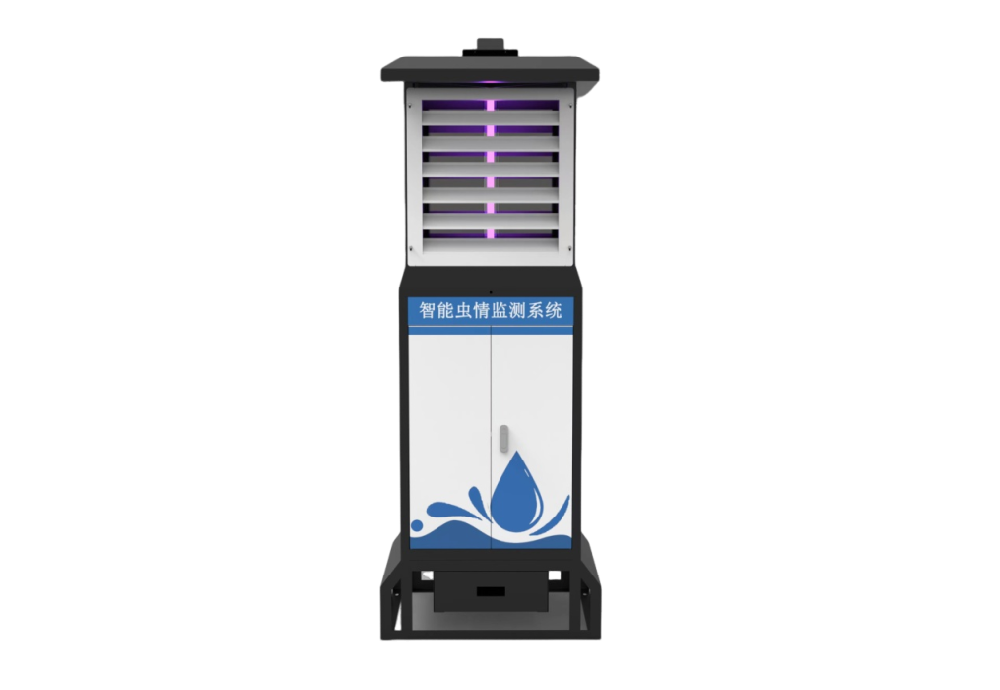
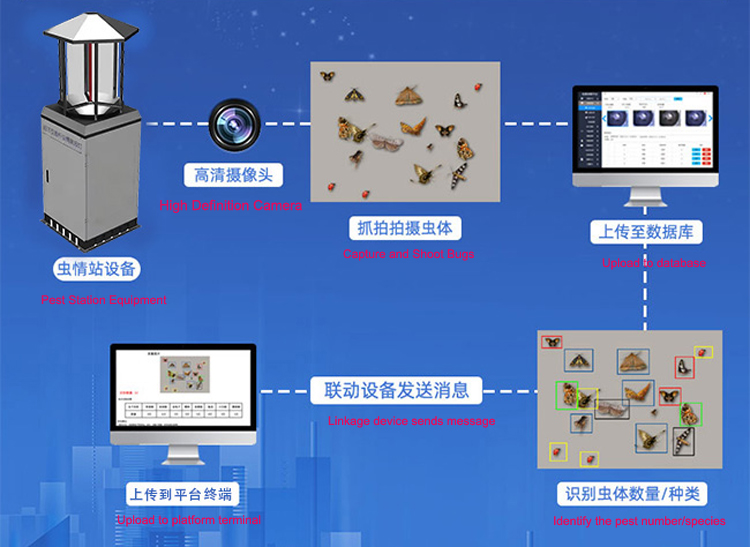
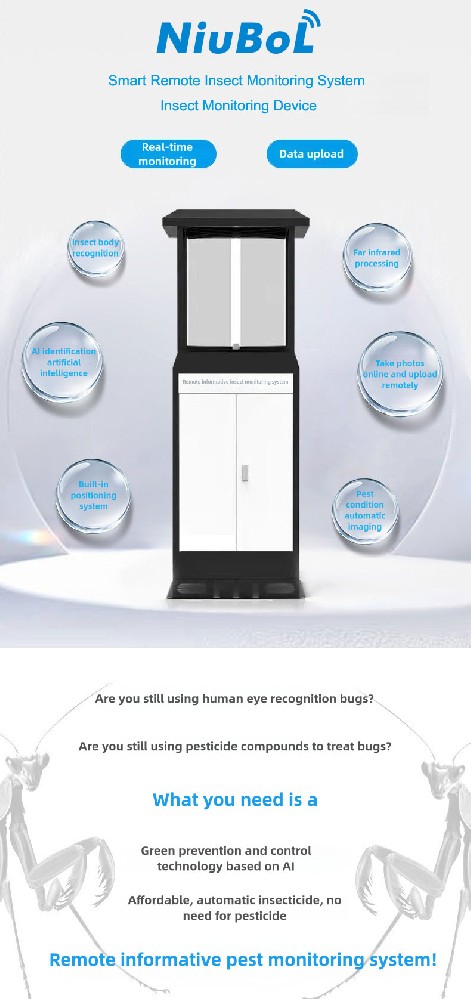
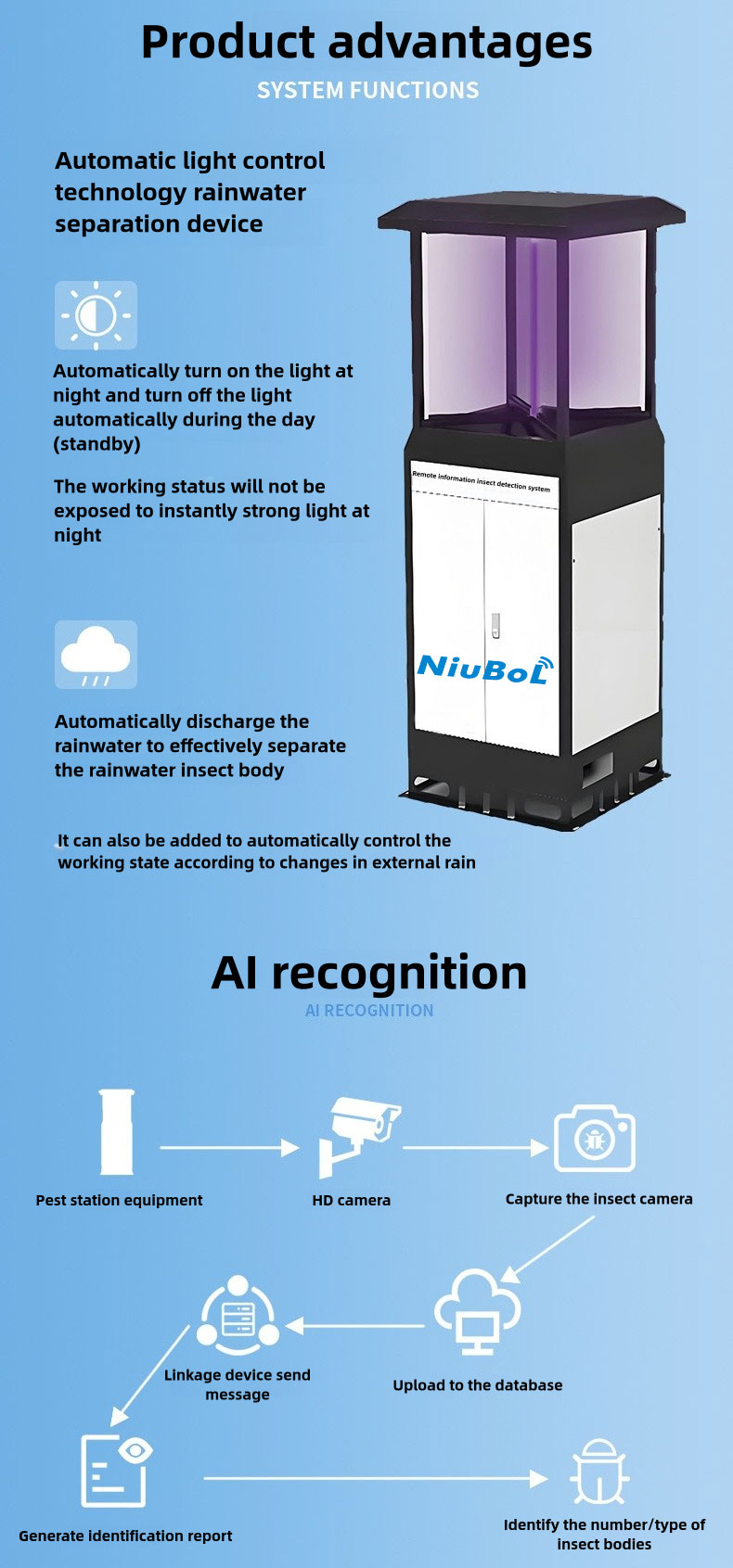
The NiuBoL NBL-IoT-SRPMS remote pest monitoring system combines attraction, specimen processing, photography and transmission. Its pipeline-vibration configuration prepares captured specimens for imaging. Where classification is included, retain the images and review uncertain target insects. A classification result is an observation requiring interpretation, not a crop-treatment instruction.
Start with a pilot that separates the main questions. For example, a project might compare observations at two relevant boundaries and two interior positions. That is an illustrative trial arrangement, not a recommended density or a promise that four devices cover a farm. The crop adviser must determine whether the target pest and site justify those positions.
Use the same equipment configuration and operating schedule where catches will be compared. Keep a record of competing lights, crop height, nearby barriers and service interruptions. Changing the schedule halfway through the trial may change the catch independently of pest activity. Keep the original point series identifiable if the device is later moved.
Review whether the pilot changed a real action: did it identify where to scout, distinguish border activity from interior activity or reveal a period missed by existing inspections? If points produce redundant observations without changing a decision, adding more of the same may offer little value. If they disagree, investigate method and exposure before interpreting the difference biologically.
Do not infer a pest population per hectare from cabinet totals without a validated sampling relationship. Attraction varies with the organism, environment and method. An increase at one point can justify a field visit, but it cannot by itself quantify crop damage or demonstrate that a neighboring block needs the same intervention.
A biologically useful position still needs safe access, suitable foundations, power and a workable service route. Review these before civil work. The cabinet and any solar support need an installation design appropriate to local ground and exposure; a foundation dimension from another site is not a universal structural design.
| NBL-IoT-SRPMS item | Pipeline-vibration configuration | Layout implication |
|---|---|---|
| Attracting light | 18 W lamp. | Account for competing light and keep operating methods consistent. |
| Operating and standby demand | Up to 225 W operating; up to 15 W standby. | The lamp rating alone is not the complete power requirement. |
| Power arrangements | AC 220 V option or a configured solar supply. | Choose the actual arrangement before approving the location. |
| Local operation | 10-inch Android touchscreen. | Allow safe access to settings and mechanism tests. |
| Remote communication | 4G and Ethernet. | Verify the selected connection at the final installed point. |
| Serial interfaces | Reserved RS485 / RS232. | Obtain an implemented interface specification before planning external integration. |
| Specimen collection | Collection drawer requiring manual emptying. | Include a service route; remote image access does not remove this task. |
Check the complete power arrangement rather than relocating the unit solely to simplify cabling. A solar option needs its own duty-cycle and seasonal-energy review. A cellular option needs a successful test at the actual antenna position. Neither option makes every isolated point suitable for unattended operation.
Give every point an identity and retain its position, mounting, trap method and installation date. Record cleaning, lure replacement and downtime with the observations. A sudden change after servicing needs a different interpretation from the same change under an unchanged method.
Record the collection interval as well as the photograph and upload times. A late upload must remain associated with the original collection period. Where rain control or a power interruption stops attraction, mark that interruption. A night with no completed observation is missing coverage, not a confirmed zero catch.
Method-specific guidance matters. UC IPM guidance for sticky-trap monitoring recommends numbered, mapped traps and recorded catches. Those recordkeeping principles are useful, but its trap-specific placement and counting methods should not be transferred automatically to a light-attraction cabinet.
Keep specimen review separate from equipment status. A clear image can contain damaged or overlapping insects that remain uncertain. Retain an unclassified category rather than forcing every object into a named pest count. Ask the reviewing specialist how changes in identification will be recorded so past observations can be reassessed without losing their history.
Time-stamped counts or images help a reviewer decide where to inspect. They do not automatically establish crop damage or a treatment threshold. Combine them with scouting, crop stage and the locally applicable pest-management method.
A useful report shows the point map, collection period, target observations, review status and relevant interruptions. Do not compare two blocks by total catch while hiding that one station ran for fewer nights. Equally, dividing catches by operating hours does not automatically correct for different attraction periods; insect activity is not uniform through the night.
For external data integration, request an example containing station identity, collection interval, image reference and device status. Reserved RS485 terminals do not establish RS485 Modbus RTU support, and image files require a defined transfer or retrieval method. Test access and exports on the customer's intended network instead of accepting a portal screenshot as evidence of compatibility.
Send NiuBoL the target insects, crops, field map, proposed point purposes, power availability and data-access requirements. Separate equipment, foundations, solar components, network service and platform functions in the quotation. Specify who will inspect the catch and act on uncertain or increasing observations; the device count alone does not define a monitoring service.

Base the number on target insects, crop blocks, boundaries and the decisions the records must support. Use a pilot to test whether proposed points capture useful differences. No single area-per-cabinet rule establishes representative biological coverage.
The locations answer different questions. Borders may reveal arrivals, while interior points can support observations within management blocks. Label the purpose and interpret the records accordingly; neither location automatically represents the other.
It can be relocated after reviewing the target pest, method and exposure, but record the move and keep the old and new location histories separate. Moving solely to increase catches can destroy the value of a consistent monitoring series.
No. Confirm that the device operated and the observation was complete, then consider the method's target and attraction conditions. Crop inspection remains necessary for pests or life stages not represented by the trap.
Verify point identity, the collection and imaging cycle, image quality, timestamps, remote access and service access. Also demonstrate interruption handling. Accepting an online cabinet does not establish a validated biological decision threshold.
Only through an implemented and documented compatible interface. Reserved RS485 / RS232 ports are not enough. Confirm the available data, message format and image-access method for the selected configuration before commissioning integration work.
Inspect the light and impact surfaces, specimen path, imaging surface, rain-control components and collection drawer. Adjust visits to observed debris and catch loading. Isolate power before work on electrical or moving components.
A light-attraction insect monitoring cabinet is not a rodent-monitoring device. Rodents require a suitable detection or trapping method and a separate placement plan. Define the organism before selecting equipment.
A useful pest monitoring layout links every point to a field question and keeps the observation method consistent. Start with a reviewable pilot, retain service and location history, and connect the images to crop inspection. Expand where another point improves a decision, not merely the size of the dashboard.
Prev:Dissolved Oxygen Meter for Water: Interpret Night-Time Decline Before an Alarm
Next:COD Sensor Alarm Thresholds: Validate the Discharge Decision Near the Limit
Related recommendations
Sensors & Weather Stations Catalog
 Agriculture Sensors and Weather Stations Catalog-NiuBoL.pdf
Weather Stations Catalog-NiuBoL.pdf
Agriculture Sensors Catalog-NiuBoL.pdf
Water Quality Sensor Catalog-NiuBoL.pdf
Related products
 Combined air temperature and relative humidity sensor
 TDR Soil Moisture & Temperature Sensor for irrigation| RS485 |4-20mA| NBL-S-THR
 Soil pH sensor RS485 soil Testing instrument soil ph meter for agriculture |NBL-S-PH
 Wind Speed sensor Output Modbus/RS485/Analog/0-5V/4-20mA
 Tipping bucket rain gauge for weather monitoring auto rainfall sensor RS485/Outdoor/stainless steel
 Pyranometer Solar Radiation Sensor 4-20mA/RS485


Screenshot, WhatsApp to identify the QR code
WhatsApp number:+8615367865107
(Click on WhatsApp to copy and add friends)

