





— Blogs —
—Products—
 Consumer hotline +8618073152920
WhatsApp:+8615367865107
Address:Room 102, District D, Houhu Industrial Park, Yuelu District, Changsha City, Hunan Province, China
Product knowledge
Time:2026-08-21 09:08:00 Popularity:292
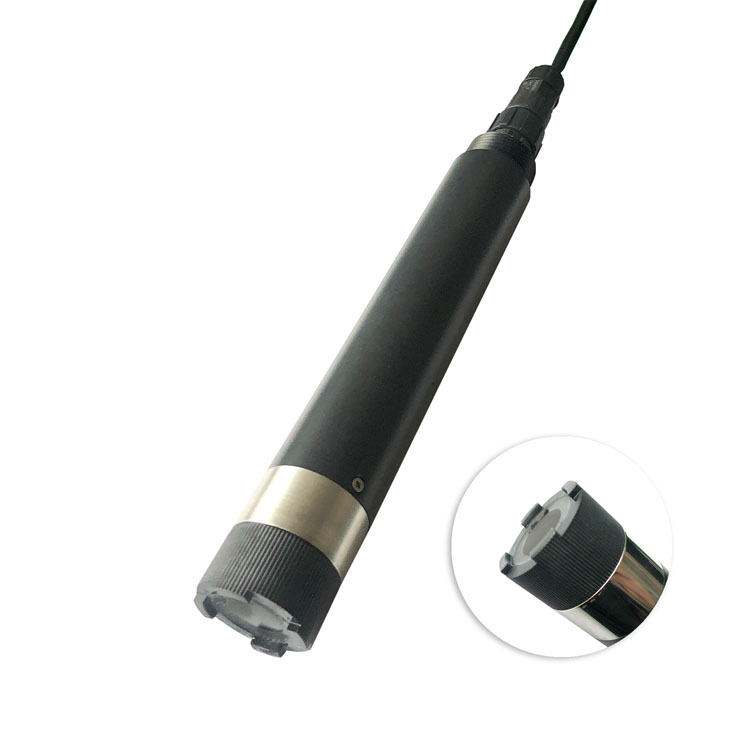
An instrument to measure dissolved oxygen in water may pass a steady reference check yet respond too slowly for the intended monitoring task. Before using its value for a short event or an aeration decision, distinguish probe response from water transport, logger polling and display filtering. A stable final reading does not establish how quickly the complete channel detects a change.
| Part of the measurement path | Possible delay | Useful check |
|---|---|---|
| Process to sensing point | Mixing, depth gradients or sample transport | Compare conditions at the actual sensing location rather than only at the aerator or sample takeoff |
| Water to probe output | Cap response, temperature equilibration, fouling or bubbles | Check the clean probe under a controlled change with stable test conditions |
| Probe output to local record | Polling interval, retries, filtering or averaging | Compare timestamped source observations with the logger record |
| Local record to remote display | Upload schedule, caching or network interruption | Compare acquisition and arrival times, including data-validity status |
A slow pond recovery after aeration starts may reflect the water volume and mixing pattern rather than a slow probe. Conversely, a smooth dashboard curve may be produced by software even when the sensor output changes sooner. Investigate those paths separately before changing calibration or tuning a controller.
Optical DO measurement does not consume oxygen, so sample motion is not required to replenish oxygen consumed by the measuring reaction. Local water renewal still matters: a stagnant pocket, coated cap or isolated sample line can delay the condition reaching the sensing surface.
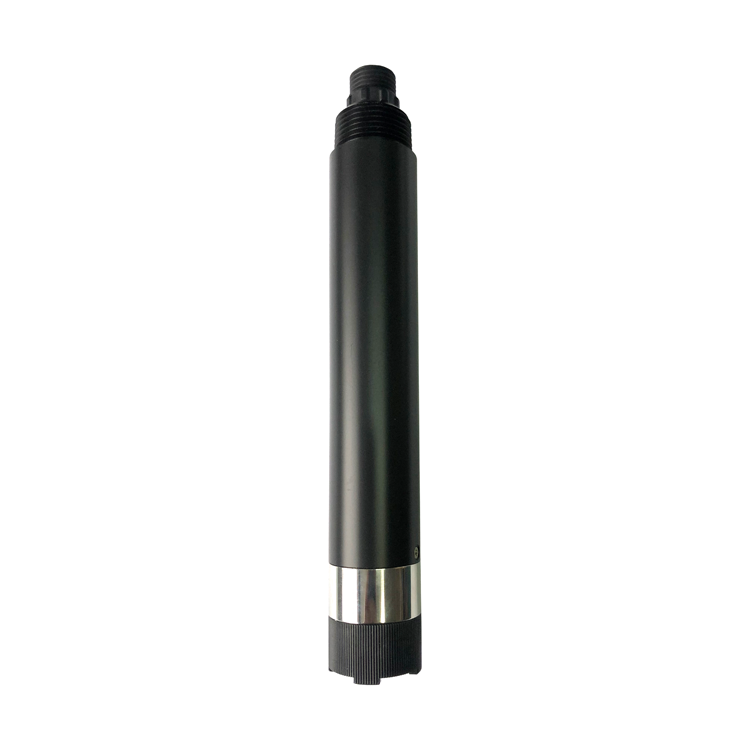
The NiuBoL NBL-WQ-DO is an immersion fluorescence probe. Its measurement range, accuracy and interface describe important parts of the channel, but they do not establish a complete installed response time.
| Specification | NBL-WQ-DO value | Relevance to a response test |
|---|---|---|
| DO span | 0-20.00 mg/L | Keep test conditions within the ordered measuring span |
| Accuracy and resolution | +/-2% FS; resolution 0.01 mg/L | A small displayed increment does not establish fast or accurate detection of a small change |
| Temperature | Accuracy +/-0.3 degrees C; Pt1000 automatic compensation | Separate oxygen response from changing water temperature |
| Water conditions | 0-45 degrees C; pressure below 0.2 MPa | Do not extrapolate a room test to an unsupported process condition |
| Supply and power | 12-24 V DC; below 0.3 W at 12 V | Verify stable supply during acquisition and communication |
| Interface and installation | RS485 Modbus RTU; immersion; 3/4 NPT | Record polling and mounting conditions separately |
| Construction | POM and 316L stainless steel; IP68; 5 m standard cable, customizable | Check cap condition, retrieval access and external terminations |
For the 20 mg/L span, +/-2% FS corresponds to +/-0.4 mg/L. A small apparent step close to the measurement uncertainty may not support a precise response-time determination. Select a meaningful test change and reference method without treating resolution as uncertainty.
Ask for any proposed response-time figure together with the definition, water conditions, direction of change and receiving settings. For example, T90 describes the time to complete 90% of the change between stable endpoints under the stated test conditions. It is not the same as the time to reach an operating alarm threshold.
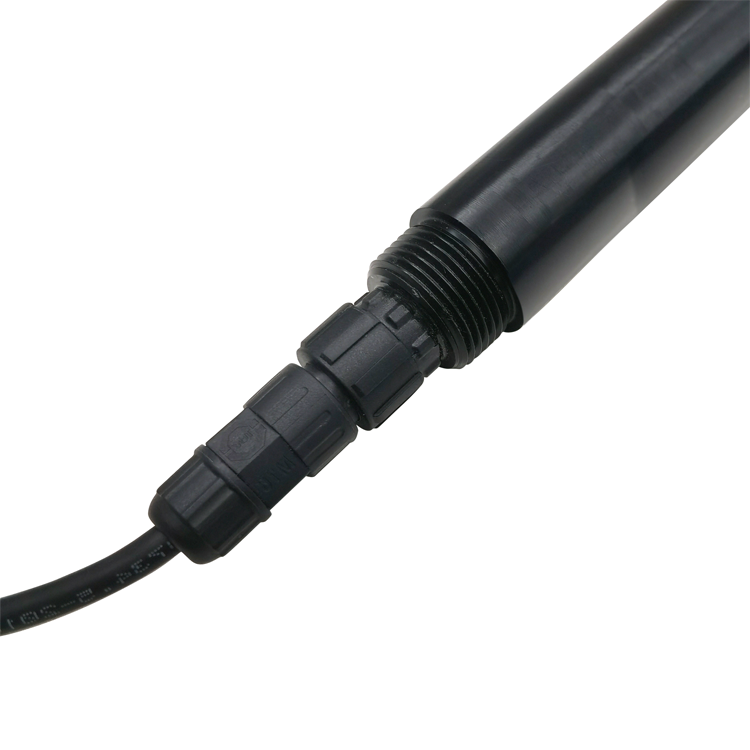
First inspect the optical cap and cable, clean using the appropriate procedure and verify the steady measurement. Preserve the as-found observations before cleaning. Check that the salinity setting matches the water; a configured salinity value is not an independent salinity measurement.
Use an approved test arrangement that creates a known change at the probe without simultaneously introducing uncontrolled temperature, salinity or bubble changes. Record when the changed condition actually reaches the sensing surface. Moving a probe between distant locations without that timing cannot isolate its response.
Retain the source output at an acquisition interval suitable for the test. Identify any averaging or damping in the sensor, receiver and display where applicable. A slow logging schedule can hide the response even if the instrument reacts sooner.
Compare increasing and decreasing oxygen conditions if both matter to the application. Record initial and final conditions, transition timing, temperature and the reference used. Repeat the check sufficiently to identify inconsistent behavior rather than selecting the fastest single trace as representative.
After the probe check, evaluate the complete field arrangement with the process operator. In a treatment basin, relate the trend to actual mixing and aeration events at the monitored point. In a bypass, assess sample renewal, residence time and bubbles. In aquaculture, compare the fixed location with the oxygen conditions relevant to the stock.
Verify that the PLC, RTU or data logger preserves fresh values and shows communication failure separately. Check whether the remote alarm uses a source observation, an interval mean or a cached display value. Do not shorten a delay simply to make a trace appear faster without reviewing noise, process behavior and the intended response.
Carry out testing under a supervised procedure without disabling an operating protective function or creating harmful oxygen conditions in stocked water. A controlled sensor test and a live process-response trial have different risks and should not be treated as the same task.
No. Polling changes how often the host reads available data. It does not remove physical sensor response, sample transport or mixing delay. Verify the selected model's update behavior and complete measurement path.
No. It checks a stable measurement condition. Short-event monitoring also needs suitable response, acquisition timing and a record that does not hide the event through averaging or upload delays.
It needs the test definition, stable endpoints, water conditions, direction of change and relevant instrument settings. Do not compare figures produced under unlike conditions as equivalent installed performance.
Not by itself. Check aeration delivery, mixing, measurement location, cap condition and the data path. Recalibration does not correct a hydraulic delay or a cached display.
Provide the model, water temperature and salinity, installation drawing, cap condition, timestamped source and displayed traces, acquisition settings and the event that initiated the change. State the required detection task rather than only requesting a fast probe.
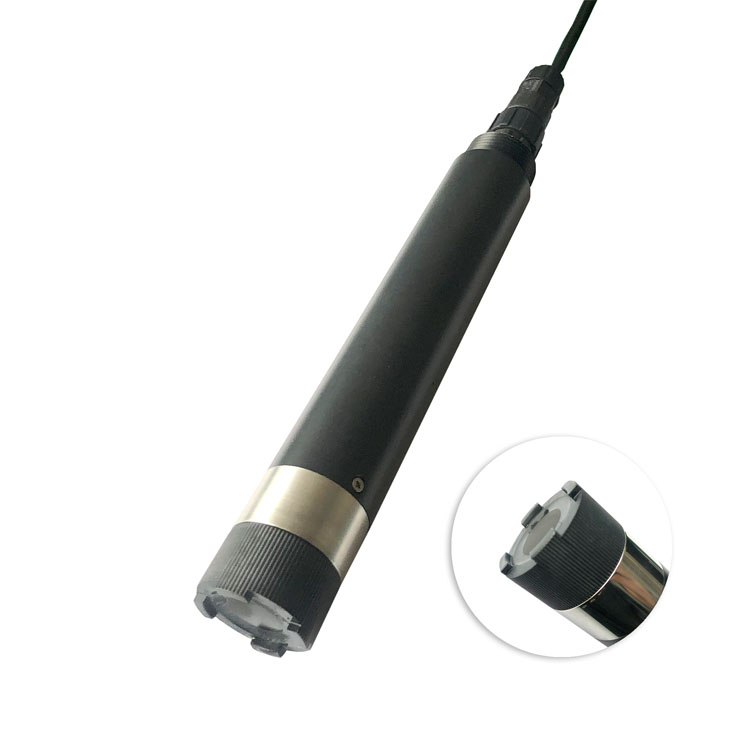
Select an instrument to measure dissolved oxygen in water by both steady measurement capability and the required dynamic task. Test the probe under controlled conditions, then evaluate transport, acquisition and display delay in the installed channel. NiuBoL can review the probe configuration when the process conditions and timing requirements are defined.
Prev:Digital pH Water Quality Tester: Fix PLC Scaling and Stale Data
Next:Evaluate IoT Tools for Pest Monitoring: Test Local Insect Counts
Related recommendations
Sensors & Weather Stations Catalog
 Agriculture Sensors and Weather Stations Catalog-NiuBoL.pdf
Weather Stations Catalog-NiuBoL.pdf
Agriculture Sensors Catalog-NiuBoL.pdf
Water Quality Sensor Catalog-NiuBoL.pdf
Related products
 Combined air temperature and relative humidity sensor
 TDR Soil Moisture & Temperature Sensor for irrigation| RS485 |4-20mA| NBL-S-THR
 Soil pH sensor RS485 soil Testing instrument soil ph meter for agriculture |NBL-S-PH
 Wind Speed sensor Output Modbus/RS485/Analog/0-5V/4-20mA
 Tipping bucket rain gauge for weather monitoring auto rainfall sensor RS485/Outdoor/stainless steel
 Pyranometer Solar Radiation Sensor 4-20mA/RS485


Screenshot, WhatsApp to identify the QR code
WhatsApp number:+8615367865107
(Click on WhatsApp to copy and add friends)

