





— Blogs —
—Products—
 Consumer hotline +8618073152920
WhatsApp:+8615367865107
Address:Room 102, District D, Houhu Industrial Park, Yuelu District, Changsha City, Hunan Province, China
Product knowledge
Time:2026-06-03 14:11:23 Popularity:357
Quick Answer: Online pH meter troubleshooting should distinguish a failed instrument check from a valid reading of different water. When buffers check correctly but the process comparison fails, investigate sampling time, temperature, mixing, electrical conditions and installation before recalibrating. A receiver offset that makes two displays agree can hide the original cause.
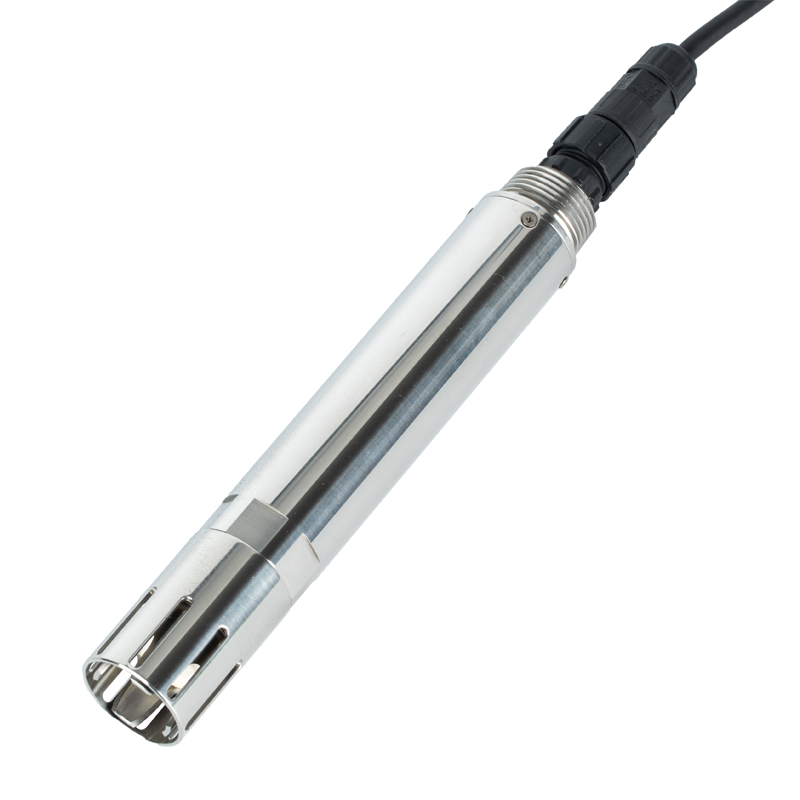
A common site complaint is that an online pH meter disagrees with a portable meter even after calibration. That comparison is meaningful only if both instruments measure equivalent water under comparable conditions. A tank value recorded now and a grab sample tested later are not automatically a valid pair.
First retain the original online value, reference value, temperatures, locations and times. Identify the full probe models and the last calibration. If the online channel controls acid or alkali feed, use the site's approved maintenance mode before removing it or putting it into buffers. Keep those service readings separate from process history.
This article addresses a received but disputed pH value. For a probe with no reply, frozen data or a receiver decoding problem, use the separate online pH fault-diagnosis procedure before examining process disagreement.
| Comparison condition | Why disagreement is possible | Better test |
|---|---|---|
| Tank probe versus sample beside a dosing point | The chemical is not uniformly mixed | Compare at the probe location and document mixer and dosing state |
| Online water versus a sample left open | Temperature and gas exchange may change the sample | Measure promptly with minimal disturbance and record both temperatures |
| Bypass probe versus current tank reading | Sample-line transport creates a time difference | Estimate transport time and compare the corresponding process period |
| Different sampling depths or stagnant areas | Local water conditions differ | Repeat at a defined representative position |
| Reference cup with cleaner or buffer residue | The container changes the sample | Use suitable clean sampling equipment and prevent carryover |
If readings agree when both instruments see the same fresh sample but diverge in their normal locations, that is evidence to investigate sampling and placement. It is not proof that the installed probe needs a new slope.
Check both instruments in fresh, suitable buffers before recalibrating either one. Use the buffer's temperature-dependent reference value and wait for stable response. Keep used portions separate from stock solution, and prevent carryover between buffers. A contaminated buffer can make two otherwise functioning instruments appear faulty.
Record the as-found difference at each point. Then inspect and clean the affected probe using a method compatible with its deposits and construction. Repeat the check before adjustment where practical. This sequence separates the effect of cleaning from the effect of recalibration.
If a clean, conditioned probe fails suitable checks repeatedly, investigate the glass, reference junction and measurement electronics. If both checks are satisfactory, return to the process comparison. Passing buffers is useful evidence but does not prove that the probe suits every process matrix.
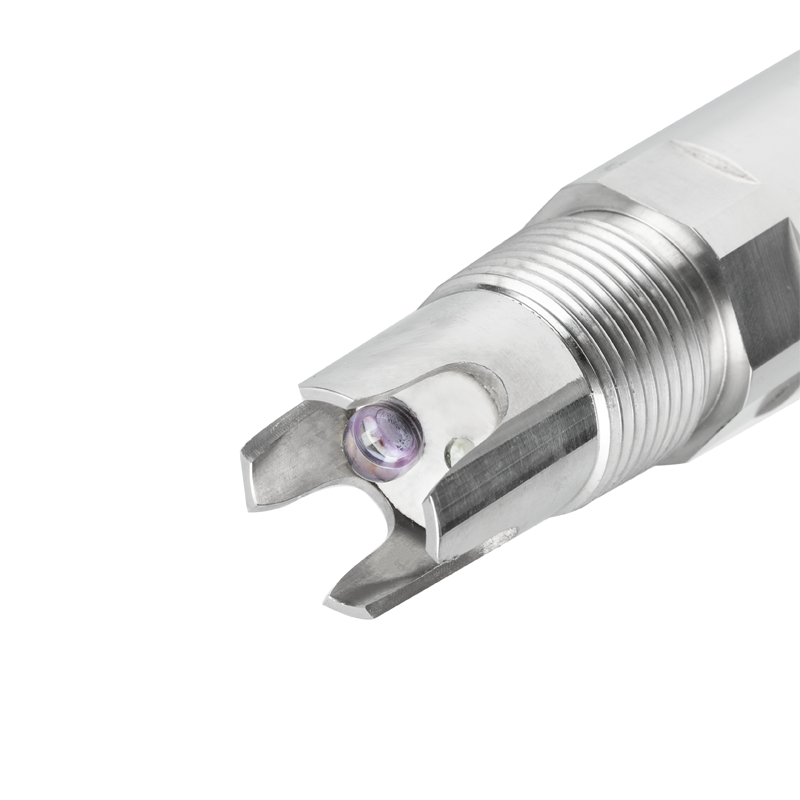
The protected probe below still requires appropriate water contact. Inspect for a trapped pocket, deposits around the sensing end or a mounting position that leaves the junction outside the sample. Do not use the cable to retrieve an unsupported assembly.
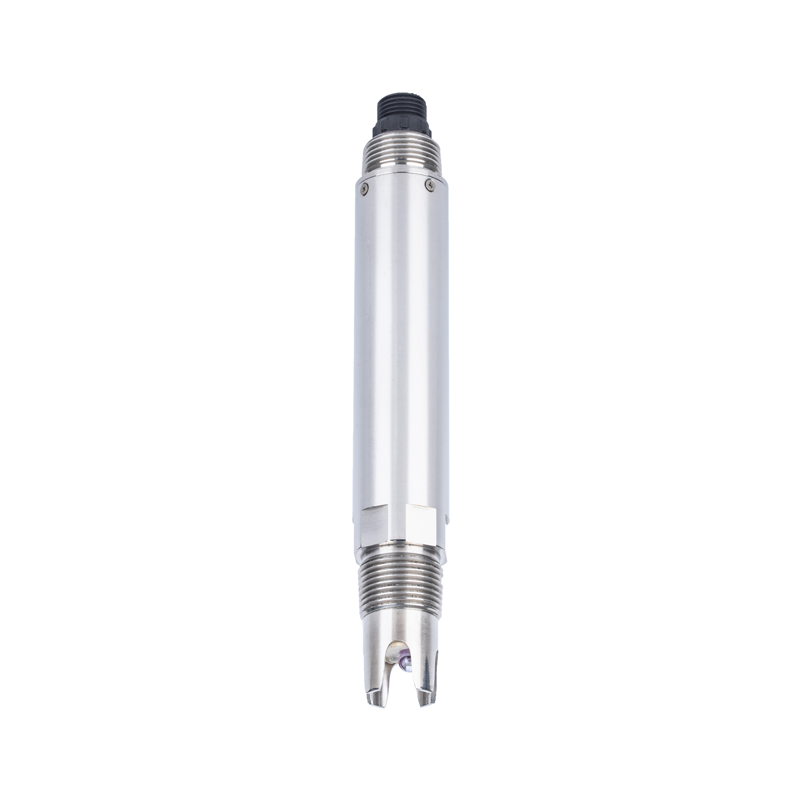
A reading that stabilizes in a separate container may indicate a more uniform sample, a change in temperature or an electrical condition associated with the installation. It does not by itself identify which one. Repeat comparisons in a controlled sequence instead of changing calibration, mounting and wiring simultaneously.
Correlate shifts with pump and mixer operation. These machines can alter mixing as well as electrical conditions, so timing alone does not prove electromagnetic interference. Qualified personnel should investigate grounding, leakage and cable routing under the site's electrical safety procedures. Never disconnect protective earth as a troubleshooting shortcut.
Inspect field terminations for moisture and damaged shielding. The probe's IP68 rating does not establish the protection of an opened connector or an improvised cable splice. Any test using an alternative supply or isolated reader must preserve required process and electrical protection.
| PH-4 characteristic | Specification | Relevance to the complaint |
|---|---|---|
| pH range / accuracy | 0-14.00; +/-0.1 pH | Two instruments each have their own uncertainty; display agreement to 0.01 pH is not guaranteed |
| Temperature compensation | Pt1000; temperature accuracy +/-0.3 degrees C | Check the temperature channel as well as pH |
| Water conditions | 0-50 degrees C; at or below 0.2 MPa | Review actual probe conditions, including operating excursions |
| Signal / supply | RS485 Modbus RTU; optional 4-20 mA; 12-24 V DC | Identify which acquired value is being compared |
| Consumption | 0.2 W at 12 V | Not a whole-station or transmitter power specification |
| Housing / protection | 4A POM/ABS; 4S POM/316L; IP68 | Material selection must also suit the process and cleaner |
| Installation / cable | 3/4 NPT immersion; standard 5 m shielded cable | Check safe access, delivered jacket compatibility and extensions |
Use these values for the NiuBoL PH-4 series, not for an unidentified replacement probe. The 0.01 pH resolution is a display increment. Agreement criteria must account for the reference instrument, buffers, temperature and comparison method as well as the online probe's accuracy.
If cleaning restores buffer response and the installed comparison, address the fouling mechanism and service interval. If buffer checks pass but the installed difference persists, improve the sampling comparison or investigate the application. If only the PLC display differs from a direct digital read, correct the receiver conversion rather than the electrode calibration.
Replace a damaged sensing element or an assembly that cannot meet the required checks after appropriate service. Repeated failures in the same duty should trigger a compatibility review. A new probe of the same unsuitable construction may reproduce the fault.
For supplier support, send the paired readings with time and temperature, buffer check results before and after cleaning, current calibration information if available, installation photographs and the complete model. This is more useful than a screenshot showing a single unexplained pH value.
Not until the portable meter and sampling method are verified. Check both in suitable buffers and compare equivalent fresh water. Matching an unreliable reference creates another incorrect value.
Yes. Temperature compensation does not remove every temperature-related change in the sample's chemistry. Record temperature and minimize the difference between online and reference conditions.
It directs attention to sample equivalence, installation, process matrix and electrical conditions. It does not prove the electrode is universally suitable, nor does it justify an arbitrary calibration offset.
No. Pump operation can also change mixing and the water arriving at the probe. Separate hydraulic and electrical tests with qualified personnel; do not remove protective grounding.
Replace physically damaged elements or equipment that cannot meet the required checks after proper cleaning and conditioning. If the failure recurs, review the material, junction, exposure and installation before ordering an identical replacement.
Effective online pH meter troubleshooting preserves the original error long enough to explain it. Compare the same water, verify both instruments and separate cleaning from adjustment. Change calibration, installation or equipment only when the tests identify which part of the measurement is responsible.
Prev:Industrial Online pH Monitor Installation Guide
Next:Residual Chlorine Electrode Cleaning: Preparation and Return to Service
Related recommendations
Sensors & Weather Stations Catalog
 Agriculture Sensors and Weather Stations Catalog-NiuBoL.pdf
Weather Stations Catalog-NiuBoL.pdf
Agriculture Sensors Catalog-NiuBoL.pdf
Water Quality Sensor Catalog-NiuBoL.pdf
Related products
 Combined air temperature and relative humidity sensor
 TDR Soil Moisture & Temperature Sensor for irrigation| RS485 |4-20mA| NBL-S-THR
 Soil pH sensor RS485 soil Testing instrument soil ph meter for agriculture |NBL-S-PH
 Wind Speed sensor Output Modbus/RS485/Analog/0-5V/4-20mA
 Tipping bucket rain gauge for weather monitoring auto rainfall sensor RS485/Outdoor/stainless steel
 Pyranometer Solar Radiation Sensor 4-20mA/RS485


Screenshot, WhatsApp to identify the QR code
WhatsApp number:+8615367865107
(Click on WhatsApp to copy and add friends)

