





— Blogs —
—Products—
 Consumer hotline +8618073152920
WhatsApp:+8615367865107
Address:Room 102, District D, Houhu Industrial Park, Yuelu District, Changsha City, Hunan Province, China
Product knowledge
Time:2026-06-03 14:11:32 Popularity:360
Quick Answer: Residual chlorine electrode cleaning should be followed by a controlled return to service, not an immediate slope adjustment. Identify the electrode and deposit, use a compatible cleaning procedure, restore its specified preparation and flow conditions, then compare the reading with an appropriate fresh reference. For a constant-voltage HOCl sensor, flow and pH can change the response independently of dirt.
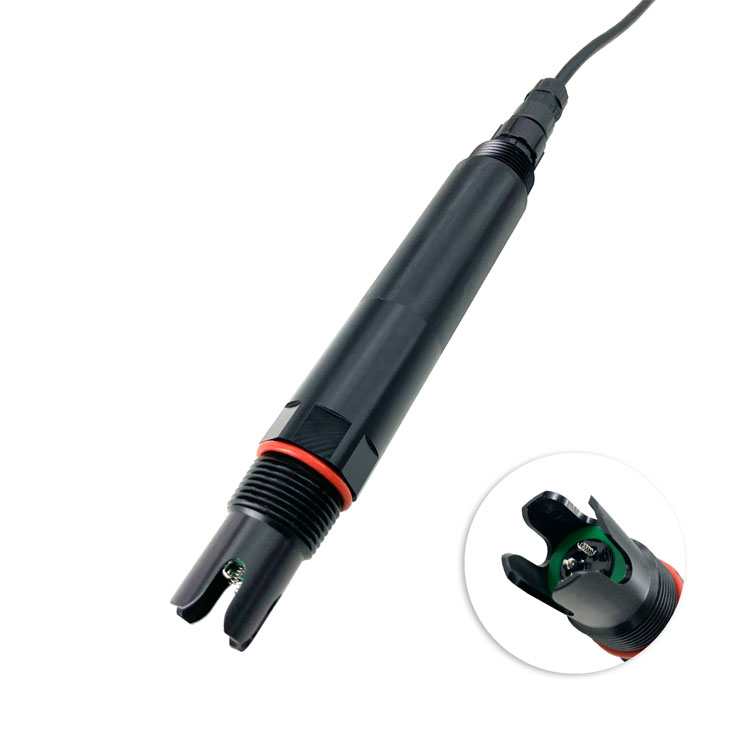
A low or slow residual-chlorine reading can come from a fouled electrode, but it can also come from a blocked sample line, lost flow or a real change in the water. Record the as-found reading with flow, pH, temperature and dosing state before disturbing the installation. Check whether fresh water is actually reaching the measuring region.
If flow is absent, do not let a dosing controller interpret the value as a confirmed disinfectant deficiency. Apply the site's approved maintenance and fallback procedure. The chlorine channel alone cannot establish whether the sample valve is closed or whether the process has genuinely lost disinfectant.
Cleaning a sample strainer or removing a line blockage may restore the measurement without servicing the electrode. Keep these actions separate in the service record so the next low-reading complaint can be investigated more quickly.
| Condition | Useful action | What to avoid |
|---|---|---|
| Debris in tubing or flow-cell inlet | Isolate, drain and service the sample route using its approved procedure | Treating a hydraulic blockage as an electrode-calibration error |
| Loose material around the sensing end | Inspect after a compatible gentle rinse; confirm whether the deposit remains | Scraping or polishing an unidentified sensing surface |
| Scale or persistent film | Obtain the deposit-specific cleaner, contact time and rinse requirements for that assembly | Applying a universal acid or solvent recipe |
| Damaged sensing surface, seal or cable | Withdraw the affected assembly and seek service or replacement | Opening sealed electronics or treating damage as removable fouling |
| Unstable result after cleaning | Recheck preparation, flow, pH, temperature and the comparison method | Repeatedly increasing the slope to force agreement |
A chlorine electrode is not automatically serviced like a pH bulb, optical turbidity window or membrane-covered amperometric probe. Do not transfer polishing, membrane replacement or electrolyte instructions between technologies. The supplied construction determines which parts can be serviced and which require factory attention.
Where a chemical cleaner is proposed, confirm compatibility with every wetted component and the approved discharge route. Prevent cleaner residues from contaminating the flow cell or reference sample. A cleaning procedure should identify its endpoint and rinse requirement, not merely name a chemical.
The NiuBoL NBL-WQ-CL-4A is a constant-voltage residual chlorine sensor with an HOCl-related response. New and long-stored electrodes require activation that includes 24 hours in tap water. This is a preparation requirement for those conditions, not a claim that every routine rinse needs the same delay or that every electrode is ready after exactly 24 hours.
After servicing, follow the return-to-service procedure for the delivered assembly. Do not shorten a required conditioning step by applying an offset. Restore the matching flow cell and ensure that water reaches the measuring region near its inlet, rather than arranging the electrode to face the outlet.
The recommended sample flow for this configuration is 30-60 L/h, kept stable. Confirm it at the cell, not only at a distant supply valve. A stable upstream pressure does not prove the same flow after a strainer, regulator or outlet has been disturbed.
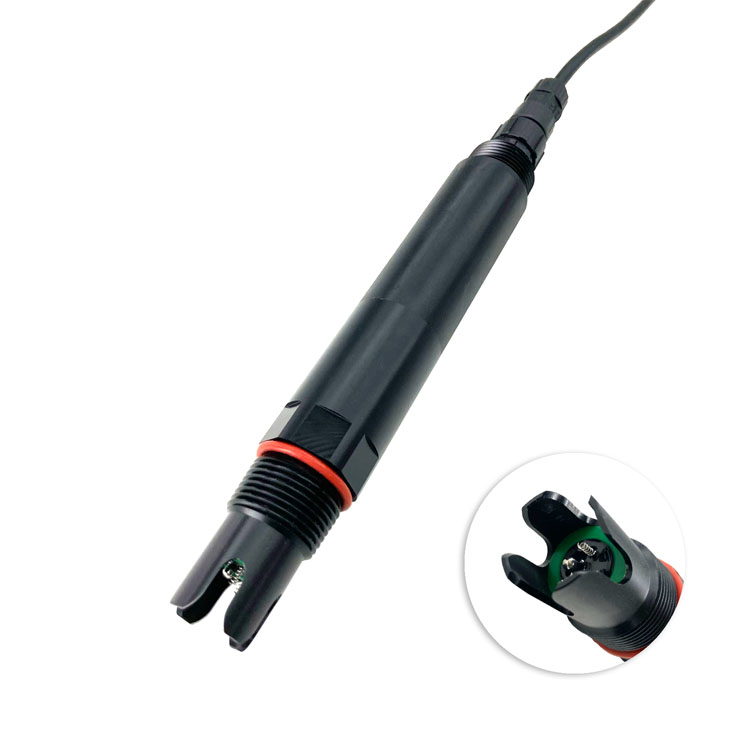
| Parameter | NBL-WQ-CL-4A |
|---|---|
| Principle | Constant-voltage electrochemical method; HOCl basis |
| Range / resolution | 0-2.000 mg/L / 0.001 mg/L, or 0-20.00 mg/L / 0.01 mg/L |
| Accuracy | Low-range expression +/-5%; confirm percentage basis and range-specific acceptance statement. Temperature +/-0.3 degrees C. |
| Response / detection limit | T90 below 90 s; minimum detection limit 0.05 mg/L |
| Sample conditions | 0-60 degrees C; pressure at or below 0.2 MPa; pH 4-9 |
| Flow / installation | Matching flow cell; recommended 30-60 L/h; 3/4 NPT |
| Supply / consumption | 12-24 V DC; 0.2 W at 12 V |
| Output | RS485 Modbus RTU; optional 4-20 mA |
| Construction / protection | 316L housing configuration; IP68 |
| Cable | Standard 5 m cable; confirm delivered jacket and any extension compatibility |
These are operating limits for the CL-4A chlorine sensor, not permission to expose it to any cleaning chemical at those temperatures. Pt1000 temperature compensation does not establish automatic correction for pH-related changes in chlorine species. The selected range and measurement basis must remain consistent through maintenance.
Once the sample and electrode are stable, compare with an appropriate reference method using fresh water from the same location and period. A stored bottle or a sample taken before cleaning may no longer represent the live cell. Identify whether the reference reports free chlorine, total chlorine or another result; an HOCl-related channel cannot be compared indiscriminately with all of them.
A specified zero check uses chlorine-free water. Slope work requires an appropriately assigned reference and competent preparation; an assumed dilution is not an independently known concentration. Follow the supported calibration procedure only after flow, temperature, pH and preparation have been checked.
If the process discrepancy disappears after restoring flow, leave a satisfactory calibration alone. If the result remains inconsistent, retain both readings and their conditions for technical review. Repeated adjustment can hide a damaged electrode or a mismatch between the online method and the reference test.
During maintenance, a sensor in rinse water must not be recorded as the process chlorine residual. Mark the interval appropriately in the PLC, RTU or data logger. After installation, confirm that the final display receives a fresh value in the correct units and selected-range scaling.
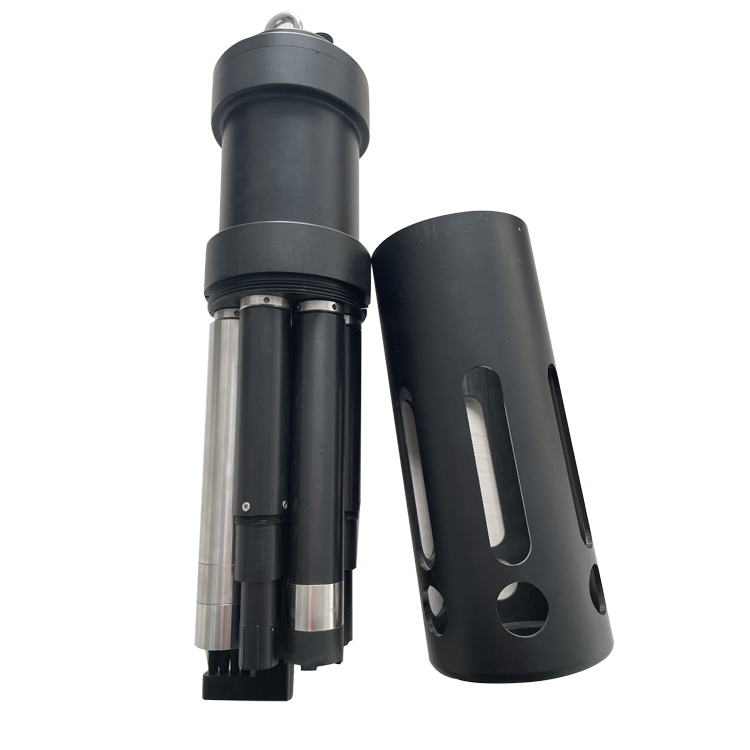
Restore automatic dosing only through the approved site procedure after the flow and measurement checks pass. Where a multiparameter assembly is used, verify the fitted chlorine channel separately rather than assuming that the pH or temperature channel confirms its performance. The instrument below illustrates a separate multiparameter construction, not a replacement maintenance procedure for the standalone CL-4A.
Only if contamination is the cause. First check actual sample delivery, disinfectant condition, pH and comparison timing. Cleaning will not correct lost flow or a genuine low residual.
Not without a compatible procedure for the deposit and assembly. Establish the cleaner, exposure and rinse requirements; do not apply one acid treatment to every unexplained drift.
The 24-hour tap-water preparation applies to new and long-stored CL-4A electrodes. Routine servicing needs the appropriate recovery procedure for its condition; do not assume all interventions have identical requirements.
Service may change flow, sample residence time, bubbles or the water reaching the electrode. Re-establish stable flow and representative sampling before deciding that the electrode calibration has changed.
Send the full model and range, deposit photographs, cleaning steps already taken, before-and-after readings, cell flow, pH, temperature and fresh reference results. Identify whether the sensor controls dosing so restoration requirements can be reviewed.
Residual chlorine electrode cleaning is successful when the restored installation produces a stable, interpretable result, not merely a clean-looking probe. Separate hydraulic service, electrode preparation and calibration. For NiuBoL support, provide the actual deposit and sample conditions before choosing a cleaner or replacement assembly.
Prev:Online pH Meter Troubleshooting: Buffers Pass but Process Readings Differ
Next:Aquaculture Pond pH Monitoring: Daily Cycles and Abnormal Readings
Related recommendations
Sensors & Weather Stations Catalog
 Agriculture Sensors and Weather Stations Catalog-NiuBoL.pdf
Weather Stations Catalog-NiuBoL.pdf
Agriculture Sensors Catalog-NiuBoL.pdf
Water Quality Sensor Catalog-NiuBoL.pdf
Related products
 Combined air temperature and relative humidity sensor
 TDR Soil Moisture & Temperature Sensor for irrigation| RS485 |4-20mA| NBL-S-THR
 Soil pH sensor RS485 soil Testing instrument soil ph meter for agriculture |NBL-S-PH
 Wind Speed sensor Output Modbus/RS485/Analog/0-5V/4-20mA
 Tipping bucket rain gauge for weather monitoring auto rainfall sensor RS485/Outdoor/stainless steel
 Pyranometer Solar Radiation Sensor 4-20mA/RS485


Screenshot, WhatsApp to identify the QR code
WhatsApp number:+8615367865107
(Click on WhatsApp to copy and add friends)

