





— Blogs —
—Products—
 Consumer hotline +8618073152920
 WhatsApp:+8615367865107
Address:Room 102, District D, Houhu Industrial Park, Yuelu District, Changsha City, Hunan Province, China
Product knowledge
Time:2026-07-08 16:11:23 Popularity:186
A portable weather station is useful for sports events because outdoor performance and safety can change quickly with temperature, humidity, wind and rainfall. Marathon, rowing, sailing, archery, shooting, cycling, football, school sports meetings and temporary outdoor competitions all need site-level weather information. A city forecast is not enough when the venue has its own wind corridor, heat exposure or rain cell.
For organizers, the buying decision should focus on deployment speed, parameter set, battery life, screen readability, data storage, export method and whether the station can be fixed on a temporary bracket. The device should help staff make event decisions, not just display weather numbers.
| Variable | Why It Matters | Buying Note |
|---|---|---|
| Temperature | High temperature increases dehydration and heat cramp risk | Check range -40 to +80 C and response time |
| Humidity | High humidity limits sweat evaporation and endurance | Accuracy around ±3% RH is useful for event monitoring |
| Wind speed | Affects sailing, archery, shooting, cycling and heat dissipation | Range up to 0-60 m/s and fast response are useful |
| Wind direction | Important for sailing routes, shooting range and field layout | Accuracy around ±3 degrees supports local decisions |
| Rainfall | Affects schedule, safety and field condition | Optical rainfall is useful for portable integrated stations |
| PM2.5/PM10 | Supports air quality checks for public events | Useful for urban or school sports activities |
| Noise and CO2 | Optional for venue environment assessment | Select only when the event requires these indicators |
For most event organizers, temperature, humidity, pressure, wind speed, wind direction and rainfall are the basic set. For running events in urban areas, PM2.5 and PM10 may be worth adding. For indoor-outdoor mixed venues or temporary tents, CO2 and noise are useful only if the organizer wants environmental comfort data beyond weather.
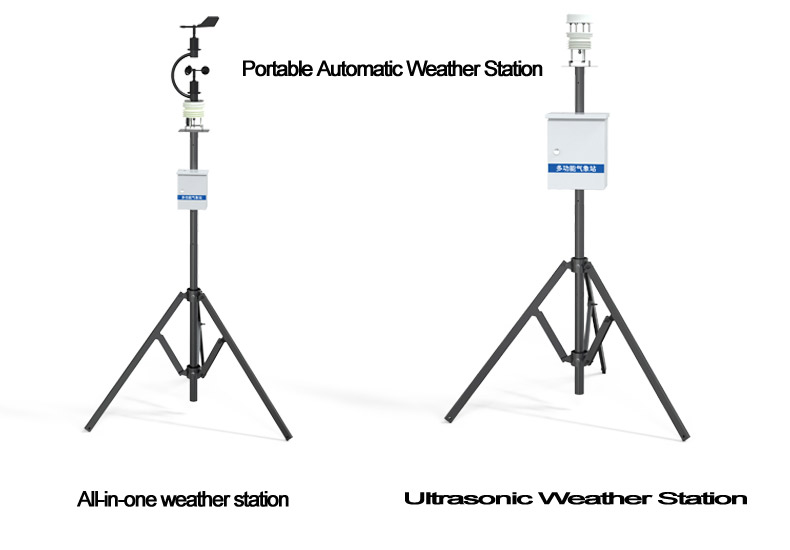
The portable weather station configuration described here includes a handheld micro weather station with a 2.4-inch touch screen, optional parameters, Bluetooth configuration, Type-C data export, up to 260,000 stored records and rechargeable battery operation. Battery endurance can reach up to 36 hours under specific configuration conditions. Buyers should confirm endurance with their selected sensor set, because power consumption changes with optional modules.
| Item | Portable Weather Station | Fixed Weather Station |
|---|---|---|
| Deployment | Fast, movable, suitable for temporary venues | Installed for long-term monitoring |
| Power | Battery powered, no wiring needed for short events | Mains or solar power |
| Data continuity | Good for event period and spot checks | Good for long-term climate records |
| Cost structure | Lower civil work and installation cost | Higher installation but better permanent coverage |
| Suitable buyer | Event organizers, emergency teams, field inspectors | Facilities, farms, airports, road managers |
Event type and weather variables that affect safety or scoring.
Need for handheld operation, tripod mounting or fixed temporary station.
Battery endurance under selected parameter configuration.
Data export requirement: Type-C, app, Bluetooth or platform.
Storage capacity and whether records need timestamps for later review.
Transport case, bracket, spare battery and on-site training needs.
Do not buy every optional sensor if the data will not be used. For a small school sports day, wind, temperature, humidity and rainfall may be enough. For sailing or shooting, wind accuracy and response are more important than PM data. For a public marathon, heat, humidity, PM and data export may matter more.
Before the event, organizers can use the station to check heat stress, wind trend and rainfall risk. During the event, the same data supports schedule adjustment, water station preparation, field safety and communication with referees or safety staff. After the event, exported records can help explain why a delay or safety decision was made.
The device should therefore have a clear operating owner. A portable station that stays in a box during the event creates no value. Assign one person to set it up, check battery, confirm time settings and export the record.
Station body and selected sensors.
Tripod or temporary bracket.
Charged batteries and charger.
Type-C data cable and spare storage plan.
Transport case, quick guide and event threshold table.
A portable station is suitable for event organizers that need temporary site data and can assign staff to operate it. It is not a replacement for official meteorological services or sport-specific certified measurement when competition rules require official instruments. It is a decision-support tool for local safety and operation.
For procurement, ask whether the supplier can provide a carrying case, bracket, battery, data cable, English guide and pre-shipment test. If the station will travel between venues, packing quality and fast setup are as important as sensor count.
For marathons and endurance events, temperature, humidity, PM2.5 and rainfall are more important than noise. For archery and shooting, wind speed and wind direction accuracy are the core requirements. For sailing and rowing, wind trend and direction change are critical, and a temporary fixed bracket is usually better than handheld readings.
For school or community events, a mid-range configuration is often enough. The organizer needs clear readings, battery reliability and simple export rather than every possible sensor. For professional events, confirm whether competition rules require certified instruments or official measurement procedures.
A simple workflow makes the station more useful. Charge the battery before the event, set the time, confirm sensor configuration, deploy the station at a representative point, record baseline weather before athletes arrive, monitor values during key periods and export data after the event. If thresholds are used, such as heat or wind warning levels, they should be written before the event starts.
For multi-day events, daily data export and battery checks should be part of the routine. The station should be stored in its case after use and protected from impact during transport between venues.
Screen readability in sunlight, tripod stability, battery replacement, data export and staff training are easy to overlook. These details affect real use more than a long parameter list. If the device will be used by non-technical staff, the interface and quick guide should be simple.
For professional or municipal events, the station record can become part of the event file. Temperature, humidity, wind and rainfall data can explain safety decisions, delays or schedule adjustments. The organizer should export and store the data after the event instead of leaving it in the device memory.
If the event is repeated annually, historical records help compare weather risk by season and venue. This can improve the next event plan and help justify equipment investment.
If the station will be shared by several venues, confirm that the transport case is durable and that each accessory has a fixed storage position. Lost brackets, cables or chargers are common reasons portable equipment becomes unavailable when needed.
For sports events, avoid selecting the station only by the number of parameters. A smaller station with reliable wind, temperature, humidity, rainfall, battery and export functions can be more useful than a complex device that staff do not understand. Match the configuration to the sport and the staff who will operate it.
If multiple events will share one station, standardize the setup procedure and storage checklist. This prevents missing cables, uncharged batteries or inconsistent measurement locations.
A: It provides on-site weather data that helps organizers assess heat stress, wind influence, rainfall risk and event safety.
A: Temperature, humidity, wind speed, wind direction and rainfall are usually the core parameters. PM data is useful for urban outdoor events.
A: Yes. Handheld operation is possible, and a temporary bracket can be used when longer fixed observation is needed.
A: The referenced configuration can reach up to 36 hours under specific conditions. Confirm endurance with the selected parameters.
A: Type-C export and large-capacity storage up to 260,000 records can support post-event reporting.
A: It is useful for local monitoring, but formal competitions may need to follow sport-specific rules and official measurement procedures.
A: Yes. It affects sailing, archery, shooting, cycling and heat exchange for endurance athletes.
A: Parameter set, screen, storage, battery, bracket, communication, case and calibration requirements affect price.
A: Parameter selection, bracket, data export and communication options can usually be configured by project.
A: Send event type, venue, monitoring duration, required parameters, data reporting needs and budget range.
A portable weather station for sports events should be selected around event decisions. Do not buy a sensor list; buy a usable event monitoring workflow: quick deployment, readable data, enough battery, clear export and parameters that match the sport.
Prev:What Does a Greenhouse Do for Agriculture? Irrigation, Yield, and Site Selection Guide
Next:Portable Weather Station for Disaster Response: Deployment, Parameters, and Procurement Guide
Related recommendations
Sensors & Weather Stations Catalog
 Agriculture Sensors and Weather Stations Catalog-NiuBoL.pdf
Weather Stations Catalog-NiuBoL.pdf
Agriculture Sensors Catalog-NiuBoL.pdf
Water Quality Sensor Catalog-NiuBoL.pdf
Related products
 Combined air temperature and relative humidity sensor
 TDR Soil Moisture & Temperature Sensor for irrigation| RS485 |4-20mA| NBL-S-THR
 Soil pH sensor RS485 soil Testing instrument soil ph meter for agriculture |NBL-S-PH
 Wind Speed sensor Output Modbus/RS485/Analog/0-5V/4-20mA
 Tipping bucket rain gauge for weather monitoring auto rainfall sensor RS485/Outdoor/stainless steel
 Pyranometer Solar Radiation Sensor 4-20mA/RS485

Screenshot, WhatsApp to identify the QR code
WhatsApp number:+8615367865107
(Click on WhatsApp to copy and add friends)

