





— Blogs —
—Products—
 Consumer hotline +8618073152920
WhatsApp:+8615367865107
Address:Room 102, District D, Houhu Industrial Park, Yuelu District, Changsha City, Hunan Province, China
Product knowledge
Time:2026-08-16 09:09:00 Popularity:286
Quick Answer: A professional wireless weather station needs a sensing arrangement that represents the site and a data path that survives the expected communication gaps. Wireless usually describes the connection from a logger or gateway to the receiving system; it does not mean that every sensor is cable-free. Choose a compact head, separate instruments or a mixed arrangement according to exposure, required channels and service access.
A farm may need wind above an obstruction, rainfall in an open position and soil measurements inside a managed root zone. A single enclosure cannot occupy all those positions. Conversely, a distributed observation network may benefit from compact heads when the specified measurements can share a suitable location and height.
Begin with a drawing showing the required quantities and proposed positions. Mark buildings, trees, irrigation spray, reflective surfaces and accessible routes. Specify the project's exposure and height requirements before ordering a mast. A convenient antenna position should not determine where the air temperature or wind is measured.
| Arrangement | Reason to consider it | Limitation to check |
|---|---|---|
| One integrated sensing head | Fewer field connections and a compact mounting assembly | Its measurements share one position; removal may interrupt several channels |
| Separate weather instruments | Different exposure, heights and individual replacement access | More supports, cables, inputs and field connections |
| Integrated head plus separate channels | Common weather observations with a separately positioned rain, radiation or soil measurement | The logger must acquire each actual interface and distinguish overlapping quantities |
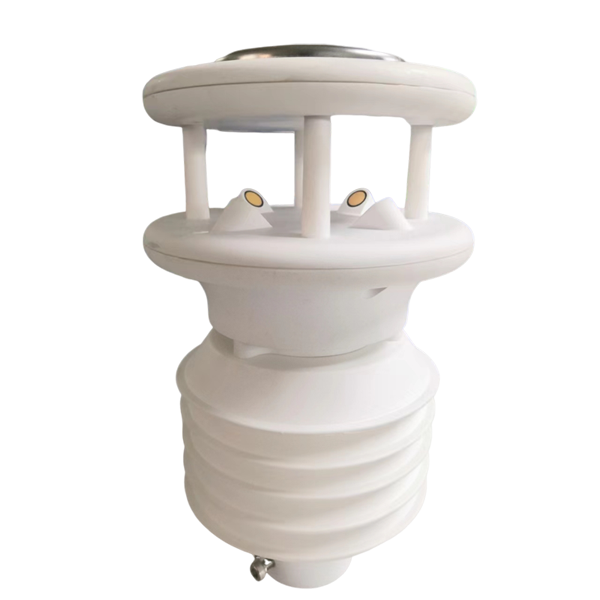
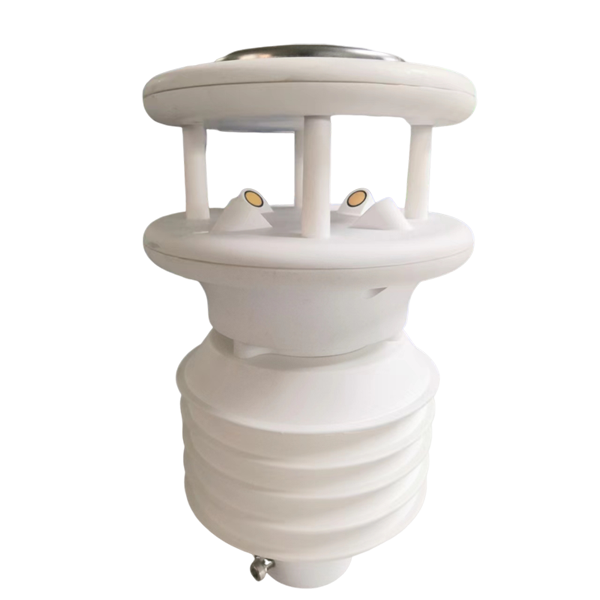
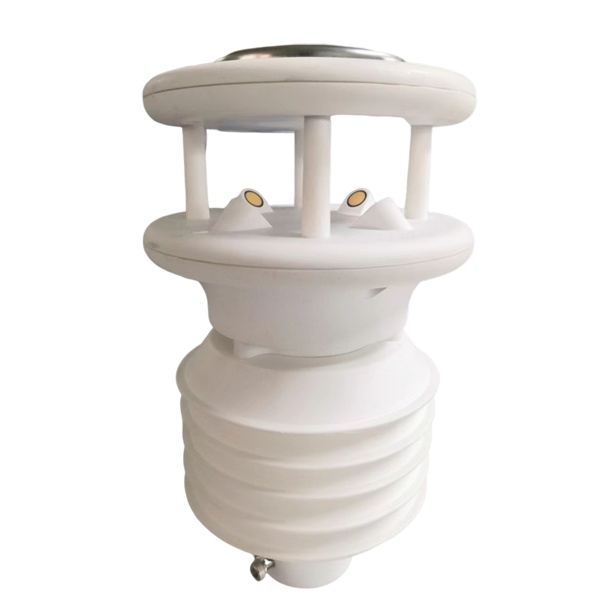
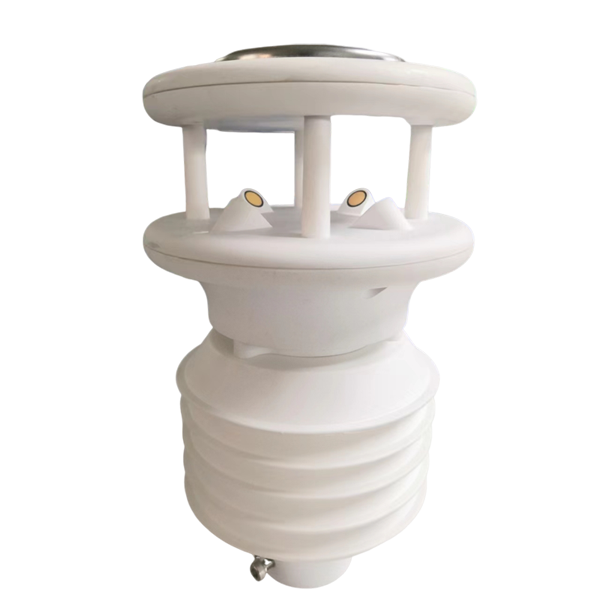
The NiuBoL NBL-W-71GUWS combines wind, air temperature, humidity, pressure and rainfall with either solar irradiance or illuminance. Select the seventh channel explicitly. A light value in lux is not a substitute for irradiance in W/m2 or a dedicated photosynthetic measurement.
The NBL-W-81GUWS has a different purpose: it adds particulate and noise observations to core weather channels. It does not acquire rainfall merely because eight is a larger number than seven. A project requiring rain and particles must specify an arrangement that actually supplies both.
| Configuration | Selected technical data | Decision before ordering |
|---|---|---|
| NBL-W-71GUWS | Wind 0-60 m/s; rainfall 0-8 mm/min; alternative irradiance 0-1500 W/m2 or illuminance 0-200,000 lux; RS485 Modbus RTU; IP65 | Choose the light channel and check whether combined exposure suits the monitoring task |
| NBL-W-81GUWS | Wind 0-60 m/s; PM2.5 0-1000 micrograms/m3; PM10 0-2000 micrograms/m3; noise 30-130 dB; RS485 Modbus RTU; IP65 | Identify any separate rainfall or radiation requirement; method suitability is not established by range alone |
Keep the complete error specification with each chosen channel. A broad wind range does not demonstrate a particular gust response, and a noise display does not establish a regulated acoustic measurement. Where a project requires a named method or reporting indicator, qualify that duty before choosing the sensor package.
A common architecture is sensors to a local data logger, followed by the selected radio, cellular or wired uplink to a private server or monitoring application. A wired RS485 connection between the sensing head and logger can allow the head to occupy an exposed position while the enclosure remains accessible.
Define the logger's acquisition job separately from its network job. It must read the actual sensors, assign observation times and provide the required records. The gateway then has to support the receiving application's protocol, authentication and message structure. A successful network connection does not establish that the server has accepted the intended measurements.
Test coverage with the installed antenna, enclosure closed and the intended network. Record antenna location and cable arrangements. A phone signal observed nearby or an advertised radio distance does not demonstrate performance through the site's obstructions, network restrictions and seasonal vegetation.
For a modular station, list the serial devices, analog inputs and pulse channels the logger must support. An RS485 port cannot read a pulse-output anemometer without an appropriate acquisition interface. An analog rain-related input cannot be assumed equivalent to a tipping-bucket contact.
Identify one polling master for each Modbus RTU segment, use unique device addresses and check each model's register definition. Different sensors need not use the same scale, data type or address convention. Adding a second independent master without an appropriate design can disrupt an otherwise working bus.
Also check the final scan schedule. More devices can increase acquisition time, while some instruments update more slowly than the host polls. Repeatedly reading an unchanged register does not create a new weather observation. Keep measurement time distinct from upload time in the receiving records.
A mixed station needs clear names for overlapping channels. If both an integrated head and a separate wind instrument are installed, retain their location and height identities. Do not silently substitute one for the other when a reading is missing; they may represent different exposure.
The NiuBoL NBL-W-SS cup anemometer provides a separate wind-speed measurement. Wind direction requires another suitable channel. Select its range and ordered electrical output before assigning logger terminals; the product's available outputs are alternatives, not evidence that one unit supplies all of them simultaneously.
| NBL-W-SS item | Configuration detail |
|---|---|
| Wind-speed range | 0-45 or 0-70 m/s |
| Accuracy | +/-(0.3 + 0.03V) m/s, where V is wind speed |
| Starting speed and resolution | At or below 0.5 m/s; resolution 0.1 m/s |
| Output choices | RS485 Modbus RTU, 4-20 mA, voltage or pulse configuration |
| Supply | 5 V DC or 12-24 V DC, depending on the selected output |
| Operating temperature and protection | -40 to 80 degrees C; IP65 |
| Cable | Standard 2.5 m; specify extensions and jacket requirements for the route |
For a pulse input, use the conversion belonging to the ordered sensor rather than an assumed pulses-per-unit relationship. For an analog input, match the span at both ends. For RS485, verify a live value through the actual register map. These are different commissioning tests.
Specify whether the logger must continue acquisition without the remote platform and how staff will retrieve those records. Storage hardware alone does not prove a usable retention period, export format or automatic retransmission. Demonstrate the required behavior with a controlled interruption.
On reconnection, check observation timestamps, gaps and duplicate handling. A delayed rainfall record must not become new rainfall at the reconnection time. If the logger restarts, verify its clock and counter behavior before using the data in accumulated totals.
Define averaging by quantity. A wind gust needs a stated sampling and reporting basis; rainfall amount and rainfall intensity are different results. Ordinary arithmetic averaging of 359 and 1 degrees produces an incorrect southerly direction. Confirm the supported calculation rather than applying one averaging rule to every channel.
Prepare a load schedule for sensors, logger, modem and any heating or other auxiliaries. Evaluate running, startup and transmission demands separately. A low-power sensing head does not establish low whole-station energy use, particularly where a weak connection causes repeated transmission attempts.
Solar sizing needs local seasonal conditions, usable battery capacity and required autonomy. A battery rating in ampere-hours is incomplete without voltage and permitted operating conditions. Reducing uploads can reduce one load, but does not necessarily reduce a continuously powered sensor's consumption.
Compare service interruptions as well as installation labor. Removing an integrated head can interrupt several measurements; a separate instrument may be replaced independently. On the other hand, modular equipment adds exposed connections to inspect. Choose the arrangement that can be serviced safely at this site, not the largest channel list.
Retain the sensor schedule, output versions, cable routes and location photographs with the station record. When requesting a quotation, send NiuBoL that schedule together with the proposed positions, power source, network and required offline behavior. Separate equipment supply, application integration and site installation in the comparison.

No. Many systems use wired sensors connected to a logger and a wireless uplink from that logger. Identify both links in the proposed architecture before deciding cable routes and installation positions.
Use separate instruments when measurements need different positions, heights or independent replacement access. An integrated head is useful when its channels can share suitable exposure and the resulting service interruption is acceptable.
Only after comparing the named channels. The configurations discussed here differ: the 81GUWS includes particles and noise, while the 71GUWS includes rainfall and a selected light channel. Parameter count alone does not establish interchangeability.
Disconnect the uplink under an agreed test procedure while leaving acquisition powered. Check retained observations and their timestamps, then verify export and reconnection behavior. Test a separate power restart; network recovery and power recovery are not the same event.
A weather measurement and remote dashboard do not constitute an engineered protective system. Any shutdown function requires suitable sensing performance, local control, fault handling and a design accepted for that duty. Do not depend on an unqualified public upload path.
Match the measurements, ranges, output versions, logger inputs, communications, power and service provisions. A sensing-head price excludes functions that a complete station may include. Ask for an itemized offer against the same station drawing rather than a single generic package label.
Specify a professional wireless weather station from the measuring positions outward. Select the sensing arrangement, verify logger inputs and calculations, then qualify the uplink and offline record. NiuBoL compact and modular components can be compared against that design without assuming that every sensor is wireless or that a larger parameter count supplies the required observations.
Prev:COD Sensor SCADA Integration: Decode Values and Validate Tags
Next:Water Quality Sonde or Separate Probes? Compare Service Downtime
Related recommendations
Sensors & Weather Stations Catalog
 Agriculture Sensors and Weather Stations Catalog-NiuBoL.pdf
Weather Stations Catalog-NiuBoL.pdf
Agriculture Sensors Catalog-NiuBoL.pdf
Water Quality Sensor Catalog-NiuBoL.pdf
Related products
 Combined air temperature and relative humidity sensor
 TDR Soil Moisture & Temperature Sensor for irrigation| RS485 |4-20mA| NBL-S-THR
 Soil pH sensor RS485 soil Testing instrument soil ph meter for agriculture |NBL-S-PH Wind Speed sensor Output Modbus/RS485/Analog/0-5V/4-20mA
 Tipping bucket rain gauge for weather monitoring auto rainfall sensor RS485/Outdoor/stainless steel
 Pyranometer Solar Radiation Sensor 4-20mA/RS485


Screenshot, WhatsApp to identify the QR code
WhatsApp number:+8615367865107
(Click on WhatsApp to copy and add friends)

