





— Blogs —
—Products—
 Consumer hotline +8618073152920
 WhatsApp:+8615367865107
Address:Room 102, District D, Houhu Industrial Park, Yuelu District, Changsha City, Hunan Province, China
Product knowledge
Time:2026-09-05 16:00:00 Popularity:206
A river water quality monitoring system is only useful when a change in its record can be traced to a place and acted on. A station at a convenient bridge may be easy to power but may miss a tributary, a drain or a stratified reach. Begin with the decision: detect an upstream change, check a discharge influence, follow a restoration project or provide continuous context for periodic samples. The purpose determines the sites and sensors.
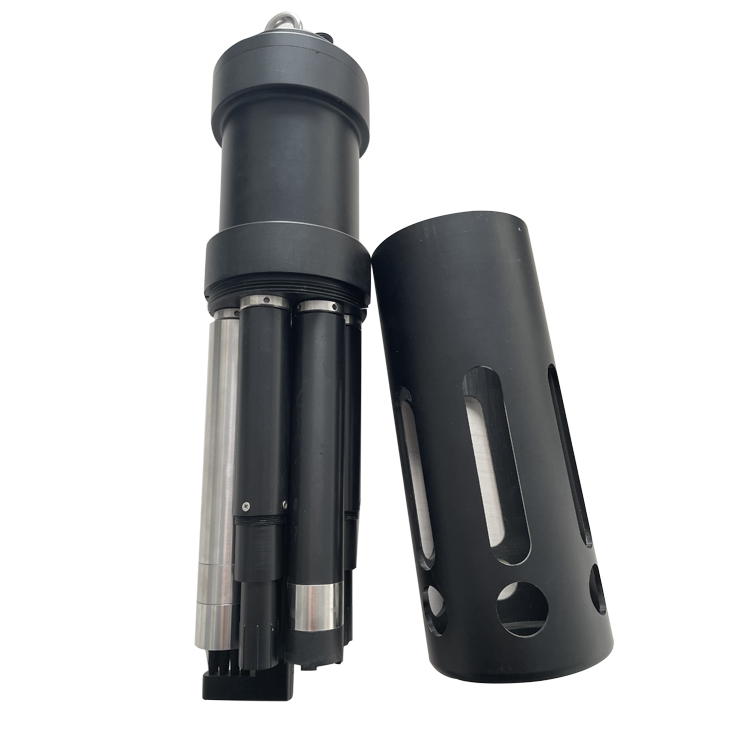
Mark tributaries, outfalls, abstractions, weirs and accessible cross-sections on a map. Walk the proposed sites in normal flow and, where safe, after rain. Record depth variation, bank access, floating debris, silt, sunlight and the highest credible water level. A single bank-mounted probe can describe its immediate water, not the whole cross-section. Where the river is poorly mixed, decide whether a second depth or opposite-bank measurement is justified before buying additional analytes.
Place an upstream reference above the influence of interest and a downstream point far enough below it for the flow to mix, without introducing another major source between them. For an urban reach, rainfall and level context help explain changes in conductivity and turbidity. For a restoration reach, repeated paired measurements and matched grab samples are more useful than an isolated dashboard number. Neither arrangement replaces the laboratory method required by a permit or research protocol.
| River question | Useful online signal | What the signal cannot establish alone |
|---|---|---|
| Did runoff or sediment enter the reach? | Turbidity with rainfall and water-level context | Turbidity is not a universal suspended-solids concentration; establish a site-specific relation if TSS is needed. |
| Did mineral-rich or saline water enter? | Conductivity and temperature | Conductivity does not identify the individual ions or the source. |
| Is oxygen stress developing? | Dissolved oxygen, temperature and time of day | A single daytime reading can miss a pre-dawn minimum. |
| Is a discharge suspected? | pH, conductivity, turbidity, DO and targeted analytes | Confirm the cause and concentration with sampling and the appropriate reference method. |
For many screening stations, temperature, pH, conductivity, DO and turbidity form a defensible starting set. Add ammonia, UV-based organic indicators, ORP or other analytes only where an identified event or operating decision needs them. The station's output must be named accurately: a UV-derived COD-equivalent estimate is not automatically the result of a laboratory dichromate method. If a parameter cannot be maintained or compared at that site, more channels may create more uncertainty rather than more evidence.
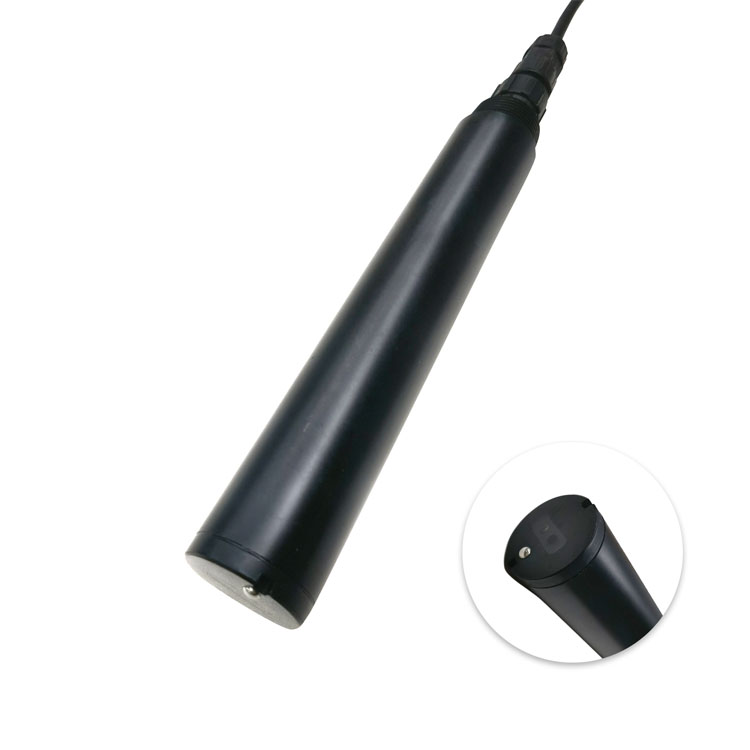
NiuBoL's NBL-WQ-MPS-5A self-cleaning multiparameter sensor combines selectable channels on one RS485 Modbus RTU interface. It is attractive where a compact submerged assembly and planned retrieval are possible. Its brush can reduce surface deposits, but it does not eliminate sensor-specific calibration, inspection or a reference-sampling program. In very shallow water, a large head may be hard to keep submerged; in debris-heavy water, the holder and protective cage may matter more than the number of built-in channels.
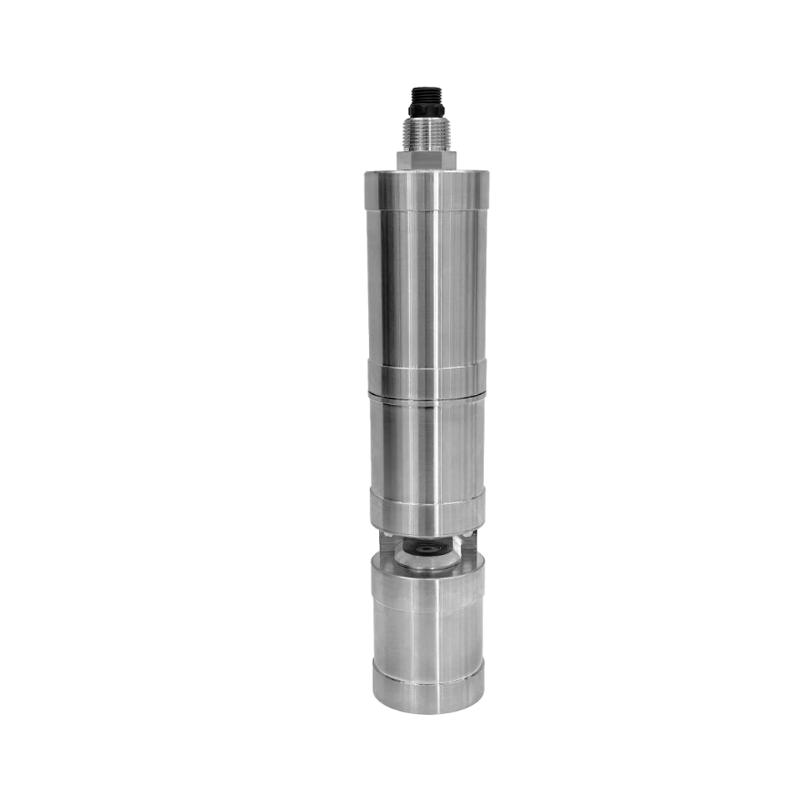
Separate probes can be easier to position and replace where only two parameters are needed or where cleaning duties differ. They also mean more mounts, cables and potential water-entry points. Compare the complete installation, not just the price of the wet-end instruments. The third and fourth photos show another NiuBoL multiparameter configuration; its channel count and limits should not be inferred from the MPS-5A specification below.
| NBL-WQ-MPS-5A published item | Reference value | Selection implication |
|---|---|---|
| Configured capacity | Up to eight parameters including temperature | List the selected modules explicitly in the RFQ. |
| DO | 0-20 mg/L; ±0.4 mg/L; 0.01 mg/L resolution | Check the required low-oxygen decision threshold. |
| pH | 0-14 pH; ±0.1 pH; 0.01 pH resolution | Allow access for buffer checks. |
| ORP | -1500 to +1500 mV; ±6 mV; 1 mV resolution | Use as a process indicator, not a direct concentration measurement. |
| Power and output | 12 VDC ±5%; 5 W at 12 V; RS485 Modbus RTU | Budget cleaning power and test the logger map. |
| Cable and cleaning | 5 m standard cable; configurable automatic cleaning | Confirm cable route, wet joints and brush service access. |
These are module-specific figures, not a blanket accuracy for the station. Confirm the delivered combination, water compatibility and documentation before approval. The enclosure, gateway, power supply and mounting hardware are separate design decisions; a waterproof probe does not make its cable joint or cabinet waterproof.

Fix the holder where the probe remains below the expected low-water line but above bed sediment. A hinged arm or retrievable rail can make service possible without entering fast water. Keep the sensing surfaces clear of the structure itself and leave room to remove the cover and brush. In channels with floating branches, protect the instrument without enclosing it in stagnant water. Photograph the as-built position against a stable site reference so future teams can detect movement.
At the bank, separate the wet assembly, junction, data logger and telemetry enclosure. Route cable above flood exposure where possible; provide strain relief and sealed glands. Lightning and surge protection must be designed for the mast, power feed and signal route. Check actual solar-battery autonomy against the sensor's 5 W operating demand, cleaning duty, logger, modem, upload interval and the site's low-sun period. A generic panel wattage printed on a quotation is not an autonomy calculation.
RS485 is the sensor bus, not a guarantee that the platform will understand the data. The integrator needs the delivered register map, address, baud rate, data type, scaling, units and fault values. Log raw values and timestamps before applying dashboard smoothing. Test a disconnected probe, failed cleaning cycle, low battery and delayed upload; each should appear as a distinct state rather than a plausible held value.

First compare the installed sensor with field checks and matched samples at the same location and time, after readings have stabilized. Document the reference method, temperature, sample depth and any laboratory delay. Then examine a complete day of data for flat lines, clock offsets and missing intervals. A turbidity rise during rain may be real; a simultaneous step in every channel after a power restart may be a system artifact. The commissioning record should show how those two cases are distinguished.
Set alert thresholds only after reviewing baseline variation and expected events. For dissolved oxygen, time-of-day and water temperature matter. For conductivity, compare upstream and downstream levels before assigning a source. An alarm needs an owner, a response time and a sampling or inspection step. Use site-specific thresholds in the operating procedure rather than copying limits from another river.
Ask for an itemized sensor configuration, protective holder, cleaning parts, cable length, junctions, logger or RTU, cellular or wired gateway, enclosure, power system, surge protection, mounting hardware, commissioning and spares. Provide river width and depth range, flood level, access photographs, likely fouling, water chemistry, target parameters, data interval, platform interface and the required sampling standard. NiuBoL can then quote the wet-end package and identify what the civil and integration contractor must provide.
The fifth image shows a different full-spectrum water-quality product family. It can be considered where spectral indicators are required, but it is not an automatic substitute for the selected MPS-5A modules or for laboratory confirmation. Request the exact output definitions and a field correlation plan before treating unlike methods as equivalent.
Q1. Where should the first two river stations go?
A1. Use one above and one below the influence being tested, with enough downstream mixing and no new major source between them. Check accessibility and low-water submergence before fixing coordinates.
Q2. Can one bank-mounted sensor represent the full river?
A2. Only after the reach has been assessed for mixing and depth variation. A stratified or broad cross-section may need additional measurements or a sampling traverse.
Q3. Is self-cleaning enough for unattended operation?
A3. No. The brush reduces deposits on accessible surfaces; inspect the cover, replace worn parts and compare each channel with a suitable reference on a site-driven schedule.
Q4. Do we need COD in every station?
A4. No. Define the event it must detect and the method that generates the COD-related result. Use targeted sampling when a laboratory COD value is required.
Q5. What must be checked on the Modbus interface?
A5. Verify the delivered register map, device address, serial settings, data type, units, timestamps and fault values at the final logger and platform. A successful bus response alone does not prove correct engineering units.
Q6. How should a solar-powered quotation be compared?
A6. Compare the full load budget, cleaning and modem duty, worst-season solar input, battery autonomy and site access for maintenance. Probe-only power figures omit the rest of the station.
Q7. What is acceptable evidence at handover?
A7. Retain as-built photos, installed depth, serial numbers, configuration, functional fault tests, reference comparisons and a continuous initial data record. Define tolerances and methods before installation.
A river water quality monitoring system should be specified from the river process outward: site pair, parameter question, maintainable wet-end installation and traceable data path. Send NiuBoL the site and method details for a model-specific proposal, then accept the station against representative samples and end-to-end fault behavior.
Prev:Fluorescence Dissolved Oxygen Sensor Maintenance: Cap Life, Fouling and Calibration
Next:ORP Interpretation in Water Treatment: Trends and Control Limits
Related recommendations
Sensors & Weather Stations Catalog
 Agriculture Sensors and Weather Stations Catalog-NiuBoL.pdf
Weather Stations Catalog-NiuBoL.pdf
Agriculture Sensors Catalog-NiuBoL.pdf
Water Quality Sensor Catalog-NiuBoL.pdf
Related products
 Combined air temperature and relative humidity sensor
 TDR Soil Moisture & Temperature Sensor for irrigation| RS485 |4-20mA| NBL-S-THR
 Soil pH sensor RS485 soil Testing instrument soil ph meter for agriculture |NBL-S-PH
 Wind Speed sensor Output Modbus/RS485/Analog/0-5V/4-20mA
 Tipping bucket rain gauge for weather monitoring auto rainfall sensor RS485/Outdoor/stainless steel
 Pyranometer Solar Radiation Sensor 4-20mA/RS485

Screenshot, WhatsApp to identify the QR code
WhatsApp number:+8615367865107
(Click on WhatsApp to copy and add friends)

