





— Blogs —
—Products—
 Consumer hotline +8618073152920
 WhatsApp:+8615367865107
Address:Room 102, District D, Houhu Industrial Park, Yuelu District, Changsha City, Hunan Province, China
Product knowledge
Time:2026-09-10 17:00:00 Popularity:208
Quick Answer: Small water quality buoy deployment starts with the measuring depth, seasonal water levels and a safe retrieval route, not with the number of sensor channels. The mooring must keep the instrument clear of the bed and navigation routes while allowing water-level movement. Size the power system for the actual probes, cleaning cycles and communications duty, then test the complete assembly before launching it.
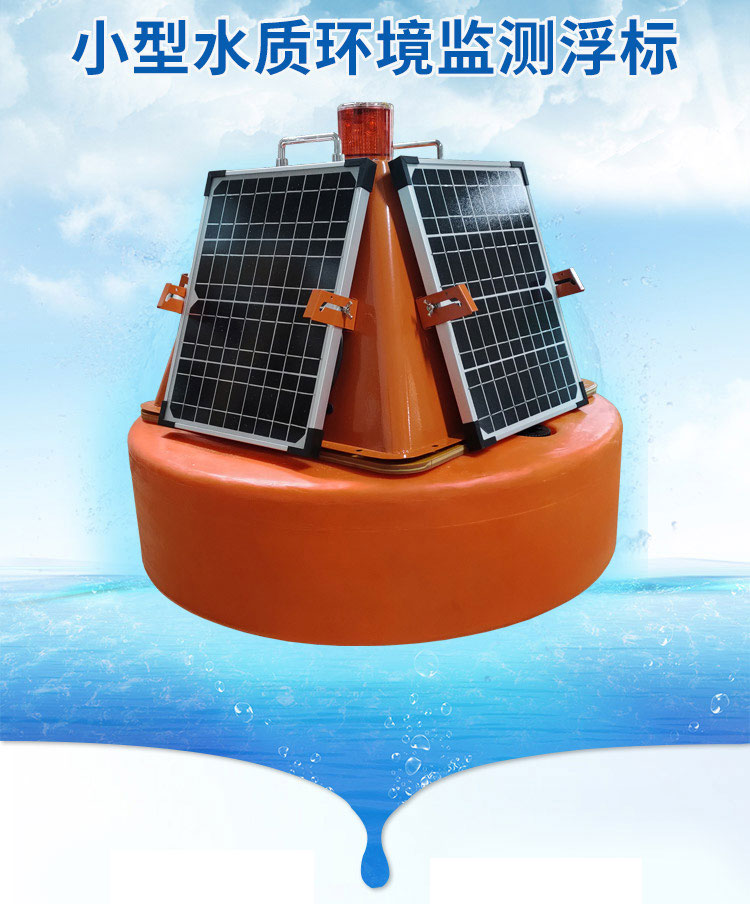
A buoy follows the surface. Its suspended sensor therefore normally observes a depth below that surface, rather than a fixed elevation above the bed. This is useful for tracking conditions in a surface layer, but it cannot describe an entire stratified reservoir. If the project needs a vertical profile or a bottom-water warning, specify additional depths or another mounting arrangement.
Place the monitoring point according to the management question. A fish pond may need conditions in the occupied water layer away from direct aerator disturbance. An intake project may need a location hydraulically related to the intake. A lake survey may need several representative locations. Convenience of shore access alone does not establish representativeness.
Before selecting the hull, record water depth at low and high seasonal levels, current direction, wave exposure, floating vegetation, vessel traffic and any restrictions on anchors or markers. Obtain the required permissions locally. A compact buoy is not automatically suitable for an exposed coast, a shipping route or a channel carrying flood debris.
Check the vertical clearance between the lowest part of the instrument or guard and the bed at the minimum water level. For example, with 2.0 m of water, a sensing assembly extending 0.8 m below the surface has 1.2 m clearance before accounting for waves, tilt and sediment accumulation. If the level falls by 1.5 m, that arrangement grounds. These are illustrative dimensions, not a rating for a NiuBoL buoy.
| Site condition | Deployment consequence |
|---|---|
| Large seasonal level change | Review mooring slack and excursion throughout the full level envelope |
| Soft sediment or uneven bottom | Select an anchor arrangement for the actual bed and retrieval method |
| Strong current or wave action | Have a competent designer assess loads, fatigue, attachments and hull stability |
| Floating weed or fishing activity | Provide clearance and inspection access; assess snagging and entanglement |
| Boats or public access | Review permitted location, identification and navigation marking requirements |
Do not set an anchor weight or mooring length from buoy diameter alone. The loaded hull, exposed area, current, waves, seabed and permitted excursion all matter. A taut line can pull the buoy down as water rises; excessive slack can allow collision, grounding or cable entanglement. Neither problem is solved by simply buying a heavier anchor.
Keep the electrical cable out of the mooring load path. Use the designated lifting and suspension points for the assembly, with strain relief and enough protected slack for its expected motion. A waterproof connector is not a lifting fitting.
An integrated NiuBoL multi-parameter self-cleaning sensor combines several channels at one location. Separate probes allow individual replacement but require more mounting space, connectors and address management. Compare the assembled dimensions and maintenance method, not just the list of parameter names.
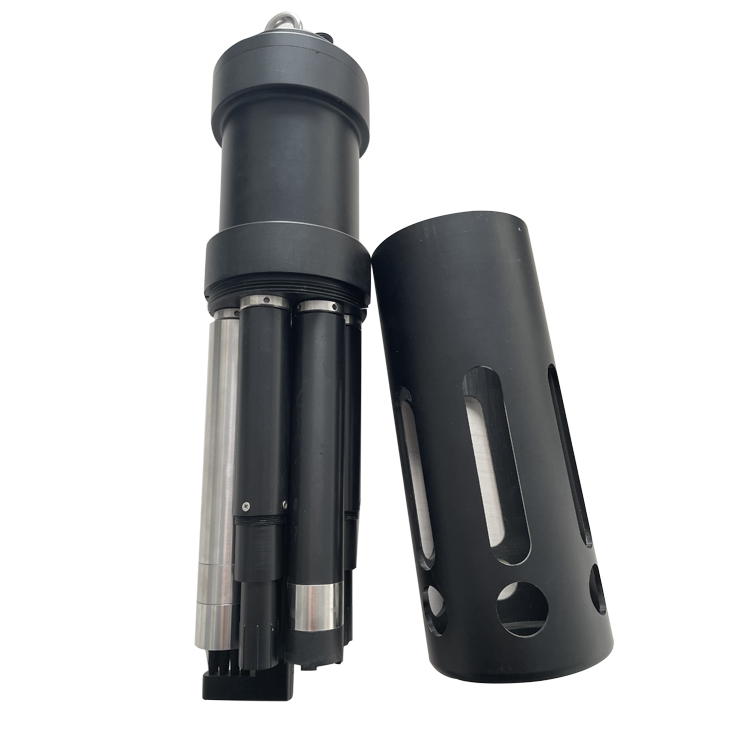
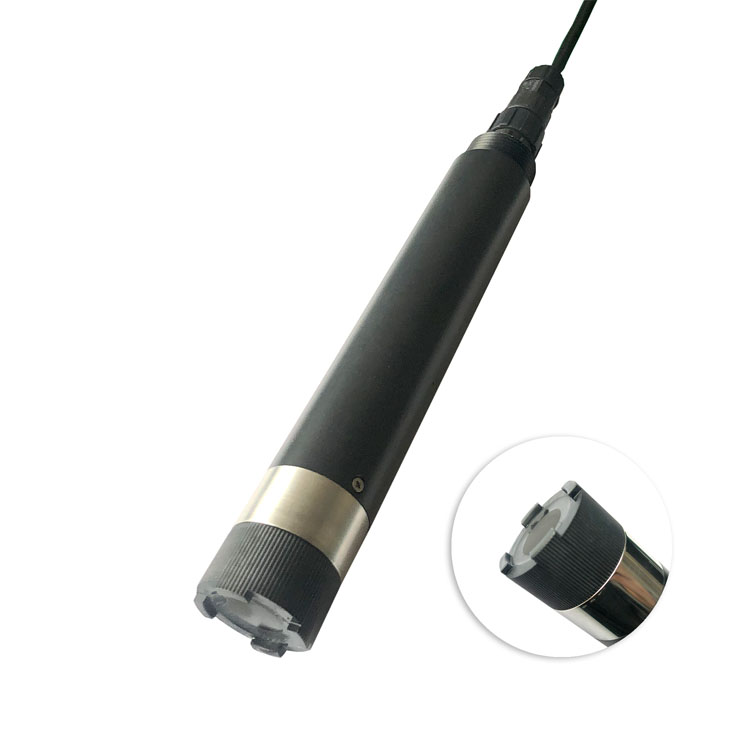
For dissolved oxygen monitoring, keep the sensing face away from trapped air and direct aerator bubbles. An optical DO probe can still need cleaning and compensation settings; its operating principle does not remove those tasks. Confirm whether the configured output is mg/L, percent saturation or both, and use the same quantity in the alarm logic.
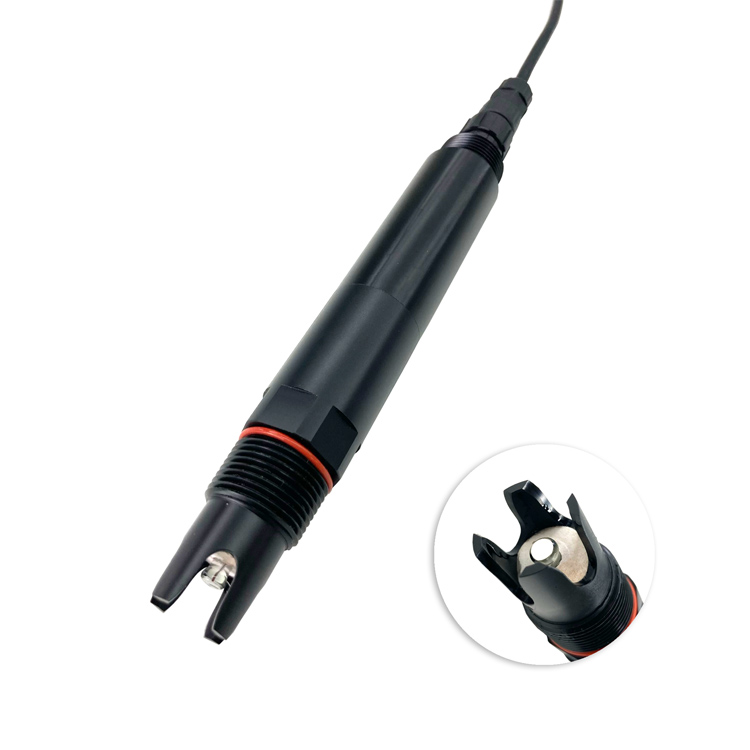
For pH, provide access to the sensing element for cleaning, calibration and replacement. Plan how the instrument will be lifted into a safe work area without dragging other cables or pulling against the mooring. Store and service the electrode according to its own requirements rather than treating every water-quality channel identically.
The NBL-WQ-MPS-5A is one possible sensor assembly, not a specification for the buoy hull. Its product specifications identify the following electrical and measurement options. Final channels depend on the ordered configuration.
| Sensor item | NBL-WQ-MPS-5A value |
|---|---|
| Supply | 12 V DC +/-5% |
| Power consumption | 5 W at 12 V; separately confirm cleaner peak current and duty |
| Communication | RS485 Modbus RTU |
| pH option | 0-14 pH; specified accuracy +/-0.1 pH |
| DO option | 0-20 mg/L; specified accuracy +/-0.4 mg/L |
| Temperature | 0-50 C; specified accuracy +/-0.5 C |
| Cable | Standard length 5 m; confirm sheath, connectors and immersion limits for the site |
Hull payload, complete-station protection, battery capacity, permitted waves and deployment depth must be specified for the assembled system. Do not transfer a probe's immersion rating to the control box or assume that a sensor power figure includes the modem. Saline water also requires a review of wetted materials and electrical isolation, not just an EC range that extends far enough.
As a conservative illustration, a continuously powered 5 W assembly uses 120 Wh per day. If logging and communications average another 1 W, the total is 144 Wh per day. Three days without useful charging require 432 Wh delivered to the loads. At an assumed 80% usable battery fraction and 90% conversion efficiency, nominal battery energy would be 432 / (0.8 x 0.9) = 600 Wh.
This is a calculation example, not a promised autonomy or standard battery. Include cleaning peaks, modem transmissions, low-temperature limitations, battery aging and the solar resource during the least favorable season. At nominal 12 V, 600 Wh corresponds to 50 Ah before any additional design margins. Panel wattage alone says little about recovery after several cloudy days.
If power cycling is proposed to reduce consumption, verify warm-up, stabilization and cleaning requirements for each sensor. A low-power plan that records values before they stabilize can produce a long operating time but poor measurements.
Protective cages should prevent contact damage while allowing representative water exchange. A fine screen that traps algae or sediment can create a different water environment around the sensing faces. Check whether the guard changes turbidity response or creates a bubble pocket as the buoy tilts.
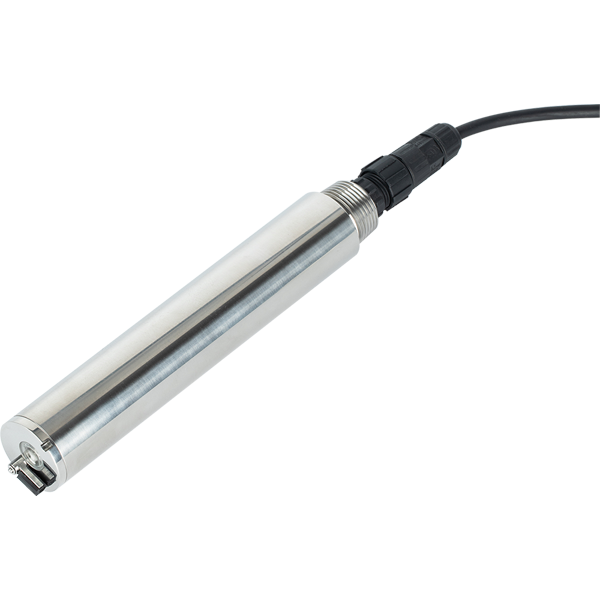
For turbidity, inspect optical surfaces, nearby reflectors and settled material. Record cleaning times so a sudden step after brushing is not automatically classified as an environmental event. Establish the initial visit interval from early inspections; a brush does not justify an unattended maintenance-free claim.
During each visit, compare the as-found value with a suitable field reference before cleaning where practical, then record the post-cleaning result. This distinguishes fouling effects from genuine water changes more usefully than retaining only the final clean reading. Calibration checks need the method and tolerance appropriate to the individual parameter.
Remote transmission comes from a compatible logger and gateway, not from the RS485 interface itself. Distinguish water-quality alarms from low battery, missing packets and failed cleaning. A communication failure should create a station-health event, not a zero DO or zero pH value.

It can serve an in-situ point where a floating mount is suitable and service access is practical. A bank or pumped station may be preferable where navigation, ice, waves or retrieval make a buoy unsuitable. Compare the sampling objective and maintenance method, not only civil-work cost.
The answer depends on payload, mounting space, stability, power and communication capacity. Ask for the configured assembly drawing and loaded specification. A controller's channel count does not prove that the hull can carry every possible probe combination.
No. It observes selected parameters at its location and depth. A plume can pass elsewhere or below the probes. Select locations and additional stations from the expected flow paths and the management response.
No. Inspect fouling, cable condition, calibration and the cleaning mechanism itself. Start with accessible inspections and adjust the service interval from recorded conditions. Different probes on the same buoy may need different maintenance.
Provide the waterbody, seasonal levels, depth, flow and wave exposure, required channels, upload interval and service access. Request separate scope for hull, probes, mooring, power, gateway, spares and deployment. Anchor design and installation should not be assumed included in a probe quotation.
Local logging can preserve observations if the selected logger supports it. Remote notification requires another suitable communication path or restored coverage. Offline storage is not real-time warning.
A successful small water quality buoy deployment keeps the probes in representative water, protects the assembly through changing levels and leaves a workable service route. Send NiuBoL the site envelope and required parameters before selecting the sensor package. The buoy, mooring, power supply and data connection should then be evaluated as one configured installation.
Prev:Compact Ultrasonic Weather Sensor Installation Checklist
Next:Small Weather Station Installation: Siting, Mast and Commissioning
Related recommendations
Sensors & Weather Stations Catalog
 Agriculture Sensors and Weather Stations Catalog-NiuBoL.pdf
Weather Stations Catalog-NiuBoL.pdf
Agriculture Sensors Catalog-NiuBoL.pdf
Water Quality Sensor Catalog-NiuBoL.pdf
Related products
 Combined air temperature and relative humidity sensor
 TDR Soil Moisture & Temperature Sensor for irrigation| RS485 |4-20mA| NBL-S-THR
 Soil pH sensor RS485 soil Testing instrument soil ph meter for agriculture |NBL-S-PH
 Wind Speed sensor Output Modbus/RS485/Analog/0-5V/4-20mA
 Tipping bucket rain gauge for weather monitoring auto rainfall sensor RS485/Outdoor/stainless steel
 Pyranometer Solar Radiation Sensor 4-20mA/RS485

Screenshot, WhatsApp to identify the QR code
WhatsApp number:+8615367865107
(Click on WhatsApp to copy and add friends)

