





— Blogs —
—Products—
 Consumer hotline +8618073152920
WhatsApp:+8615367865107
Address:Room 102, District D, Houhu Industrial Park, Yuelu District, Changsha City, Hunan Province, China
Product knowledge
Time:2026-09-11 14:00:00 Popularity:202
Quick Answer: A smart fertigation system needs separate feedback for the delivered solution and the crop root zone. Liquid EC and pH sensors can inform a compatible dosing controller; soil probes show the response after irrigation. Neither a soil sensor nor an IoT gateway supplies the pump, mixing, filtration or backflow protection required by the hydraulic installation.
Two questions often become confused in a fertigation specification: when a zone needs water, and what solution should be delivered while that zone is irrigated. Root-zone moisture can inform the first decision. Measurements in the mixed irrigation stream can inform the second. A remote dashboard displaying both does not make the two control loops interchangeable.
A practical architecture has a local controller supervising water flow, dosing equipment and process measurements. A field logger can collect soil observations, while a gateway transfers selected records to a farm platform. Keep the local permissions and shutdown behavior defined independently of internet availability.
The greenhouse layout below represents the crop environment, not a complete dosing skid. The skid still needs a hydraulic design around the available flow, pressure, fertilizer solution, filtration and injection equipment. Specify what the sensor supplier, skid builder and installer each supply before comparing package prices.
Place process EC and pH measurements at locations that represent the solution delivered downstream, with suitable mixing and a fully wetted sensing arrangement. Do not install a probe immediately in a concentrated injection plume and assume that its reading represents the whole pipe cross-section.
Determine whether the sensor measures the main line, a mixing tank or a bypass. A bypass adds transport volume and may have a different flow condition. Confirm pressure, temperature, materials and cleaning access for the complete assembly. A threaded immersion probe is not automatically qualified for any pressurized fertilizer line.
For scale, a 30 m pipe with a 50 mm internal diameter contains about 58.9 L. At 6 m3/h, equivalent to 100 L/min, nominal plug-flow transit time is about 35 seconds before allowing for mixing and sensor response. These are illustrative dimensions, not a controller delay setting. A controller that repeatedly increases dosing before the previous change reaches the measurement point can overshoot.
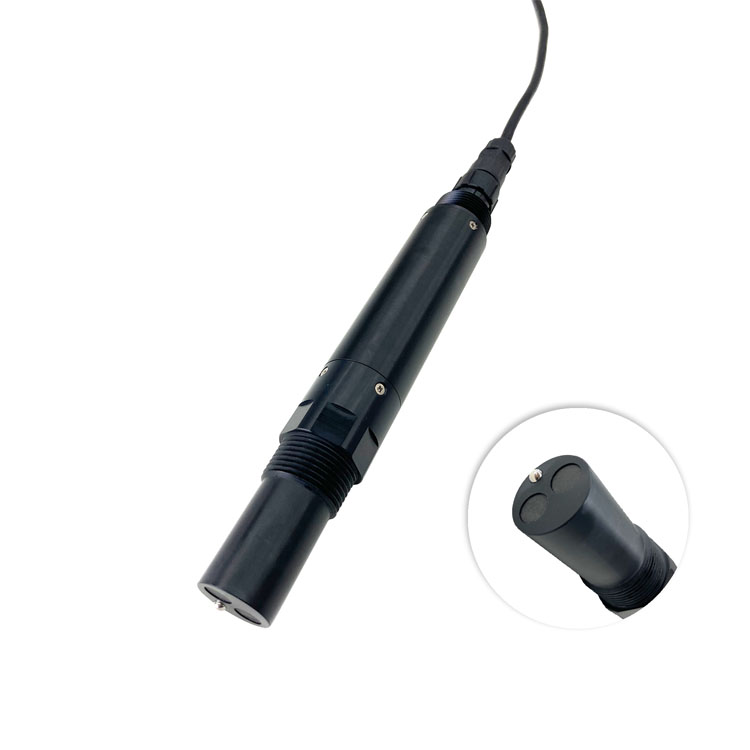
The NiuBoL NBL-WQ-EC liquid conductivity sensor is one possible process input. It differs from a soil EC probe and from other water-quality models with similar names. Its range and materials must match the diluted solution and installation conditions.
| Item | NBL-WQ-EC specification |
|---|---|
| Selected EC ranges | 0-20.00, 0-200.0 or 0-5000 uS/cm; or 0-200.0 mS/cm, according to version |
| EC accuracy | +/-1% F.S. |
| Temperature | Accuracy +/-0.3 deg C; Pt1000 automatic temperature compensation |
| Operating envelope | 0-50 deg C; working pressure below 0.6 MPa |
| Electrical supply | 12-24 V DC +/-10%; consumption 0.2 W at 12 V |
| Output | RS485 Modbus RTU |
| Construction | IP68; wetted material ABS, SUS316L or PVC by configuration; 3/4 NPT mounting |
| Cable | Standard 5 m; confirm required length and sheath for the installation |
On a 0-5000 uS/cm span, 1% F.S. is 50 uS/cm, or 0.05 mS/cm. Use that scale when deciding whether the instrument can resolve a recipe deviation that matters to the process. Do not select the widest available range without checking the resulting uncertainty at the normal operating value.
EC indicates aggregate conductivity, not the concentration of each fertilizer ingredient. Source-water changes and the recipe both influence it. Keep the source-water baseline and the selected temperature-compensation convention with the recipe record. pH needs its own compatible measurement channel, calibration method and process limits.
Soil moisture and salt-related readings help evaluate how water and fertilizer management affect the crop area. They do not directly report the concentration leaving the dosing skid. Locate fixed probes at representative depths and positions relative to emitters, and separate blocks with different soil or drainage behavior.
A portable soil instrument can help investigate a dry sector or compare locations during commissioning. It is not a continuously connected dosing permissive, and its phone connection does not replace a fixed controller. Record where a portable test was taken before comparing it with an installed probe.
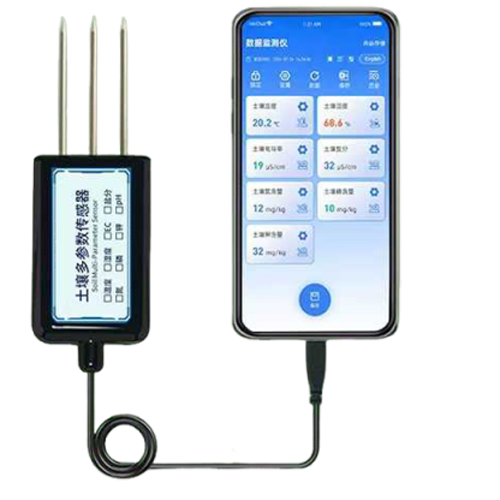
When root-zone EC rises, review water content, fertilizer history, source-water quality and drainage before changing the recipe. A dry soil condition can change the interpretation of conductivity. Do not use one field EC limit to identify an individual nutrient deficiency or to calculate an amendment dose without suitable agronomic analysis.
| Condition | Control question to settle |
|---|---|
| No confirmed irrigation flow | What inhibits injection and identifies a failed flow proof? |
| Process EC or pH outside its operating limit | Which action is allowed, how is the condition confirmed, and who resets the fault? |
| Invalid or stale process measurement | How does the controller distinguish a sensor failure from a real recipe deviation? |
| Zone valve change | How are flow, mixing delay and the next zone's recipe handled? |
| Manual operation | Which protections remain active and how does automatic operation resume? |
These questions belong in the process control design; a general-purpose sensor does not establish a safety-rated protective function. Have the hydraulic designer specify source protection and backflow prevention suitable for the site and local requirements. NC Agriculture's fertigation backflow-prevention guidance describes protective components intended to prevent contamination of the water supply.
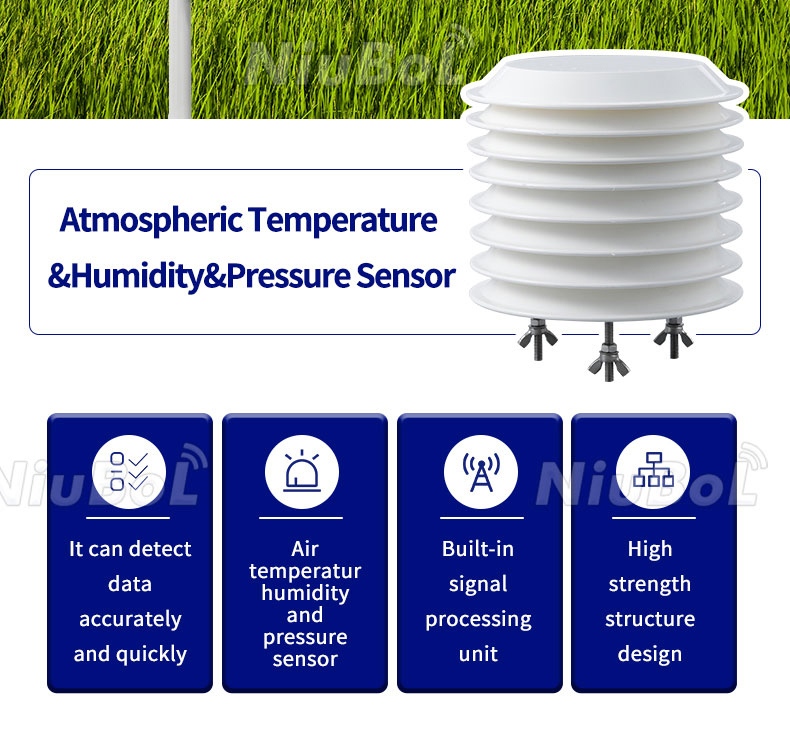
Air temperature, humidity and pressure may provide crop-environment context, but the louvered sensor below is not a liquid EC or pH instrument. Keep its tags separate from the process channels used by the dosing controller.
At the PLC or controller, implement the exact liquid-sensor register map, data types, units and status handling. A soil probe and a liquid probe may both use RS485 Modbus RTU while having different registers and timing. A successful reply is not enough: compare the decoded value with the local test result and ensure that stale data cannot remain indefinitely valid.
Keep local acquisition, recipe execution and remote reporting on defined time bases. During a network outage, a gateway may buffer observations, but it should not invent a completed irrigation event from a command that was never confirmed by flow or valve feedback.
A field station such as the installation below can add environmental context and collect crop-zone measurements. It is a separate part of the architecture from the dosing skid. Identify which local device retains recipes and controls the hydraulic equipment when remote access is unavailable.
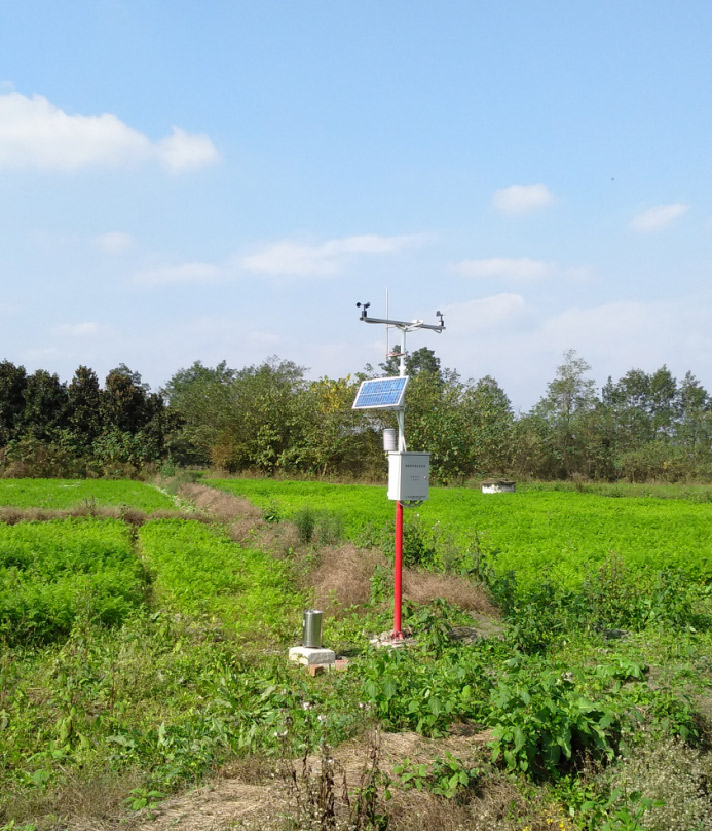
Preserve recipe changes, measured delivery and operator overrides in the event history. Weather observations can help explain changing water demand, but a weather enclosure or atmospheric instrument does not prove fertilizer delivery. Do not use a shared dashboard as a substitute for those separate observations.

Not as a direct measurement of the mixed irrigation stream. Soil EC reflects conditions around the buried probe and depends on moisture and site factors. Use suitable process measurements for the dosing loop and root-zone measurements for field-response review.
No. It measures conductivity. Different dissolved ions contribute to that value, so the same EC does not guarantee the same nutrient composition. Recipe formulation and nutrient verification need appropriate additional methods.
Include normal solution EC, source-water variability and credible deviations. Evaluate full-scale accuracy at the change the controller must detect. Check pressure, temperature and materials independently from the electrical range.
Only according to the specified local controller behavior. Confirm local recipe storage, valid measurement handling and event logging. Remote access is not a substitute for local flow and dosing permissions.
Separate sensing, hydraulic dosing equipment, controller software, communications and installation. Provide flow and pressure ranges, solution conditions, zone layout and existing controller details. A sensor price does not include a complete commissioned skid.
No. Crop stage, substrate or soil, irrigation layout and drainage can require different schedules and recipes. Apply the approved agronomic plan and verify zone identity before allowing automatic delivery.
A smart fertigation system works as an integrated process, with liquid measurements controlling delivery and field observations explaining the result. Select each NiuBoL sensor for its actual medium, range and interface, then verify the hydraulic and controller sequence separately. For a configuration review, provide the process drawing, operating envelope and division between the dosing skid and crop-zone monitoring.
Prev:Plant Growth Sensor Principle and Installation for Field Research
Next:Automatic Groundwater Quality Monitoring Station: Sampling Cycles
Related recommendations
Sensors & Weather Stations Catalog
 Agriculture Sensors and Weather Stations Catalog-NiuBoL.pdf
Weather Stations Catalog-NiuBoL.pdf
Agriculture Sensors Catalog-NiuBoL.pdf
Water Quality Sensor Catalog-NiuBoL.pdf
Related products
Combined air temperature and relative humidity sensor TDR Soil Moisture & Temperature Sensor for irrigation| RS485 |4-20mA| NBL-S-THR
 Soil pH sensor RS485 soil Testing instrument soil ph meter for agriculture |NBL-S-PH
 Wind Speed sensor Output Modbus/RS485/Analog/0-5V/4-20mA
 Tipping bucket rain gauge for weather monitoring auto rainfall sensor RS485/Outdoor/stainless steel
 Pyranometer Solar Radiation Sensor 4-20mA/RS485


Screenshot, WhatsApp to identify the QR code
WhatsApp number:+8615367865107
(Click on WhatsApp to copy and add friends)

