





— Blogs —
—Products—
 Consumer hotline +8618073152920
 WhatsApp:+8615367865107
Address:Room 102, District D, Houhu Industrial Park, Yuelu District, Changsha City, Hunan Province, China
Product knowledge
Time:2026-09-07 16:27:30 Popularity:305
Soil pH determines the acid-base environment in the root zone and affects nutrient availability and microbial activity. Unlike homogeneous water samples, pH measurements in soil are highly dependent on moisture, probe contact, and soil spatial differences, so proper installation and understanding of the data is just as important as the sensor itself.
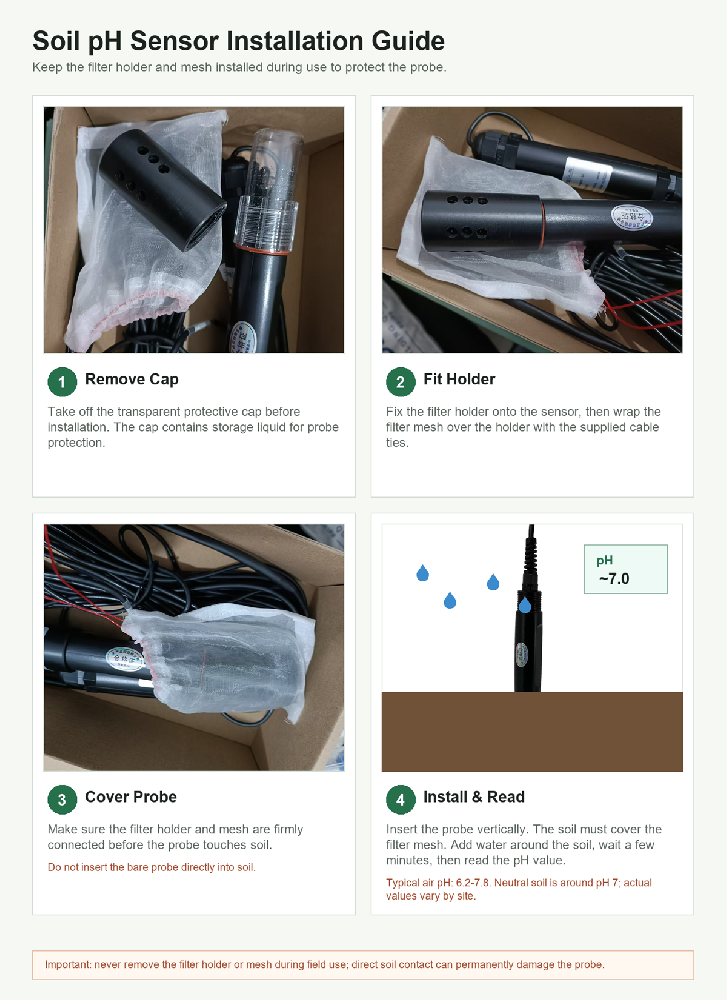
Soil pH sensors are used to measure soil pH. Common products use the electrode method to form an electrochemical response with the wetted soil through the sensitive electrode and reference system, and then convert the potential related to the activity of hydrogen ions to the pH value. Different models may use glass electrodes, composite electrodes, or metal electrode structures for rapid in-situ detection.
Electrode measurements require stable conduction of ions in the aqueous phase. If the soil is too dry and there is a lack of continuous water film around the electrode, the readings may respond slowly, drift or become unrepresentative. There is no fixed VWC threshold for all soils; more importantly, the soils have sufficient moisture to allow the electrodes to form stable, sufficient ionic contact with the medium.
The online water-quality pH usually uses glass electrodes, which can be calibrated at one or two points using standard buffers such as pH4.01, 7.00, and 10.01, and combined with temperature compensation. The structure and transmission method of the soil in situ pH probe may be different. Some models are calibrated by the factory and do not provide user on-site buffer calibration.
Therefore, the ability to calibrate in the field must be based on the calibration design of the specific model. The operating procedure of the water quality pH electrode cannot be applied directly to all soil pH probes.
The life of the soil pH probe is affected by pH, contamination, mechanical wear, soil particles, cleaning methods and frequency of use and does not have a fixed replacement life for all sites. When the response becomes significantly slower, the reading continues to drift, or deviates from the reference soil sample for a long time, the moisture, contact, power supply and cables should be checked first, and then the electrode status should be evaluated.
When high accuracy is required, soil samples from the same area can be taken regularly for standard laboratory tests to check long-term drift and establish on-site correction relationships.
If the measurement object is water, nutrient solution, circulating solution or pressure line, and standard buffer calibration, automatic temperature compensation or continuous liquid monitoring is required, a dedicated water quality pH sensor should be selected. The application environment of the soil pH probe and the water quality pH probe is different, and it should not be considered completely interchangeable because the measuring range is 0–14 pH.
NBL-S-PH provides in-situ measurement of soil pH and has different output schemes such as RS485, 4-20mA, or 0-5V; multi-parameter soil sensors can also be selected when monitoring with moisture, EC, salt, and NBL-S-PH5.
Refer to NiuBoL NBL-S-TMC-8 8-in-1 Soil Sensor, NBL-S-TMC-7 7-in-1 Soil Sensor, NBL-S-TMC-8 8-in-1 Soil Sensor.
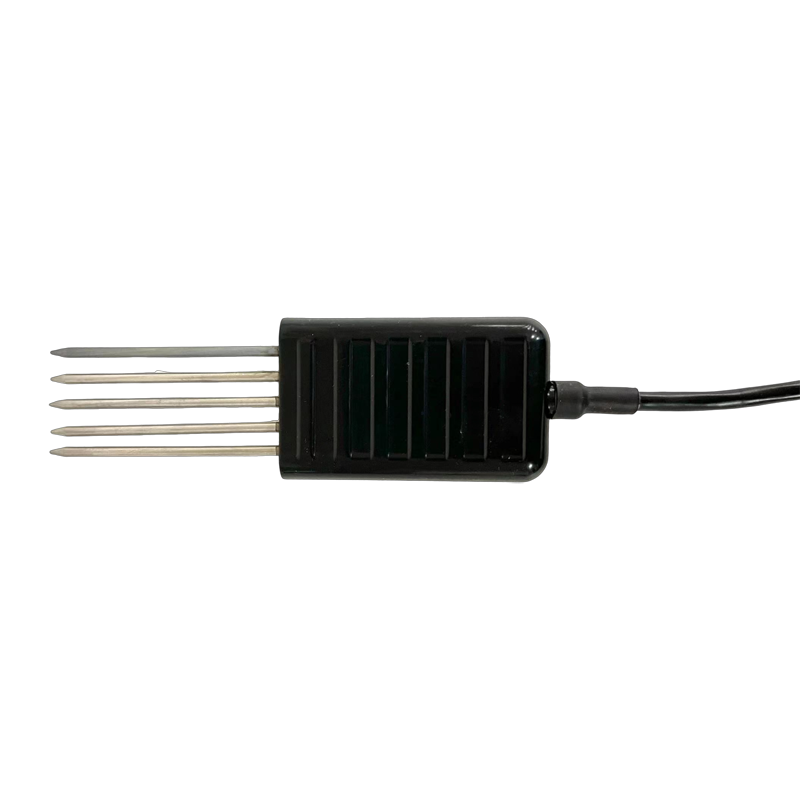
A1: There is no fixed VWC threshold for all soil types. The focus of the measurement is that the soil has sufficient moisture to allow the electrode to form stable ionic contact with the medium.
A2: Depends on whether the specific model supports user calibration. For models that do not support on-site calibration, long-term drift can be periodically verified by reference soil samples or laboratory tests.
A3: Drift or a value corresponding to a potential may occur, but the air reading has no meaning for soil pH, and should be evaluated under specified media and stable contact conditions.
A4: It is not recommended to use the soil type probe as An online water-quality pH electrode for a long time. Special water quality pH products should be selected for continuous water quality monitoring.
A5: Moisture, salinity, fertilizer concentration, stones, air gaps and poor probe contact can affect the apparent value. Compare readings only after using a consistent installation method and representative soil condition.
A6: Use the calibration or reference method specified for the selected model, clean the sensing surface and document the reference material, temperature, stabilization time and result. Do not infer calibration from one field reading.
A7: It can when supply, output and protocol match the host. For RS485 Modbus RTU, confirm address, baud rate, register, data type, decimal scaling and engineering unit before commissioning.
A8: Provide soil type, expected pH range, installation method and depth, measurement frequency, power, output, cable length, logger or platform scope, quantity and the required acceptance records.
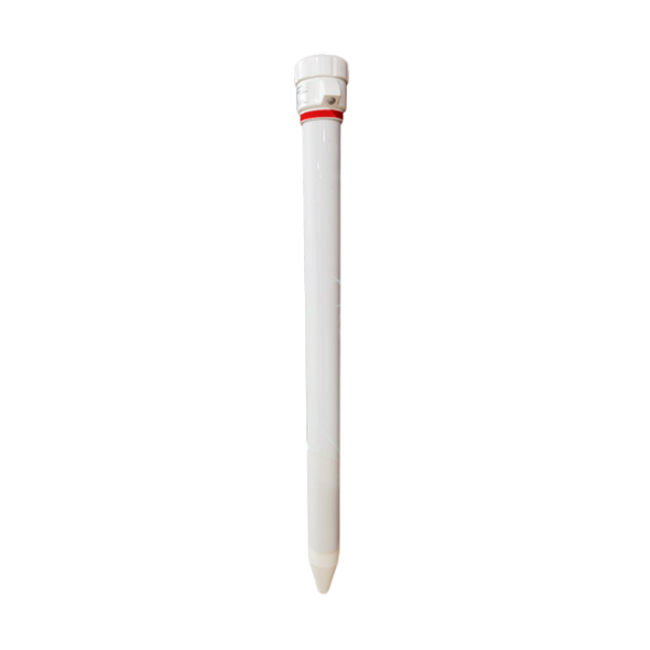
For Soil pH Sensor Guide Principle, the project specification should connect site conditions, interface settings, commissioning checks and maintenance records. Acceptance check for electrochemical water-quality measurement: Confirm those boundaries before model approval, then retain the measured acceptance evidence for later troubleshooting and system expansion.
Prev:Soil NPK Sensor Guide: Principle, EC Conversion, Accuracy and Fertilizer Use
Next:Multi-Parameter Soil Sensors: 2-in-1, 3-in-1, 7-in-1 and Handheld Options
Related recommendations
Sensors & Weather Stations Catalog
 Agriculture Sensors and Weather Stations Catalog-NiuBoL.pdf
Weather Stations Catalog-NiuBoL.pdf
Agriculture Sensors Catalog-NiuBoL.pdf
Water Quality Sensor Catalog-NiuBoL.pdf
Related products
 Combined air temperature and relative humidity sensor
 TDR Soil Moisture & Temperature Sensor for irrigation| RS485 |4-20mA| NBL-S-THR
 Soil pH sensor RS485 soil Testing instrument soil ph meter for agriculture |NBL-S-PH
 Wind Speed sensor Output Modbus/RS485/Analog/0-5V/4-20mA
 Tipping bucket rain gauge for weather monitoring auto rainfall sensor RS485/Outdoor/stainless steel
 Pyranometer Solar Radiation Sensor 4-20mA/RS485

Screenshot, WhatsApp to identify the QR code
WhatsApp number:+8615367865107
(Click on WhatsApp to copy and add friends)

