





— Blogs —
—Products—
 Consumer hotline +8618073152920
WhatsApp:+8615367865107
Address:Room 102, District D, Houhu Industrial Park, Yuelu District, Changsha City, Hunan Province, China
Product knowledge
Time:2026-08-17 09:01:00 Popularity:264
Quick answer: Solar irradiance meter price depends on more than the sensor housing. Compare the detector and optical construction, output version, calibration information, mounting and receiving input as one measurement channel. For the NiuBoL NBL-W-HPRS, raw millivolt and conditioned-output versions have different integration requirements. Request a current itemized quotation for the selected configuration rather than treating every irradiance instrument as an interchangeable W/m2 device.
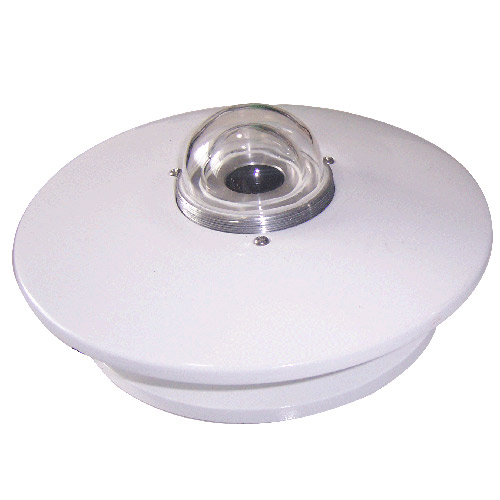
For a photovoltaic project, identify whether the sensor will measure irradiance in the module plane or on a horizontal reference surface. For meteorology, define the required exposure and recording interval. A portable survey instrument, a permanently mounted pyranometer and a complete weather station are different purchases.
The HPRS uses a thermoelectric sensing principle for broadband solar radiation. Its spectral range is not a resolved spectrum, and the instrument should not be quoted as a direct-normal irradiance tracker, a PAR sensor or a complete radiation-component measurement system without the appropriate separate equipment.
State any required performance classification and calibration evidence before price comparison. A glass dome, a broad spectral range or a high-resolution logger does not by itself establish that a particular classification has been met.
| HPRS characteristic | Specification | Quotation consequence |
|---|---|---|
| Measurement range | 0-2000 W/m2 | Match the receiving span and expected exposure |
| Spectral range | 0.3-3 um | Broadband irradiance, not a spectrum or PPFD measurement |
| Sensitivity | 7-14 uV per W/m2 | Use the individual instrument's calibration sensitivity for raw-output conversion |
| Output versions | 4-20 mA; 0-2.5 V; 0-5 V; 0-20 mV; optional RS485 | Specify one version and obtain its electrical and scaling definition |
| Supply options | 5 VDC, 12 VDC or 24 VDC according to configuration | Confirm the actual version; do not assume one universal supply |
| Response | Up to 35 s to 99% | Not a T90 value and not proof of rapid transient tracking |
| Annual stability | At or below +/-2% | Not a complete statement of measurement uncertainty |
| Operating temperature | -40 to 50 C | Check site conditions and mounting exposure |
| Power, IP and cable details | Confirm consumption, protection grade, cable length and jacket for the order | Match the required outdoor installation and field power budget |
A raw millivolt version needs a receiving input suited to a small differential signal and its expected maximum output. A conditioned voltage or current version moves some signal processing into the instrument assembly. RS485 requires the actual protocol, register map and units; the interface label alone does not establish Modbus RTU compatibility.
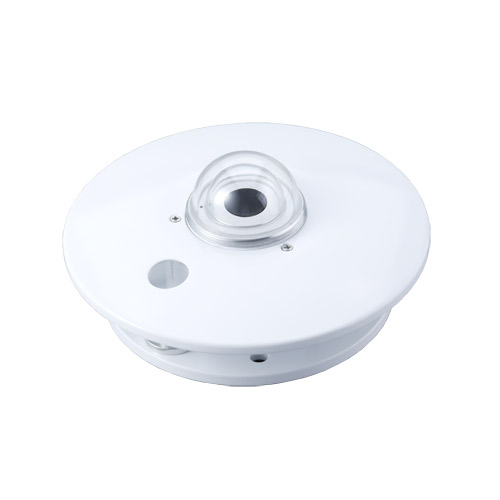
The alternate product view below shows the sensing assembly and cabling arrangement. Confirm which cable, connector and mounting parts belong to the quoted version rather than assuming every pictured accessory is included.

For raw thermopile output, the individual sensitivity is essential. As an illustrative calculation, an instrument with sensitivity of 10 uV per W/m2 produces 8 mV at 800 W/m2. That selected sensitivity is not the calibration value for every HPRS. Use the delivered instrument's value and confirm the receiving channel's scaling and input range.
Ask what accompanies the sensor: individual identification, sensitivity data, test conditions and the requested calibration document. Where traceability or an accredited calibration is required, obtain confirmation of the actual service and documentation being quoted. Do not infer it from a generic product datasheet.
For a PLC, RTU or data logger, include the input hardware, configuration and a recorded end-to-end conversion check. A digital display showing W/m2 can still be wrong if an old analog span or another instrument's sensitivity remains in the configuration.
Include a stable mounting arrangement suited to the selected measurement plane, clear exposure and cleaning access. Define the cable route and any extension. If the supplier is also providing a logger, cabinet, power system or gateway, request separate items for those components and the commissioning work.
The station illustrations below show possible system arrangements, not a bill of materials for one irradiance sensor. A complete station can be appropriate where no compatible logger or field supply exists. Where those are already available, specifying the correct sensor output may be sufficient.
For lifecycle comparison, identify calibration and inspection responsibilities, cleaning access and replacement procedures. A lower sensor-only quotation may omit receiver work that a conditioned-output offer includes. Conversely, additional communications hardware has little value if the site already records the required channel reliably. Compare the same delivered function before comparing totals.
Output, cable, mounting, calibration documentation and receiving-system work vary. Request a current quotation for a defined configuration; a sensor-only amount is not a complete installed station price.
No. It describes a product sensitivity range. Obtain the individual sensitivity and the calibration documentation required for the delivered instrument.
No. Confirm the ordered protocol, address, serial format, register definitions and units before developing the logger interface.
No. Annual stability describes change over time. Assess the full performance information, calibration and installation contributions against the project's required uncertainty.
Send the PV or meteorological application, measurement plane, required performance, logger model, preferred output, cable route and calibration-document requirements. Ask NiuBoL to separate the sensor from mounting, acquisition and commissioning items.
Compare irradiance offers at the level of a complete, correctly scaled measurement channel. Define the optical measurement, output and calibration requirements first; then compare hardware, receiver work and service scope without assuming that the housing or communication label proves equivalence.
Prev:Water Quality Sonde or Separate Probes? Compare Service Downtime
Next:Smart Soil Moisture Meter: Recheck Irrigation Thresholds After Replanting
Related recommendations
Sensors & Weather Stations Catalog
 Agriculture Sensors and Weather Stations Catalog-NiuBoL.pdf
Weather Stations Catalog-NiuBoL.pdf
Agriculture Sensors Catalog-NiuBoL.pdf
Water Quality Sensor Catalog-NiuBoL.pdf
Related products
 Combined air temperature and relative humidity sensor
 TDR Soil Moisture & Temperature Sensor for irrigation| RS485 |4-20mA| NBL-S-THR
 Soil pH sensor RS485 soil Testing instrument soil ph meter for agriculture |NBL-S-PH
 Wind Speed sensor Output Modbus/RS485/Analog/0-5V/4-20mA
 Tipping bucket rain gauge for weather monitoring auto rainfall sensor RS485/Outdoor/stainless steel
 Pyranometer Solar Radiation Sensor 4-20mA/RS485


Screenshot, WhatsApp to identify the QR code
WhatsApp number:+8615367865107
(Click on WhatsApp to copy and add friends)

