





— Blogs —
—Products—
 Consumer hotline +8618073152920
 WhatsApp:+8615367865107
Address:Room 102, District D, Houhu Industrial Park, Yuelu District, Changsha City, Hunan Province, China
Product knowledge
Time:2023-09-11 14:25:33 Popularity:20339
A tipping bucket rain gauge is an automatic precipitation instrument used to measure accumulated rainfall and rainfall intensity. It collects rainwater through a calibrated opening and converts the continuous rainfall process into a series of individual tipping events.
Each completed tip represents a known amount of rainfall. The tipping event can generate a pulse through a reed switch or be processed by a transmitter and provided as RS485 Modbus or another electrical output.
Because of its simple structure, automatic output and compatibility with data loggers, tipping bucket rain gauges are widely used in automatic weather stations, hydrology, agriculture, flood monitoring, reservoirs and environmental monitoring.
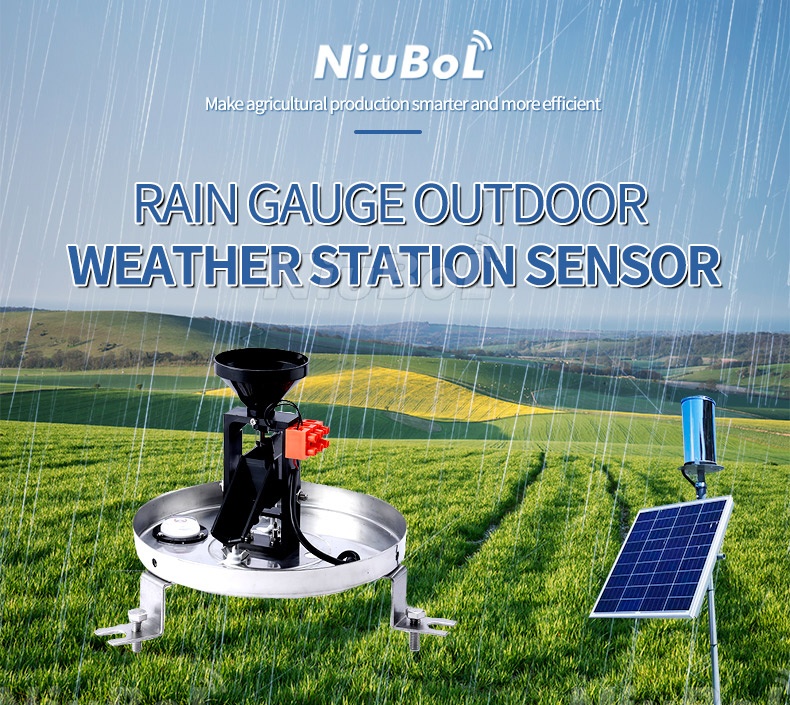
A tipping bucket rain gauge consists of a rainfall collector, funnel, filter, tipping mechanism, switch or sensing element, housing and electrical output interface.
Rainwater entering the collector flows through the funnel and into one side of a balanced two-chamber tipping bucket. When the collected water reaches the calibrated volume, the bucket tips and empties while the opposite chamber moves into the collection position.
The instrument therefore does not measure the size or number of individual raindrops. It measures rainfall by counting calibrated tipping events.
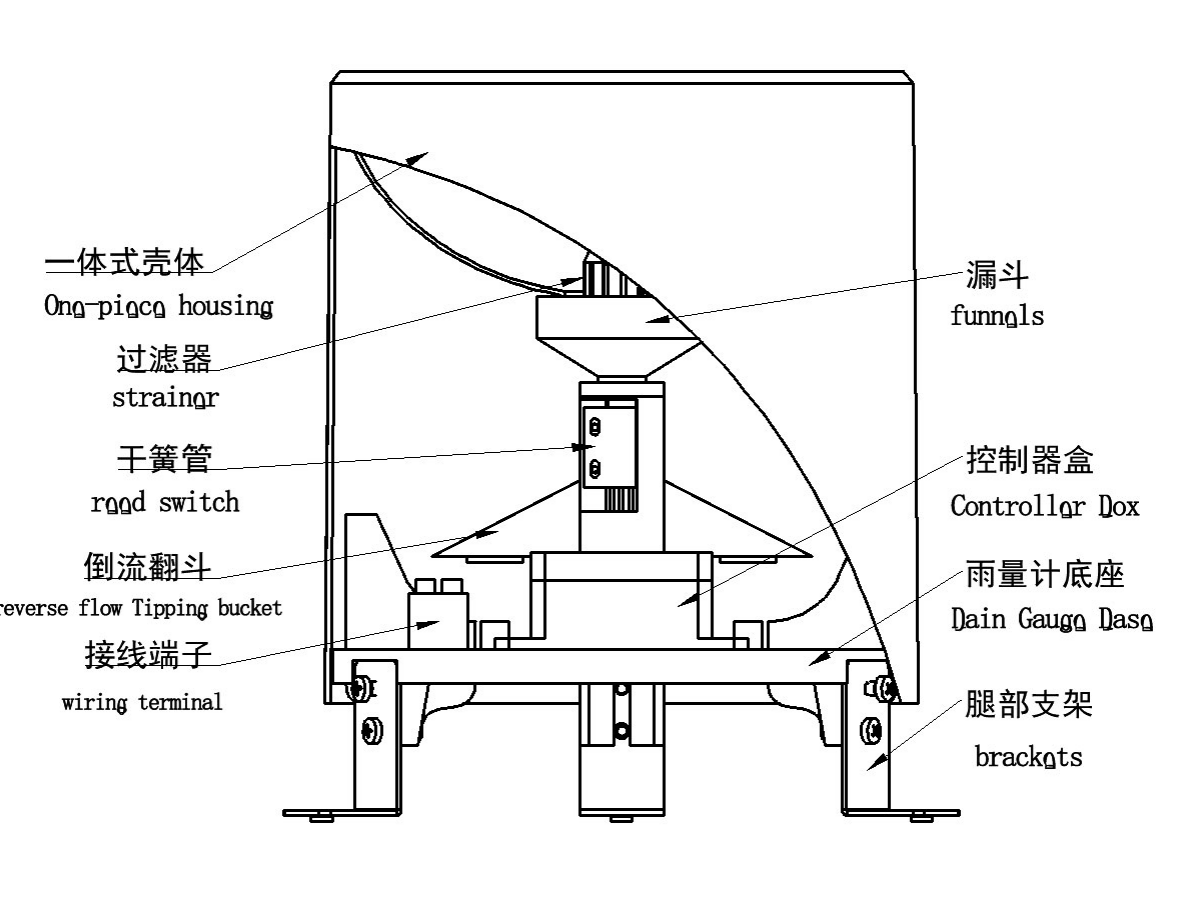
The working process can be divided into five steps:
Collection: Rainwater enters the calibrated rainfall collector.
Filtration: A filter helps prevent leaves, insects and larger debris from entering the measuring mechanism.
Filling: Water flows into one side of the tipping bucket.
Tipping: Once the calibrated volume is reached, the bucket tips and empties.
Counting: The tipping movement triggers a reed switch or electronic measurement event that is counted by the recorder or transmitter.
Rainfall → Collector → Funnel → Tipping Bucket → Pulse / RS485 Signal → Data Logger
By counting the number of tips, the monitoring system calculates accumulated rainfall. The timing between tipping events can also be used to determine rainfall intensity.
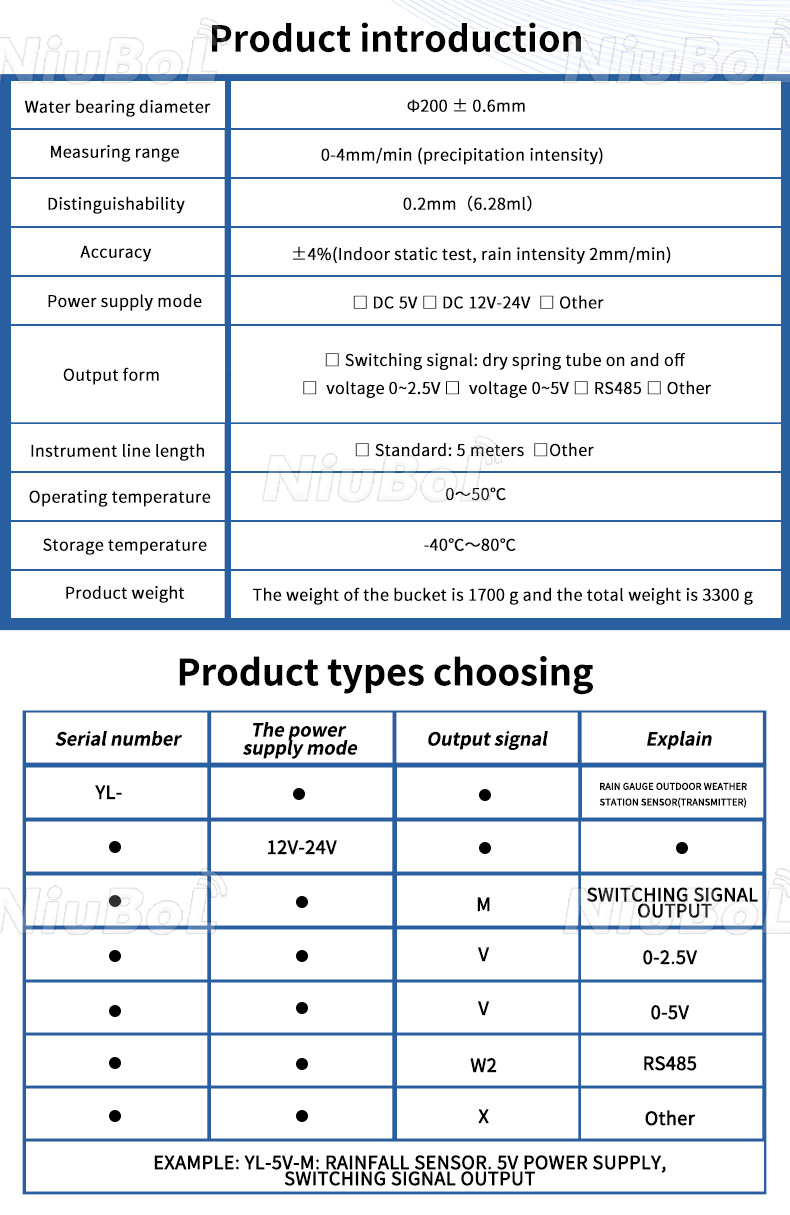
For the standard NBL-W-RS configuration, each completed tipping event represents 0.2 mm of rainfall.
The collector diameter is approximately 200 mm. With this collection area, 0.2 mm of rainfall corresponds to approximately 6.28 ml of collected water.
| Number of Tips | Rainfall |
|---|---|
| 1 | 0.2 mm |
| 5 | 1.0 mm |
| 10 | 2.0 mm |
| 50 | 10.0 mm |
| 100 | 20.0 mm |
The data logger does not need to measure the water volume directly. It only needs to count the calibrated tipping events or read the processed rainfall value from the RS485 transmitter.
| Measurement Principle | Tipping bucket |
| Collector Diameter | Φ200 ±0.6 mm |
| Rainfall Intensity Range | 0–4 mm/min |
| Resolution | 0.2 mm (6.28 ml) |
| Accuracy | ±4% under specified indoor static test conditions at 2 mm/min |
| Output Options | Reed switch / pulse, 0–2.5 V, 0–5 V, RS485 depending on configuration |
| Power Supply | 5 V DC or 12–24 V DC depending on version |
| Standard Cable | 5 m |
| Working Temperature | 0–50°C |
| RS485 Protocol | Modbus RTU |
| Default Baud Rate | 9600 bps |
| Device Address | 0–255 configurable |
| Feature | Pulse / Reed Switch | RS485 Modbus |
|---|---|---|
| Signal | One switching event for each tip | Digital rainfall value |
| Data Processing | Logger counts pulses | Sensor/transmitter processes rainfall data |
| Typical Connection | Pulse counter / weather logger | PLC / RTU / data logger |
| Multi-Sensor Integration | Depends on logger input | Suitable for Modbus bus integration |
| Best For | Traditional rainfall stations | Industrial and IoT monitoring |
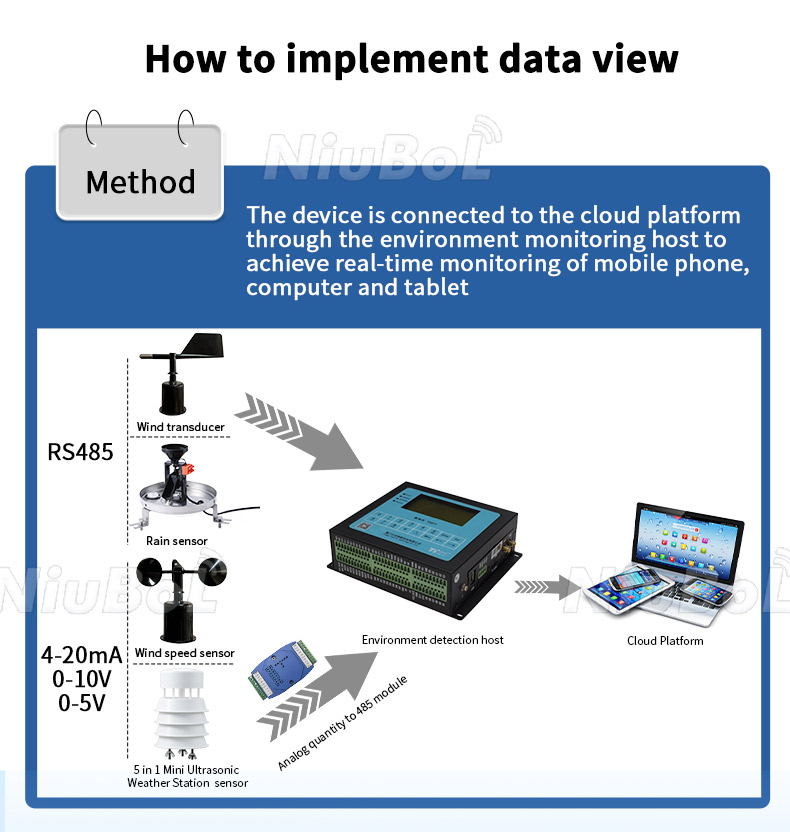
The RS485 version can connect to a compatible PLC, RTU, weather-station logger or IoT data collector.
Tipping Bucket Rain Gauge → RS485 Modbus → Data Logger / PLC → 4G / Ethernet → MQTT / HTTP → Cloud or Private Server
The standard Modbus communication rate is 9600 bps, and the device address can be configured for integration with other RS485 sensors.
A typical Modbus read request retrieves the accumulated rainfall register. For example, a returned value of 26 with a scale factor of 0.1 represents 2.6 mm of rainfall.
Before installation, confirm the available mounting space and foundation dimensions. The standard NBL-W-RS uses a collector approximately 206 mm in external diameter and a total housing height of approximately 500 mm, depending on configuration.
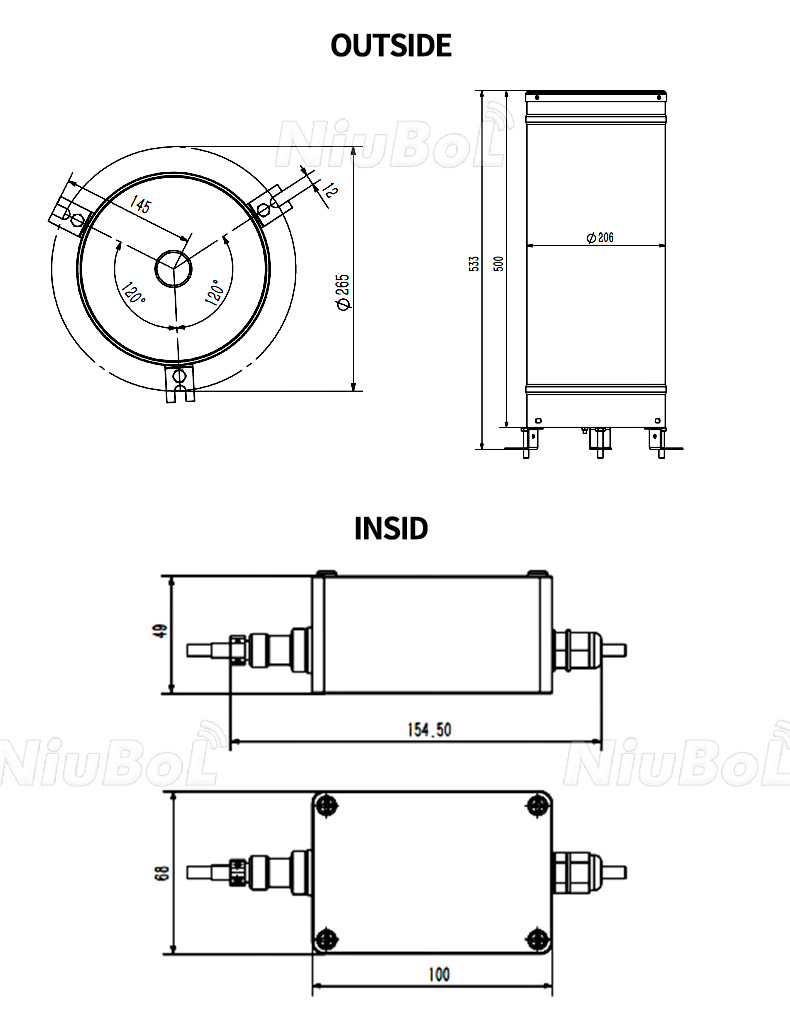
Choose a location that represents the rainfall conditions of the monitoring site. Avoid unnecessary obstruction from buildings, trees, walls and equipment.
The instrument can be installed on a suitable ground foundation, column flange, platform or other stable mounting structure according to project requirements.
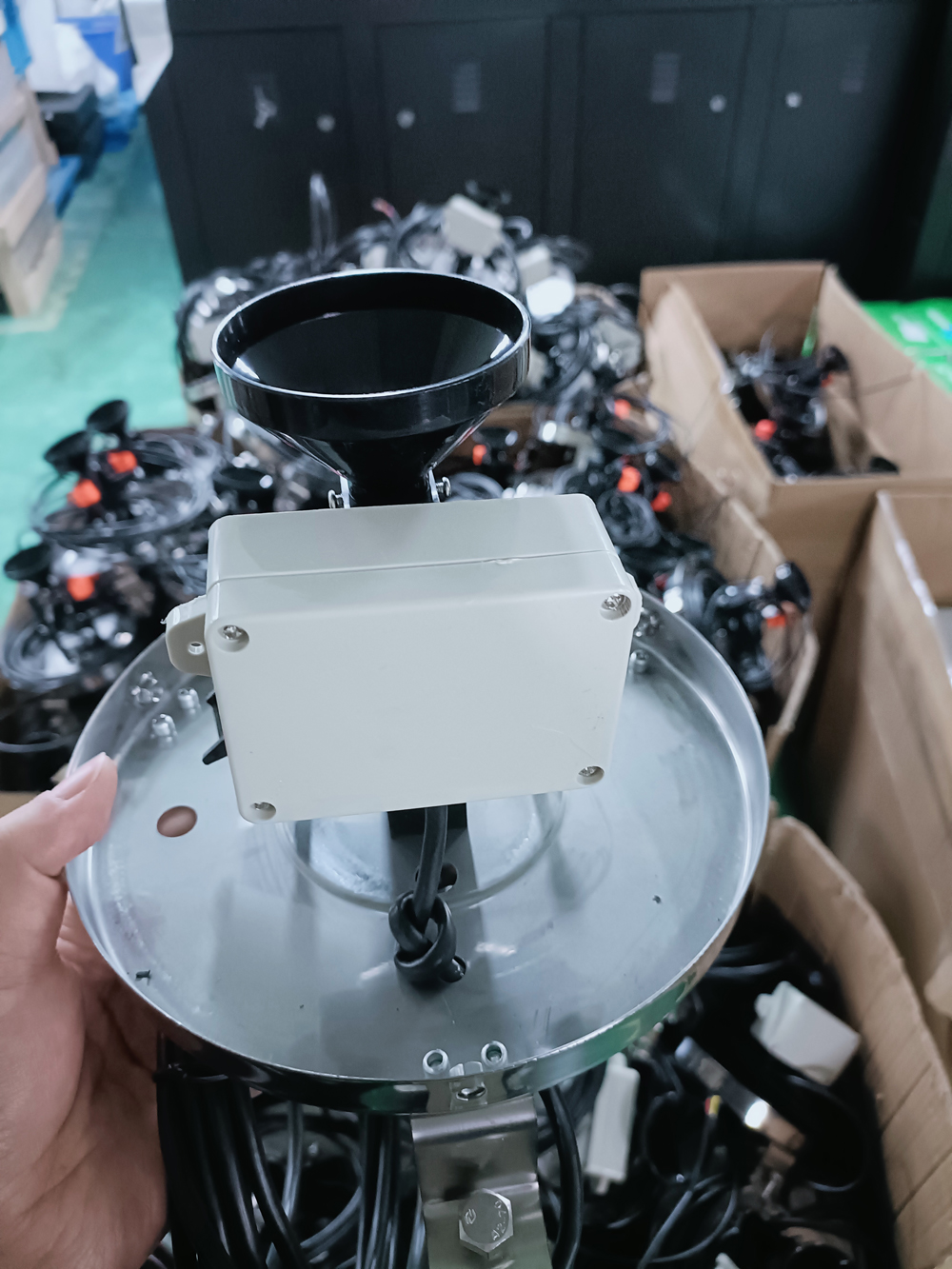
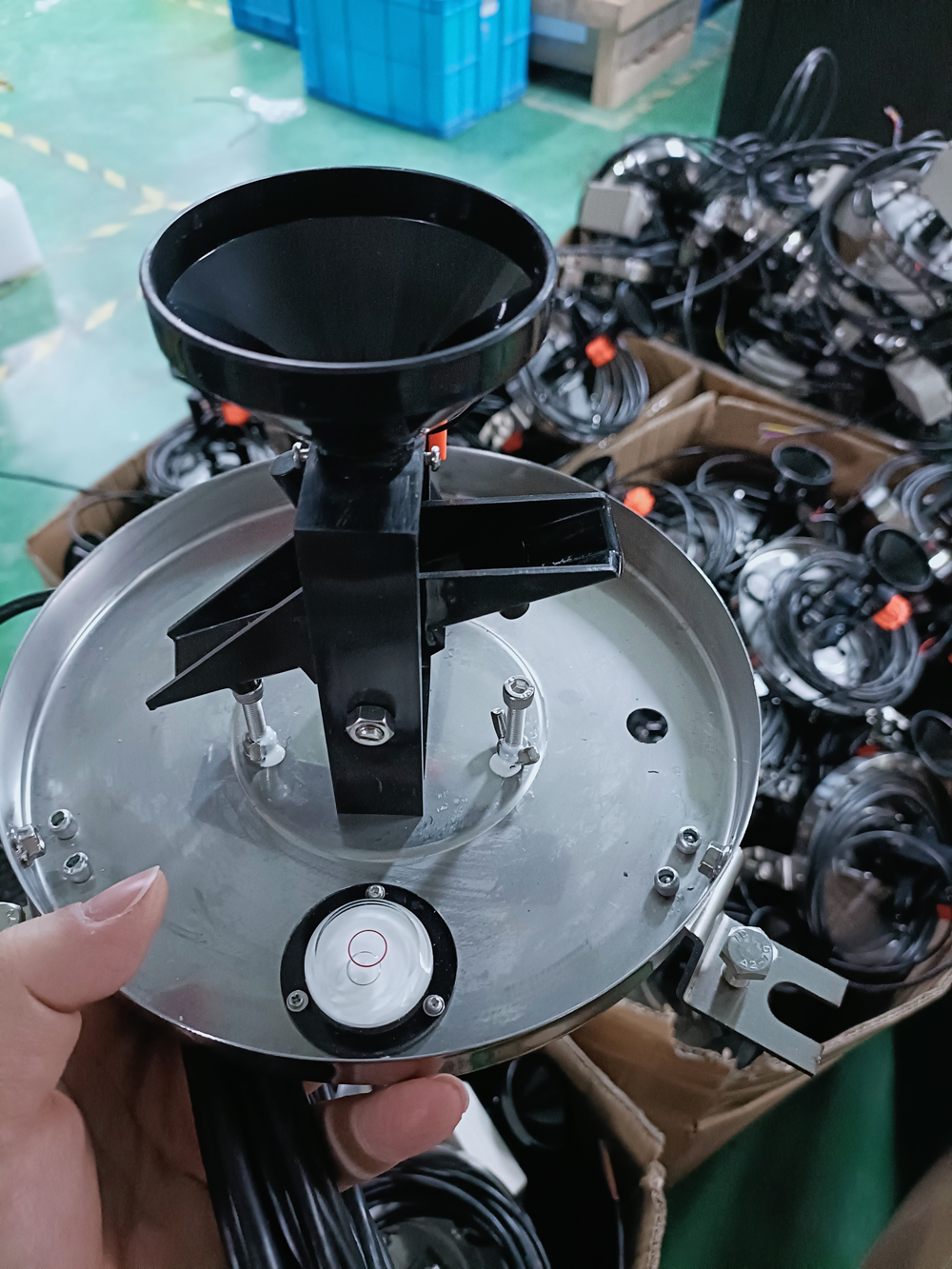
Use the three leveling screws and the built-in bubble level to keep the rain gauge horizontal. Incorrect leveling can change the tipping balance and affect measurement performance.
After installation, slowly pour clean water into the collector and verify that the tipping bucket moves freely and that the connected logger receives the tipping events or rainfall data.
A controlled quantity of water can be used to compare the expected rainfall value with the reading from the acquisition system. If the difference is excessive, inspect the installation, cleanliness and tipping mechanism.
Mechanical tipping bucket gauges can show intensity-dependent error because water continues flowing while the bucket is moving between positions. The specified accuracy should therefore be considered together with the test rainfall intensity.
If the instrument is tilted, the two sides of the tipping bucket may not operate symmetrically.
Wind can change the trajectory of falling raindrops and cause precipitation to pass over or around the collector. Installation exposure therefore affects rainfall catch.
Leaves, dust, insects, mud and other debris can prevent rainwater from reaching the tipping mechanism correctly.
Contamination can change the water-flow characteristics inside the bucket. The internal surface should be cleaned according to the maintenance instructions without scratching or contaminating it.
The standard model is designed for liquid precipitation and should not be assumed to measure snow or frozen precipitation. A heated or specialized precipitation instrument may be required in freezing environments.
Tipping bucket rain gauges are relatively simple instruments, but they are not maintenance-free.
Inspect the collector regularly.
Remove leaves, insects, mud, sand and dust.
Remove and rinse the filter with clean water when necessary.
Confirm that the tipping bucket moves freely.
Keep the internal water path clean.
Do not scratch or contaminate the inner surface of the tipping bucket.
Check cables and electrical connections.
Confirm the instrument remains level.
Perform a controlled water test if readings appear abnormal.
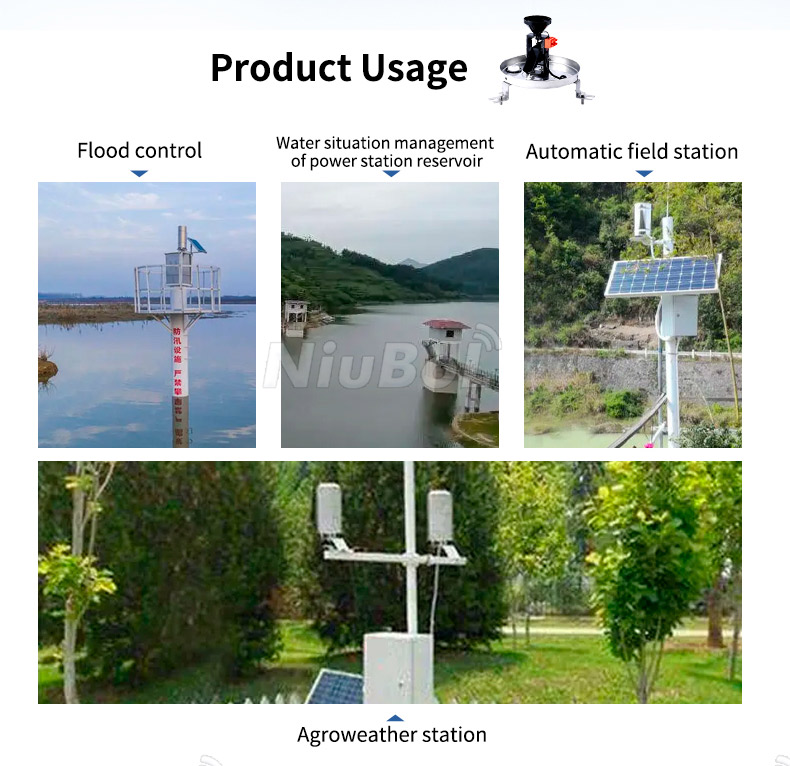
Tipping bucket sensors are widely used as the rainfall component of automatic weather stations for continuous precipitation monitoring.
Rainfall data can be combined with river level, reservoir level and flow measurements to support watershed and flood-monitoring systems.
Rainfall information helps agricultural operators understand natural water input and can be combined with soil moisture measurements for irrigation management.
Rainfall monitoring provides supporting data for reservoir, catchment and water-supply management.
RS485 or pulse rain gauges can be connected to solar-powered RTUs and 4G gateways for unattended remote monitoring.
| Type | Main Advantage | Typical Limitation |
|---|---|---|
| Tipping Bucket | Automatic, mature and easy to integrate | Mechanical maintenance and high-intensity error |
| Manual Gauge | Simple and low cost | Requires manual observation |
| Weighing Gauge | Measures accumulated precipitation by mass | More complex and expensive |
| Piezoelectric | No tipping mechanism | Impact signals may be affected by debris or environmental conditions |
| Optical | No traditional collector mechanism | More dependent on optical sensing and algorithms |
For a broader comparison, see Types of Rain Gauges.
Before purchasing, confirm:
Required rainfall resolution
Expected maximum rainfall intensity
Pulse, RS485 or analog output
Available power supply
Required cable length
Connection to PLC, RTU or weather station
Remote communication requirements
Operating temperature
Whether snow or freezing precipitation must be measured
Required mounting structure
Maintenance accessibility
A1. It is an automatic rain gauge that converts collected rainfall into calibrated tipping events. Each tip represents a known rainfall depth.
A2. It means each completed bucket tip represents 0.2 mm of accumulated rainfall.
A3. Yes. Rainfall intensity can be calculated from how quickly successive tipping events occur.
A4. Yes. The RS485 Modbus version can connect to a compatible PLC, RTU or data logger. Pulse versions require a compatible pulse-counting input.
A5. Yes. Each compatible Modbus device should use a unique address, and the RS485 wiring and power supply must be designed correctly.
A6. Yes. The collector, filter, water path and tipping mechanism should be inspected and cleaned periodically.
A7. A standard unheated tipping bucket rain gauge is intended mainly for liquid precipitation. Snow or freezing precipitation may require specialized heated equipment.
A8. During very high rainfall intensity, water continues entering while the bucket is tipping. Mechanical transition time can therefore introduce intensity-dependent error.
A9. Yes. An RS485 rain gauge can connect to a compatible gateway or data logger, which can transmit data through MQTT, HTTP or TCP.
A10. Yes. It is one of the most commonly used rainfall sensors in automatic weather stations because it provides automatic electrical output and continuous rainfall measurement.
1. NBL-W-ARS Tipping Bucket Rain Gauge Instruction Manual
 NBL-W-ARS-Tipping-bucket-rain-gauge-instruction-manual.pdf
2. NBL-W-RS Rain Sensor Instruction Manual
NBL-W-RS-Rain-sensors-instruction-manual-V4.0.pdf
NiuBoL provides tipping bucket rain gauges with pulse, voltage and RS485 output options for meteorological, agricultural, hydrological and environmental monitoring.
For quotation and system selection, provide the required quantity, output signal, cable length, installation environment and whether a data logger, 4G gateway, solar power system or complete weather station is required.
Related recommendations
Sensors & Weather Stations Catalog
 Agriculture Sensors and Weather Stations Catalog-NiuBoL.pdf
Weather Stations Catalog-NiuBoL.pdf
Agriculture Sensors Catalog-NiuBoL.pdf
Water Quality Sensor Catalog-NiuBoL.pdf
Related products
 Combined air temperature and relative humidity sensor
 TDR Soil Moisture & Temperature Sensor for irrigation| RS485 |4-20mA| NBL-S-THR
 Soil pH sensor RS485 soil Testing instrument soil ph meter for agriculture |NBL-S-PH
 Wind Speed sensor Output Modbus/RS485/Analog/0-5V/4-20mA
 Tipping bucket rain gauge for weather monitoring auto rainfall sensor RS485/Outdoor/stainless steel
 Pyranometer Solar Radiation Sensor 4-20mA/RS485

Screenshot, WhatsApp to identify the QR code
WhatsApp number:+8615367865107
(Click on WhatsApp to copy and add friends)

