





— Blogs —
—Products—
 Consumer hotline +8618073152920
 WhatsApp:+8615367865107
Address:Room 102, District D, Houhu Industrial Park, Yuelu District, Changsha City, Hunan Province, China
Product knowledge
Time:2026-05-28 16:00:50 Popularity:418
Quick Answer: Water turbidity detection methods differ in light source, detector geometry and sample presentation. For online selection, establish the required method and low-end performance before comparing range or resolution. A 90-degree infrared probe can provide useful particle-related trends, but its display unit alone does not prove suitability for a regulated low-turbidity measurement.
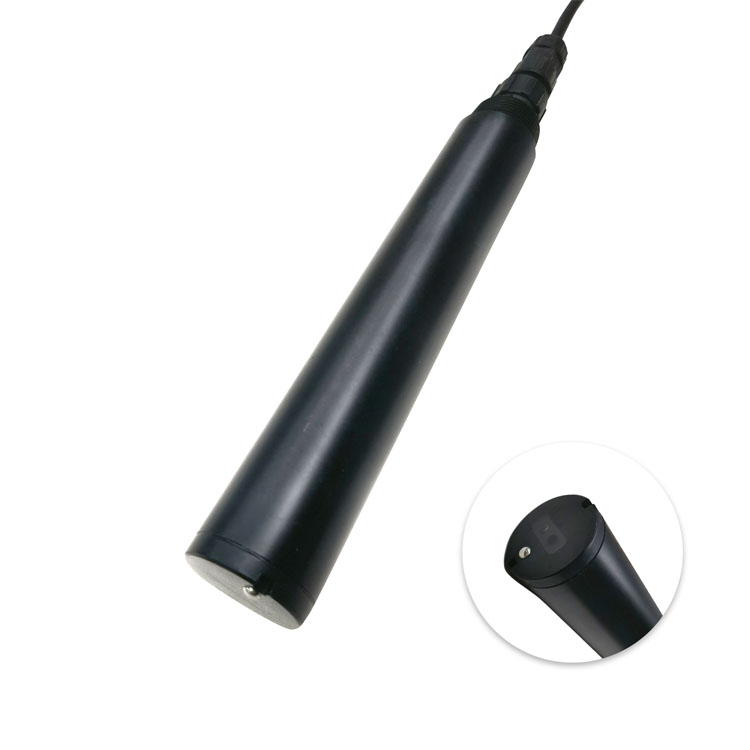
Turbidity is an optical response, not a direct count or mass of suspended particles. Particle size, shape and optical properties influence the result. Instrument design also matters. Two instruments calibrated with suitable standards may still respond differently to a real sample if their light sources or detector arrangements differ.
Lists of "ten turbidity methods" often mix measurement geometry, light sources and construction features. A laser is a light source; an optical fiber is a way to transmit light; a calibration suspension is a reference. None of those terms alone defines a complete analytical method.
| Approach | Measurement arrangement | Useful selection distinction |
|---|---|---|
| Nephelometric measurement | Measures light scattered at a defined angle, commonly 90 degrees | Check source, geometry, method, low-end accuracy and interference controls |
| Transmitted-light measurement | Measures reduction in light passing through a sample | Path length, color and sample concentration affect interpretation |
| Backscatter or multi-detector arrangement | Uses a different scattering angle or several optical signals | May address different concentration ranges; verify the actual method and application |
| Surface-scatter arrangement | Observes light scattered from a flowing sample surface | Sample presentation and flow conditions become part of the installation |
| Visual comparison | Compares sample appearance under specified conditions | Does not provide an unattended digital monitoring channel and is not equivalent to every instrumental method |
A sensor described as infrared or laser-based is not automatically more suitable than another optical design. Ask how it performs over the concentration and sample conditions that matter. Similarly, acoustic suspended-solids measurements should not be assumed interchangeable with a nephelometric turbidity result.
The EPA field turbidity measurement procedure distinguishes instrument and method arrangements. A method requirement is more specific than the word "turbidity" on a purchase order. Establish the applicable reporting requirement before selecting a monitor for a drinking-water filter outlet or other regulated point.
The NiuBoL NBL-WQ-TS uses 90-degree scattered light with an infrared LED. That description does not by itself demonstrate conformity to every named turbidity standard. Do not infer a certified method, a particular wavelength or an approved compliance role from the displayed NTU unit alone.
| Range configuration | Resolution | Listed accuracy specification |
|---|---|---|
| 0-20.00 NTU | 0.01 NTU | +/-3% or +/-1.5 NTU |
| 0-100.0 NTU | 0.1 NTU | +/-3% or +/-2 NTU |
| 0-1000.0 NTU | 0.1 NTU | +/-5% or +/-3 NTU |
These are separate configurations. Obtain the percentage basis and applicable absolute-error rule for the selected version. A 0.01 NTU display step is not a promise of +/-0.01 NTU measurement accuracy. If the project must distinguish changes around a small fraction of an NTU, require performance evidence at that level rather than selecting this probe solely because its range starts at zero.
| Operating item | NBL-WQ-TS digital configuration |
|---|---|
| Optical principle | 90-degree scattered light; infrared LED |
| Output | RS485, Modbus RTU |
| Supply | 12-24 V DC, +/-10% |
| Power consumption | Below 0.3 W at 12 V |
| Working conditions | 0-50 degrees C; pressure below 0.2 MPa |
| Wetted material | POM and ABS |
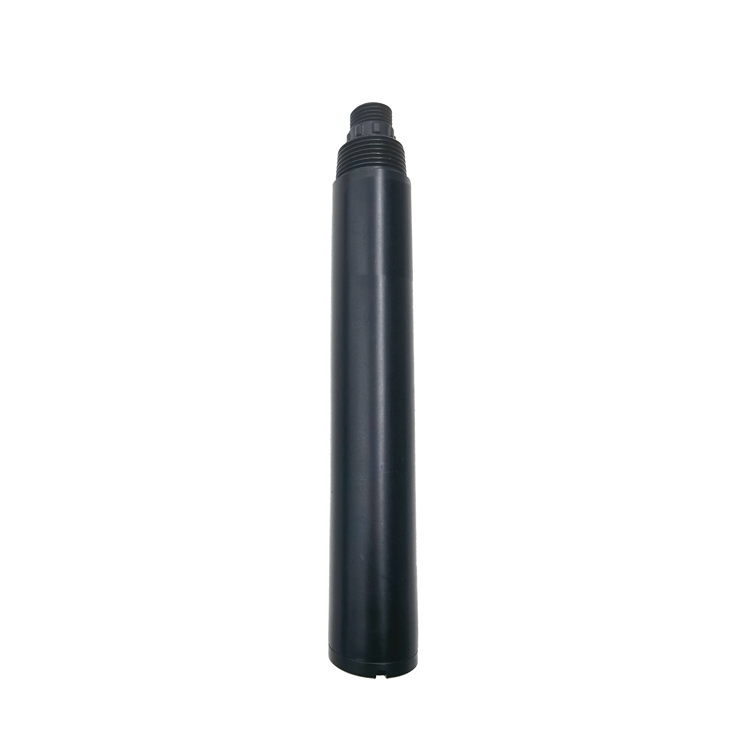
| Mounting | Immersion; 3/4 NPT thread |
| Cable and protection | Standard 5 m cable; IP68; confirm jacket material for the actual chemical exposure |
The digital configuration above should not be quoted as having 4-20 mA merely because an existing controller expects an analog input. If an analog signal is required, identify the compatible transmitter or separately specified output version and include it in the installation scope.
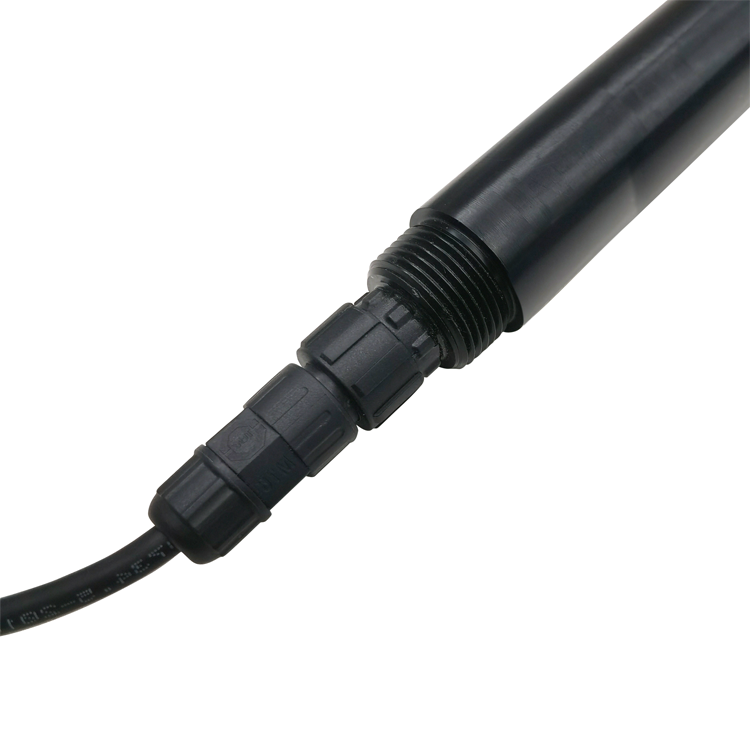
For NBL-WQ-TS installation, maintain more than 5 cm clearance from a side wall and more than 10 cm from the bottom. A narrow cup, reflective wall or accumulated sediment can affect the optical path. Apply those clearances during calibration comparisons as well as permanent mounting.
Place the probe where the sample represents the process. Avoid a settled corner when the objective is flowing-water turbidity. Conversely, avoid a heavily aerated location where bubbles interfere with the optical reading. A quieter mounting point is only useful if it still receives representative water.
A rapid spike following a pump start may reflect particles, bubbles or movement at the probe. Compare the event timing with operation and inspect a representative sample before changing calibration. Cleaning the optical window is a different intervention from altering the stored zero or slope.
If the reading depends strongly on the container or probe position during a field check, resolve the geometry first. Forcing calibration to a reference value in an unsuitable container can transfer that error into every subsequent measurement.
For raw-water and river observation, turbidity is useful for tracking particle-related changes. It does not identify the pollutant carried by those particles. For a treatment-stage comparison, measure representative inlet and outlet water and account for the time taken by water to pass through the process.
For industrial recirculating water, a turbidity change can prompt inspection or a targeted sample. The process may also require conductivity, pH or another parameter. Do not interpret low turbidity as proof that dissolved contaminants are absent.
For filter-outlet measurements near a stringent low limit, method compatibility and low-end performance take priority over a broad measurement range. If this probe's specification cannot demonstrate the required discrimination, evaluate another appropriate instrument configuration instead of increasing the number of display decimals.
Turbidity and TSS are different quantities. If a project needs a solids estimate, establish and periodically review a relationship using representative paired samples. A universal NTU-to-mg/L factor is not an acceptable substitute for that work.
RS485 Modbus RTU makes the value accessible to a compatible host; it does not make every monitor's register map identical. Check the delivered model's addresses and data format. A disconnected probe or failed response must not be recorded as zero turbidity.
For a NiuBoL turbidity sensor inquiry, include the normal and maximum expected values, the smallest change that matters, the required analytical method and the mounting arrangement. Photos or dimensions of the proposed location help assess optical clearance and service access. These details are more useful than requesting only "an IP68 NTU probe."
No. A light-source description alone does not establish method conformity or approval. Confirm the exact instrument design, method documentation and the requirements for the reporting point. Do not infer approval from the unit shown on the display.
No. Resolution only describes the displayed or reported increment. Evaluate accuracy, repeatability, detection performance and method compatibility at the actual operating level. A broad range beginning at zero is not enough.
The digital configuration discussed here provides RS485 Modbus RTU. A suitable transmitter or separately specified analog version is needed if the host only accepts current signals. Confirm that equipment explicitly rather than assuming an undocumented probe output.
Check method, light source, calibration, sample handling, bubbles and measurement geometry. Samples may also change through settling between tests. Agreement on a calibration standard does not guarantee identical responses to every process sample.
Not with a universal factor. Establish a relationship for the relevant particles and water using paired turbidity and TSS results. Reassess it when the particle composition changes.
Set the interval from observed fouling and reference checks. Investigate unexpected drift or position-dependent readings, inspect the window and clean it with a suitable non-damaging procedure. Verify the result before deciding whether calibration needs adjustment.
Compare water turbidity detection methods by optical design, reporting requirement and performance at the actual concentration. Then check mounting geometry and data scaling. The NiuBoL NBL-WQ-TS provides an immersed digital turbidity channel within its stated limits; it should not be represented as a universal low-level compliance monitor or direct TSS analyzer.
 NBL-WQ-CL Water Quality Sensor Online Residual Chlorine Sensor.pdf
NBL-WQ-DO Online Fluorescence Dissolved Oxygen Sensor.pdf
NBL-WQ-NHN Ammonia Nitrogen Water Quality Sensor.pdf
NBL-WQ-COD Online Water Quality COD Sensor.pdf
NBL-WQ-PH Online pH Water Quality Sensor.pdf
NBL-WQ-EC water quality conductivity sensor.pdf
Prev:Water Quality Analyzer Types: Portable, Laboratory and Online Compared
Next:COD as a Pollution Indicator and Online Sensor Application
Related recommendations
Sensors & Weather Stations Catalog
Agriculture Sensors and Weather Stations Catalog-NiuBoL.pdf
Weather Stations Catalog-NiuBoL.pdf
Agriculture Sensors Catalog-NiuBoL.pdf
Water Quality Sensor Catalog-NiuBoL.pdf
Related products
 Combined air temperature and relative humidity sensor
 TDR Soil Moisture & Temperature Sensor for irrigation| RS485 |4-20mA| NBL-S-THR
 Soil pH sensor RS485 soil Testing instrument soil ph meter for agriculture |NBL-S-PH
 Wind Speed sensor Output Modbus/RS485/Analog/0-5V/4-20mA
 Tipping bucket rain gauge for weather monitoring auto rainfall sensor RS485/Outdoor/stainless steel
 Pyranometer Solar Radiation Sensor 4-20mA/RS485

Screenshot, WhatsApp to identify the QR code
WhatsApp number:+8615367865107
(Click on WhatsApp to copy and add friends)

